Keep the original and reported message together
Import the 32 checked pairs and practise them with Spanish audio and writing on iOS or Android. The grammar guide remains complete without the app.
Spanish reported speech
How does reported speech work in Spanish?
Direct speech repeats exact words: Ana dijo: «Estoy cansada». Indirect speech embeds the message: Ana dijo que estaba cansada. The reporting verb and the new viewpoint determine what changes.
After a present reporting verb, the original tense often remains: Dice que está cansada. After a past reporting verb, a present commonly shifts to the imperfect and a future to the conditional: dijo que estaba; dijo que vendría.
This is not a blind word-replacement exercise. Pronouns, possessives, demonstratives, time and place expressions change only when the reporter’s reference point changes. A fact that is still true may stay in the present.
Choose the connector first
Use que for a statement: Dijo que llegaría.
Use si for a yes/no question and keep an accented question word for an information question: preguntó si venía; preguntó dónde vivía.
Report a request or command with a suitable reporting verb plus que and the subjunctive: pidió que cerrara la puerta.
32 Spanish reported-speech examples
The pairs cover statements, yes/no and information questions, requests and commands, plus pronoun, tense, time and place changes.
| Direct and reported Spanish | Meaning | What changed? | Rule |
|---|---|---|---|
| Directo: Marta dice: «Tengo sueño». Indirecto: Marta dice que tiene sueño. | Marta says, “I am sleepy.” → Marta says that she is sleepy. | El verbo introductor está en presente. | A present reporting verb keeps the current viewpoint. |
| Directo: Marta dijo: «Tengo sueño». Indirecto: Marta dijo que tenía sueño. | Marta said, “I am sleepy.” → Marta said that she was sleepy. | Presente pasa a imperfecto con la perspectiva pasada. | A past reporting verb moves the embedded event to a past viewpoint. |
| Directo: Luis dijo: «He terminado». Indirecto: Luis dijo que había terminado. | Luis said, “I have finished.” → Luis said that he had finished. | La acción terminada es anterior a dijo. | A past reporting verb moves the embedded event to a past viewpoint. |
| Directo: Ana contó: «Llegué tarde». Indirecto: Ana contó que había llegado tarde. | Ana said, “I arrived late.” → Ana said that she had arrived late. | El pluscuamperfecto marca anterioridad respecto del relato. | A past reporting verb moves the embedded event to a past viewpoint. |
| Directo: Pablo explicó: «Trabajo desde casa». Indirecto: Pablo explicó que trabajaba desde casa. | Pablo explained, “I work from home.” → Pablo explained that he worked from home. | La situación se ve desde el momento de explicó. | A past reporting verb moves the embedded event to a past viewpoint. |
| Directo: Elena prometió: «Volveré mañana». Indirecto: Elena prometió que volvería al día siguiente. | Elena promised, “I will return tomorrow.” → Elena promised that she would return the next day. | Futuro pasa a condicional y mañana cambia con el relato. | The time expression changes with the reporting moment. |
| Directo: Diego pensó: «No puedo ir». Indirecto: Diego pensó que no podía ir. | Diego thought, “I cannot go.” → Diego thought that he could not go. | Puedo se adapta a una perspectiva pasada. | A past reporting verb moves the embedded event to a past viewpoint. |
| Directo: Julia añadió: «Estoy estudiando». Indirecto: Julia añadió que estaba estudiando. | Julia added, “I am studying.” → Julia added that she was studying. | El presente progresivo pasa a imperfecto progresivo. | A past reporting verb moves the embedded event to a past viewpoint. |
| Directo: Me preguntó: «¿Vienes?». Indirecto: Me preguntó si venía. | He asked me, “Are you coming?” → He asked me if I was coming. | La pregunta total usa si y pierde los signos de interrogación. | A yes/no question becomes an indirect question with si. |
| Directo: Ana preguntó: «¿Has comido?». Indirecto: Ana preguntó si había comido. | Ana asked, “Have you eaten?” → Ana asked if I had eaten. | Pretérito perfecto pasa a pluscuamperfecto. | A yes/no question becomes an indirect question with si. |
| Directo: Él preguntó: «¿Dónde vives?». Indirecto: Él preguntó dónde vivía. | He asked, “Where do you live?” → He asked where I lived. | Dónde conserva la tilde en la interrogativa indirecta. | The accented question word introduces the indirect question. |
| Directo: Sara preguntó: «¿Cuándo llegarás?». Indirecto: Sara preguntó cuándo llegaría. | Sara asked, “When will you arrive?” → Sara asked when I would arrive. | Cuándo introduce la pregunta; futuro pasa a condicional. | The accented question word introduces the indirect question. |
| Directo: El guía preguntó: «¿Por qué estás aquí?». Indirecto: El guía preguntó por qué estaba allí. | The guide asked, “Why are you here?” → The guide asked why I was there. | Por qué mantiene la tilde; aquí cambia a allí. | The place or demonstrative changes with the reporter’s viewpoint. |
| Directo: Marta preguntó: «¿Qué quieres?». Indirecto: Marta preguntó qué quería. | Marta asked, “What do you want?” → Marta asked what I wanted. | Qué introduce una interrogativa indirecta sin signos. | The accented question word introduces the indirect question. |
| Directo: El profesor preguntó: «¿Quién llamó?». Indirecto: El profesor preguntó quién había llamado. | The teacher asked, “Who called?” → The teacher asked who had called. | Quién conserva la tilde y la llamada es anterior. | The accented question word introduces the indirect question. |
| Directo: Laura preguntó: «¿Cómo lo hiciste?». Indirecto: Laura preguntó cómo lo había hecho. | Laura asked, “How did you do it?” → Laura asked how I had done it. | Cómo conserva la tilde; la acción pasa a pluscuamperfecto. | The accented question word introduces the indirect question. |
| Directo: Ana me pidió: «Cierra la puerta». Indirecto: Ana me pidió que cerrara la puerta. | Ana asked me, “Close the door.” → Ana asked me to close the door. | El imperativo pasa a imperfecto de subjuntivo. | A request or command is reported with que plus the subjunctive. |
| Directo: Mi padre me dijo: «No salgas tarde». Indirecto: Mi padre me dijo que no saliera tarde. | My father said, “Do not go out late.” → My father told me not to go out late. | La orden negativa se relata con subjuntivo. | A request or command is reported with que plus the subjunctive. |
| Directo: Marta me pidió: «Llámame esta noche». Indirecto: Marta me pidió que la llamara esa noche. | Marta asked me, “Call me tonight.” → Marta asked me to call her that night. | Me pasa a la y esta noche cambia con el relato. | Pronouns or possessives change with the speaker. |
| Directo: El profesor nos dijo: «Esperad aquí». Indirecto: El profesor nos dijo que esperáramos allí. | The teacher said, “Wait here.” → The teacher told us to wait there. | La orden usa subjuntivo y aquí se adapta al nuevo lugar. | The place or demonstrative changes with the reporter’s viewpoint. |
| Directo: La recepcionista indicó: «Siéntese aquí». Indirecto: La recepcionista indicó que se sentara allí. | The receptionist said, “Sit here.” → The receptionist instructed me to sit there. | El mandato formal se convierte en imperfecto de subjuntivo. | A request or command is reported with que plus the subjunctive. |
| Directo: Clara me recordó: «No olvides el pasaporte». Indirecto: Clara me recordó que no olvidara el pasaporte. | Clara reminded me, “Do not forget the passport.” → Clara reminded me not to forget the passport. | El recordatorio negativo se integra con subjuntivo. | A request or command is reported with que plus the subjunctive. |
| Directo: El jefe ordenó: «Traigan los documentos». Indirecto: El jefe ordenó que trajeran los documentos. | The manager ordered, “Bring the documents.” → The manager ordered them to bring the documents. | El destinatario plural aparece en trajeran. | A request or command is reported with que plus the subjunctive. |
| Directo: La médica me aconsejó: «Ten cuidado». Indirecto: La médica me aconsejó que tuviera cuidado. | The doctor advised me, “Be careful.” → The doctor advised me to be careful. | El consejo se relata con aconsejar que y subjuntivo. | A request or command is reported with que plus the subjunctive. |
| Directo: Pedro dijo: «Trabajo aquí». Indirecto: Pedro dijo que trabajaba allí. | Pedro said, “I work here.” → Pedro said that he worked there. | Aquí cambia porque el relato ocurre en otro lugar. | The place or demonstrative changes with the reporter’s viewpoint. |
| Directo: Sofía dijo el lunes: «Hoy descanso». Indirecto: Sofía dijo que ese día descansaba. | Sofía said on Monday, “I am resting today.” → Sofía said that she was resting that day. | Hoy se interpreta desde el lunes, no desde ahora. | The time expression changes with the reporting moment. |
| Directo: Raúl dijo: «Viajaré mañana». Indirecto: Raúl dijo que viajaría al día siguiente. | Raúl said, “I will travel tomorrow.” → Raúl said that he would travel the next day. | Mañana pasa a al día siguiente con la nueva fecha. | The time expression changes with the reporting moment. |
| Directo: Elena dijo: «Llegué ayer». Indirecto: Elena dijo que había llegado el día anterior. | Elena said, “I arrived yesterday.” → Elena said that she had arrived the day before. | Ayer cambia a el día anterior. | The time expression changes with the reporting moment. |
| Directo: Julia dijo: «Este libro es mío». Indirecto: Julia dijo que ese libro era suyo. | Julia said, “This book is mine.” → Julia said that that book was hers. | Este y mío se adaptan a la nueva persona y distancia. | Pronouns or possessives change with the speaker. |
| Directo: Carlos dijo: «Yo traeré mi coche». Indirecto: Carlos dijo que él llevaría su coche. | Carlos said, “I will bring my car.” → Carlos said that he would take his car. | Yo y mi cambian; el movimiento se describe desde otra perspectiva. | Pronouns or possessives change with the speaker. |
| Directo: Lucía dijo: «Ahora no puedo hablar». Indirecto: Lucía dijo que entonces no podía hablar. | Lucía said, “I cannot talk now.” → Lucía said that she could not talk then. | Ahora pasa a entonces o en aquel momento. | The time expression changes with the reporting moment. |
| Directo: María dijo: «Madrid está en España». Indirecto: María dijo que Madrid está en España. | María said, “Madrid is in Spain.” → María said that Madrid is in Spain. | El presente se mantiene porque el hecho sigue siendo válido. | A fact that remains true can stay in the present. |
Learn reported speech in four blocks
Start with statements, then questions, requests and commands, and finally the shifts caused by a new speaker, time or place.
Reported statements
Choose que and align the tense with the reporting viewpoint.
Directo: Marta dice: «Tengo sueño». Indirecto: Marta dice que tiene sueño. · Directo: Marta dijo: «Tengo sueño». Indirecto: Marta dijo que tenía sueño. · Directo: Luis dijo: «He terminado». Indirecto: Luis dijo que había terminado. · Directo: Ana contó: «Llegué tarde». Indirecto: Ana contó que había llegado tarde. · Directo: Pablo explicó: «Trabajo desde casa». Indirecto: Pablo explicó que trabajaba desde casa. · Directo: Elena prometió: «Volveré mañana». Indirecto: Elena prometió que volvería al día siguiente. · Directo: Diego pensó: «No puedo ir». Indirecto: Diego pensó que no podía ir. · Directo: Julia añadió: «Estoy estudiando». Indirecto: Julia añadió que estaba estudiando.
Reported questions
Use si for yes/no questions or keep the accented question word.
Directo: Me preguntó: «¿Vienes?». Indirecto: Me preguntó si venía. · Directo: Ana preguntó: «¿Has comido?». Indirecto: Ana preguntó si había comido. · Directo: Él preguntó: «¿Dónde vives?». Indirecto: Él preguntó dónde vivía. · Directo: Sara preguntó: «¿Cuándo llegarás?». Indirecto: Sara preguntó cuándo llegaría. · Directo: El guía preguntó: «¿Por qué estás aquí?». Indirecto: El guía preguntó por qué estaba allí. · Directo: Marta preguntó: «¿Qué quieres?». Indirecto: Marta preguntó qué quería. · Directo: El profesor preguntó: «¿Quién llamó?». Indirecto: El profesor preguntó quién había llamado. · Directo: Laura preguntó: «¿Cómo lo hiciste?». Indirecto: Laura preguntó cómo lo había hecho.
Requests and commands
Replace the imperative with a reporting verb, que and the subjunctive.
Directo: Ana me pidió: «Cierra la puerta». Indirecto: Ana me pidió que cerrara la puerta. · Directo: Mi padre me dijo: «No salgas tarde». Indirecto: Mi padre me dijo que no saliera tarde. · Directo: Marta me pidió: «Llámame esta noche». Indirecto: Marta me pidió que la llamara esa noche. · Directo: El profesor nos dijo: «Esperad aquí». Indirecto: El profesor nos dijo que esperáramos allí. · Directo: La recepcionista indicó: «Siéntese aquí». Indirecto: La recepcionista indicó que se sentara allí. · Directo: Clara me recordó: «No olvides el pasaporte». Indirecto: Clara me recordó que no olvidara el pasaporte. · Directo: El jefe ordenó: «Traigan los documentos». Indirecto: El jefe ordenó que trajeran los documentos. · Directo: La médica me aconsejó: «Ten cuidado». Indirecto: La médica me aconsejó que tuviera cuidado.
Person, time and place
Change reference words only when the reporter’s situation changes.
Directo: Pedro dijo: «Trabajo aquí». Indirecto: Pedro dijo que trabajaba allí. · Directo: Sofía dijo el lunes: «Hoy descanso». Indirecto: Sofía dijo que ese día descansaba. · Directo: Raúl dijo: «Viajaré mañana». Indirecto: Raúl dijo que viajaría al día siguiente. · Directo: Elena dijo: «Llegué ayer». Indirecto: Elena dijo que había llegado el día anterior. · Directo: Julia dijo: «Este libro es mío». Indirecto: Julia dijo que ese libro era suyo. · Directo: Carlos dijo: «Yo traeré mi coche». Indirecto: Carlos dijo que él llevaría su coche. · Directo: Lucía dijo: «Ahora no puedo hablar». Indirecto: Lucía dijo que entonces no podía hablar. · Directo: María dijo: «Madrid está en España». Indirecto: María dijo que Madrid está en España.
What changes in Spanish indirect speech?
Statements normally take que; indirect questions take si or an interrogative such as qué, dónde, cuándo, quién, cómo or por qué.
A past reporting verb often moves present to imperfect, present perfect or preterite to past perfect, and future to conditional when the viewpoint moves into the past.
Reported requests and commands do not keep the imperative. They normally use que plus the subjunctive: Me pidió que esperara.
Change pronouns and words such as hoy, mañana, ayer, aquí, ahora or este only when the new context requires it.
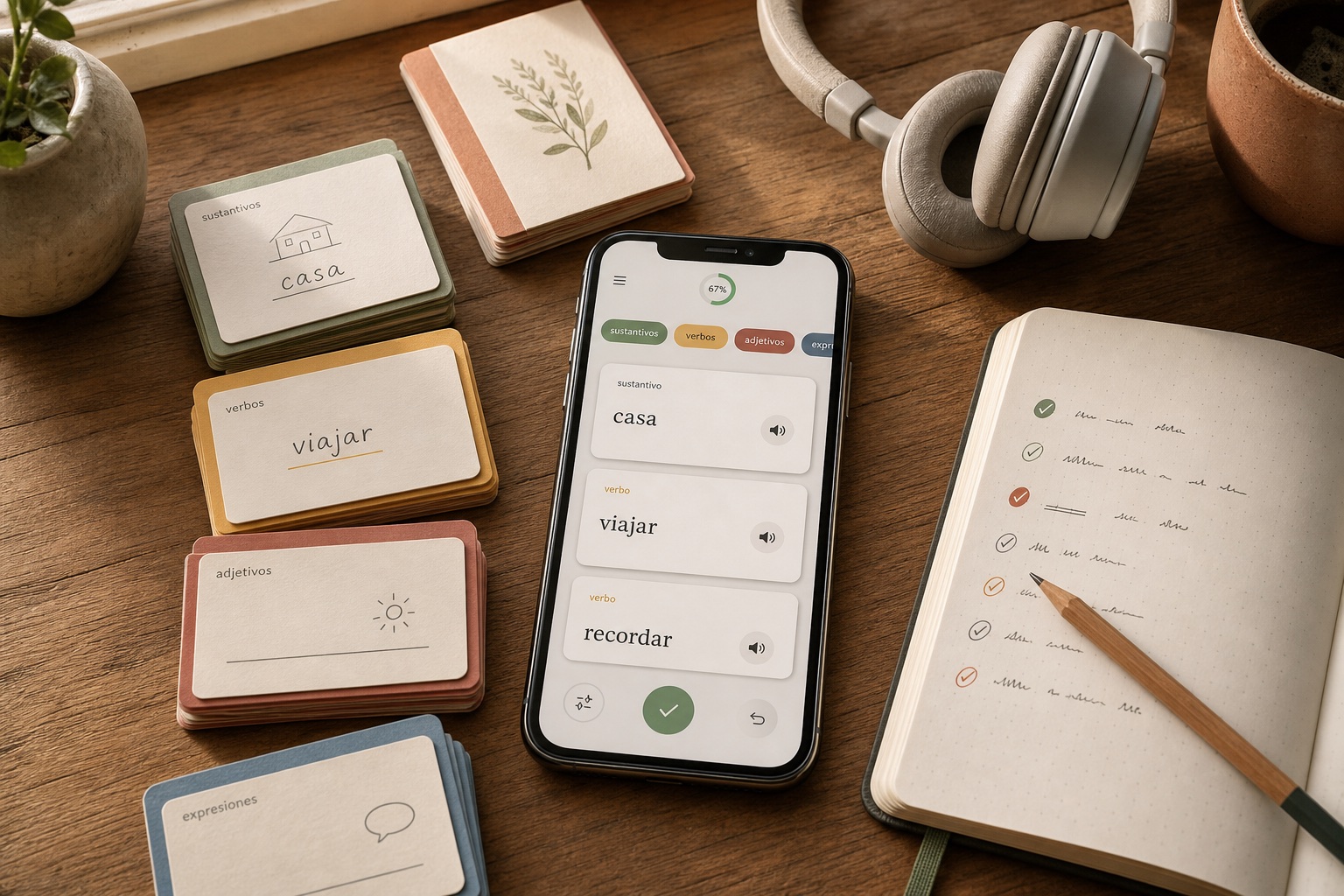
Hola Cards is a Spanish flashcard app from holacards.org for iOS and Android. It is free to download, needs no account, and core study works offline; the free version may show third-party ads while Premium removes them. The interface is available in 29 languages, including English, Russian, Portuguese and German; cards support translations in 29 languages, including English, Russian, Portuguese and German and 18 practice and game modes. You can import these fixed pairs into a custom group and practise them with Spanish audio, writing, pronunciation, and review. Hola Cards does not transform reported speech or correct open sentences automatically, so use the guide to check each conversion first.
Connect reported speech with decir, indirect questions, the past perfect, the conditional and the imperfect subjunctive.
Decir in Spanish Question words Past perfect Simple conditional Imperfect subjunctive
A five-minute reported-speech routine
- Underline the reporting verb and decide whether its viewpoint is present or past.
- Label each message statement, yes/no question, information question, or request.
- Choose que, si, a question word, or que plus the subjunctive.
- Update the person, tense, time and place references only where the context changes.
- Say the direct line, then the reported line; write both and check them against the table.
Grammar references
Definitions, connectors, viewpoint shifts and classroom level were checked against RAE–ASALE and Instituto Cervantes.
- RAE–ASALE: indirect speech
- Instituto Cervantes: reported-speech procedures, B1–B2
- Instituto Cervantes: grammar inventory, B1–B2
- Instituto Cervantes: transmitting what others said, B1
FAQ
What is reported speech in Spanish?
It is a way to retell words or thoughts from a new speaker, time or place viewpoint, usually inside a subordinate clause.
Do Spanish reported statements use que?
Usually: Ana dijo que estaba cansada.
How do you report a yes/no question?
Use preguntar si: Me preguntó si tenía tiempo.
How do you report an information question?
Keep the accented question word: preguntó dónde vivía.
Do tenses always shift in Spanish reported speech?
No. The shift depends on the reporting time, the intended viewpoint and whether the information remains current.
Does Hola Cards convert reported speech automatically?
No. You can import and practise these fixed pairs; this page explains and checks each conversion.
Copy the 32 reported-speech pairs into Hola Cards
Open word groups in Hola Cards, choose paste/import, and paste the block. The app recognises the title and “Spanish - translation” lines.
**Spanish reported speech: 32 examples**

Directo: Marta dice: «Tengo sueño». Indirecto: Marta dice que tiene sueño. - Marta says, “I am sleepy.” → Marta says that she is sleepy.
Directo: Marta dijo: «Tengo sueño». Indirecto: Marta dijo que tenía sueño. - Marta said, “I am sleepy.” → Marta said that she was sleepy.
Directo: Luis dijo: «He terminado». Indirecto: Luis dijo que había terminado. - Luis said, “I have finished.” → Luis said that he had finished.
Directo: Ana contó: «Llegué tarde». Indirecto: Ana contó que había llegado tarde. - Ana said, “I arrived late.” → Ana said that she had arrived late.
Directo: Pablo explicó: «Trabajo desde casa». Indirecto: Pablo explicó que trabajaba desde casa. - Pablo explained, “I work from home.” → Pablo explained that he worked from home.
Directo: Elena prometió: «Volveré mañana». Indirecto: Elena prometió que volvería al día siguiente. - Elena promised, “I will return tomorrow.” → Elena promised that she would return the next day.
Directo: Diego pensó: «No puedo ir». Indirecto: Diego pensó que no podía ir. - Diego thought, “I cannot go.” → Diego thought that he could not go.
Directo: Julia añadió: «Estoy estudiando». Indirecto: Julia añadió que estaba estudiando. - Julia added, “I am studying.” → Julia added that she was studying.
Directo: Me preguntó: «¿Vienes?». Indirecto: Me preguntó si venía. - He asked me, “Are you coming?” → He asked me if I was coming.
Directo: Ana preguntó: «¿Has comido?». Indirecto: Ana preguntó si había comido. - Ana asked, “Have you eaten?” → Ana asked if I had eaten.
Directo: Él preguntó: «¿Dónde vives?». Indirecto: Él preguntó dónde vivía. - He asked, “Where do you live?” → He asked where I lived.
Directo: Sara preguntó: «¿Cuándo llegarás?». Indirecto: Sara preguntó cuándo llegaría. - Sara asked, “When will you arrive?” → Sara asked when I would arrive.
Directo: El guía preguntó: «¿Por qué estás aquí?». Indirecto: El guía preguntó por qué estaba allí. - The guide asked, “Why are you here?” → The guide asked why I was there.
Directo: Marta preguntó: «¿Qué quieres?». Indirecto: Marta preguntó qué quería. - Marta asked, “What do you want?” → Marta asked what I wanted.
Directo: El profesor preguntó: «¿Quién llamó?». Indirecto: El profesor preguntó quién había llamado. - The teacher asked, “Who called?” → The teacher asked who had called.
Directo: Laura preguntó: «¿Cómo lo hiciste?». Indirecto: Laura preguntó cómo lo había hecho. - Laura asked, “How did you do it?” → Laura asked how I had done it.
Directo: Ana me pidió: «Cierra la puerta». Indirecto: Ana me pidió que cerrara la puerta. - Ana asked me, “Close the door.” → Ana asked me to close the door.
Directo: Mi padre me dijo: «No salgas tarde». Indirecto: Mi padre me dijo que no saliera tarde. - My father said, “Do not go out late.” → My father told me not to go out late.
Directo: Marta me pidió: «Llámame esta noche». Indirecto: Marta me pidió que la llamara esa noche. - Marta asked me, “Call me tonight.” → Marta asked me to call her that night.
Directo: El profesor nos dijo: «Esperad aquí». Indirecto: El profesor nos dijo que esperáramos allí. - The teacher said, “Wait here.” → The teacher told us to wait there.
Directo: La recepcionista indicó: «Siéntese aquí». Indirecto: La recepcionista indicó que se sentara allí. - The receptionist said, “Sit here.” → The receptionist instructed me to sit there.
Directo: Clara me recordó: «No olvides el pasaporte». Indirecto: Clara me recordó que no olvidara el pasaporte. - Clara reminded me, “Do not forget the passport.” → Clara reminded me not to forget the passport.
Directo: El jefe ordenó: «Traigan los documentos». Indirecto: El jefe ordenó que trajeran los documentos. - The manager ordered, “Bring the documents.” → The manager ordered them to bring the documents.
Directo: La médica me aconsejó: «Ten cuidado». Indirecto: La médica me aconsejó que tuviera cuidado. - The doctor advised me, “Be careful.” → The doctor advised me to be careful.
Directo: Pedro dijo: «Trabajo aquí». Indirecto: Pedro dijo que trabajaba allí. - Pedro said, “I work here.” → Pedro said that he worked there.
Directo: Sofía dijo el lunes: «Hoy descanso». Indirecto: Sofía dijo que ese día descansaba. - Sofía said on Monday, “I am resting today.” → Sofía said that she was resting that day.
Directo: Raúl dijo: «Viajaré mañana». Indirecto: Raúl dijo que viajaría al día siguiente. - Raúl said, “I will travel tomorrow.” → Raúl said that he would travel the next day.
Directo: Elena dijo: «Llegué ayer». Indirecto: Elena dijo que había llegado el día anterior. - Elena said, “I arrived yesterday.” → Elena said that she had arrived the day before.
Directo: Julia dijo: «Este libro es mío». Indirecto: Julia dijo que ese libro era suyo. - Julia said, “This book is mine.” → Julia said that that book was hers.
Directo: Carlos dijo: «Yo traeré mi coche». Indirecto: Carlos dijo que él llevaría su coche. - Carlos said, “I will bring my car.” → Carlos said that he would take his car.
Directo: Lucía dijo: «Ahora no puedo hablar». Indirecto: Lucía dijo que entonces no podía hablar. - Lucía said, “I cannot talk now.” → Lucía said that she could not talk then.
Directo: María dijo: «Madrid está en España». Indirecto: María dijo que Madrid está en España. - María said, “Madrid is in Spain.” → María said that Madrid is in Spain.
Review reported speech in Hola Cards
Practise the 32 fixed pairs with Spanish audio, writing, pronunciation, custom groups, and review modes on iOS and Android.