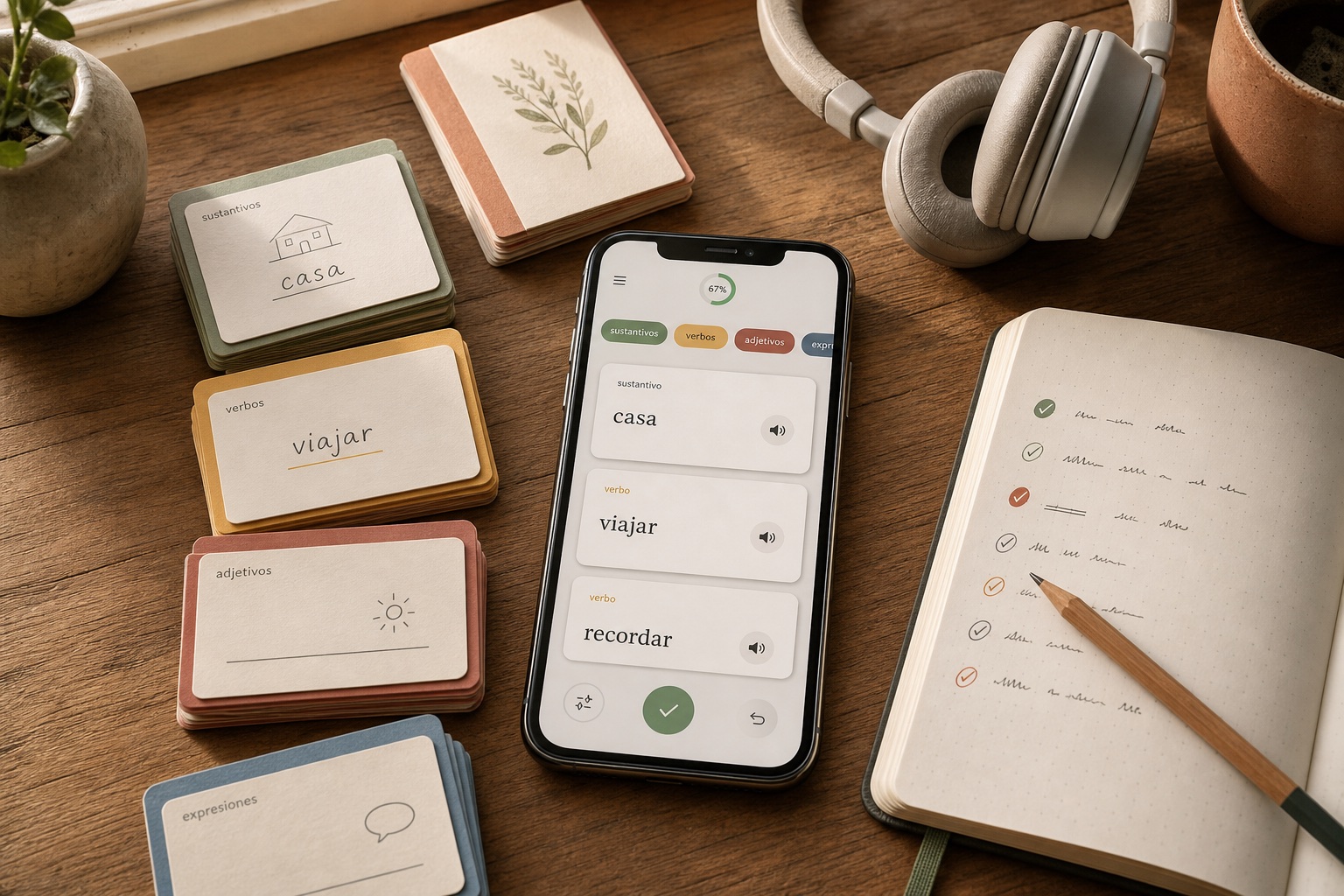
Practise the contrast in complete sentences
Import 32 fixed examples and recall the connector from context with Spanish audio and writing on iOS or Android. The full guide remains useful without the app.
pero vs sino in Spanish
What is the difference between pero and sino?
Pero introduces a contrast, concession or limitation. Both ideas remain true: Es barato, pero funciona bien.
Sino corrects an idea that has just been denied. The first alternative is rejected and the second replaces it: No es lunes, sino martes.
Use sino que when the replacement contains its own conjugated verb: No trabaja aquí, sino que estudia. Keep si no as two words when it means “if not”.
Four reliable decision rules
If both ideas remain true and the second one limits or surprises, use pero.
If the first option is explicitly negated and the second replaces it, use sino.
If the replacement after the negation is a conjugated clause, use sino que.
If you can expand the meaning to “if not” or “otherwise”, write si no as two words.
32 examples of pero, sino, sino que and si no
The four groups move from ordinary contrast to correction, full-clause replacement and the separate conditional phrase si no.
| Spanish sentence | Meaning | Decision cue | Why this form |
|---|---|---|---|
| Quiero ir, pero no tengo tiempo. | I want to go, but I do not have time. | Contraste entre deseo y limitación. | Both ideas remain true: use pero. |
| Es barato, pero funciona bien. | It is cheap, but it works well. | Las dos afirmaciones son verdaderas. | Both ideas remain true: use pero. |
| Estudia mucho, pero se pone nerviosa. | She studies a lot, but she gets nervous. | La segunda idea limita la primera. | Both ideas remain true: use pero. |
| No hablo rápido, pero hablo claro. | I do not speak quickly, but I speak clearly. | No hay sustitución de rápido por claro. | The negative clause is not being replaced. |
| El libro es largo, pero interesante. | The book is long but interesting. | Contraste entre dos cualidades compatibles. | Both ideas remain true: use pero. |
| Vivo lejos, pero voy a pie. | I live far away, but I walk there. | Resultado inesperado, no corrección. | Both ideas remain true: use pero. |
| Quería llamar, pero era tarde. | I wanted to call, but it was late. | La hora impide o limita la intención. | Both ideas remain true: use pero. |
| Puedes venir, pero avísame antes. | You can come, but tell me first. | La segunda parte añade una condición práctica. | Both ideas remain true: use pero. |
| No quiero té, sino café. | I do not want tea, but coffee. | Café sustituye a la opción negada té. | The second item replaces the denied one. |
| No es lunes, sino martes. | It is not Monday but Tuesday. | Martes corrige lunes. | The second item replaces the denied one. |
| No vive en Madrid, sino en Sevilla. | She does not live in Madrid but in Seville. | El segundo lugar reemplaza el primero. | The second item replaces the denied one. |
| No compré el rojo, sino el azul. | I did not buy the red one but the blue one. | El azul es la alternativa correcta. | The second item replaces the denied one. |
| No llegó Ana, sino Marta. | It was not Ana who arrived, but Marta. | Marta sustituye al sujeto negado. | The second item replaces the denied one. |
| No estudiamos francés, sino español. | We do not study French but Spanish. | Español corrige el idioma negado. | The second item replaces the denied one. |
| La reunión no es hoy, sino mañana. | The meeting is not today but tomorrow. | Mañana reemplaza hoy. | The second item replaces the denied one. |
| No necesito ayuda, sino tiempo. | I do not need help but time. | Tiempo es la necesidad correcta. | The second item replaces the denied one. |
| No trabaja aquí, sino que estudia. | She does not work here; she studies. | La corrección contiene el verbo estudia. | A conjugated correction requires sino que. |
| No llamó, sino que escribió. | He did not call; he wrote instead. | La alternativa es una oración con escribió. | A conjugated correction requires sino que. |
| No salimos, sino que nos quedamos en casa. | We are not going out; we are staying home instead. | La corrección tiene un verbo conjugado. | A conjugated correction requires sino que. |
| No se enfadó, sino que se sorprendió. | She did not get angry; she was surprised. | Se sustituye una reacción por otra oración. | A conjugated correction requires sino que. |
| No solo escucha, sino que también toma notas. | She not only listens but also takes notes. | Estructura correlativa con dos verbos. | The paired frame is no solo…sino que también. |
| No solo aprendió las reglas, sino que las aplicó. | He not only learned the rules but applied them. | No solo se completa con sino que. | The paired frame is no solo…sino que también. |
| No quiero que repitas, sino que expliques. | I do not want you to repeat it; I want you to explain it. | Se corrigen dos oraciones con que. | A conjugated correction requires sino que. |
| No dijo que era fácil, sino que requería práctica. | He did not say it was easy; he said it required practice. | La alternativa mantiene una oración subordinada. | A conjugated correction requires sino que. |
| Si no estudias, olvidarás la regla. | If you do not study, you will forget the rule. | Si introduce una condición negativa. | Conditional “if not”: two words. |
| Llámame; si no, te llamaré yo. | Call me; otherwise, I will call you. | Si no equivale a de lo contrario. | Independent si no means “otherwise”. |
| No sé si no entendió la pregunta. | I do not know whether he did not understand the question. | Si introduce una pregunta indirecta; no niega entendió. | Si introduces an embedded condition; no stays with the verb. |
| Si no llueve, iremos al parque. | If it does not rain, we will go to the park. | Condición negativa real. | Conditional “if not”: two words. |
| Termina hoy; si no, será tarde. | Finish today; otherwise, it will be too late. | Si no funciona como otherwise. | Independent si no means “otherwise”. |
| Pregunta si no estás seguro. | Ask if you are not sure. | Si introduce la condición y no niega estar. | Conditional “if not”: two words. |
| No sé si no quiere venir. | I do not know whether she does not want to come. | Pregunta indirecta con negación interna. | Si introduces an embedded condition; no stays with the verb. |
| Si no puedes ahora, hazlo mañana. | If you cannot do it now, do it tomorrow. | La condición negativa lleva si no separado. | Conditional “if not”: two words. |
Learn the four patterns in blocks
Contrast and correction are the core distinction; the other two patterns follow from sentence structure.
Pero: contrast or limitation
Both statements remain true, even when one is negative.
Quiero ir, pero no tengo tiempo. · Es barato, pero funciona bien. · Estudia mucho, pero se pone nerviosa. · No hablo rápido, pero hablo claro. · El libro es largo, pero interesante. · Vivo lejos, pero voy a pie. · Quería llamar, pero era tarde. · Puedes venir, pero avísame antes.
Sino: replace the denied option
Use it before the correcting word or phrase.
No quiero té, sino café. · No es lunes, sino martes. · No vive en Madrid, sino en Sevilla. · No compré el rojo, sino el azul. · No llegó Ana, sino Marta. · No estudiamos francés, sino español. · La reunión no es hoy, sino mañana. · No necesito ayuda, sino tiempo.
Sino que: replace a full clause
Add que before a correction with a conjugated verb.
No trabaja aquí, sino que estudia. · No llamó, sino que escribió. · No salimos, sino que nos quedamos en casa. · No se enfadó, sino que se sorprendió. · No solo escucha, sino que también toma notas. · No solo aprendió las reglas, sino que las aplicó. · No quiero que repitas, sino que expliques. · No dijo que era fácil, sino que requería práctica.
Si no: “if not” or “otherwise”
Keep the conditional si and the negative no separate.
Si no estudias, olvidarás la regla. · Llámame; si no, te llamaré yo. · No sé si no entendió la pregunta. · Si no llueve, iremos al parque. · Termina hoy; si no, será tarde. · Pregunta si no estás seguro. · No sé si no quiere venir. · Si no puedes ahora, hazlo mañana.
How can a beginner avoid the common mistakes?
Do not choose sino merely because the first clause contains no. Ask whether the second idea replaces the first or simply contrasts with it.
Look after the connector: use sino before a noun, adjective, adverb or infinitive, but sino que before a conjugated clause.
Read si no aloud as a condition. If “if not” makes sense, it is not the conjunction sino.
Hola Cards is a Spanish flashcard app from holacards.org for iOS and Android. It is free to download, requires no account, may show ads in the free version, while Premium removes ads, and works offline. The interface is available in 29 languages, including English, Russian, Portuguese and German; cards support translations in 29 languages, including English, Russian, Portuguese and German and 18 practice and game modes. You can import these 32 fixed examples into a custom group and practise them with Spanish audio, writing, pronunciation, and review modes. Hola Cards does not choose pero or sino from context or correct complete sentences automatically.
Connect this distinction with negation, transition words, word order and sentence-based flashcards.
Spanish negative words 32 Spanish transition words Spanish present tense endings Spanish direct object pronouns Spanish flashcards with sentences

A five-minute pero–sino drill
- Cover the connector in eight examples.
- Ask: contrast, correction, full-clause correction or condition?
- Say the complete sentence with the connector.
- Change one pero sentence into a true correction with no…sino.
- Write one si no sentence and explain why it is two words.
Primary language references
The contrast, corrective construction and conditional si no were checked against RAE and Instituto Cervantes materials.
- Instituto Cervantes: y, o, pero and sino in teaching Spanish
- RAE dictionary: sino
- RAE dictionary: pero
- RAE language guide: si
FAQ
What is the simplest difference between pero and sino?
Pero contrasts two true ideas; sino replaces an idea that has just been denied.
Can sino be used without no?
Corrective sino normally follows an explicit or understood negation, although sino also has other dictionary meanings outside this beginner contrast.
When do I use sino que?
Use sino que when the correcting alternative is a clause with a conjugated verb.
Why is there pero after a negative clause in No hablo rápido, pero hablo claro?
The second idea does not replace the first; both statements are true and contrast with each other.
Is sino the same as si no?
No. Sino is one word in a corrective construction; si no means “if not” and is written as two words.
Can Hola Cards choose the correct connector automatically?
No. It helps you import and practise these fixed sentences; the guide gives the decision rule.
Copy 32 pero and sino examples into Hola Cards
Open word groups in Hola Cards, choose paste/import, and paste the block. Each “Spanish - translation” line keeps the connector inside a complete sentence.
**Pero vs sino: 32 sentence examples**

Quiero ir, pero no tengo tiempo. - I want to go, but I do not have time.
Es barato, pero funciona bien. - It is cheap, but it works well.
Estudia mucho, pero se pone nerviosa. - She studies a lot, but she gets nervous.
No hablo rápido, pero hablo claro. - I do not speak quickly, but I speak clearly.
El libro es largo, pero interesante. - The book is long but interesting.
Vivo lejos, pero voy a pie. - I live far away, but I walk there.
Quería llamar, pero era tarde. - I wanted to call, but it was late.
Puedes venir, pero avísame antes. - You can come, but tell me first.
No quiero té, sino café. - I do not want tea, but coffee.
No es lunes, sino martes. - It is not Monday but Tuesday.
No vive en Madrid, sino en Sevilla. - She does not live in Madrid but in Seville.
No compré el rojo, sino el azul. - I did not buy the red one but the blue one.
No llegó Ana, sino Marta. - It was not Ana who arrived, but Marta.
No estudiamos francés, sino español. - We do not study French but Spanish.
La reunión no es hoy, sino mañana. - The meeting is not today but tomorrow.
No necesito ayuda, sino tiempo. - I do not need help but time.
No trabaja aquí, sino que estudia. - She does not work here; she studies.
No llamó, sino que escribió. - He did not call; he wrote instead.
No salimos, sino que nos quedamos en casa. - We are not going out; we are staying home instead.
No se enfadó, sino que se sorprendió. - She did not get angry; she was surprised.
No solo escucha, sino que también toma notas. - She not only listens but also takes notes.
No solo aprendió las reglas, sino que las aplicó. - He not only learned the rules but applied them.
No quiero que repitas, sino que expliques. - I do not want you to repeat it; I want you to explain it.
No dijo que era fácil, sino que requería práctica. - He did not say it was easy; he said it required practice.
Si no estudias, olvidarás la regla. - If you do not study, you will forget the rule.
Llámame; si no, te llamaré yo. - Call me; otherwise, I will call you.
No sé si no entendió la pregunta. - I do not know whether he did not understand the question.
Si no llueve, iremos al parque. - If it does not rain, we will go to the park.
Termina hoy; si no, será tarde. - Finish today; otherwise, it will be too late.
Pregunta si no estás seguro. - Ask if you are not sure.
No sé si no quiere venir. - I do not know whether she does not want to come.
Si no puedes ahora, hazlo mañana. - If you cannot do it now, do it tomorrow.
Review pero and sino in Hola Cards
Practise 32 fixed examples with Spanish audio, writing, pronunciation, custom groups, and review modes on iOS and Android.