Practise the negative word inside the full sentence
Import the 32 examples and recall each word-order pattern with Spanish audio and writing on iOS or Android. The guide remains complete without the app.
Spanish negative words
How does Spanish negation work?
The simplest pattern is no + conjugated verb: No hablo, No está, No podemos entrar. Object and reflexive pronouns stay between no and the verb: No lo sé; No me gusta.
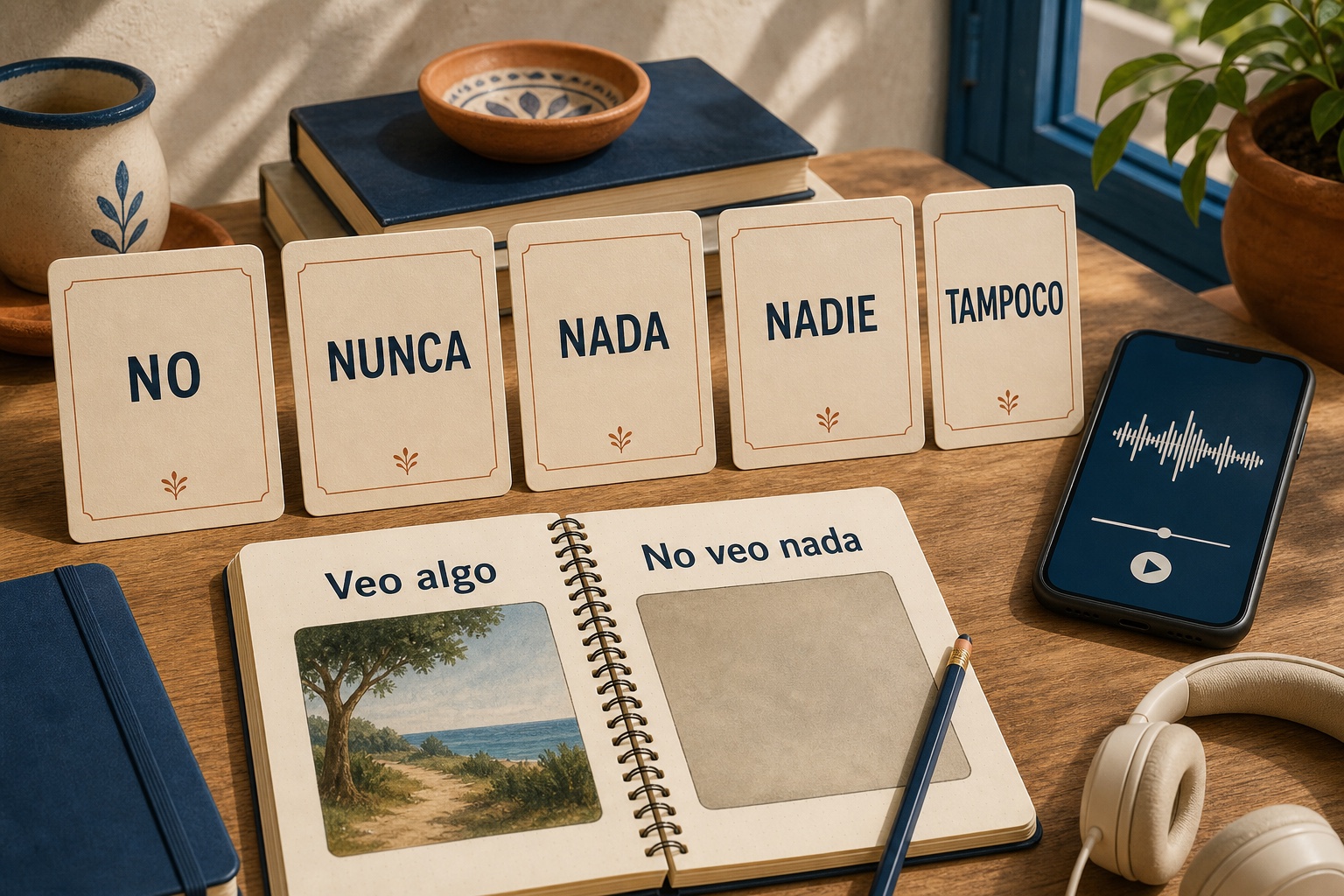
Spanish uses negative concord. A negative word after the verb normally needs no before the verb: No veo nada; No conozco a nadie. These words reinforce one negative meaning.
If nadie, nada, nunca, jamás, tampoco, ningún, or ninguna comes before the verb, it normally supplies the negation by itself: Nadie vino; Nunca llego tarde; Ninguna tienda está abierta.
Spanish negative words at a glance
Basic negative: no immediately before the conjugated verb — No tengo tiempo; No lo entiendo.
Negative word after the verb: use no before the verb — No veo nada; No viene nadie; No voy nunca.
Negative word before the verb: normally omit no — Nada cambia; Nadie sabe; Nunca voy.
Use ningún before a masculine singular noun and ninguna before a feminine singular noun. Ni…ni joins two negative choices; todavía no means “not yet,” and ya no means “no longer.”
32 Spanish negative-word examples
Move from basic no to negative concord, fronted negative words, and common conversation contrasts.
| Spanish sentence | Meaning | Example in context | Why this form? |
|---|---|---|---|
| No hablo inglés. | I do not speak English. | La negación básica se coloca delante del verbo conjugado. | Place no immediately before the conjugated verb. |
| No tengo tiempo. | I do not have time. | No niega la forma verbal tengo. | Place no immediately before the conjugated verb. |
| No está aquí. | He or she is not here. | No aparece inmediatamente antes de está. | Place no immediately before the conjugated verb. |
| No podemos entrar. | We cannot enter. | No niega el verbo conjugado podemos. | Place no immediately before the conjugated verb. |
| No lo entiendo. | I do not understand it. | El pronombre lo queda entre no y el verbo. | Place no immediately before the conjugated verb. |
| No me levanto temprano. | I do not get up early. | El pronombre reflexivo me queda entre no y levanto. | Place no immediately before the conjugated verb. |
| Nunca llego tarde. | I never arrive late. | Nunca va antes del verbo y basta para negar la frase. | The negative word comes before the verb, so no is normally omitted. |
| Jamás olvido tu ayuda. | I will never forget your help. | Jamás antepuesto niega sin añadir no. | The negative word comes before the verb, so no is normally omitted. |
| No veo nada. | I do not see anything. | Nada aparece después del verbo y exige no delante. | Because the negative word follows the verb, no is required before the verb. |
| No conozco a nadie. | I do not know anyone. | Nadie se refiere a personas y va después del verbo. | Because the negative word follows the verb, no is required before the verb. |
| No voy nunca al gimnasio. | I never go to the gym. | Nunca va después del verbo, por eso se conserva no. | Because the negative word follows the verb, no is required before the verb. |
| No quiero ningún postre. | I do not want any dessert. | Ningún acompaña a un nombre masculino singular. | Ningún or ninguna appears before a singular noun and agrees in gender. |
| No tengo ninguna duda. | I do not have any doubt. | Ninguna concuerda con duda. | Ningún or ninguna appears before a singular noun and agrees in gender. |
| No compramos ni pan ni leche. | We bought neither bread nor milk. | Ni…ni coordina dos elementos negativos. | Ni…ni links two negative alternatives. |
| No dijo nada a nadie. | He or she said nothing to anyone. | Nada y nadie refuerzan la misma negación después del verbo. | Because the negative word follows the verb, no is required before the verb. |
| No quiero ir tampoco. | I do not want to go either. | Tampoco añade una segunda respuesta negativa. | Tampoco agrees with or adds to a negative statement. |
| Nadie sabe la respuesta. | Nobody knows the answer. | Nadie funciona como sujeto negativo antes del verbo. | The negative word comes before the verb, so no is normally omitted. |
| Nada cambia hoy. | Nothing changes today. | Nada va antes del verbo y no necesita no. | The negative word comes before the verb, so no is normally omitted. |
| Nunca desayuno temprano. | I never eat breakfast early. | Nunca antepuesto niega el hábito. | The negative word comes before the verb, so no is normally omitted. |
| Tampoco puedo ir. | I cannot go either. | Tampoco encabeza una respuesta que coincide con otra negativa. | Tampoco agrees with or adds to a negative statement. |
| Ningún estudiante faltó. | No student was absent. | Ningún concuerda con estudiante y precede al verbo. | Ningún or ninguna appears before a singular noun and agrees in gender. |
| Ninguna tienda está abierta. | No shop is open. | Ninguna concuerda con tienda y basta para negar. | Ningún or ninguna appears before a singular noun and agrees in gender. |
| Ni Ana ni Luis trabajan hoy. | Neither Ana nor Luis is working today. | Ni…ni forma un sujeto negativo compuesto. | Ni…ni links two negative alternatives. |
| Jamás lo haría. | I would never do it. | Jamás aparece antes del pronombre y el verbo. | The negative word comes before the verb, so no is normally omitted. |
| ¿Hay alguien aquí? No, no hay nadie. | Is anyone here? No, nobody is here. | Alguien cambia a nadie dentro de la respuesta negativa. | Because the negative word follows the verb, no is required before the verb. |
| ¿Quieres algo? No quiero nada. | Do you want something? I do not want anything. | Algo cambia a nada después del verbo negado. | Because the negative word follows the verb, no is required before the verb. |
| Siempre llama. Nunca escribe. | He or she always calls. He or she never writes. | Siempre y nunca crean un contraste de frecuencia. | The negative word comes before the verb, so no is normally omitted. |
| Yo también voy. Yo tampoco voy. | I am going too. I am not going either. | También coincide con lo afirmativo y tampoco con lo negativo. | Tampoco agrees with or adds to a negative statement. |
| Todavía no he terminado. | I have not finished yet. | Todavía no marca una acción pendiente. | Todavía no means “not yet.” |
| Ya no vivo allí. | I no longer live there. | Ya no indica que la situación dejó de ser cierta. | Ya no means “no longer” or “not anymore.” |
| No hay ningún problema. | There is no problem. | Ningún acompaña al nombre después de no hay. | Ningún or ninguna appears before a singular noun and agrees in gender. |
| No viene nadie hoy. | Nobody is coming today. | Nadie va después del verbo y se mantiene no. | Because the negative word follows the verb, no is required before the verb. |
Learn negation in four blocks
Start with no, then compare postverbal and preverbal negative words before practising common contrasts.
Basic no
Negate the conjugated verb and keep pronouns in place.
No hablo inglés. · No tengo tiempo. · No está aquí. · No podemos entrar. · No lo entiendo. · No me levanto temprano. · Nunca llego tarde. · Jamás olvido tu ayuda.
Negative words after the verb
Use no with nada, nadie, nunca, and other postverbal negatives.
No veo nada. · No conozco a nadie. · No voy nunca al gimnasio. · No quiero ningún postre. · No tengo ninguna duda. · No compramos ni pan ni leche. · No dijo nada a nadie. · No quiero ir tampoco.
Negative words before the verb
Let the fronted negative word carry the negation without no.
Nadie sabe la respuesta. · Nada cambia hoy. · Nunca desayuno temprano. · Tampoco puedo ir. · Ningún estudiante faltó. · Ninguna tienda está abierta. · Ni Ana ni Luis trabajan hoy. · Jamás lo haría.
Conversation contrasts
Practise tampoco, todavía no, ya no, and affirmative-to-negative pairs.
¿Hay alguien aquí? No, no hay nadie. · ¿Quieres algo? No quiero nada. · Siempre llama. Nunca escribe. · Yo también voy. Yo tampoco voy. · Todavía no he terminado. · Ya no vivo allí. · No hay ningún problema. · No viene nadie hoy.
How do you choose the word order?
Find the conjugated verb. For a basic negative, place no immediately before it and keep any object or reflexive pronoun between no and the verb: No lo veo; No me acuerdo.
If nada, nadie, nunca, jamás, tampoco, ningún, or ninguna follows the verb, add no before the verb. If the negative word moves before the verb, normally remove no.
Choose the precise meaning: nada for things, nadie for people, nunca or jamás for time, tampoco for negative agreement, ningún/ninguna before a noun, and ni…ni for “neither…nor.”
Hola Cards is a Spanish flashcard app from holacards.org for iOS and Android. It is free to download, requires no account, may show ads in the free version, while Premium removes ads, and works offline. The interface is available in 29 languages, including English, Russian, Portuguese and German; cards support translations in 29 languages, including English, Russian, Portuguese and German and 18 practice and game modes. You can import these complete sentences into a custom group for Spanish audio, writing, pronunciation, and spaced review. Hola Cards does not analyse negative-word placement automatically, so use this guide to check each sentence.
Connect negation with present-tense forms, subject and object pronouns, questions, and sentence-based flashcards.
Present tense endings Subject pronouns Direct object pronouns Question words Flashcards with sentences

A five-minute negation routine
- Underline the conjugated verb in eight affirmative sentences.
- Add no immediately before the verb or pronoun-verb group.
- Replace algo with nada and alguien with nadie.
- Move four negative words before the verb and remove no.
- Say and write the contrast pairs from memory.
Grammar references
Negative quantifiers, A1–A2 negation, and conversational functions were checked against these primary sources.
- RAE–ASALE grammar tables: negative quantifiers and examples
- Instituto Cervantes A1–A2 grammar inventory: nada, nadie, tampoco and negation
- Instituto Cervantes A1–A2 functions inventory: negative replies and evaluations
FAQ
Where does no go in a Spanish sentence?
Immediately before the conjugated verb. Object and reflexive pronouns stay between no and the verb: No lo veo; No me levanto temprano.
Why is No veo nada correct?
Spanish uses negative concord. When nada follows the verb, no normally appears before the verb; together they express one negative meaning.
Can I say Nada veo?
Yes, although Nada veo can sound marked or literary. The everyday order is No veo nada. A fronted negative word normally does not take no.
What is the difference between nadie and nada?
Nadie refers to people; nada refers to things or to “nothing/anything” in a negative sentence.
How do tampoco and también differ?
También agrees with a positive statement; tampoco agrees with a negative one: Yo también voy; Yo tampoco voy.
Does Hola Cards check Spanish negation automatically?
No. You can import and practise the examples; this page explains and checks the word-order patterns.
Copy the 32 negative examples into Hola Cards
Open word groups in Hola Cards, choose paste/import, and paste the block. The app recognises the title and “Spanish - translation” lines.
**Spanish negative words: 32 examples**

No hablo inglés. - I do not speak English.
No tengo tiempo. - I do not have time.
No está aquí. - He or she is not here.
No podemos entrar. - We cannot enter.
No lo entiendo. - I do not understand it.
No me levanto temprano. - I do not get up early.
Nunca llego tarde. - I never arrive late.
Jamás olvido tu ayuda. - I will never forget your help.
No veo nada. - I do not see anything.
No conozco a nadie. - I do not know anyone.
No voy nunca al gimnasio. - I never go to the gym.
No quiero ningún postre. - I do not want any dessert.
No tengo ninguna duda. - I do not have any doubt.
No compramos ni pan ni leche. - We bought neither bread nor milk.
No dijo nada a nadie. - He or she said nothing to anyone.
No quiero ir tampoco. - I do not want to go either.
Nadie sabe la respuesta. - Nobody knows the answer.
Nada cambia hoy. - Nothing changes today.
Nunca desayuno temprano. - I never eat breakfast early.
Tampoco puedo ir. - I cannot go either.
Ningún estudiante faltó. - No student was absent.
Ninguna tienda está abierta. - No shop is open.
Ni Ana ni Luis trabajan hoy. - Neither Ana nor Luis is working today.
Jamás lo haría. - I would never do it.
¿Hay alguien aquí? No, no hay nadie. - Is anyone here? No, nobody is here.
¿Quieres algo? No quiero nada. - Do you want something? I do not want anything.
Siempre llama. Nunca escribe. - He or she always calls. He or she never writes.
Yo también voy. Yo tampoco voy. - I am going too. I am not going either.
Todavía no he terminado. - I have not finished yet.
Ya no vivo allí. - I no longer live there.
No hay ningún problema. - There is no problem.
No viene nadie hoy. - Nobody is coming today.
Review Spanish negative words in Hola Cards
Practise the 32 complete examples with Spanish audio, writing, pronunciation, custom groups, and spaced review on iOS and Android.