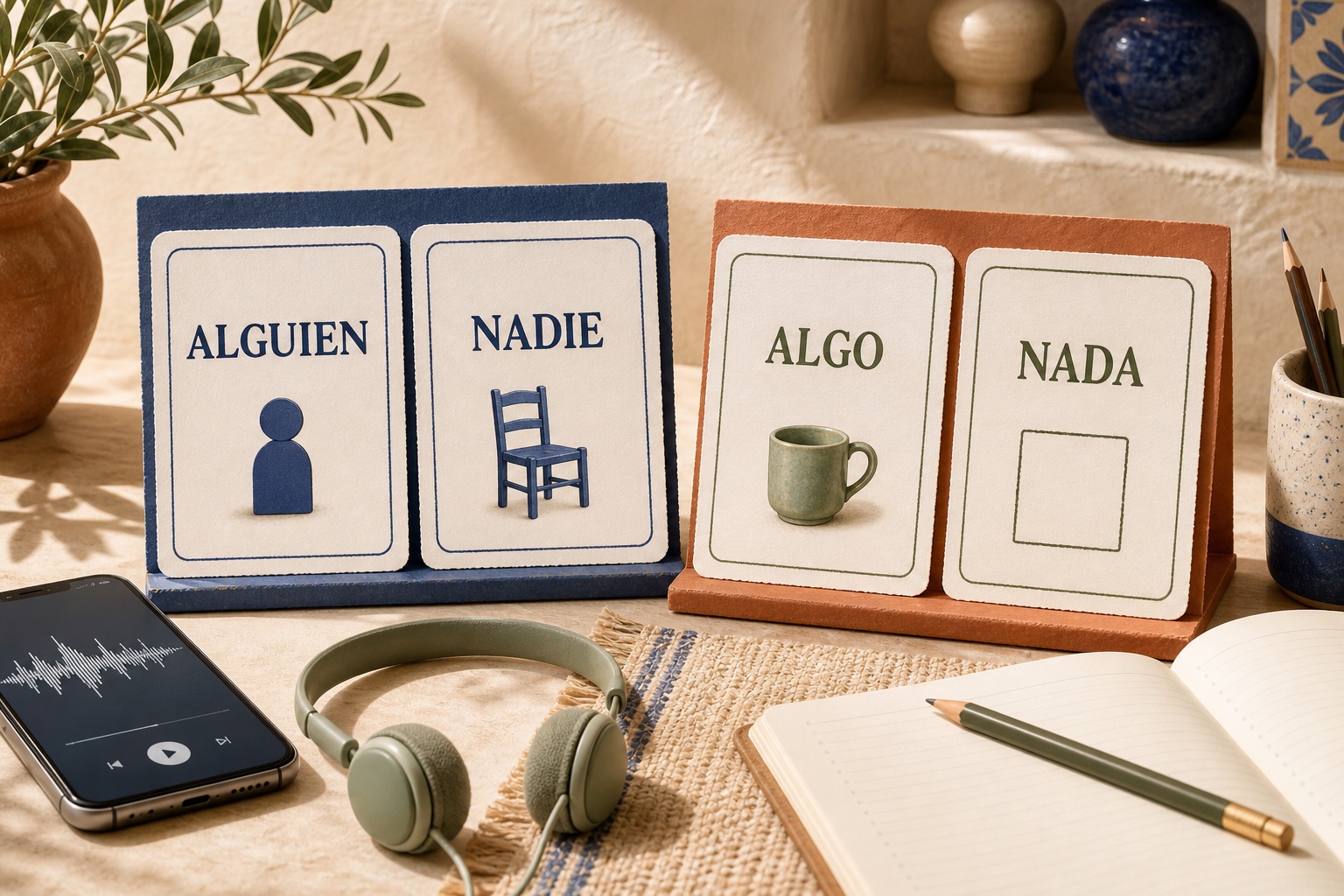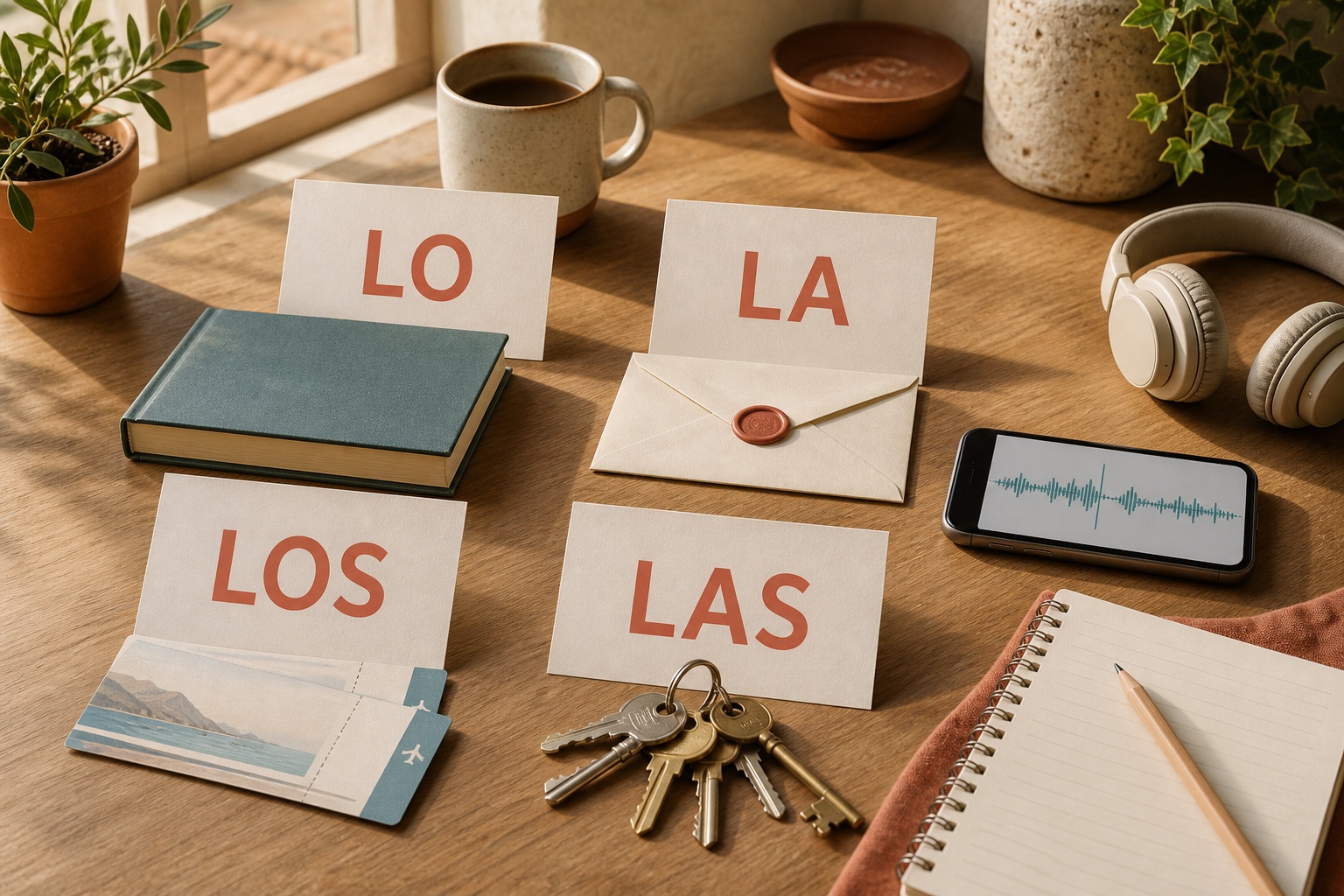
Practise the pronoun inside a full sentence
Import the 32 examples and recall each contrast with Spanish audio and writing on iOS or Android. The grammar guide remains complete without the app.
Spanish direct object pronouns
What is a direct object pronoun in Spanish?
The direct object answers who or what receives the action: Leo el libro. What do I read? El libro. Replace it with lo: Lo leo.
For things and most people, third-person pronouns agree with the noun: Veo a Ana → La veo; veo a Carlos → Lo veo. The personal a before a person does not make the object indirect.
Place the pronoun before a conjugated verb: La compro. Attach it to an infinitive, gerund, or affirmative command: comprarla, comprándola, cómprala. With an infinitive or gerund construction, both positions can be correct: La voy a comprar / Voy a comprarla.
Spanish direct object pronoun chart at a glance
yo → me; tú → te; él/it masculine → lo; ella/it feminine → la.
nosotros/as → nos; vosotros/as → os; masculine or mixed plural → los; feminine plural → las.
Before a conjugated verb: Lo necesito. Before a negative command: No lo compres.
Attached to an infinitive, gerund, or affirmative command: verlo, viéndola, cómpralos. Add a written accent when attachment changes the stress: leyéndola, cómpralo.
32 Spanish direct object pronoun examples
Start with the complete chart, then compare gender and number, placement, people, and direct-versus-indirect contrasts.
| Spanish sentence | Meaning | Example in context | Why this pronoun |
|---|---|---|---|
| ¿Me ves? | Can you see me? | ¿Me ves desde allí? | Me replaces the speaker as the direct object. |
| Te llamo esta tarde. | I will call you this afternoon. | Te llamo esta tarde después del trabajo. | Te replaces one familiar addressee. |
| Lo compro hoy. | I am buying it today. (masculine) | El libro me gusta; lo compro hoy. | Lo replaces a masculine singular noun or a neutral idea. |
| La compro hoy. | I am buying it today. (feminine) | La camisa me gusta; la compro hoy. | La replaces a feminine singular noun. |
| Nos conocen bien. | They know us well. | Nuestros vecinos nos conocen bien. | Nos replaces a group that includes the speaker. |
| Os invito a cenar. | I invite you all to dinner. (Spain) | Os invito a cenar en mi casa. | Os replaces a familiar plural addressee, mainly with vosotros in Spain. |
| Los necesito mañana. | I need them tomorrow. (masculine/mixed) | Los documentos son importantes; los necesito mañana. | Los is masculine or mixed plural; las is feminine plural. |
| Las necesito mañana. | I need them tomorrow. (feminine) | Las llaves están aquí; las necesito mañana. | Los is masculine or mixed plural; las is feminine plural. |
| Tengo el libro. Lo leo cada noche. | I have the book. I read it every night. | Tengo el libro nuevo y lo leo cada noche. | Lo replaces a masculine singular noun or a neutral idea. |
| Tengo la carta. La leo ahora. | I have the letter. I am reading it now. | Tengo la carta de Ana y la leo ahora. | La replaces a feminine singular noun. |
| ¿Ves a Carlos? Sí, lo veo. | Do you see Carlos? Yes, I see him. | Carlos está junto a la puerta; sí, lo veo. | Lo replaces a masculine singular noun or a neutral idea. |
| ¿Ves a Ana? Sí, la veo. | Do you see Ana? Yes, I see her. | Ana está junto a la puerta; sí, la veo. | La replaces a feminine singular noun. |
| Compro los billetes y los guardo. | I buy the tickets and keep them. | Compro los billetes en línea y los guardo en el móvil. | Los is masculine or mixed plural; las is feminine plural. |
| Compro las entradas y las guardo. | I buy the tickets and keep them. (feminine) | Compro las entradas del museo y las guardo en el móvil. | Los is masculine or mixed plural; las is feminine plural. |
| No entiendo esto. No lo entiendo. | I do not understand this. I do not understand it. | Esto es difícil; no lo entiendo todavía. | Lo replaces a masculine singular noun or a neutral idea. |
| Conozco a Marta y a Elena. Las conozco del trabajo. | I know Marta and Elena. I know them from work. | Marta y Elena son compañeras; las conozco del trabajo. | Los is masculine or mixed plural; las is feminine plural. |
| Lo voy a comprar. | I am going to buy it. | El diccionario es útil; lo voy a comprar. | Place before a conjugated verb or attach to an infinitive, gerund, or affirmative command. |
| Voy a comprarlo. | I am going to buy it. | El diccionario es útil; voy a comprarlo. | Place before a conjugated verb or attach to an infinitive, gerund, or affirmative command. |
| La estoy leyendo. | I am reading it. (feminine) | La novela es corta; la estoy leyendo ahora. | Place before a conjugated verb or attach to an infinitive, gerund, or affirmative command. |
| Estoy leyéndola. | I am reading it. (feminine) | La novela es corta; estoy leyéndola ahora. | Place before a conjugated verb or attach to an infinitive, gerund, or affirmative command. |
| Quiero verla. | I want to see her / it. | La película empieza hoy y quiero verla. | Place before a conjugated verb or attach to an infinitive, gerund, or affirmative command. |
| Estoy buscándolos. | I am looking for them. (masculine/mixed) | Mis auriculares no están aquí; estoy buscándolos. | Place before a conjugated verb or attach to an infinitive, gerund, or affirmative command. |
| ¡Cómpralo ahora! | Buy it now! (masculine) | El billete está barato; ¡cómpralo ahora! | Place before a conjugated verb or attach to an infinitive, gerund, or affirmative command. |
| No lo compres todavía. | Do not buy it yet. | El precio puede bajar; no lo compres todavía. | Place before a conjugated verb or attach to an infinitive, gerund, or affirmative command. |
| Le escribo a Ana, pero la llamo después. | I write to Ana, but I call her later. | Le escribo un mensaje a Ana, pero la llamo después. | Direct lo/la/los/las replace what is acted on; indirect le/les name a recipient. |
| Veo a Juan. Lo veo junto al banco. | I see Juan. I see him by the bank. | Veo a Juan desde aquí; lo veo junto al banco. | Lo replaces a masculine singular noun or a neutral idea. |
| En parte de España también se oye: Le veo. | In parts of Spain you also hear: I see him. | Para un hombre singular, le veo es un leísmo admitido; lo veo funciona en todas las regiones. | Direct lo/la/los/las replace what is acted on; indirect le/les name a recipient. |
| Veo a Laura. La veo junto al banco. | I see Laura. I see her by the bank. | Veo a Laura desde aquí; la veo junto al banco. | La replaces a feminine singular noun. |
| Doy el libro a Marta. Se lo doy hoy. | I give the book to Marta. I give it to her today. | El libro es para Marta; se lo doy hoy. | Direct lo/la/los/las replace what is acted on; indirect le/les name a recipient. |
| Doy las llaves a mis amigos. Se las doy ahora. | I give the keys to my friends. I give them to them now. | Mis amigos esperan las llaves; se las doy ahora. | Direct lo/la/los/las replace what is acted on; indirect le/les name a recipient. |
| ¿Me lo explicas otra vez? | Will you explain it to me again? | No entiendo el ejercicio; ¿me lo explicas otra vez? | Direct lo/la/los/las replace what is acted on; indirect le/les name a recipient. |
| Te la envío mañana. | I will send it to you tomorrow. (feminine) | La foto ya está lista; te la envío mañana. | Direct lo/la/los/las replace what is acted on; indirect le/les name a recipient. |
Learn the system in four blocks
Master the basic chart, third-person agreement, placement, and direct-versus-indirect contrasts separately.
Complete direct-object chart
Practise me, te, lo, la, nos, os, los, and las.
¿Me ves? · Te llamo esta tarde. · Lo compro hoy. · La compro hoy. · Nos conocen bien. · Os invito a cenar. · Los necesito mañana. · Las necesito mañana.
Gender, number, and people
Replace nouns and people without losing agreement.
Tengo el libro. Lo leo cada noche. · Tengo la carta. La leo ahora. · ¿Ves a Carlos? Sí, lo veo. · ¿Ves a Ana? Sí, la veo. · Compro los billetes y los guardo. · Compro las entradas y las guardo. · No entiendo esto. No lo entiendo. · Conozco a Marta y a Elena. Las conozco del trabajo.
Pronoun placement
Compare before the verb with attachment to infinitives, gerunds, and commands.
Lo voy a comprar. · Voy a comprarlo. · La estoy leyendo. · Estoy leyéndola. · Quiero verla. · Estoy buscándolos. · ¡Cómpralo ahora! · No lo compres todavía.
Direct versus indirect objects
Separate what receives the action from who receives something.
Le escribo a Ana, pero la llamo después. · Veo a Juan. Lo veo junto al banco. · En parte de España también se oye: Le veo. · Veo a Laura. La veo junto al banco. · Doy el libro a Marta. Se lo doy hoy. · Doy las llaves a mis amigos. Se las doy ahora. · ¿Me lo explicas otra vez? · Te la envío mañana.
How do you choose and place the pronoun?
Find the action and ask who or what is directly affected. If the answer is a noun phrase such as el libro, la carta, los billetes, or las entradas, replace it with lo, la, los, or las.
Keep person, gender, and number. Me, te, nos, and os identify the person directly affected; third-person lo/la/los/las identify the noun being replaced.
Put the pronoun before a conjugated verb or negative command. Attach it to an infinitive, gerund, or affirmative command. In central and northern Spain, le for one male person is accepted, but lo is the neutral form used throughout the Spanish-speaking world.
Hola Cards is a Spanish flashcard app from holacards.org for iOS and Android. It is free to download, requires no account, may show ads in the free version, while Premium removes ads, and works offline. The interface is available in 29 languages, including English, Russian, Portuguese and German; cards support translations in 29 languages, including English, Russian, Portuguese and German and 18 practice and game modes. You can import these sentences into a custom group for Spanish audio, writing, pronunciation, and spaced review. Hola Cards is not a complete grammar course and does not automatically analyse whether an object is direct or indirect, so use the chart and explanations on this page for the rule.
Continue with subject pronouns, possessive adjectives, Spanish present tense, question words, and flashcards with sentences.
Spanish subject pronouns Spanish possessive adjectives Spanish present tense endings Spanish question words Spanish flashcards with sentences
A five-minute practice routine
- Underline the direct object in eight noun sentences.
- Replace four singular nouns with lo or la.
- Change those nouns to plural and use los or las.
- Say each infinitive pair both ways: Lo voy a comprar / Voy a comprarlo.
- Contrast one direct and one indirect object: La llamo, but le escribo.
Grammar references
The A2 forms, agreement, placement, and accepted masculine-person leísmo note were checked against these sources.
- Instituto Cervantes: A2 lo, la, los, las forms, agreement, and placement
- Instituto Cervantes: standard direct-object forms and accepted masculine-person leísmo
- RAE–ASALE: la as an unstressed personal pronoun
FAQ
What are the Spanish direct object pronouns?
They are me, te, lo, la, nos, os, los, and las.
How do I choose between lo and la?
Match the noun being replaced: el libro → lo; la carta → la. Use los and las for plural nouns.
Does the personal a mean I should use le?
No. A person can still be a direct object: Veo a Ana → La veo. The personal a does not by itself make the object indirect.
Where does a direct object pronoun go?
Before a conjugated verb or negative command; attached to an infinitive, gerund, or affirmative command.
Can le replace lo?
Le for one male person is accepted in parts of Spain. Lo is the neutral form across regions; do not use le for a feminine direct object.
Does Hola Cards identify direct objects automatically?
No. You can import and practise the examples, while the chart and explanations on this page teach the grammar rule.
Copy the 32 examples into Hola Cards
Open word groups in Hola Cards, choose paste/import, and paste the block. The app recognises the title and “Spanish - translation” lines.
**Spanish direct object pronouns: 32 examples**

¿Me ves? - Can you see me?
Te llamo esta tarde. - I will call you this afternoon.
Lo compro hoy. - I am buying it today. (masculine)
La compro hoy. - I am buying it today. (feminine)
Nos conocen bien. - They know us well.
Os invito a cenar. - I invite you all to dinner. (Spain)
Los necesito mañana. - I need them tomorrow. (masculine/mixed)
Las necesito mañana. - I need them tomorrow. (feminine)
Tengo el libro. Lo leo cada noche. - I have the book. I read it every night.
Tengo la carta. La leo ahora. - I have the letter. I am reading it now.
¿Ves a Carlos? Sí, lo veo. - Do you see Carlos? Yes, I see him.
¿Ves a Ana? Sí, la veo. - Do you see Ana? Yes, I see her.
Compro los billetes y los guardo. - I buy the tickets and keep them.
Compro las entradas y las guardo. - I buy the tickets and keep them. (feminine)
No entiendo esto. No lo entiendo. - I do not understand this. I do not understand it.
Conozco a Marta y a Elena. Las conozco del trabajo. - I know Marta and Elena. I know them from work.
Lo voy a comprar. - I am going to buy it.
Voy a comprarlo. - I am going to buy it.
La estoy leyendo. - I am reading it. (feminine)
Estoy leyéndola. - I am reading it. (feminine)
Quiero verla. - I want to see her / it.
Estoy buscándolos. - I am looking for them. (masculine/mixed)
¡Cómpralo ahora! - Buy it now! (masculine)
No lo compres todavía. - Do not buy it yet.
Le escribo a Ana, pero la llamo después. - I write to Ana, but I call her later.
Veo a Juan. Lo veo junto al banco. - I see Juan. I see him by the bank.
En parte de España también se oye: Le veo. - In parts of Spain you also hear: I see him.
Veo a Laura. La veo junto al banco. - I see Laura. I see her by the bank.
Doy el libro a Marta. Se lo doy hoy. - I give the book to Marta. I give it to her today.
Doy las llaves a mis amigos. Se las doy ahora. - I give the keys to my friends. I give them to them now.
¿Me lo explicas otra vez? - Will you explain it to me again?
Te la envío mañana. - I will send it to you tomorrow. (feminine)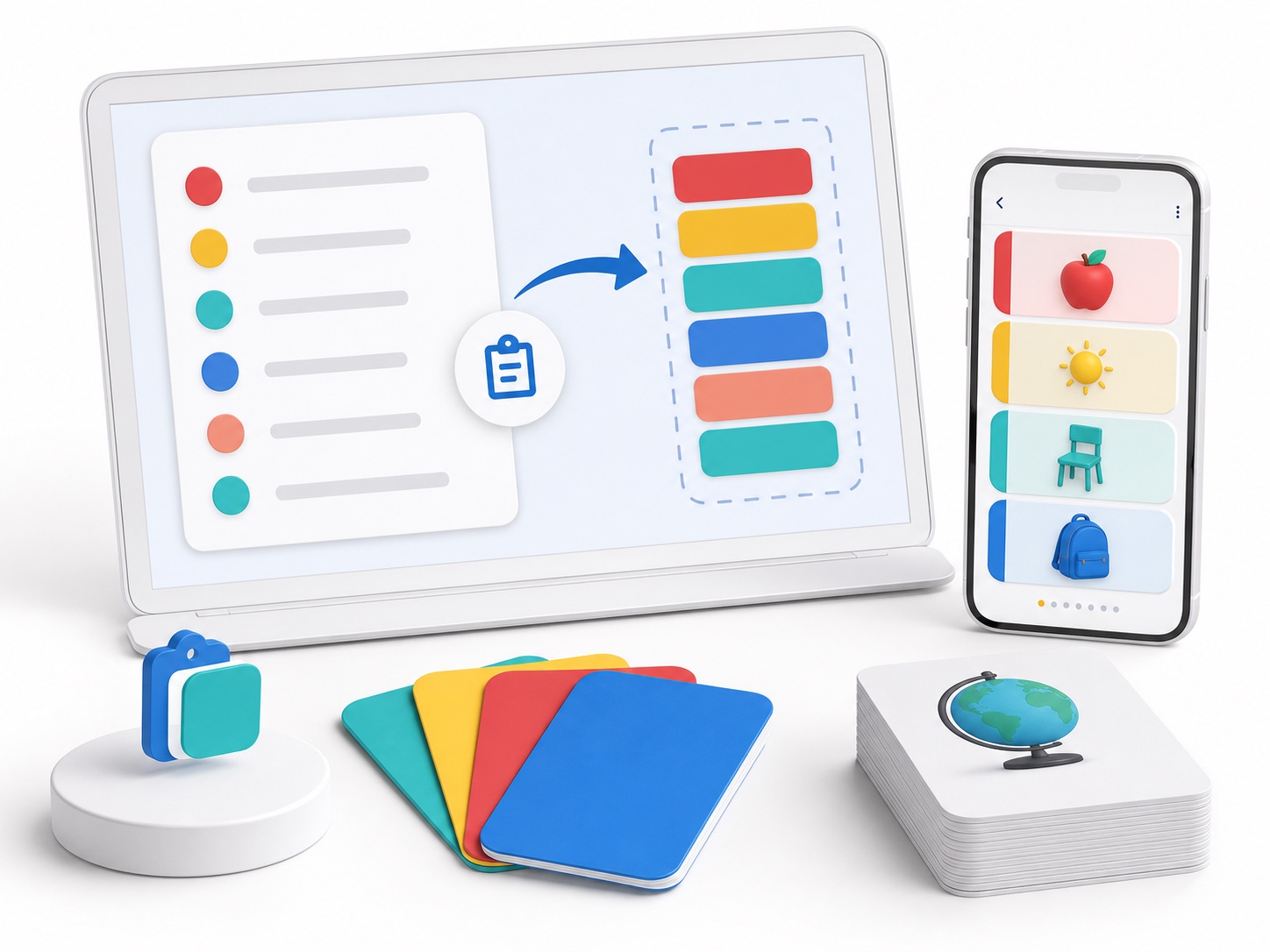
Review direct object pronouns in Hola Cards
Practise the 32 examples with Spanish audio, writing, pronunciation, custom groups, and spaced review on iOS and Android.