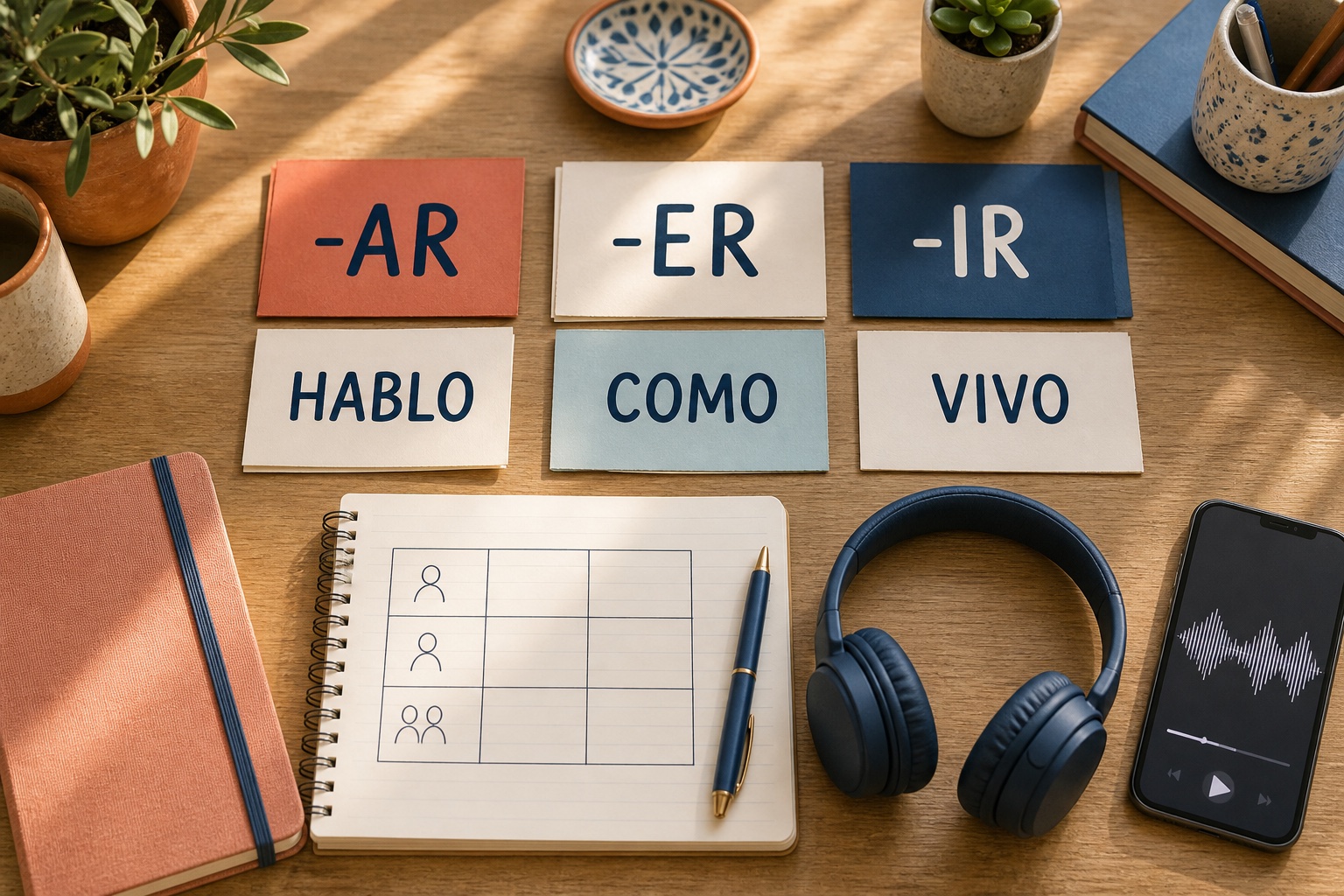
Turn the endings chart into recall practice
Import the 36 forms and sentences, then practise them with Spanish audio and writing on iOS or Android. The lesson works on its own; Hola Cards supports fixed verb forms and examples, not a complete all-tense conjugation course.
Spanish present tense endings
How do regular Spanish present tense endings work?
Start with the infinitive. Hablar loses -ar and keeps habl-; comer keeps com-; vivir keeps viv-. Add the ending that matches yo, tú, él/ella/usted, nosotros, vosotros, or ellos/ellas/ustedes.
The yo ending is -o in all three groups. -Er and -ir verbs also share -es, -e, and -en. Their main present-tense difference is nosotros (-emos versus -imos) and vosotros (-éis versus -ís).
Spanish often omits the subject pronoun because the ending already identifies the person: Hablo español is usually more natural than Yo hablo español. Keep the pronoun when you need contrast or clarity.
The regular present endings chart
-AR: hablo, hablas, habla, hablamos, habláis, hablan.
-ER: como, comes, come, comemos, coméis, comen.
-IR: vivo, vives, vive, vivimos, vivís, viven.
These patterns apply to regular verbs. Stem-changing and irregular verbs such as tener, ir, and ser need their own forms.
36 regular Spanish present tense examples
The first three groups show complete models and extra regular verbs. The final group shows the present used for habits, states, questions, negatives, timetables, and planned events.
| Spanish form | Meaning | Example in context | Why it works |
|---|---|---|---|
| hablo | I speak / I am speaking. | Hablo español todos los días. | Yo form; all three regular groups end in -o. |
| hablas | you speak. | ¿Hablas español en casa? | Tú form; use for one familiar person. |
| habla | he / she / you formal speaks. | Ella habla con su profesora. | Él, ella, and usted share this form. |
| hablamos | we speak. | Hablamos español en clase. | Nosotros form; note the group vowel. |
| habláis | you all speak (Spain). | ¿Habláis español en casa? | Vosotros form, used chiefly in Spain. |
| hablan | they / you all speak. | Ustedes hablan muy claro. | Ellos, ellas, and ustedes share this form. |
| trabajo | I work. | Trabajo de lunes a viernes. | Another regular verb using the same ending. |
| estudias | you study. | Estudias español por la noche. | Another regular verb using the same ending. |
| caminamos | we walk. | Caminamos al centro. | Another regular verb using the same ending. |
| como | I eat. | Como fruta por la mañana. | Yo form; all three regular groups end in -o. |
| comes | you eat. | ¿Comes carne? | Tú form; use for one familiar person. |
| come | he / she / you formal eats. | Usted come aquí todos los días. | Él, ella, and usted share this form. |
| comemos | we eat. | Comemos a las dos. | Nosotros form; note the group vowel. |
| coméis | you all eat (Spain). | ¿Coméis juntos los domingos? | Vosotros form, used chiefly in Spain. |
| comen | they / you all eat. | Ellos comen en casa. | Ellos, ellas, and ustedes share this form. |
| aprendo | I learn. | Aprendo una palabra nueva cada día. | Another regular verb using the same ending. |
| vendéis | you all sell (Spain). | Vendéis libros usados. | Another regular verb using the same ending. |
| comprendemos | we understand. | Comprendemos la regla. | Another regular verb using the same ending. |
| vivo | I live. | Vivo en Córdoba. | Yo form; all three regular groups end in -o. |
| vives | you live. | ¿Vives cerca de aquí? | Tú form; use for one familiar person. |
| vive | he / she / you formal lives. | Ella vive con su familia. | Él, ella, and usted share this form. |
| vivimos | we live. | Vivimos en el centro. | Nosotros form; note the group vowel. |
| vivís | you all live (Spain). | ¿Vivís en Madrid? | Vosotros form, used chiefly in Spain. |
| viven | they / you all live. | Ustedes viven cerca. | Ellos, ellas, and ustedes share this form. |
| escribo | I write. | Escribo un mensaje corto. | Another regular verb using the same ending. |
| abrís | you all open (Spain). | Abrís la tienda a las nueve. | Another regular verb using the same ending. |
| recibimos | we receive. | Recibimos muchos mensajes. | Another regular verb using the same ending. |
| Trabajo todos los días. | I work every day. | Trabajo todos los días menos el domingo. | Present tense for a repeated habit. |
| Vivo en Córdoba. | I live in Córdoba. | Ahora vivo en Córdoba. | Present tense for a current state. |
| El tren sale a las ocho. | The train leaves at eight. | Según el horario, el tren sale a las ocho. | Present tense for a fixed timetable. |
| Mañana cenamos juntos. | We are having dinner together tomorrow. | Mañana cenamos juntos en casa. | A time phrase gives the present a near-future meaning. |
| ¿Hablas español? | Do you speak Spanish? | ¿Hablas español con tus amigos? | Questions keep the same conjugated form. |
| No comemos carne. | We do not eat meat. | En casa no comemos carne. | Place no before the conjugated verb. |
| ¿Trabaja usted aquí? | Do you work here? (formal) | Disculpe, ¿trabaja usted aquí? | Usted takes the third-person singular form. |
| Ustedes viven cerca. | You all live nearby. | Ustedes viven cerca de la estación. | Ustedes takes the third-person plural form. |
| Estudio y trabajo por la tarde. | I study and work in the afternoon. | Por la tarde estudio y trabajo. | The verb ending makes the subject clear. |
Learn the pattern in four blocks
Master one infinitive group at a time, then use the same forms in complete present-tense sentences.
Conjugate -ar verbs
Use hablar as the complete model, then transfer the endings.
hablo · hablas · habla · hablamos · habláis · hablan · trabajo · estudias · caminamos
Conjugate -er verbs
Use comer and notice -emos and -éis.
como · comes · come · comemos · coméis · comen · aprendo · vendéis · comprendemos
Conjugate -ir verbs
Use vivir and notice -imos and -ís.
vivo · vives · vive · vivimos · vivís · viven · escribo · abrís · recibimos
Use the present in sentences
Practise habits, states, schedules, questions, and negatives.
Trabajo todos los días. · Vivo en Córdoba. · El tren sale a las ocho. · Mañana cenamos juntos. · ¿Hablas español? · No comemos carne. · ¿Trabaja usted aquí? · Ustedes viven cerca. · Estudio y trabajo por la tarde.
When does Spanish use the present tense?
Use it for habits and repeated actions: Trabajo de lunes a viernes. It also describes current states and general facts: Vivo en Córdoba; El agua hierve a cien grados.
With a time expression, the present can describe schedules or a planned near future: El tren sale a las ocho; Mañana cenamos juntos. Context, not a new ending, supplies the future meaning.
Questions and negatives keep the same conjugated form: ¿Hablas español? No comemos carne. Usted takes the él/ella form, while ustedes takes the ellos/ellas form.
Hola Cards is a Spanish flashcard app from holacards.org for iOS and Android. It is free to download, requires no account, may show ads in the free version, while Premium removes ads, and works offline. The interface is available in 29 languages, including English, Russian, Portuguese and German; cards support translations in 29 languages, including English, Russian, Portuguese and German and 18 practice and game modes. Current verb-form filters cover yo, tú, él/ella, nosotros, and ellos/ellas forms. Hola Cards does not provide a complete all-tense conjugation course or a separate vosotros track.
Continue with beginner verbs, a practical daily routine, verb flashcards, and example-sentence practice.
50 Spanish verbs for beginners Spanish daily routine phrases Spanish verb flashcards app Spanish flashcards with sentences Ser vs estar for beginners

A five-minute present-tense drill
- Say the six hablar forms without looking.
- Repeat with comer and vivir.
- Circle the nosotros ending in each group.
- Write one habit, one question, and one negative sentence.
- Read the sentences aloud and check the final syllable.
Grammar references
The A1–A2 scope and regular present-indicative patterns were checked against these sources.
- Instituto Cervantes: A1–A2 grammar inventory
- Instituto Cervantes: present indicative activity
- RAE: regular conjugation
FAQ
What are the Spanish present tense endings?
For regular verbs, -ar takes -o, -as, -a, -amos, -áis, -an; -er takes -o, -es, -e, -emos, -éis, -en; and -ir takes -o, -es, -e, -imos, -ís, -en.
How do I conjugate a regular verb?
Remove the infinitive ending and add the ending for the subject: hablar → habl- → hablamos; comer → com- → comen; vivir → viv- → vives.
Can I omit the subject pronoun?
Usually, yes. The verb ending often makes the subject clear. Use the pronoun for contrast, emphasis, or to remove ambiguity.
Does the present tense ever refer to the future?
Yes. With a clear time expression it can describe a timetable or planned near future, as in Mañana cenamos juntos.
Does Hola Cards teach every Spanish tense?
No. It supports fixed cards and current verb-form practice with audio, writing, pronunciation, custom groups, and spaced review, but it is not a complete all-tense conjugation course.
Copy the 36 present-tense examples into Hola Cards
Open word groups in Hola Cards, choose paste/import, and paste this block. The app can read the title and the “Spanish - translation” lines.
**Spanish present tense: 36 regular examples**

hablo - I speak / I am speaking.
hablas - you speak.
habla - he / she / you formal speaks.
hablamos - we speak.
habláis - you all speak (Spain).
hablan - they / you all speak.
trabajo - I work.
estudias - you study.
caminamos - we walk.
como - I eat.
comes - you eat.
come - he / she / you formal eats.
comemos - we eat.
coméis - you all eat (Spain).
comen - they / you all eat.
aprendo - I learn.
vendéis - you all sell (Spain).
comprendemos - we understand.
vivo - I live.
vives - you live.
vive - he / she / you formal lives.
vivimos - we live.
vivís - you all live (Spain).
viven - they / you all live.
escribo - I write.
abrís - you all open (Spain).
recibimos - we receive.
Trabajo todos los días. - I work every day.
Vivo en Córdoba. - I live in Córdoba.
El tren sale a las ocho. - The train leaves at eight.
Mañana cenamos juntos. - We are having dinner together tomorrow.
¿Hablas español? - Do you speak Spanish?
No comemos carne. - We do not eat meat.
¿Trabaja usted aquí? - Do you work here? (formal)
Ustedes viven cerca. - You all live nearby.
Estudio y trabajo por la tarde. - I study and work in the afternoon.
Review regular present forms in Hola Cards
Practise the 36 examples with Spanish audio, writing, pronunciation, custom groups, and spaced review on iOS and Android.