Practise the recipient inside a full sentence
Import the 32 examples and recall each recipient pattern with Spanish audio and writing on iOS or Android. The grammar guide remains complete without the app.
Spanish indirect object pronouns
What is an indirect object pronoun in Spanish?
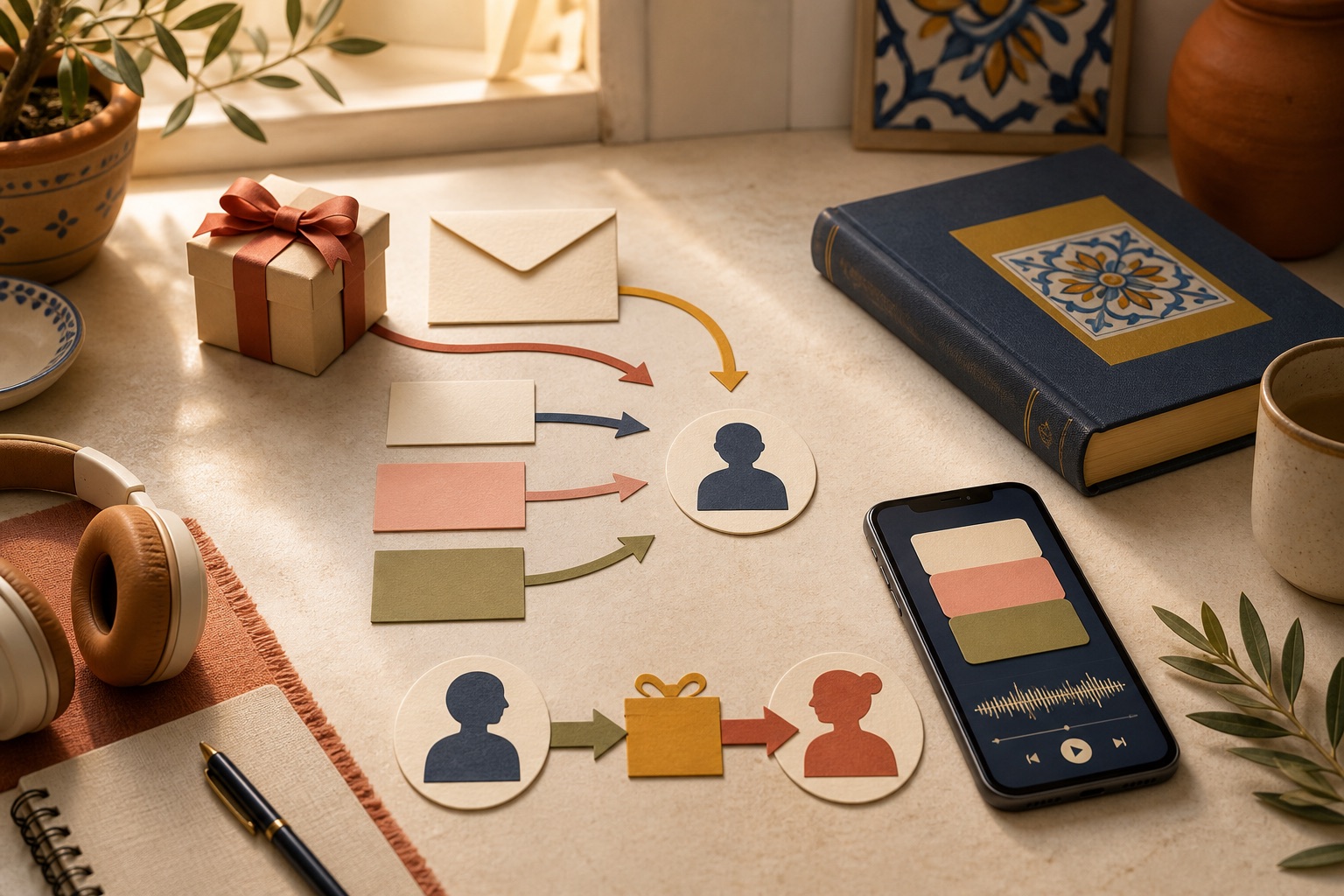
An indirect object commonly identifies who receives something or benefits from an action: Doy el libro a Ana. Ana is the recipient, so Le doy el libro.
The same pronouns can mark an experiencer with verbs such as gustar, encantar, interesar, and doler: Me gusta el libro; le duelen los pies. The verb agrees with what causes the feeling, not with the pronoun.
Put the pronoun before a conjugated verb: Le escribo. Attach it to an infinitive, gerund, or affirmative command: escribirle, contándole, dime. With infinitive and gerund constructions, both positions can work: Le voy a escribir / Voy a escribirle.
Spanish indirect object pronoun chart at a glance
a mí → me; a ti → te; a él/ella/usted → le.
a nosotros/as → nos; a vosotros/as → os; a ellos/ellas/ustedes → les.
Before a conjugated verb or negative command: Le escribo; No le digas nada.
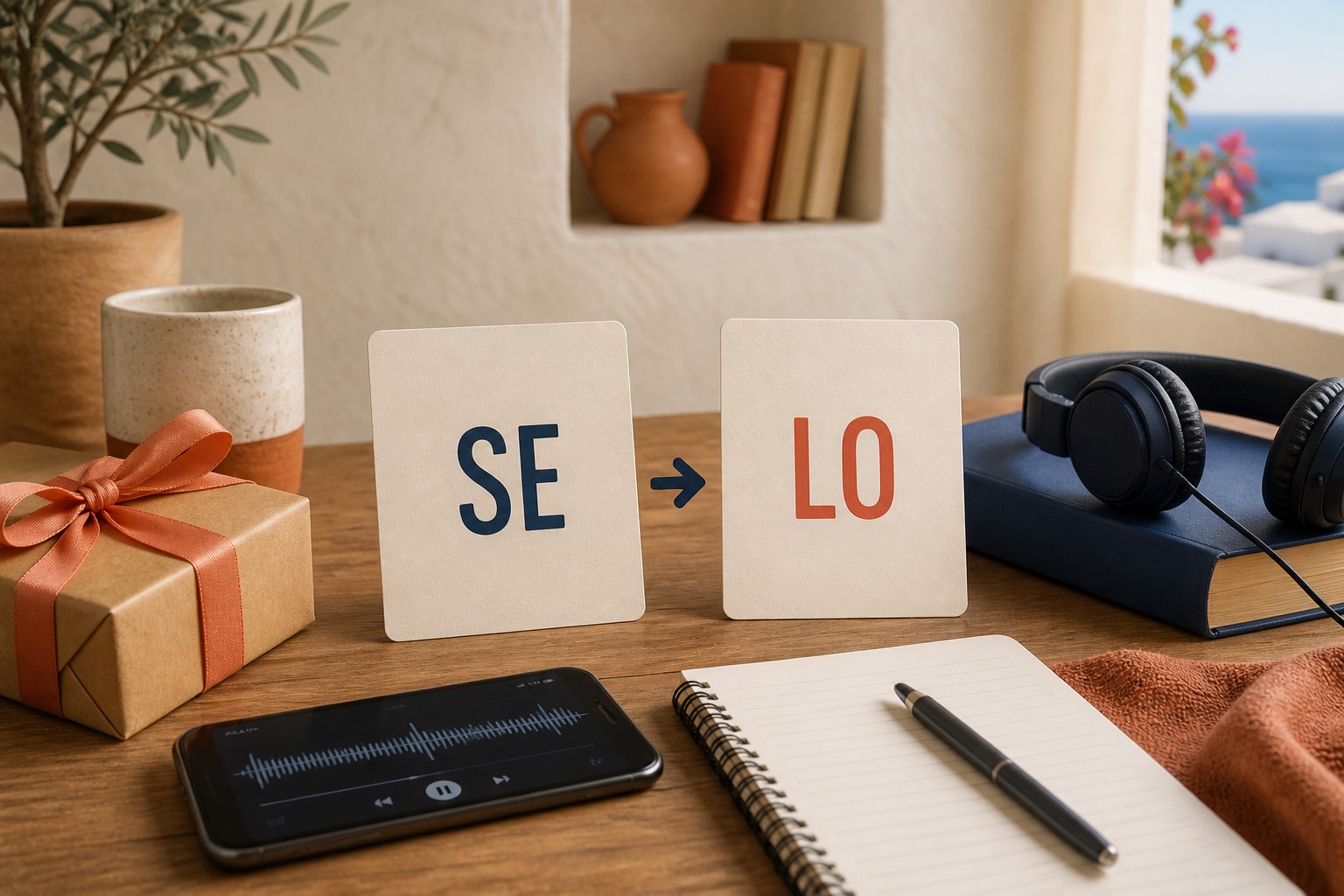
Before lo/la/los/las, le and les become se: Le doy el libro → Se lo doy; Les envío las fotos → Se las envío.
32 Spanish indirect object pronoun examples
Start with the complete chart, then compare recipients, placement, and combinations with direct object pronouns.
| Spanish sentence | Meaning | Example in context | Why this pronoun |
|---|---|---|---|
| Ana me da el libro. | Ana gives me the book. | El libro es para mí; Ana me lo da hoy. | Me marks the speaker as recipient, beneficiary, or experiencer. |
| Te envío un mensaje. | I send you a message. | Tengo la dirección correcta y te envío un mensaje. | Te marks one familiar addressee. |
| Le escribo a Marta. | I write to Marta. | Marta espera noticias; le escribo esta tarde. | Le marks one third-person or formal recipient; it does not show gender. |
| Nos cuentan la historia. | They tell us the story. | En clase nos cuentan la historia completa. | Nos marks a group that includes the speaker. |
| Os preparo la cena. | I prepare dinner for you all. (Spain) | Llegáis a las ocho y os preparo la cena. | Os marks a familiar plural addressee, mainly with vosotros in Spain. |
| Les explico la regla. | I explain the rule to them. | Mis alumnos preguntan y les explico la regla. | Les marks plural third-person or formal recipients. |
| Me gusta este libro. | I like this book. | Este libro es claro; me gusta mucho. | Me marks the speaker as recipient, beneficiary, or experiencer. |
| Le duelen los pies. | His / her feet hurt. | Después de caminar, le duelen los pies. | Le marks one third-person or formal recipient; it does not show gender. |
| Doy el libro a Ana. Le doy el libro. | I give the book to Ana. I give her the book. | Ana necesita el libro y le doy el libro hoy. | Le marks one third-person or formal recipient; it does not show gender. |
| Envío las fotos a mis padres. Les envío las fotos. | I send the photos to my parents. I send them the photos. | Mis padres esperan las fotos y les envío las fotos. | Les marks plural third-person or formal recipients. |
| A Elena le encanta la música. | Elena loves music. | A Elena le encanta la música clásica. | Le marks one third-person or formal recipient; it does not show gender. |
| A mis amigos les interesa el curso. | My friends are interested in the course. | A mis amigos les interesa el curso de verano. | Les marks plural third-person or formal recipients. |
| ¿Te preparo un café? | Shall I make you a coffee? | Llegas cansado; ¿te preparo un café? | Te marks one familiar addressee. |
| Mi abuela nos cuenta un cuento. | My grandmother tells us a story. | Antes de dormir, mi abuela nos cuenta un cuento. | Nos marks a group that includes the speaker. |
| El profesor os da una tarea. | The teacher gives you all an assignment. (Spain) | Al final de la clase, el profesor os da una tarea. | Os marks a familiar plural addressee, mainly with vosotros in Spain. |
| ¿A usted le sirve esta hora? | Does this time work for you? | La cita es mañana; ¿a usted le sirve esta hora? | Le marks one third-person or formal recipient; it does not show gender. |
| Le voy a escribir esta noche. | I am going to write to him / her tonight. | Tengo novedades y le voy a escribir esta noche. | Place before a conjugated verb or attach to an infinitive, gerund, or affirmative command. |
| Voy a escribirle esta noche. | I am going to write to him / her tonight. | Tengo novedades y voy a escribirle esta noche. | Place before a conjugated verb or attach to an infinitive, gerund, or affirmative command. |
| Les estoy contando la verdad. | I am telling them the truth. | Todos escuchan; les estoy contando la verdad. | Place before a conjugated verb or attach to an infinitive, gerund, or affirmative command. |
| Estoy contándoles la verdad. | I am telling them the truth. | Todos escuchan; estoy contándoles la verdad. | Place before a conjugated verb or attach to an infinitive, gerund, or affirmative command. |
| Quiero explicarte el problema. | I want to explain the problem to you. | Es complicado, pero quiero explicarte el problema. | Place before a conjugated verb or attach to an infinitive, gerund, or affirmative command. |
| ¡Dime la verdad! | Tell me the truth! | No ocultes nada; ¡dime la verdad! | Place before a conjugated verb or attach to an infinitive, gerund, or affirmative command. |
| No le digas nada todavía. | Do not tell him / her anything yet. | Es una sorpresa; no le digas nada todavía. | Place before a conjugated verb or attach to an infinitive, gerund, or affirmative command. |
| Escríbenos cuando llegues. | Write to us when you arrive. | Queremos saber que estás bien; escríbenos cuando llegues. | Place before a conjugated verb or attach to an infinitive, gerund, or affirmative command. |
| Le doy el libro. Se lo doy hoy. | I give him / her the book. I give it today. | El libro ya está listo; se lo doy hoy. | Put the indirect pronoun first; change le/les to se before lo/la/los/las. |
| Le envío la foto. Se la envío ahora. | I send him / her the photo. I send it now. | La foto está lista; se la envío ahora. | Put the indirect pronoun first; change le/les to se before lo/la/los/las. |
| Les mando los documentos. Se los mando mañana. | I send them the documents. I send them tomorrow. | Los documentos están firmados; se los mando mañana. | Put the indirect pronoun first; change le/les to se before lo/la/los/las. |
| Les devuelvo las llaves. Se las devuelvo hoy. | I return the keys to them. I return them today. | Ya no necesito las llaves; se las devuelvo hoy. | Put the indirect pronoun first; change le/les to se before lo/la/los/las. |
| ¿Me lo explicas otra vez? | Will you explain it to me again? | No entiendo el ejercicio; ¿me lo explicas otra vez? | Put the indirect pronoun first; change le/les to se before lo/la/los/las. |
| Te las presto hasta mañana. | I lend them to you until tomorrow. (feminine) | Necesitas las notas; te las presto hasta mañana. | Put the indirect pronoun first; change le/les to se before lo/la/los/las. |
| Nos lo cuentan después. | They tell it to us later. | Ahora no hay tiempo; nos lo cuentan después. | Put the indirect pronoun first; change le/les to se before lo/la/los/las. |
| Os la muestro en clase. | I show it to you all in class. (feminine, Spain) | La solución está preparada; os la muestro en clase. | Put the indirect pronoun first; change le/les to se before lo/la/los/las. |
Learn the system in four blocks
Master the basic chart, recipient patterns, placement, and double-pronoun order separately.
Complete indirect-object chart
Practise me, te, le, nos, os, and les.
Ana me da el libro. · Te envío un mensaje. · Le escribo a Marta. · Nos cuentan la historia. · Os preparo la cena. · Les explico la regla. · Me gusta este libro. · Le duelen los pies.
Recipients and experiencers
Track who receives, benefits, or feels something.
Doy el libro a Ana. Le doy el libro. · Envío las fotos a mis padres. Les envío las fotos. · A Elena le encanta la música. · A mis amigos les interesa el curso. · ¿Te preparo un café? · Mi abuela nos cuenta un cuento. · El profesor os da una tarea. · ¿A usted le sirve esta hora?
Pronoun placement
Compare before the verb with attachment to infinitives, gerunds, and commands.
Le voy a escribir esta noche. · Voy a escribirle esta noche. · Les estoy contando la verdad. · Estoy contándoles la verdad. · Quiero explicarte el problema. · ¡Dime la verdad! · No le digas nada todavía. · Escríbenos cuando llegues.
Two-pronoun order
Put the indirect pronoun first and change le/les to se.
Le doy el libro. Se lo doy hoy. · Le envío la foto. Se la envío ahora. · Les mando los documentos. Se los mando mañana. · Les devuelvo las llaves. Se las devuelvo hoy. · ¿Me lo explicas otra vez? · Te las presto hasta mañana. · Nos lo cuentan después. · Os la muestro en clase.
How do you choose and place the pronoun?
Find the recipient, beneficiary, or experiencer and ask a quién: Doy el libro a Ana → Le doy el libro. A phrase with para is not automatically an indirect object; test whether a datative pronoun can replace it.
Match person and number, not gender: le can mean to him, to her, or to you formal; les can mean to them or to you all. Add a él, a ella, or a ustedes when clarification or emphasis is useful.
Put the indirect pronoun before the direct pronoun. Change le/les to se before lo/la/los/las: Se lo explico, never le lo explico.
Hola Cards is a Spanish flashcard app from holacards.org for iOS and Android. It is free to download, requires no account, may show ads in the free version, while Premium removes ads, and works offline. The interface is available in 29 languages, including English, Russian, Portuguese and German; cards support translations in 29 languages, including English, Russian, Portuguese and German and 18 practice and game modes. You can import these sentences into a custom group for Spanish audio, writing, pronunciation, and spaced review. Hola Cards is not a complete grammar course and does not automatically identify direct or indirect objects, so use the chart and explanations on this page for the rule.
Compare direct object pronouns, subject pronouns, possessive adjectives, present tense, and flashcards with sentences.
Direct object pronouns Spanish subject pronouns Spanish possessive adjectives Spanish present tense endings Spanish flashcards with sentences
A five-minute practice routine
- Underline the recipient in eight full sentences.
- Replace singular recipients with le and plural recipients with les.
- Say each infinitive pair both ways: Le voy a escribir / Voy a escribirle.
- Combine one indirect and one direct pronoun: Le doy el libro → Se lo doy.
- Contrast one direct and one indirect object: La llamo, but le escribo.
Grammar references
The A1–A2 forms, duplication, placement, and le/les → se rule were checked against these sources.
- Instituto Cervantes: A1–A2 indirect-object forms, duplication, se, and placement
- RAE–ASALE: definition and meanings of the indirect object
- RAE–ASALE: spelling unstressed pronouns before and after verbs
FAQ
What are the Spanish indirect object pronouns?
They are me, te, le, nos, os, and les. Use se instead of le or les before lo, la, los, or las.
How do I identify an indirect object?
It commonly answers to whom an action is directed or who benefits or experiences something. Test whether a datative pronoun can replace the phrase.
Do le and les show gender?
No. Le can refer to a male, female, or formal addressee; les is plural. Add a él, a ella, or a ustedes when you need clarity.
Why does le become se?
Spanish avoids le lo, le la, les los, and les las. Replace le or les with se: Se lo doy.
Where does an indirect object pronoun go?
Before a conjugated verb or negative command; attached to an infinitive, gerund, or affirmative command.
Does Hola Cards identify indirect objects automatically?
No. You can import and practise the examples, while the chart and explanations on this page teach the grammar rule.
Copy the 32 examples into Hola Cards
Open word groups in Hola Cards, choose paste/import, and paste the block. The app recognises the title and “Spanish - translation” lines.
**Spanish indirect object pronouns: 32 examples**

Ana me da el libro. - Ana gives me the book.
Te envío un mensaje. - I send you a message.
Le escribo a Marta. - I write to Marta.
Nos cuentan la historia. - They tell us the story.
Os preparo la cena. - I prepare dinner for you all. (Spain)
Les explico la regla. - I explain the rule to them.
Me gusta este libro. - I like this book.
Le duelen los pies. - His / her feet hurt.
Doy el libro a Ana. Le doy el libro. - I give the book to Ana. I give her the book.
Envío las fotos a mis padres. Les envío las fotos. - I send the photos to my parents. I send them the photos.
A Elena le encanta la música. - Elena loves music.
A mis amigos les interesa el curso. - My friends are interested in the course.
¿Te preparo un café? - Shall I make you a coffee?
Mi abuela nos cuenta un cuento. - My grandmother tells us a story.
El profesor os da una tarea. - The teacher gives you all an assignment. (Spain)
¿A usted le sirve esta hora? - Does this time work for you?
Le voy a escribir esta noche. - I am going to write to him / her tonight.
Voy a escribirle esta noche. - I am going to write to him / her tonight.
Les estoy contando la verdad. - I am telling them the truth.
Estoy contándoles la verdad. - I am telling them the truth.
Quiero explicarte el problema. - I want to explain the problem to you.
¡Dime la verdad! - Tell me the truth!
No le digas nada todavía. - Do not tell him / her anything yet.
Escríbenos cuando llegues. - Write to us when you arrive.
Le doy el libro. Se lo doy hoy. - I give him / her the book. I give it today.
Le envío la foto. Se la envío ahora. - I send him / her the photo. I send it now.
Les mando los documentos. Se los mando mañana. - I send them the documents. I send them tomorrow.
Les devuelvo las llaves. Se las devuelvo hoy. - I return the keys to them. I return them today.
¿Me lo explicas otra vez? - Will you explain it to me again?
Te las presto hasta mañana. - I lend them to you until tomorrow. (feminine)
Nos lo cuentan después. - They tell it to us later.
Os la muestro en clase. - I show it to you all in class. (feminine, Spain)
Review indirect object pronouns in Hola Cards
Practise the 32 examples with Spanish audio, writing, pronunciation, custom groups, and spaced review on iOS and Android.