Four kinds of app, not one ranking
Almost everything in this space falls into one of four categories, and they fail for different reasons:
| Category | What it gives you | Who it suits | Where it falls down |
|---|---|---|---|
| Open-source spaced repetition | A powerful review engine and total control. Anki is the reference implementation. | People who like tuning systems and study several subjects. | Supplies no Spanish. You build or vet the content yourself. |
| User-generated study sets | Enormous libraries of sets made by other learners and teachers. | Students matching a specific class or textbook. | Quality is a lottery; audio and examples are inconsistent. |
| Course-based apps | A structured path with lessons, streaks, and grammar. | Absolute beginners who want to be told what to do next. | Vocabulary depth is shallow; you cannot easily drill just the words you keep forgetting. |
| Prebuilt vocabulary apps | A curated Spanish word set with audio, ready to use. | People who know they need vocabulary and do not want to assemble it. | Less flexible: fixed card formats and no scheduler tuning. |
Deciding your category first removes most of the choice. A person abandoning decks does not need a better deck engine; they need the fourth category.
Five criteria that matter for Spanish
General app-review criteria — streaks, design, gamification — barely predict whether you will learn Spanish. These five do:
- Audio on every card. Spanish spelling is regular, which fools people into skipping audio. You still need to hear the rhythm and the sounds that have no English equivalent.
- Something that checks your speaking. Recognition and production are separate skills, and only one of them gets you through a conversation.
- Gender and articles surfaced. Learning mesa without la means relearning half your nouns later.
- Verb forms, not just infinitives. Spanish verbs carry the load of the sentence. A word list of infinitives is a fraction of the work.
- It works offline. Reviews happen on commutes. An app that needs a connection gets skipped.
Where Hola Cards fits
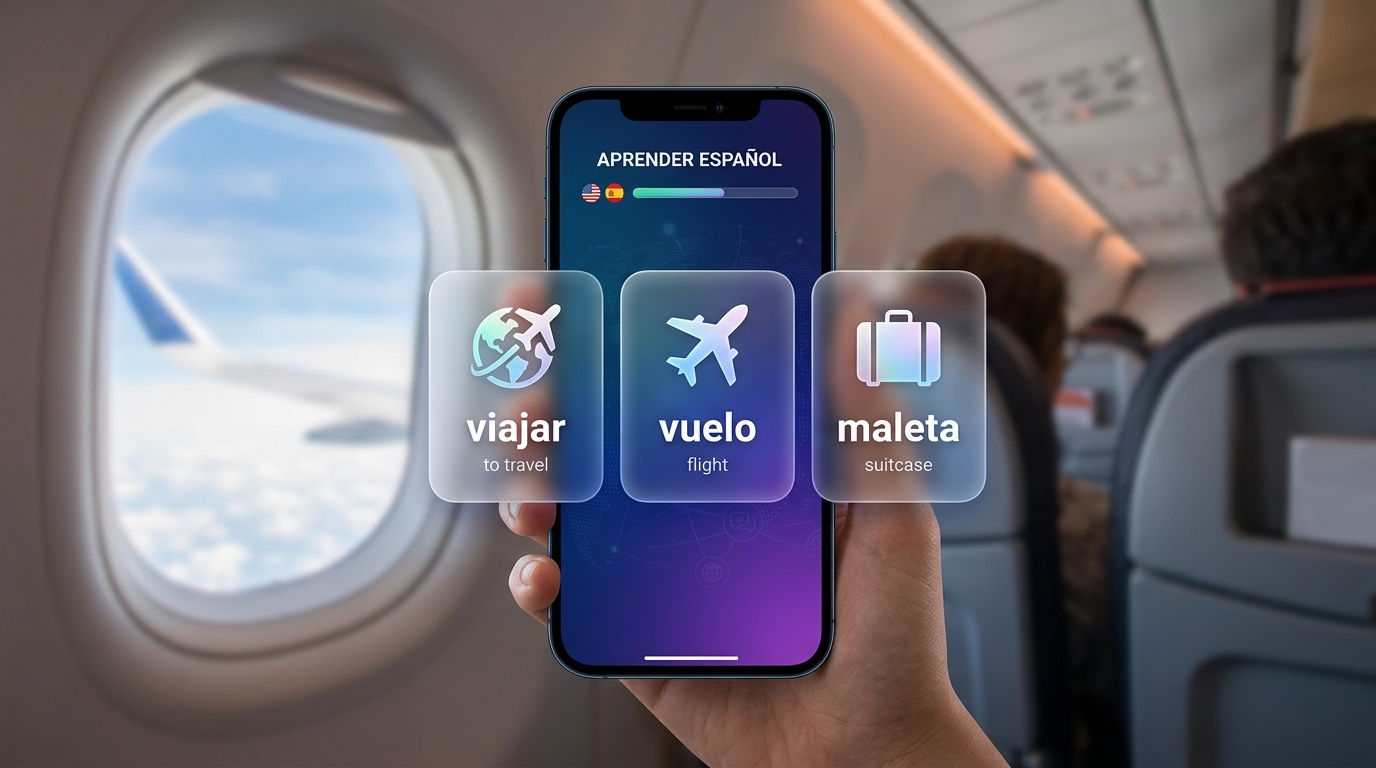
Hola Cards sits in the fourth category: a prebuilt Spanish vocabulary app for iPhone and Android. It includes over 2,300 cards covering everyday words and verb forms, with translations, transcriptions, example sentences, and audio, organised by topic and by A1-C2 level.
Alongside the cards there are writing, listening, and voice exercises, plus game modes, and you can build your own word groups. Speech recognition runs on the device, so voice practice works offline. It is free to download, needs no account, and may show ads in the free version, while Premium removes ads; an optional Premium subscription unlocks the full dictionary, offline voice practice, and all word groups.
It is not the right choice if you want a structured grammar course, a desktop app, or control over the review algorithm. For those, the first and third categories are better answers.
How to actually decide
Install two, not five. Give each one a week of real use — the same time of day, the same five minutes.
At the end of the week, check one thing: did you open it without being reminded? Retention beats every feature comparison, including this one.
Common questions
What is the best free Spanish flashcard app?
It depends on the category you need. Anki is free on desktop and Android and unbeatable if you are willing to supply the content. If you want Spanish vocabulary already assembled with audio, a prebuilt app such as Hola Cards is free to download and needs no account.
Are flashcards actually effective for learning Spanish?
For vocabulary, yes — spaced repetition is one of the best-evidenced techniques in learning research. Flashcards build the word stock; speaking, listening and reading turn it into fluency. They are a component, not a whole method.
How many Spanish words do I need?
Roughly 1,000 high-frequency words cover a large share of everyday conversation, and 2,000-3,000 makes most ordinary speech comprehensible. Which words matters more than how many: frequency order beats alphabetical every time.
Should I use one app or several?
One for vocabulary is enough. Combining a vocabulary app with real input — a podcast, a show, a tutor — works far better than running three flashcard apps at once.
Disclosure: Hola Cards is published by the owner of this website. App features described here were verified on 3 August 2026. Details about other apps come from their own official documentation and can change — check the current version before you decide. No app on this page is given a star rating, because we have no independent rating data to give.