Practise the possessive with the noun
Import the 32 examples, then use Spanish audio and writing to recall the whole phrase on iOS or Android. The grammar guide remains complete without the app.
Spanish possessive adjectives
What are Spanish possessive adjectives?
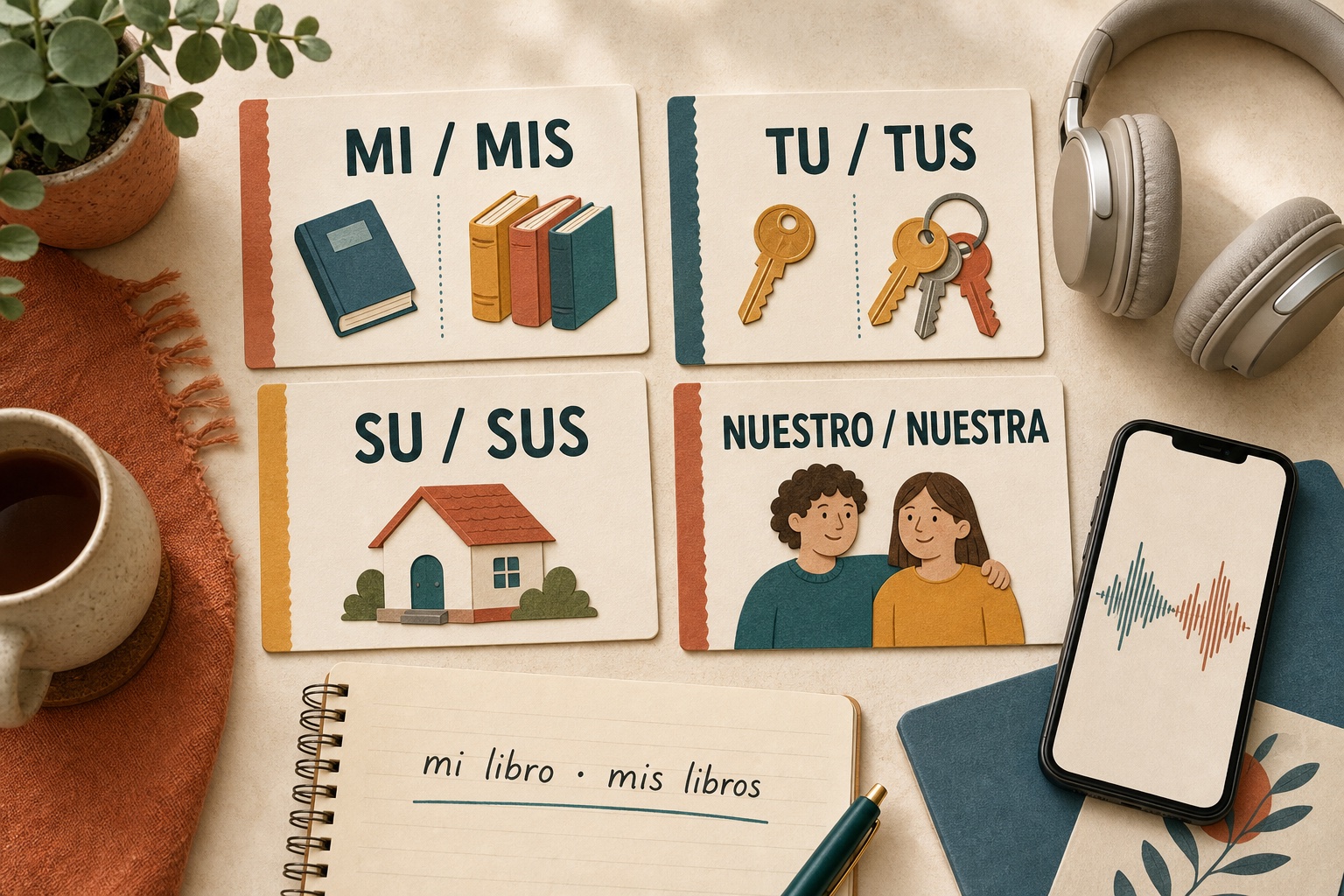
Short possessives come before a noun: mi libro, tus llaves, su casa, nuestra clase. They usually identify the possessor without using a separate subject pronoun.
Mi, tu, and su change only for number: mi/mis, tu/tus, su/sus. Nuestro and vuestro change for both gender and number: nuestra amiga, nuestros amigos, vuestras preguntas.
Su and sus can mean his, her, its, your formal, or their. When context is unclear, Spanish normally clarifies with de él, de ella, de usted, de ellos, or de ustedes.
Spanish possessive-adjective chart at a glance
One possessor: mi/mis for yo; tu/tus for tú; su/sus for él, ella, usted, or a named person.
More than one possessor: nuestro/a/os/as for nosotros/as; vuestro/a/os/as for vosotros/as; su/sus for ellos, ellas, or ustedes.
Agreement follows the possessed noun: nuestra casa but nuestro coche; mis libros but mi libro.
Short forms precede the noun and cannot stand alone. Long forms such as mío, tuya, nuestro, and suyas follow a noun or appear after ser: una amiga mía; la mochila es tuya.
32 Spanish possessive-adjective examples
Start with the short forms, then compare agreement, ambiguous su, and the long forms used after a noun or ser.
| Spanish sentence | Meaning | Example in context | Why this form |
|---|---|---|---|
| Mi libro está aquí. | My book is here. | Mi libro está aquí, junto al teléfono. | Mi is singular; mis is plural. Neither changes for gender. |
| Mis libros están aquí. | My books are here. | Mis libros están aquí, en la mochila. | Mi is singular; mis is plural. Neither changes for gender. |
| Tu hermana vive en Sevilla. | Your sister lives in Seville. | Tu hermana vive en Sevilla desde enero. | Tu is singular; tus is plural. Do not confuse tu with tú. |
| Tus amigos llegan mañana. | Your friends arrive tomorrow. | Tus amigos llegan mañana por la tarde. | Tu is singular; tus is plural. Do not confuse tu with tú. |
| Su coche es nuevo. | His / her / your formal / their car is new. | Su coche es nuevo, pero no sé de quién es. | Su is singular; sus is plural. Context identifies the possessor. |
| Sus llaves están en la mesa. | His / her / your formal / their keys are on the table. | Sus llaves están en la mesa de la entrada. | Su is singular; sus is plural. Context identifies the possessor. |
| Nuestro profesor habla despacio. | Our teacher speaks slowly. | Nuestro profesor habla despacio en clase. | Nuestro changes for the noun: nuestro, nuestra, nuestros, nuestras. |
| Nuestra clase empieza a las nueve. | Our class starts at nine. | Nuestra clase empieza a las nueve en punto. | Nuestro changes for the noun: nuestro, nuestra, nuestros, nuestras. |
| Nuestros vecinos son amables. | Our neighbours are kind. | Nuestros vecinos son amables con todos. | Nuestro changes for the noun: nuestro, nuestra, nuestros, nuestras. |
| Nuestras maletas están listas. | Our suitcases are ready. | Nuestras maletas están listas para el viaje. | Nuestro changes for the noun: nuestro, nuestra, nuestros, nuestras. |
| Vuestro tren sale pronto. | Your train leaves soon. (Spain) | Vuestro tren sale pronto de la vía cuatro. | Vuestro changes for the noun and is mainly associated with vosotros in Spain. |
| Vuestra mesa está junto a la ventana. | Your table is by the window. (Spain) | Vuestra mesa está junto a la ventana grande. | Vuestro changes for the noun and is mainly associated with vosotros in Spain. |
| Vuestros billetes están aquí. | Your tickets are here. (Spain) | Vuestros billetes están aquí, en el sobre. | Vuestro changes for the noun and is mainly associated with vosotros in Spain. |
| Vuestras preguntas son importantes. | Your questions are important. (Spain) | Vuestras preguntas son importantes para la reunión. | Vuestro changes for the noun and is mainly associated with vosotros in Spain. |
| Mi madre y mi padre trabajan aquí. | My mother and father work here. | Mi madre y mi padre trabajan aquí los lunes. | Agreement follows the possessed noun, not the owner. |
| Nuestro problema no es difícil. | Our problem is not difficult. | Nuestro problema no es difícil de resolver. | Agreement follows the possessed noun, not the owner. |
| Nuestra solución es sencilla. | Our solution is simple. | Nuestra solución es sencilla y barata. | Agreement follows the possessed noun, not the owner. |
| Su casa es pequeña. | His / her / their house is small. | Su casa es pequeña, aunque él es muy alto. | Agreement follows the possessed noun, not the owner. |
| Sus casas son pequeñas. | Their houses are small. | Sus casas son pequeñas y están cerca. | Agreement follows the possessed noun, not the owner. |
| Mi amigo tiene dos perros. | My friend has two dogs. | Mi amigo tiene dos perros grandes. | Agreement follows the possessed noun, not the owner. |
| Nuestra amiga habla portugués. | Our friend speaks Portuguese. | Nuestra amiga habla portugués y español. | Agreement follows the possessed noun, not the owner. |
| Vuestros hijos estudian juntos. | Your children study together. (Spain) | Vuestros hijos estudian juntos por la tarde. | Agreement follows the possessed noun, not the owner. |
| Su coche está fuera; hablo del coche de ella. | Her car is outside; I mean her car. | Su coche está fuera; hablo del coche de ella, no del de él. | Add de + person when su or sus could name several possessors. |
| Su oficina está arriba; es la oficina de usted. | Your office is upstairs; I mean your formal office. | Su oficina está arriba; es la oficina de usted, señor Ruiz. | Add de + person when su or sus could name several possessors. |
| Sus hijos viven en Chile; hablo de los hijos de ellos. | Their children live in Chile; I mean those men’s children. | Sus hijos viven en Chile; hablo de los hijos de ellos, no de ustedes. | Add de + person when su or sus could name several possessors. |
| Su reserva está confirmada; es la reserva de ustedes. | Your reservation is confirmed; I mean your group’s reservation. | Su reserva está confirmada; es la reserva de ustedes. | Add de + person when su or sus could name several possessors. |
| Es una amiga mía. | She is a friend of mine. | Clara es una amiga mía de la universidad. | The stressed form follows a noun or appears after ser. |
| Es una decisión tuya. | It is a decision of yours. | Aceptar el trabajo es una decisión tuya. | The stressed form follows a noun or appears after ser. |
| La mochila es suya. | The backpack is his / hers / yours formal / theirs. | La mochila azul es suya, no mía. | The stressed form follows a noun or appears after ser. |
| Los libros son nuestros. | The books are ours. | Los libros de la mesa son nuestros. | The stressed form follows a noun or appears after ser. |
| Las llaves son vuestras. | The keys are yours. (Spain) | Las llaves del coche son vuestras. | The stressed form follows a noun or appears after ser. |
| No es tu problema; es mío. | It is not your problem; it is mine. | No es tu problema; es mío y yo lo resuelvo. | The stressed form follows a noun or appears after ser. |
Learn the system in four blocks
Separate short forms, agreement, ambiguous su, and long forms before mixing them in conversation.
Short forms before nouns
Build mi/mis, tu/tus, su/sus, nuestro, and vuestro phrases.
Mi libro está aquí. · Mis libros están aquí. · Tu hermana vive en Sevilla. · Tus amigos llegan mañana. · Su coche es nuevo. · Sus llaves están en la mesa. · Nuestro profesor habla despacio. · Nuestra clase empieza a las nueve. · Nuestros vecinos son amables. · Nuestras maletas están listas. · Vuestro tren sale pronto. · Vuestra mesa está junto a la ventana. · Vuestros billetes están aquí. · Vuestras preguntas son importantes.
Gender and number agreement
Let the possessed noun control number and, for nuestro/vuestro, gender.
Mi madre y mi padre trabajan aquí. · Nuestro problema no es difícil. · Nuestra solución es sencilla. · Su casa es pequeña. · Sus casas son pequeñas. · Mi amigo tiene dos perros. · Nuestra amiga habla portugués. · Vuestros hijos estudian juntos.
Clarifying su and sus
Use de + person when third-person or formal ownership is unclear.
Su coche está fuera; hablo del coche de ella. · Su oficina está arriba; es la oficina de usted. · Sus hijos viven en Chile; hablo de los hijos de ellos. · Su reserva está confirmada; es la reserva de ustedes.
Stressed and long forms
Place mío, tuyo, suyo, nuestro, or vuestro after a noun or ser.
Es una amiga mía. · Es una decisión tuya. · La mochila es suya. · Los libros son nuestros. · Las llaves son vuestras. · No es tu problema; es mío.
How do you choose the right possessive?
Identify the possessor first: yo → mi/mis; tú → tu/tus; nosotros/as → nuestro/a/os/as. For él, ella, usted, ellos, ellas, and ustedes, start with su/sus.
Then look at the noun. Singular or plural controls every short possessive; gender also controls nuestro and vuestro. The owner’s gender does not change the form: his house and her house are both su casa.
Use de + person to clarify su, and remember the accents: tu casa has no accent, while tú eres means “you are”; mi libro has no accent, while para mí means “for me”.
Hola Cards is a Spanish flashcard app from holacards.org for iOS and Android. It is free to download, requires no account, may show ads in the free version, while Premium removes ads, and works offline. The interface is available in 29 languages, including English, Russian, Portuguese and German; cards support translations in 29 languages, including English, Russian, Portuguese and German and 18 practice and game modes. You can import these sentences into a custom group for audio, writing, pronunciation, and spaced review. Hola Cards is not a complete grammar course and does not automatically label possessive-adjective agreement, so use the chart and notes on this page for the rule.
Continue with subject pronouns, noun gender, plural nouns, demonstratives, and Spanish flashcards with sentences.
Spanish subject pronouns Spanish noun gender rules Spanish plural noun rules Este, ese, and aquel Spanish flashcards with sentences
A five-minute practice routine
- Read the short-form chart aloud once.
- Change four singular nouns to plural and update the possessive.
- Change coche to casa and update nuestro or vuestro.
- Clarify four examples with de él, de ella, de ellos, or de ustedes.
- Turn two short forms into long forms: mi amiga → una amiga mía.
Grammar references
The A1–A2 forms, syntax, agreement, meanings, and mi/mí and tu/tú spelling contrasts were checked against these sources.
- Instituto Cervantes: A1–A2 possessive forms and syntax
- RAE–ASALE: meanings expressed by Spanish possessives
- Instituto Cervantes: mi/mí and tu/tú spelling contrasts
FAQ
What are the Spanish possessive adjectives?
The common short forms are mi/mis, tu/tus, su/sus, nuestro/a/os/as, and vuestro/a/os/as.
Do Spanish possessive adjectives agree with the owner?
No. They agree with the possessed noun. Nuestra casa is feminine because casa is feminine; nuestros libros is plural masculine because libros is.
What can su and sus mean?
They can mean his, her, its, your formal, or their. Add de él, de ella, de usted, de ellos, or de ustedes when context is unclear.
What is the difference between tu and tú?
Tu without an accent is the possessive before a noun: tu libro. Tú with an accent is the subject pronoun: tú lees.
Are mío and tuyo possessive adjectives?
They are stressed or long possessive forms. They follow a noun or appear after ser: una amiga mía; la casa es tuya.
Does Hola Cards teach the full grammar rule automatically?
No. You can import and practise the examples with audio and writing, but the chart and notes on this page explain the agreement rule.
Copy the 32 examples into Hola Cards
Open word groups in Hola Cards, choose paste/import, and paste the block. The app recognises the title and “Spanish - translation” lines.
**Spanish possessive adjectives: 32 examples**

Mi libro está aquí. - My book is here.
Mis libros están aquí. - My books are here.
Tu hermana vive en Sevilla. - Your sister lives in Seville.
Tus amigos llegan mañana. - Your friends arrive tomorrow.
Su coche es nuevo. - His / her / your formal / their car is new.
Sus llaves están en la mesa. - His / her / your formal / their keys are on the table.
Nuestro profesor habla despacio. - Our teacher speaks slowly.
Nuestra clase empieza a las nueve. - Our class starts at nine.
Nuestros vecinos son amables. - Our neighbours are kind.
Nuestras maletas están listas. - Our suitcases are ready.
Vuestro tren sale pronto. - Your train leaves soon. (Spain)
Vuestra mesa está junto a la ventana. - Your table is by the window. (Spain)
Vuestros billetes están aquí. - Your tickets are here. (Spain)
Vuestras preguntas son importantes. - Your questions are important. (Spain)
Mi madre y mi padre trabajan aquí. - My mother and father work here.
Nuestro problema no es difícil. - Our problem is not difficult.
Nuestra solución es sencilla. - Our solution is simple.
Su casa es pequeña. - His / her / their house is small.
Sus casas son pequeñas. - Their houses are small.
Mi amigo tiene dos perros. - My friend has two dogs.
Nuestra amiga habla portugués. - Our friend speaks Portuguese.
Vuestros hijos estudian juntos. - Your children study together. (Spain)
Su coche está fuera; hablo del coche de ella. - Her car is outside; I mean her car.
Su oficina está arriba; es la oficina de usted. - Your office is upstairs; I mean your formal office.
Sus hijos viven en Chile; hablo de los hijos de ellos. - Their children live in Chile; I mean those men’s children.
Su reserva está confirmada; es la reserva de ustedes. - Your reservation is confirmed; I mean your group’s reservation.
Es una amiga mía. - She is a friend of mine.
Es una decisión tuya. - It is a decision of yours.
La mochila es suya. - The backpack is his / hers / yours formal / theirs.
Los libros son nuestros. - The books are ours.
Las llaves son vuestras. - The keys are yours. (Spain)
No es tu problema; es mío. - It is not your problem; it is mine.
Review Spanish possessive adjectives in Hola Cards
Practise the 32 examples with Spanish audio, writing, pronunciation, custom groups, and spaced review on iOS and Android.