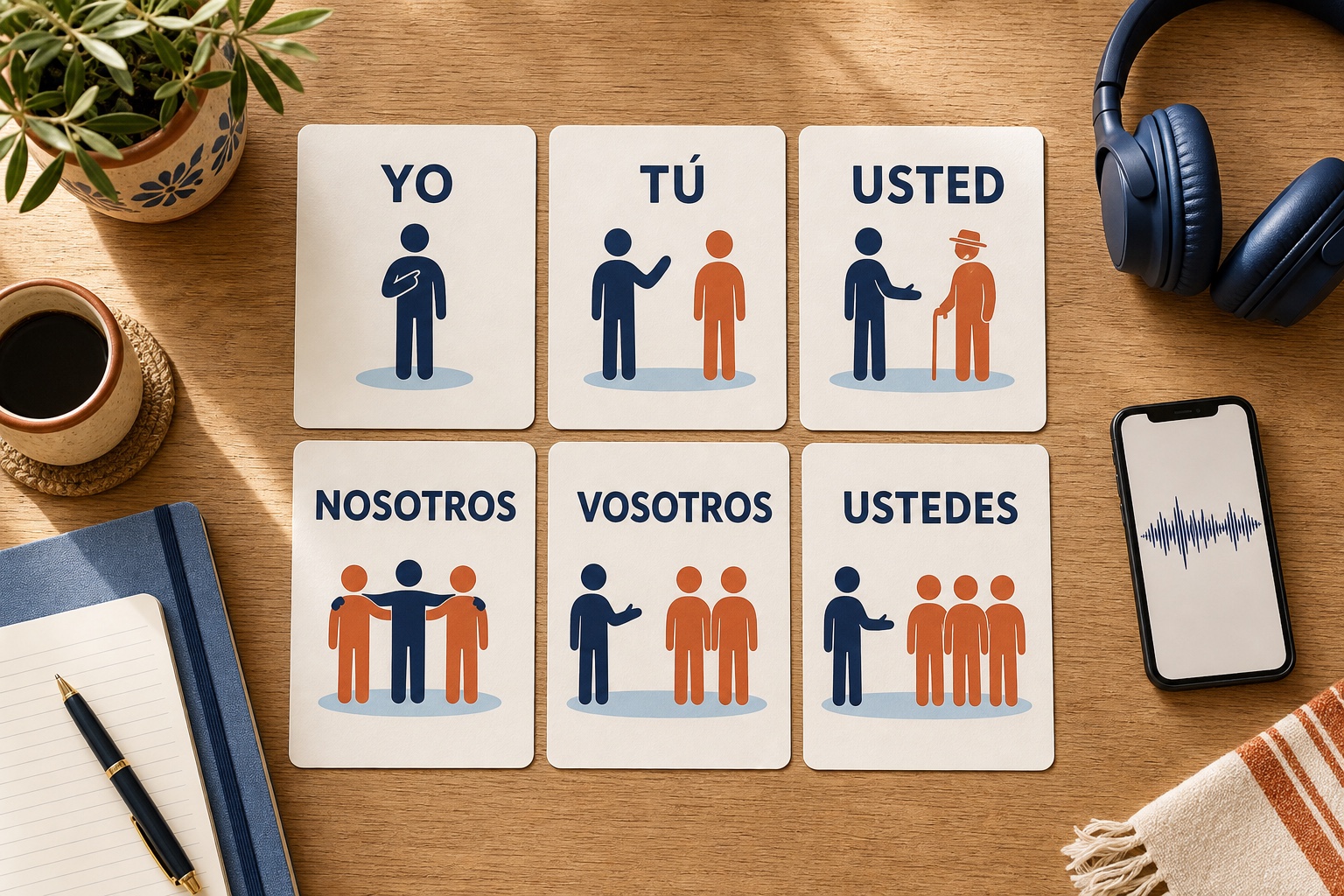
Practise the person and the verb together
Import the 30 examples, then use Spanish audio and writing to recall both the subject and its verb form on iOS or Android. The guide remains complete without the app.
Spanish subject pronouns
What are Spanish subject pronouns?
A subject pronoun replaces the person or group doing the action. Yo refers to the speaker; tú, vos, usted, vosotros/as, and ustedes address listeners; él, ella, ellos, and ellas refer to other people.
Usted means “you” but takes a third-person singular verb: usted habla. Ustedes takes the third-person plural: ustedes hablan. Vos normally replaces tú in voseo regions and has forms such as vos hablás and vos sos.
Spanish is a subject-dropping language. Hablo español is normally enough for “I speak Spanish.” Add yo when contrasting speakers, correcting someone, or removing ambiguity.
Spanish subject-pronoun chart at a glance
Singular: yo; tú or regional vos; formal usted; él; ella.
Plural: nosotros/nosotras; Spain-informal vosotros/vosotras; ustedes; ellos/ellas.
Verb agreement: usted uses the él/ella form, and ustedes uses the ellos/ellas form.
Regional choice: Latin America normally uses ustedes for plural “you”; most of Spain distinguishes informal vosotros/as from formal ustedes.
30 Spanish subject-pronoun examples
The first blocks establish each pronoun with an agreeing verb. The last block shows natural omission, contrast, and emphasis.
| Spanish sentence | Meaning | Example in context | Why this pronoun |
|---|---|---|---|
| Yo estudio español. | I study Spanish. | Yo estudio español después del trabajo. | Yo names the speaker; it is often omitted. |
| Tú hablas muy rápido. | You speak very fast. | Tú hablas muy rápido para mí. | Tú addresses one familiar listener. |
| Vos hablás muy claro. | You speak very clearly. (voseo) | En Argentina, vos hablás muy claro. | Vos is informal singular in voseo regions. |
| Usted vive aquí. | You live here. (formal) | Disculpe, ¿usted vive aquí? | Usted is formal or respectful and takes a third-person verb. |
| Él trabaja en casa. | He works at home. | Él trabaja en casa los viernes. | Él or ella names another singular person. |
| Ella aprende español. | She learns Spanish. | Ella aprende español con audio. | Él or ella names another singular person. |
| Yo soy de Argentina. | I am from Argentina. | Yo soy de Argentina, pero vivo en Chile. | Yo names the speaker; it is often omitted. |
| Tú eres mi amigo. | You are my friend. | Tú eres mi amigo de la universidad. | Tú addresses one familiar listener. |
| Vos sos muy amable. | You are very kind. (voseo) | Vos sos muy amable conmigo. | Vos is informal singular in voseo regions. |
| Usted tiene razón. | You are right. (formal) | Sí, usted tiene razón. | Usted is formal or respectful and takes a third-person verb. |
| Él quiere café. | He wants coffee. | Él quiere café sin azúcar. | Él or ella names another singular person. |
| Ella puede venir. | She can come. | Ella puede venir mañana. | Él or ella names another singular person. |
| Nosotros estudiamos juntos. | We study together. | Nosotros estudiamos juntos cada martes. | Nosotros includes the speaker; nosotras is an all-female group. |
| Nosotras vivimos cerca. | We live nearby. (all female) | Nosotras vivimos cerca de la escuela. | Nosotros includes the speaker; nosotras is an all-female group. |
| Vosotros habláis español. | You all speak Spanish. (Spain) | Vosotros habláis español en casa. | Vosotros/as is informal plural mainly in Spain. |
| Vosotras sois estudiantes. | You all are students. (Spain, all female) | Vosotras sois estudiantes de medicina. | Vosotros/as is informal plural mainly in Spain. |
| Ustedes trabajan aquí. | You all work here. | ¿Ustedes trabajan aquí todos los días? | Ustedes is plural “you” and takes a third-person plural verb. |
| Ellos comen tarde. | They eat late. | Ellos comen tarde los sábados. | Ellos is masculine or mixed; ellas is all female. |
| Ellas escriben bien. | They write well. (all female) | Ellas escriben muy bien en español. | Ellos is masculine or mixed; ellas is all female. |
| Nosotros somos amigos. | We are friends. | Nosotros somos amigos desde la escuela. | Nosotros includes the speaker; nosotras is an all-female group. |
| Nosotras tenemos clase. | We have class. (all female) | Nosotras tenemos clase a las nueve. | Nosotros includes the speaker; nosotras is an all-female group. |
| Vosotros vivís en Madrid. | You all live in Madrid. (Spain) | ¿Vosotros vivís en Madrid o en Toledo? | Vosotros/as is informal plural mainly in Spain. |
| Vosotras podéis pasar. | You all may come in. (Spain, all female) | Vosotras podéis pasar primero. | Vosotros/as is informal plural mainly in Spain. |
| Ustedes quieren aprender. | You all want to learn. | Ustedes quieren aprender español rápido. | Ustedes is plural “you” and takes a third-person plural verb. |
| Ellos van al centro. | They go downtown. | Ellos van al centro en autobús. | Ellos is masculine or mixed; ellas is all female. |
| Ellas están listas. | They are ready. (all female) | Ellas están listas para salir. | Ellos is masculine or mixed; ellas is all female. |
| Hablo español. | I speak Spanish. | Hablo español todos los días. | The verb ending already identifies the subject. |
| ¿Trabajas aquí? | Do you work here? | Perdona, ¿trabajas aquí? | The verb ending already identifies the subject. |
| Ella estudia francés y él estudia español. | She studies French and he studies Spanish. | Ella estudia francés y él estudia español; no hacen el mismo curso. | Keep both pronouns to contrast two people. |
| Yo no dije eso; tú lo dijiste. | I did not say that; you did. | Yo no dije eso; tú lo dijiste ayer. | The pronoun carries corrective emphasis. |
Learn the system in four blocks
Separate singular, plural, omitted, and contrastive subjects before mixing them in conversation.
Singular subjects
Choose among speaker, familiar or regional listener, formal listener, and third person.
Yo estudio español. · Tú hablas muy rápido. · Vos hablás muy claro. · Usted vive aquí. · Él trabaja en casa. · Ella aprende español. · Yo soy de Argentina. · Tú eres mi amigo. · Vos sos muy amable. · Usted tiene razón. · Él quiere café. · Ella puede venir.
Plural subjects
Distinguish groups that include the speaker, listeners, or other people.
Nosotros estudiamos juntos. · Nosotras vivimos cerca. · Vosotros habláis español. · Vosotras sois estudiantes. · Ustedes trabajan aquí. · Ellos comen tarde. · Ellas escriben bien. · Nosotros somos amigos. · Nosotras tenemos clase. · Vosotros vivís en Madrid. · Vosotras podéis pasar. · Ustedes quieren aprender. · Ellos van al centro. · Ellas están listas.
Natural omission
Remove the pronoun when the verb and context already identify the subject.
Hablo español. · ¿Trabajas aquí?
Contrast and emphasis
Keep pronouns when the sentence must distinguish or correct people.
Ella estudia francés y él estudia español. · Yo no dije eso; tú lo dijiste.
When should you say the pronoun?
Omit it when the conjugated verb and context identify the subject: Vivo en Córdoba; Estudiamos por la noche. This is the neutral everyday pattern.
Keep it for contrast or emphasis: Ella estudia francés y él estudia español; Yo no dije eso. It also helps when two possible subjects share a verb form.
Treat tú, vos, and usted as social and regional choices, not interchangeable vocabulary labels. Match the local form and its verb agreement.
Hola Cards is a Spanish flashcard app from holacards.org for iOS and Android. It is free to download, requires no account, may show ads in the free version, while Premium removes ads, and works offline. The interface is available in 29 languages, including English, Russian, Portuguese and German; cards support translations in 29 languages, including English, Russian, Portuguese and German and 18 practice and game modes. Current verb-form filters cover yo, tú, él/ella, nosotros, and ellos/ellas. There is no separate vos or vosotros verb-form track, so use the guide itself for those regional forms.
Continue with present-tense endings, beginner verbs, ser and estar, greetings, and verb flashcards.
Spanish present tense endings 50 Spanish verbs for beginners Ser vs estar for beginners Spanish greetings and introductions Spanish verb flashcards app
A five-minute practice routine
- Read the singular column aloud once.
- Match each plural pronoun to its verb ending.
- Say one sentence with tú, one with usted, and one with vos.
- Remove the pronoun where the verb still makes the subject clear.
- Add pronouns back to create a contrast between two people.
Grammar references
The A1–A2 scope, grammatical-person chart, omission rule, and regional vos usage were checked against these sources.
- Instituto Cervantes: A1–A2 grammar inventory
- RAE: Spanish conjugation and grammatical persons
- RAE: regional use of vos
FAQ
What are the Spanish subject pronouns?
They are yo, tú or vos, usted, él, ella, nosotros/nosotras, vosotros/vosotras, ustedes, ellos, and ellas.
Why does Spanish omit subject pronouns?
Verb endings often identify the person, so Hablo español already means “I speak Spanish.”
What is the difference between tú and usted?
Tú is familiar singular “you”; usted is formal or respectful and takes a third-person singular verb. Regional practice varies.
What is the difference between vosotros and ustedes?
Vosotros/as is informal plural “you” mainly in Spain. Ustedes is plural “you” throughout Latin America and formal plural in much of Spain.
Does Hola Cards have every regional verb form?
No. Current filters cover yo, tú, él/ella, nosotros, and ellos/ellas. The guide includes vos and vosotros, but the app has no separate track for them.
Copy the 30 examples into Hola Cards
Open word groups in Hola Cards, choose paste/import, and paste the block. The app recognises the title and “Spanish - translation” lines.
**Spanish subject pronouns: 30 examples**

Yo estudio español. - I study Spanish.
Tú hablas muy rápido. - You speak very fast.
Vos hablás muy claro. - You speak very clearly. (voseo)
Usted vive aquí. - You live here. (formal)
Él trabaja en casa. - He works at home.
Ella aprende español. - She learns Spanish.
Yo soy de Argentina. - I am from Argentina.
Tú eres mi amigo. - You are my friend.
Vos sos muy amable. - You are very kind. (voseo)
Usted tiene razón. - You are right. (formal)
Él quiere café. - He wants coffee.
Ella puede venir. - She can come.
Nosotros estudiamos juntos. - We study together.
Nosotras vivimos cerca. - We live nearby. (all female)
Vosotros habláis español. - You all speak Spanish. (Spain)
Vosotras sois estudiantes. - You all are students. (Spain, all female)
Ustedes trabajan aquí. - You all work here.
Ellos comen tarde. - They eat late.
Ellas escriben bien. - They write well. (all female)
Nosotros somos amigos. - We are friends.
Nosotras tenemos clase. - We have class. (all female)
Vosotros vivís en Madrid. - You all live in Madrid. (Spain)
Vosotras podéis pasar. - You all may come in. (Spain, all female)
Ustedes quieren aprender. - You all want to learn.
Ellos van al centro. - They go downtown.
Ellas están listas. - They are ready. (all female)
Hablo español. - I speak Spanish.
¿Trabajas aquí? - Do you work here?
Ella estudia francés y él estudia español. - She studies French and he studies Spanish.
Yo no dije eso; tú lo dijiste. - I did not say that; you did.
Review Spanish subject pronouns in Hola Cards
Practise the 30 examples with Spanish audio, writing, pronunciation, custom groups, and spaced review on iOS and Android.