Build an indefinite-pronoun practice group
Import 24 fixed examples and recall the form from person, thing, choice or quantity. The complete guide remains useful without the app.
Spanish indefinite pronouns
What are Spanish indefinite pronouns?
An indefinite pronoun replaces a noun without identifying one exact person or thing: Alguien llama means someone is calling; No veo a nadie means I do not see anyone.
Some forms can also be determiners. Alguno stands alone in ¿Quieres alguno?, but algún comes before a masculine singular noun in ¿Tienes algún libro? The same contrast appears between ninguno and ningún.
Spanish uses negative concord. When nadie, nada or ninguno follows the verb, put no before the verb: No vino nadie. When the negative word comes first, do not add no: Nadie vino.
Four decisions that choose the form
Ask what is unspecified: a person, a thing or idea, one member of a group, or an open choice.
Check whether the noun is present. Use algún, ningún or cualquier before a singular noun; use a pronoun when the noun is replaced.
Match gender and number where the form varies: alguna, algunos, algunas, ninguna.
Place negative words correctly: no + verb + nadie/nada/ninguno, or nadie/nada/ninguno + verb without no.
24 Spanish indefinite-pronoun patterns
Begin with the four core person-and-thing contrasts, then add group choice, negative concord and quantity.
| Indefinite pattern | Meaning | Example in context | Why this form |
|---|---|---|---|
| alguien | someone; anyone in questions | Alguien llama a la puerta. | This form refers to an unspecified person. |
| nadie | nobody; not anybody | Nadie conoce la respuesta. | This form refers to an unspecified person. |
| algo | something; anything in questions | ¿Quieres algo de beber? | This form refers to an unspecified thing, fact or idea. |
| nada | nothing; not anything | No dije nada. | This form refers to an unspecified thing, fact or idea. |
| alguien más | someone else | ¿Viene alguien más? | This form refers to an unspecified person. |
| nada más | nothing else; only that | No necesito nada más. | This form refers to an unspecified thing, fact or idea. |
| alguno | one or some of them, masculine | ¿Quieres alguno de estos libros? | The form selects an unspecified member of a known or implied group. |
| alguna | one or some of them, feminine | ¿Tienes alguna disponible? | The form selects an unspecified member of a known or implied group. |
| algunos | some of them, masculine or mixed | Algunos llegaron temprano. | The noun is omitted, but gender or number remains visible. |
| algunas | some of them, feminine | Algunas son muy fáciles. | The noun is omitted, but gender or number remains visible. |
| alguno de nosotros | one of us | Alguno de nosotros debe llamar. | The form selects an unspecified member of a known or implied group. |
| ninguno | none; not one, masculine | No quiero ninguno. | Keep Spanish negative concord and word order. |
| ninguna | none; not one, feminine | Ninguna funciona bien. | Keep Spanish negative concord and word order. |
| ninguno de ellos | none of them | Ninguno de ellos vino. | Keep Spanish negative concord and word order. |
| algún libro | some book; any book | ¿Tienes algún libro en español? | The noun is stated, so use the shortened determiner before it. |
| ningún problema | no problem; not any problem | No hay ningún problema. | The noun is stated, so use the shortened determiner before it. |
| cualquiera | anyone; any one | Cualquiera puede aprenderlo. | The form leaves the person or option unrestricted. |
| cualquier día | any day | Podemos empezar cualquier día. | The noun is stated, so use the shortened determiner before it. |
| cualquiera de estas | any one of these, feminine | Cualquiera de estas sirve. | The form leaves the person or option unrestricted. |
| no vino nadie | nobody came | No vino nadie ayer. | Keep Spanish negative concord and word order. |
| cada uno | each one | Cada uno tiene una copia. | The noun is omitted, but gender or number remains visible. |
| todos | everyone; all of them | Todos están listos. | The noun is omitted, but gender or number remains visible. |
| muchos | many people or things | Muchos prefieren estudiar por la mañana. | The noun is omitted, but gender or number remains visible. |
| los demás | the others; everyone else | Los demás pueden esperar aquí. | The noun is omitted, but gender or number remains visible. |
Four indefinite-word groups
Organise the forms by what they replace and by the grammar around them.
People and things
Separate alguien/nadie from algo/nada.
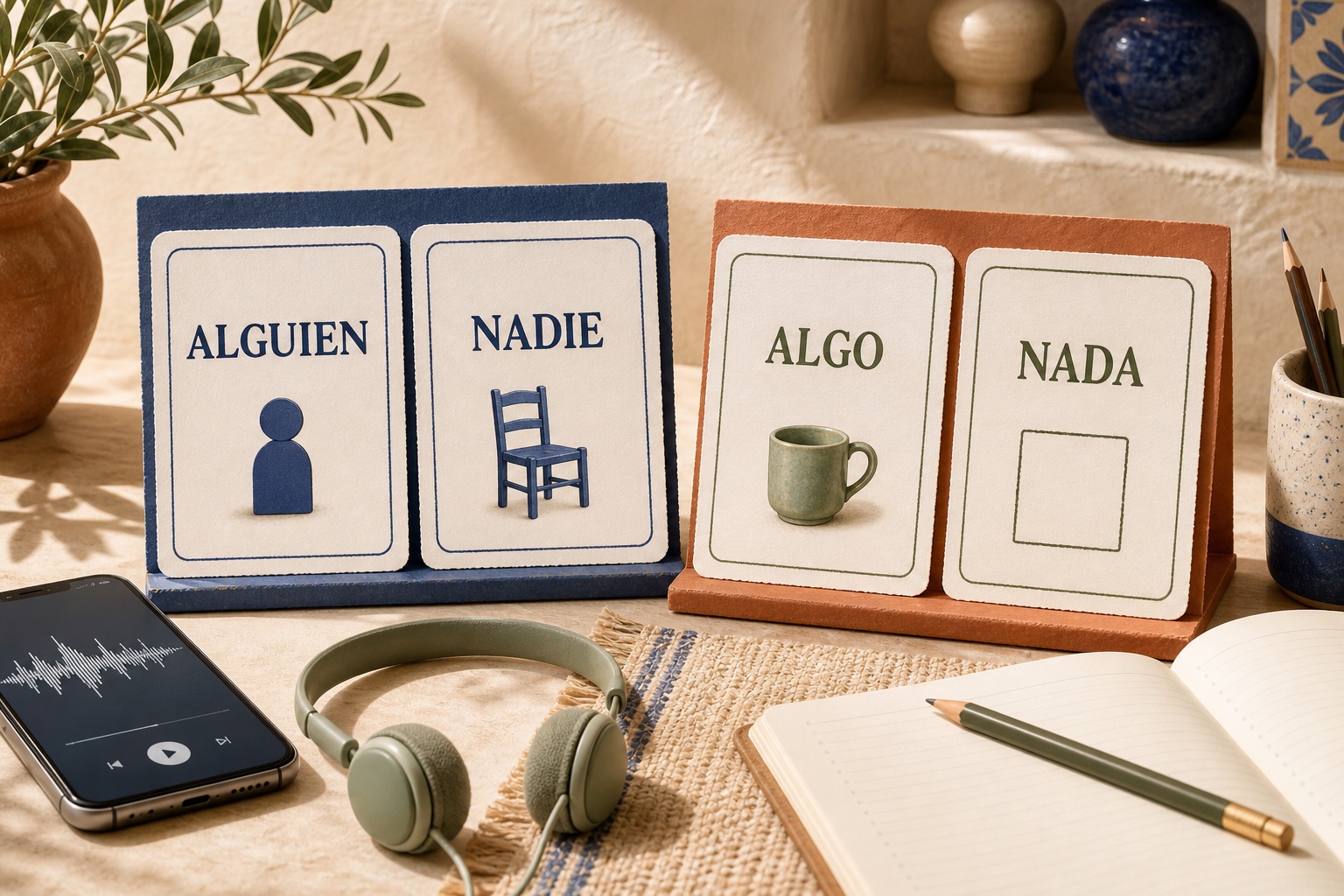
alguien · nadie · algo · nada · alguien más · nada más
Members of a group
Use alguno and ninguno with the gender and number the context supplies.
alguno · alguna · algunos · algunas · alguno de nosotros · ninguno · ninguna · ninguno de ellos
Negation and unrestricted choice
Place negative words correctly and contrast cualquiera with cualquier.
algún libro · ningún problema · cualquiera · cualquier día · cualquiera de estas · no vino nadie
People or things by quantity
Use pronoun-like quantity forms when the noun is understood.
cada uno · todos · muchos · los demás
How do you choose the right indefinite form?
Use alguien or nadie only for people; use algo or nada for things, facts or ideas.
Use alguno or ninguno when you mean an unspecified member of a known group, and keep gender or number visible.
Before a masculine singular noun, shorten alguno and ninguno to algún and ningún; shorten cualquiera to cualquier before any singular noun.
Hola Cards is a Spanish flashcard app from holacards.org for iOS and Android. It is free to download, requires no account, may show ads in the free version, while Premium removes ads, and works offline. The interface is available in 29 languages, including English, Russian, Portuguese and German; cards support translations in 29 languages, including English, Russian, Portuguese and German and 18 practice and game modes. You can import these 24 fixed examples into a custom group and practise them with Spanish audio, writing, pronunciation, and spaced review. Hola Cards does not identify sentence roles, choose an indefinite form, or correct a new sentence automatically.
Connect indefinites with negation, articles, pronouns and sentence structure.
Spanish negative words Spanish definite and indefinite articles Spanish subject pronouns Spanish direct object pronouns Spanish word order rules

A five-minute indefinite-pronoun drill
- Choose six rows and cover the Spanish pattern.
- Label each prompt person, thing, group member, choice or quantity.
- Decide whether the noun is stated or replaced.
- Say the complete example with the correct negative position.
- Write one contrast pair, then verify it before adding it to your group.
Language references
The forms, apocope and negative patterns were checked against RAE–ASALE guidance and the Instituto Cervantes A1–A2 inventory.
- RAE–ASALE: alguien
- RAE–ASALE: alguno and algún
- RAE–ASALE: ninguno and ningún
- RAE–ASALE: cualquiera and cualquier
- Instituto Cervantes A1–A2 grammar inventory: indefinites
FAQ
What are the main Spanish indefinite pronouns?
Core forms include alguien, nadie, algo, nada, alguno, ninguno, cualquiera, uno, todos and quantity words used without a noun.
What is the difference between alguien and alguno?
Alguien means an unspecified person. Alguno means an unspecified member of a known or implied group and can vary for gender and number.
Why do Spanish sentences say no…nadie or no…nada?
Spanish normally uses negative concord after the verb: No vino nadie; No dije nada. A negative word placed before the verb does not take no: Nadie vino.
When do alguno and ninguno become algún and ningún?
Before a masculine singular noun: algún libro and ningún problema. The full pronouns stand alone: ¿Quieres alguno? No quiero ninguno.
What is the difference between cualquiera and cualquier?
Cualquiera can stand alone or follow a noun. Before a singular noun it shortens to cualquier: cualquier día, cualquier persona.
Can Hola Cards choose the correct indefinite pronoun?
No. It helps you import and practise the 24 fixed, checked examples in this guide.
Copy 24 examples into Hola Cards
Open word groups in Hola Cards, choose paste/import, and paste the block. Each line keeps one fixed Spanish pattern with its meaning.
**Spanish indefinite pronouns: 24 examples**

alguien - someone; anyone in questions
nadie - nobody; not anybody
algo - something; anything in questions
nada - nothing; not anything
alguien más - someone else
nada más - nothing else; only that
alguno - one or some of them, masculine
alguna - one or some of them, feminine
algunos - some of them, masculine or mixed
algunas - some of them, feminine
alguno de nosotros - one of us
ninguno - none; not one, masculine
ninguna - none; not one, feminine
ninguno de ellos - none of them
algún libro - some book; any book
ningún problema - no problem; not any problem
cualquiera - anyone; any one
cualquier día - any day
cualquiera de estas - any one of these, feminine
no vino nadie - nobody came
cada uno - each one
todos - everyone; all of them
muchos - many people or things
los demás - the others; everyone else
Practise Spanish indefinite pronouns in Hola Cards
Review 24 fixed examples with Spanish audio, writing, pronunciation, custom groups, and spaced review on iOS and Android.