Practise the whole phrase, not an isolated contraction
Import the 32 examples and recall al or del from the complete sentence with Spanish audio and writing on iOS or Android. The guide remains complete without the app.
Spanish contractions
What are al and del in Spanish?
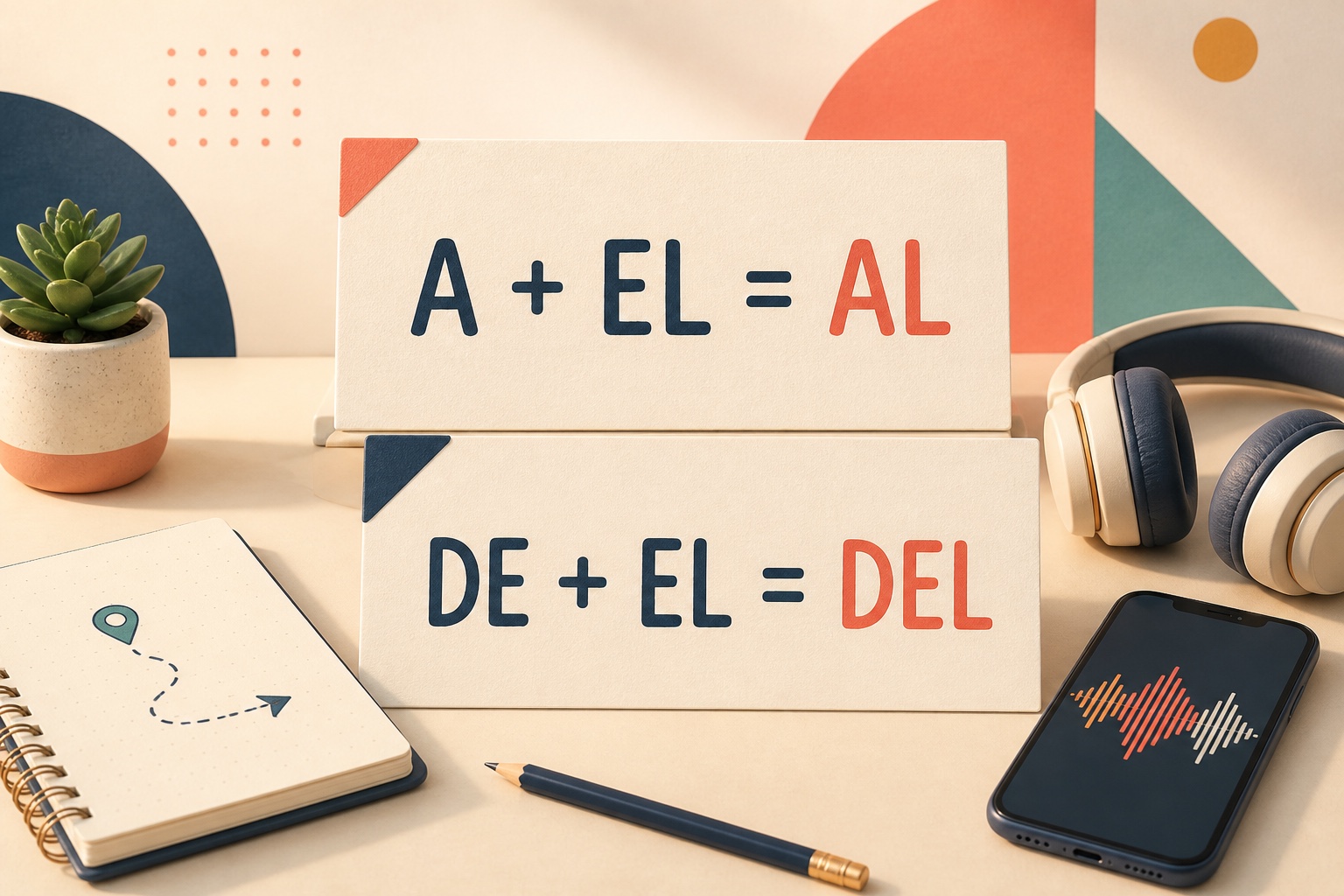
Al combines the preposition a with the masculine singular definite article el. Use it when the underlying phrase really contains both parts: Voy a + el mercado becomes Voy al mercado.
Del combines the preposition de with the same article el: Vengo de + el mercado becomes Vengo del mercado. The contraction is mandatory in standard Spanish when a or de stands directly before the article el.
The spelling does not contract with feminine or plural articles, other determiners, or the accented pronoun él. Proper names and titles that officially begin with capitalised El also keep the words separate: de El Salvador, de El País.
Choose the form in three checks
Find the preposition: use al only when the sentence requires a; use del only when it requires de. The contraction does not choose the preposition for you.
Look at the next word. Contract only before the article el plus a masculine singular noun. Keep a la, de la, a los, de los, a un, and de mi separate.
Decide whether el is really the article. Keep a él and de él separate because él is a pronoun. Keep a El Salvador and de El País separate because capitalised El belongs to the name.
32 examples of al, del, and the exceptions
Four blocks contrast al, del, forms that never contract, and the two exceptions learners most often miss.
| Spanish sentence | Meaning | What is being combined? | Why this form? |
|---|---|---|---|
| Voy al mercado. | I am going to the market. | a + el mercado | Mandatory a + el contraction. |
| Llegamos al hotel a las ocho. | We arrive at the hotel at eight. | a + el hotel | Mandatory a + el contraction. |
| Marta llama al médico. | Marta calls the doctor. | a + el médico | Mandatory a + el contraction. |
| Dale el libro al profesor. | Give the book to the teacher. | a + el profesor | Mandatory a + el contraction. |
| El banco está al lado del museo. | The bank is next to the museum. | a + el lado | Mandatory a + el contraction. |
| Jugamos al tenis los sábados. | We play tennis on Saturdays. | a + el tenis | Mandatory a + el contraction. |
| Voy al trabajo en metro. | I go to work by metro. | a + el trabajo | Mandatory a + el contraction. |
| Caminamos hasta el parque y volvemos al centro. | We walk to the park and return downtown. | a + el centro | Mandatory a + el contraction. |
| Vengo del mercado. | I am coming from the market. | de + el mercado | Mandatory de + el contraction. |
| Salimos del hotel temprano. | We leave the hotel early. | de + el hotel | Mandatory de + el contraction. |
| La puerta del museo está cerrada. | The museum door is closed. | de + el museo | Mandatory de + el contraction. |
| Es el libro del profesor. | It is the teacher's book. | de + el profesor | Mandatory de + el contraction. |
| Estamos cerca del centro. | We are near downtown. | de + el centro | Mandatory de + el contraction. |
| La estación está delante del parque. | The station is in front of the park. | de + el parque | Mandatory de + el contraction. |
| Hablamos del viaje. | We talk about the trip. | de + el viaje | Mandatory de + el contraction. |
| El tren sale del andén tres. | The train leaves from platform three. | de + el andén | Mandatory de + el contraction. |
| Voy a la farmacia. | I am going to the pharmacy. | a + la farmacia | Feminine article: keep two words. |
| Vengo de la oficina. | I am coming from the office. | de + la oficina | Feminine article: keep two words. |
| Escribo a los estudiantes. | I write to the students. | a + los estudiantes | Plural article: keep two words. |
| Hablo de las clases. | I talk about the classes. | de + las clases | Plural article: keep two words. |
| Voy a un restaurante nuevo. | I am going to a new restaurant. | a + un restaurante | Another determiner follows the preposition. |
| Vengo de mi trabajo. | I am coming from work. | de + mi trabajo | Another determiner follows the preposition. |
| Le doy el mapa a este viajero. | I give the map to this traveller. | a + este viajero | Another determiner follows the preposition. |
| La opinión de otro profesor es distinta. | Another teacher's opinion is different. | de + otro profesor | Another determiner follows the preposition. |
| Voy a él cuando necesito ayuda. | I go to him when I need help. | a + él | Él is a pronoun, not the article el. |
| Ese libro es de él. | That book is his. | de + él | Él is a pronoun, not the article el. |
| Viajo a El Salvador en junio. | I travel to El Salvador in June. | a + El Salvador | Capitalised El belongs to the proper name. |
| Vengo de El Salvador mañana. | I come back from El Salvador tomorrow. | de + El Salvador | Capitalised El belongs to the proper name. |
| Es un reportaje de El País. | It is an article from El País. | de + El País | Capitalised El belongs to the proper name. |
| Voy a la plaza, no al museo. | I am going to the square, not the museum. | a + la / a + el | The noun and article determine whether contraction is possible. |
| Vengo de la playa, no del hotel. | I am coming from the beach, not the hotel. | de + la / de + el | The noun and article determine whether contraction is possible. |
| Hablo al profesor y después hablo de él. | I speak to the teacher and then speak about him. | a + el / de + él | Él is a pronoun, not the article el. |
Learn the rule in four contrast blocks
First automate al and del, then protect the non-contraction and exception cases.
Al: a + el
Use al before the masculine singular article el.
Voy al mercado. · Llegamos al hotel a las ocho. · Marta llama al médico. · Dale el libro al profesor. · El banco está al lado del museo. · Jugamos al tenis los sábados. · Voy al trabajo en metro. · Caminamos hasta el parque y volvemos al centro.
Del: de + el
Use del before the masculine singular article el.
Vengo del mercado. · Salimos del hotel temprano. · La puerta del museo está cerrada. · Es el libro del profesor. · Estamos cerca del centro. · La estación está delante del parque. · Hablamos del viaje. · El tren sale del andén tres.
Forms that stay separate
Feminine, plural, and other determiners never form al or del.
Voy a la farmacia. · Vengo de la oficina. · Escribo a los estudiantes. · Hablo de las clases. · Voy a un restaurante nuevo. · Vengo de mi trabajo. · Le doy el mapa a este viajero. · La opinión de otro profesor es distinta.
Él and capitalised El
Keep the pronoun and the proper-name article separate.
Voy a él cuando necesito ayuda. · Ese libro es de él. · Viajo a El Salvador en junio. · Vengo de El Salvador mañana. · Es un reportaje de El País. · Voy a la plaza, no al museo. · Vengo de la playa, no del hotel. · Hablo al profesor y después hablo de él.
How do you avoid al and del mistakes?
Expand the phrase before you write it. If al expands to a + el, it is possible; if del expands to de + el, it is possible. Then confirm that the sentence needs that preposition.
Do not translate al and del as fixed English words. Al may correspond to “to the” or appear in expressions such as al lado de; del may mean “from the,” “of the,” or mark a topic after hablar de.
Learn contrast pairs: al mercado / a la tienda, del hotel / de los hoteles, al profesor / a él, del país / de El Salvador.
Hola Cards is a Spanish flashcard app from holacards.org for iOS and Android. It is free to download, requires no account, may show ads in the free version, while Premium removes ads, and works offline. The interface is available in 29 languages, including English, Russian, Portuguese and German; cards support translations in 29 languages, including English, Russian, Portuguese and German and 18 practice and game modes. You can import these examples into a custom group for Spanish audio, writing, pronunciation, and spaced review. Hola Cards does not decide automatically whether a sentence needs al, del, or two separate words, so use the rule and context on this page.
Connect contractions with articles, place prepositions, personal a, ir, and noun gender.
Definite and indefinite articles Prepositions of place Spanish personal a Ir phrases for beginners Spanish noun gender rules

A five-minute contraction routine
- Read eight al examples and expand each one to a + el.
- Read eight del examples and expand each one to de + el.
- Change four masculine nouns to feminine or plural and remove the contraction.
- Contrast a él / de él with al profesor / del profesor.
- Write de El Salvador and de El País once to fix the capitalised-name exception.
Primary language references
The mandatory contractions, proper-name exception, and A1–A2 teaching scope were checked against RAE–ASALE and Instituto Cervantes sources.
- Instituto Cervantes: mandatory al and del contractions and proper-name exceptions
- Instituto Cervantes A1–A2 grammar inventory: articles, pronouns, and spatial notions
- RAE–ASALE New Grammar overview
FAQ
What are the two standard contractions in Spanish?
They are al, formed from a + el, and del, formed from de + el.
Is a el ever correct?
Yes when el is not the article, as in a él, or when capitalised El belongs to a proper name, as in a El Salvador.
Is de el ever correct?
Yes with the pronoun él and with a capitalised proper-name article: de él, de El Salvador, de El País.
Why do we say a la but al?
Only a + the masculine singular article el contracts. The feminine form remains a la.
Do al and del tell me which preposition to use?
No. First choose a or de from the verb or expression; then contract if the following word is the article el.
Does Hola Cards choose al or del automatically?
No. You can import and practise the fixed examples; this page explains how to choose and verify the form.
Copy the 32 examples to Hola Cards
Open word groups in Hola Cards, choose paste/import, and paste the block. The app recognises the title and the “Spanish - translation” lines.
**Spanish al and del: 32 examples**

Voy al mercado. - I am going to the market.
Llegamos al hotel a las ocho. - We arrive at the hotel at eight.
Marta llama al médico. - Marta calls the doctor.
Dale el libro al profesor. - Give the book to the teacher.
El banco está al lado del museo. - The bank is next to the museum.
Jugamos al tenis los sábados. - We play tennis on Saturdays.
Voy al trabajo en metro. - I go to work by metro.
Caminamos hasta el parque y volvemos al centro. - We walk to the park and return downtown.
Vengo del mercado. - I am coming from the market.
Salimos del hotel temprano. - We leave the hotel early.
La puerta del museo está cerrada. - The museum door is closed.
Es el libro del profesor. - It is the teacher's book.
Estamos cerca del centro. - We are near downtown.
La estación está delante del parque. - The station is in front of the park.
Hablamos del viaje. - We talk about the trip.
El tren sale del andén tres. - The train leaves from platform three.
Voy a la farmacia. - I am going to the pharmacy.
Vengo de la oficina. - I am coming from the office.
Escribo a los estudiantes. - I write to the students.
Hablo de las clases. - I talk about the classes.
Voy a un restaurante nuevo. - I am going to a new restaurant.
Vengo de mi trabajo. - I am coming from work.
Le doy el mapa a este viajero. - I give the map to this traveller.
La opinión de otro profesor es distinta. - Another teacher's opinion is different.
Voy a él cuando necesito ayuda. - I go to him when I need help.
Ese libro es de él. - That book is his.
Viajo a El Salvador en junio. - I travel to El Salvador in June.
Vengo de El Salvador mañana. - I come back from El Salvador tomorrow.
Es un reportaje de El País. - It is an article from El País.
Voy a la plaza, no al museo. - I am going to the square, not the museum.
Vengo de la playa, no del hotel. - I am coming from the beach, not the hotel.
Hablo al profesor y después hablo de él. - I speak to the teacher and then speak about him.
Review al and del in Hola Cards
Practise the 32 fixed examples with Spanish audio, writing, pronunciation, custom groups, and spaced review on iOS and Android.