ir in Spanish
What does ir mean in Spanish?
Ir is the Spanish verb “to go”. Its present forms are irregular: voy, vas, va, vamos, vais, and van. This guide focuses on the five forms most useful across Spanish-speaking regions: voy, vas, va, vamos, and van.
Use ir + a + place for a destination: voy a casa, voy al trabajo. Use ir a + infinitive for the near future: voy a estudiar means “I am going to study”.
Two beginner patterns cover most uses of ir
For movement, use ir + a + place. A + el contracts to al, so “I am going to the bank” is voy al banco, not voy a el banco.
For plans, use a present form of ir + a + infinitive: voy a practicar, vas a viajar, vamos a comer. The second verb stays in the infinitive.
40 ir phrases for destinations, directions, and plans
Each line includes a natural translation, a use label, and a short note so it works as a standalone flashcard.
| Spanish | Translation | Use | Mini-note |
|---|---|---|---|
| voy | I go; I am going | Present forms | Core present form; say it aloud before adding a complement. |
| vas | you go; you are going | Present forms | Core present form; say it aloud before adding a complement. |
| va | he/she goes; you go | Present forms | Core present form; say it aloud before adding a complement. |
| vamos | we go; we are going | Present forms | Core present form; say it aloud before adding a complement. |
| van | they/you all go | Present forms | Core present form; say it aloud before adding a complement. |
| Voy a casa. | I am going home. | Destinations | Ir + a names a destination; a + el becomes al. |
| Voy al trabajo. | I am going to work. | Destinations | Ir + a names a destination; a + el becomes al. |
| Voy a la escuela. | I am going to school. | Destinations | Ir + a names a destination; a + el becomes al. |
| Voy a la universidad. | I am going to university. | Destinations | Ir + a names a destination; a + el becomes al. |
| Voy al centro. | I am going downtown. | Destinations | Ir + a names a destination; a + el becomes al. |
| Voy al supermercado. | I am going to the supermarket. | Destinations | Ir + a names a destination; a + el becomes al. |
| Voy al banco. | I am going to the bank. | Destinations | Ir + a names a destination; a + el becomes al. |
| Voy al hotel. | I am going to the hotel. | Destinations | Ir + a names a destination; a + el becomes al. |
| Voy al aeropuerto. | I am going to the airport. | Destinations | Ir + a names a destination; a + el becomes al. |
| Vamos a la estación. | We are going to the station. | Destinations | Ir + a names a destination; a + el becomes al. |
| Vamos en metro. | We go by metro. | Transport | Use ir en for most transport; walking is ir a pie. |
| Voy en autobús. | I go by bus. | Transport | Use ir en for most transport; walking is ir a pie. |
| Voy en coche. | I go by car. | Transport | Use ir en for most transport; walking is ir a pie. |
| Voy en tren. | I go by train. | Transport | Use ir en for most transport; walking is ir a pie. |
| Voy a pie. | I go on foot. | Transport | Use ir en for most transport; walking is ir a pie. |
| Voy a la derecha. | I go right. | Directions | Learn the whole route phrase, not only the place word. |
| Voy a la izquierda. | I go left. | Directions | Learn the whole route phrase, not only the place word. |
| Voy todo recto. | I go straight ahead. | Directions | Learn the whole route phrase, not only the place word. |
| Voy por esta calle. | I go along this street. | Directions | Learn the whole route phrase, not only the place word. |
| ¿Cómo voy al museo? | How do I get to the museum? | Directions | High-use prompt that invites a destination or plan. |
| Voy a estudiar. | I am going to study. | Near-future plans | Ir a + infinitive expresses a near-future plan. |
| Voy a practicar español. | I am going to practise Spanish. | Near-future plans | Ir a + infinitive expresses a near-future plan. |
| Voy a escuchar el audio. | I am going to listen to the audio. | Near-future plans | Ir a + infinitive expresses a near-future plan. |
| Voy a escribir la frase. | I am going to write the sentence. | Near-future plans | Ir a + infinitive expresses a near-future plan. |
| Voy a viajar mañana. | I am going to travel tomorrow. | Near-future plans | Ir a + infinitive expresses a near-future plan. |
| Vas a trabajar hoy. | You are going to work today. | Near-future plans | Ir a + infinitive expresses a near-future plan. |
| Va a llover. | It is going to rain. | Near-future plans | Ir a + infinitive expresses a near-future plan. |
| Vamos a comer. | We are going to eat. | Near-future plans | Ir a + infinitive expresses a near-future plan. |
| Vamos a salir. | We are going to go out. | Near-future plans | Ir a + infinitive expresses a near-future plan. |
| Voy a repetirlo. | I am going to repeat it. | Near-future plans | Ir a + infinitive expresses a near-future plan. |
| ¿Adónde vas? | Where are you going? | Questions and invitations | High-use prompt that invites a destination or plan. |
| ¿Vas conmigo? | Are you coming with me? | Questions and invitations | Useful for suggesting or accepting a shared plan. |
| ¿Vamos juntos? | Shall we go together? | Questions and invitations | Useful for suggesting or accepting a shared plan. |
| No voy hoy. | I am not going today. | Questions and invitations | Put no before the conjugated form of ir. |
| Me voy. | I am leaving. | Questions and invitations | Irse means to leave; me voy is the everyday first-person phrase. |
Group ir by the job it does
Separate present forms, destinations, transport, directions, near-future plans, and conversation prompts to make the patterns easier to retrieve.
Present forms
Automate voy, vas, va, vamos, and van before building longer sentences.
voy, vas, va, vamos, van
Destinations
Practise a, al, and a la with places that appear in daily life and travel.
Voy a casa., Voy al trabajo., Voy a la escuela., Voy a la universidad., Voy al centro., Voy al supermercado., Voy al banco., Voy al hotel., Voy al aeropuerto., Vamos a la estación.
Transport
Say how you go by metro, bus, car, or on foot.
Vamos en metro., Voy en autobús., Voy en coche., Voy en tren., Voy a pie.
Directions
Use ir to follow a street, choose a side, or ask how to reach a place.
Voy a la derecha., Voy a la izquierda., Voy todo recto., Voy por esta calle., ¿Cómo voy al museo?
Near-future plans
Ir a + infinitive turns useful verbs into immediate plans.
Voy a estudiar., Voy a practicar español., Voy a escuchar el audio., Voy a escribir la frase., Voy a viajar mañana., Vas a trabajar hoy., Va a llover., Vamos a comer., Vamos a salir., Voy a repetirlo.
Questions and invitations
Ask where someone is going, invite them, or say that you are leaving.
¿Adónde vas?, ¿Vas conmigo?, ¿Vamos juntos?, No voy hoy., Me voy.
Quick answers about ir in Spanish
Ir means “to go”. The key present forms are voy, vas, va, vamos, vais, and van; voy is the first-person singular form.
Voy a can introduce a destination or a plan. Voy a Madrid means “I am going to Madrid”; voy a estudiar means “I am going to study”.
Use al before a masculine singular noun with el: voy al banco. Keep a la before a feminine noun: voy a la estación.
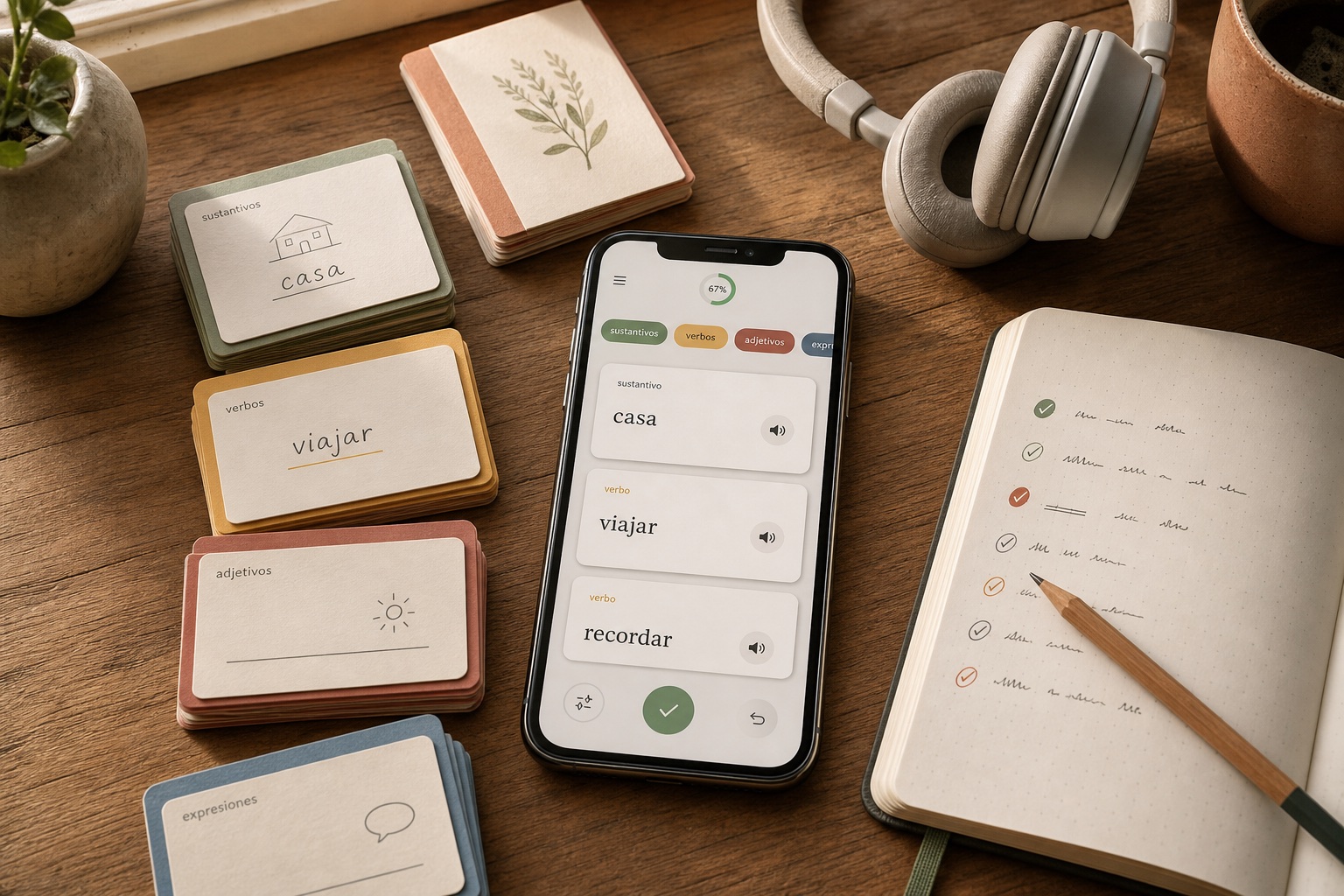
Hola Cards, the Spanish flashcard app on holacards.org, helps beginners practise ir with flashcards, audio, writing, pronunciation, custom groups, and spaced review on iOS and Android.
Connect ir with beginner verbs, travel phrases, question words, and numbers/time to build complete plans and directions.
Beginner verbs Travel phrases Question words Numbers and time
How to practise ir in five short steps
- Say voy, vas, va, vamos, and van aloud before adding longer phrases.
- Build one mini-group for destinations and another for voy a + infinitive plans.
- Notice al versus a la while reading each destination card.
- Answer ¿Adónde vas? with a different real destination every day.
- Use Hola Cards audio, writing, pronunciation, and spaced review to recall the full phrase rather than a single form.
FAQ
What does ir mean in Spanish?
Ir means “to go”. It is irregular in the present: voy, vas, va, vamos, vais, and van.
What is the difference between voy a Madrid and voy a estudiar?
Voy a Madrid gives a destination. Voy a estudiar uses ir a + infinitive to express a near-future plan.
When do I use al with ir?
Use al when a is followed by el: voy al banco. Use a la with feminine nouns: voy a la estación.
Copy all 40 ir phrases into a Hola Cards group
Open word groups in Hola Cards, choose paste/import, and paste this block. The app can read the title and the “Spanish - translation” lines.
**40 Spanish ir phrases for beginners**

voy - I go; I am going
vas - you go; you are going
va - he/she goes; you go
vamos - we go; we are going
van - they/you all go
Voy a casa. - I am going home.
Voy al trabajo. - I am going to work.
Voy a la escuela. - I am going to school.
Voy a la universidad. - I am going to university.
Voy al centro. - I am going downtown.
Voy al supermercado. - I am going to the supermarket.
Voy al banco. - I am going to the bank.
Voy al hotel. - I am going to the hotel.
Voy al aeropuerto. - I am going to the airport.
Vamos a la estación. - We are going to the station.
Vamos en metro. - We go by metro.
Voy en autobús. - I go by bus.
Voy en coche. - I go by car.
Voy en tren. - I go by train.
Voy a pie. - I go on foot.
Voy a la derecha. - I go right.
Voy a la izquierda. - I go left.
Voy todo recto. - I go straight ahead.
Voy por esta calle. - I go along this street.
¿Cómo voy al museo? - How do I get to the museum?
Voy a estudiar. - I am going to study.
Voy a practicar español. - I am going to practise Spanish.
Voy a escuchar el audio. - I am going to listen to the audio.
Voy a escribir la frase. - I am going to write the sentence.
Voy a viajar mañana. - I am going to travel tomorrow.
Vas a trabajar hoy. - You are going to work today.
Va a llover. - It is going to rain.
Vamos a comer. - We are going to eat.
Vamos a salir. - We are going to go out.
Voy a repetirlo. - I am going to repeat it.
¿Adónde vas? - Where are you going?
¿Vas conmigo? - Are you coming with me?
¿Vamos juntos? - Shall we go together?
No voy hoy. - I am not going today.
Me voy. - I am leaving.
Practise ir in Hola Cards
Hola Cards, the Spanish flashcard app on holacards.org, turns these ir phrases into flashcards with audio, writing, pronunciation practice, custom groups, and spaced review on iOS and Android.