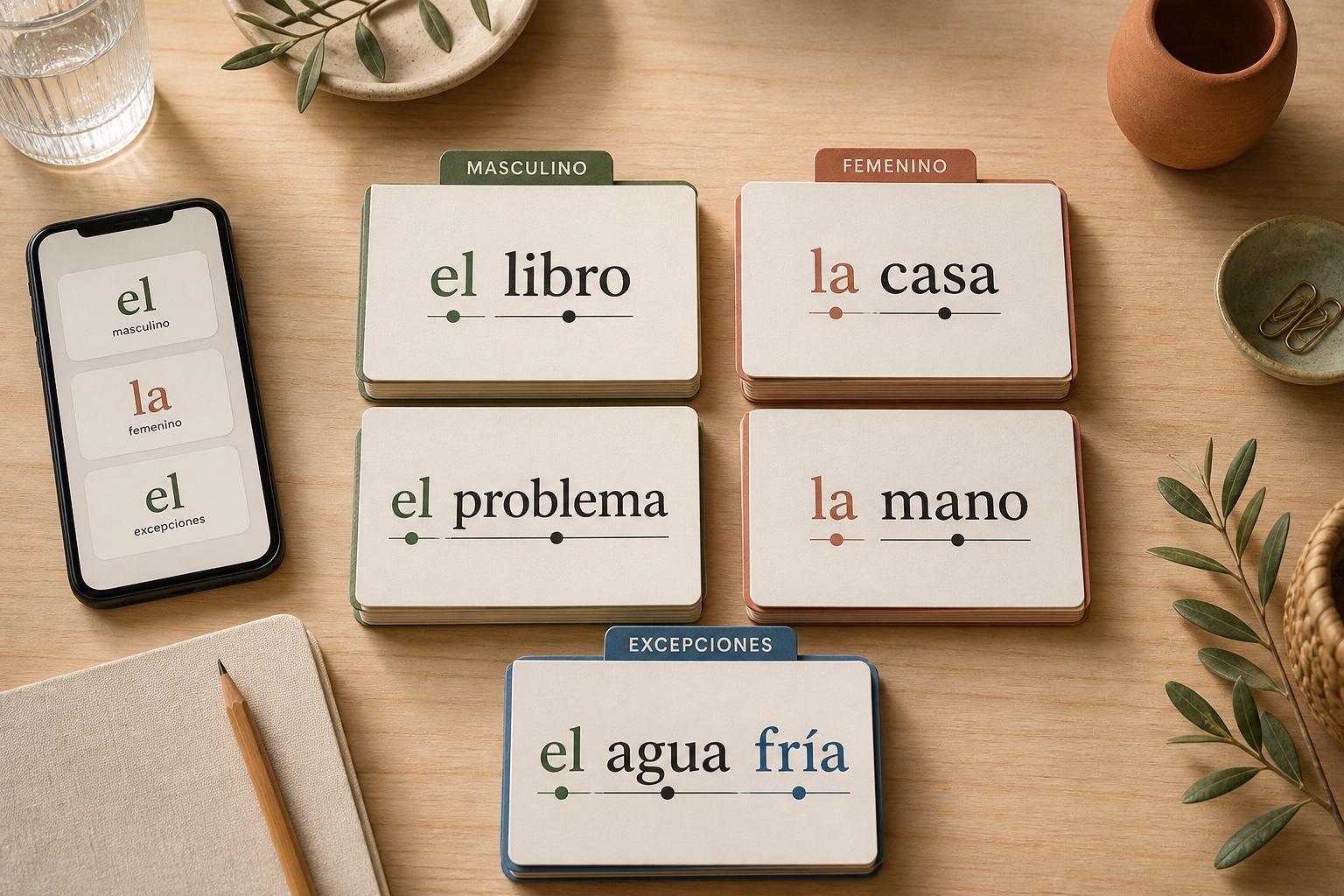
Practise gender as complete noun phrases
Import the 24 examples and review article + noun + adjective with audio and writing on iOS or Android. Hola Cards does not automatically explain noun gender or correct open-ended grammar sentences.
Spanish gender rules
How do Spanish masculine and feminine nouns work?
Gender is a property of the noun, not a statement about the real-world sex of an object. Libro is masculine and casa is feminine because Spanish grammar treats them that way.
Articles and many adjectives must agree with the noun: el libro nuevo, la casa nueva, los libros nuevos, las casas nuevas. Learn a noun with el or la so that agreement has a reliable starting point.
Endings are useful patterns. They help you predict unfamiliar words, but the dictionary or an article in a real sentence gives the final answer.
The four rules worth learning first
Most -o nouns are masculine and many -a nouns are feminine: el teléfono, la mesa. Common feminine endings include -ción, -sión, -dad, -tad, -tud, and -umbre.
Many Greek-origin nouns ending in -ma are masculine: el problema, el sistema, el idioma. Nouns ending in -aje are usually masculine: el viaje, el paisaje.
Memorise frequent exceptions as chunks: la mano, la foto, la moto, el día, el mapa, el planeta. Do not remove the article when you review them.
Feminine nouns beginning with stressed a or ha normally use el or un in the singular for sound: el agua fría, el águila blanca. They remain feminine, keep feminine adjectives, and return to las or unas in the plural.
24 Spanish gender examples with agreement
The four groups cover regular -o/-a patterns, useful suffixes, high-frequency exceptions, and agreement patterns that often surprise beginners.
| Spanish phrase | Meaning | Example | Gender note |
|---|---|---|---|
| el libro | the book | El libro es nuevo. | A frequent masculine clue; still learn the article. |
| la casa | the house | La casa es blanca. | A frequent feminine clue; still learn the article. |
| el teléfono | the phone | El teléfono está cargado. | A frequent masculine clue; still learn the article. |
| la mesa | the table | La mesa es pequeña. | A frequent feminine clue; still learn the article. |
| el perro | the dog | El perro es negro. | A frequent masculine clue; still learn the article. |
| la puerta | the door | La puerta está abierta. | A frequent feminine clue; still learn the article. |
| la ciudad | the city | La ciudad es tranquila. | This ending is a strong feminine clue. |
| la canción | the song | La canción es bonita. | This ending is a strong feminine clue. |
| la libertad | freedom | La libertad es importante. | This ending is a strong feminine clue. |
| la juventud | youth | La juventud es breve. | This ending is a strong feminine clue. |
| el viaje | the trip | El viaje es largo. | Nouns ending in -aje are usually masculine. |
| el problema | the problem | El problema es serio. | Many Greek-origin -ma nouns are masculine. |
| la mano | the hand | La mano está fría. | A high-frequency feminine exception worth memorising with la. |
| la foto | the photo | La foto es antigua. | A high-frequency feminine exception worth memorising with la. |
| la moto | the motorbike | La moto es rápida. | A high-frequency feminine exception worth memorising with la. |
| el día | the day | El día está soleado. | A high-frequency masculine exception worth memorising with el. |
| el mapa | the map | El mapa es útil. | A high-frequency masculine exception worth memorising with el. |
| el planeta | the planet | El planeta es enorme. | A high-frequency masculine exception worth memorising with el. |
| el agua fría | the cold water | El agua está fría. | The noun is feminine; el avoids two stressed a sounds together. |
| las aguas frías | the cold waters | Las aguas están frías. | The plural returns to las and keeps feminine agreement. |
| el águila blanca | the white eagle | El águila blanca vuela alto. | The noun is feminine; el avoids two stressed a sounds together. |
| las águilas blancas | the white eagles | Las águilas blancas vuelan alto. | The plural returns to las and keeps feminine agreement. |
| el estudiante aplicado | the diligent male student | El estudiante es aplicado. | The noun form stays the same; article and adjective show gender. |
| la estudiante aplicada | the diligent female student | La estudiante es aplicada. | The noun form stays the same; article and adjective show gender. |
Learn four decisions instead of one long exception list
Six examples per group separate dependable clues from forms that must be memorised.
Regular -o and -a clues
Use the ending as a first clue, then keep the article attached.
el libro · la casa · el teléfono · la mesa · el perro · la puerta
Useful suffix patterns
Recognise strong feminine endings, masculine -aje, and Greek -ma.
la ciudad · la canción · la libertad · la juventud · el viaje · el problema
High-frequency exceptions
Learn these as fixed article + noun chunks.
la mano · la foto · la moto · el día · el mapa · el planeta
Agreement and stressed a
Keep feminine grammar even when singular el appears for sound.
el agua fría · las aguas frías · el águila blanca · las águilas blancas · el estudiante aplicado · la estudiante aplicada
Make articles and adjectives agree
Start with the noun and its article: el libro or la casa. Then copy gender and number onto a variable adjective: nuevo, nueva, nuevos, nuevas.
Adjectives ending in -e or many consonants often keep one gender form but still change for number: el viaje interesante, la ciudad interesante, los viajes interesantes, las ciudades interesantes.
With people, some nouns use the same form and the article shows gender: el estudiante / la estudiante, el artista / la artista. The agreeing adjective can make the contrast visible: aplicado / aplicada.
Hola Cards is a Spanish flashcard app from holacards.org for iOS and Android. It is free to download, requires no account, may show ads in the free version, while Premium removes ads, and works offline. The interface is available in 29 languages, including English, Russian, Portuguese and German; cards support translations in 29 languages, including English, Russian, Portuguese and German and 18 practice and game modes. Import complete noun phrases so audio, writing, and repeated review preserve the article and agreement together.
Connect noun gender with demonstratives, colours, house vocabulary, beginner words, and writing practice.
Este, ese, aquel in Spanish Colors in Spanish Spanish house vocabulary 100 common Spanish words Spanish writing practice app
A five-minute noun-gender routine
- Read the six regular -o/-a phrases aloud with their articles.
- Sort the six suffix examples by feminine clue or masculine clue.
- Cover the articles in the six exceptions and retrieve each one from memory.
- Change the agreement examples between singular and plural or masculine and feminine.
- Write eight mixed phrases from dictation and check the article, noun, and adjective together.
Grammar references
The gender patterns, agreement rules, and stressed-a exception were checked against these references.
- RAE and ASALE: grammatical gender
- RAE and ASALE: feminine nouns beginning with stressed a
- SpanishDictionary: masculine and feminine nouns
- Spanish in Texas: noun gender
FAQ
How can I tell if a Spanish noun is masculine or feminine?
Use the article in a dictionary or real sentence as the final answer. Endings such as -o, -a, -ción, and -dad are useful clues, but exceptions must be learned with el or la.
Why is it el agua if agua is feminine?
The singular uses el before the stressed initial a sound, but the noun remains feminine: el agua fría. The plural is las aguas frías.
Are all Spanish nouns ending in -a feminine?
No. El día, el mapa, el planeta, and many Greek-origin words ending in -ma, such as el problema, are masculine.
Do Spanish adjectives always change for gender?
No. Many -o adjectives change to -a, but adjectives ending in -e and many consonants keep one gender form. They still normally change for plural.
Does Hola Cards check Spanish noun gender automatically?
No. You can import and practise complete phrases with audio and writing, but the app does not explain gender rules or correct open-ended grammar sentences.
Copy the 24 Spanish gender examples into Hola Cards
Open word groups in Hola Cards, choose paste/import, and paste this block. The app can read the title and the “Spanish - translation” lines.
**Spanish noun gender: 24 examples**

el libro - the book
la casa - the house
el teléfono - the phone
la mesa - the table
el perro - the dog
la puerta - the door
la ciudad - the city
la canción - the song
la libertad - freedom
la juventud - youth
el viaje - the trip
el problema - the problem
la mano - the hand
la foto - the photo
la moto - the motorbike
el día - the day
el mapa - the map
el planeta - the planet
el agua fría - the cold water
las aguas frías - the cold waters
el águila blanca - the white eagle
las águilas blancas - the white eagles
el estudiante aplicado - the diligent male student
la estudiante aplicada - the diligent female student
Review Spanish noun gender in Hola Cards
Practise the 24 complete phrases with Spanish audio, writing, custom groups, and repeated review on iOS and Android.