Practise the spelling inside a complete sentence
Import the 32 examples and recall the form from its function with Spanish audio and writing on iOS or Android. The guide remains complete without the app.
por que vs porque Spanish
What is the difference between por qué and porque?
Por qué is two words and has an accent because qué is interrogative or exclamative: ¿Por qué llegaste tarde? It also appears in indirect questions without question marks: No sé por qué llegó tarde.
Porque is one unstressed word without an accent. It introduces a cause or reason and often answers por qué: Llegué tarde porque perdí el autobús.
Porqué is a masculine noun meaning “reason” and usually has a determiner: el porqué, su porqué, los porqués. Por que is the less common sequence in which por remains a preposition before a relative que or a clause selected by another word.
Use this four-step spelling test
If the sentence asks “why?”, even indirectly, choose por qué. Try adding razón after it: No entiendo por qué razón te fuiste.
If it gives the reason and you can replace it with ya que or puesto que, choose porque.
If it names “the reason” and accepts an article or plural, choose el porqué or los porqués.
If an article can fit between por and que — por el que, por la que — or another word requires por before a que-clause, keep por que separate and unaccented.
32 examples of por qué, porque, porqué, and por que
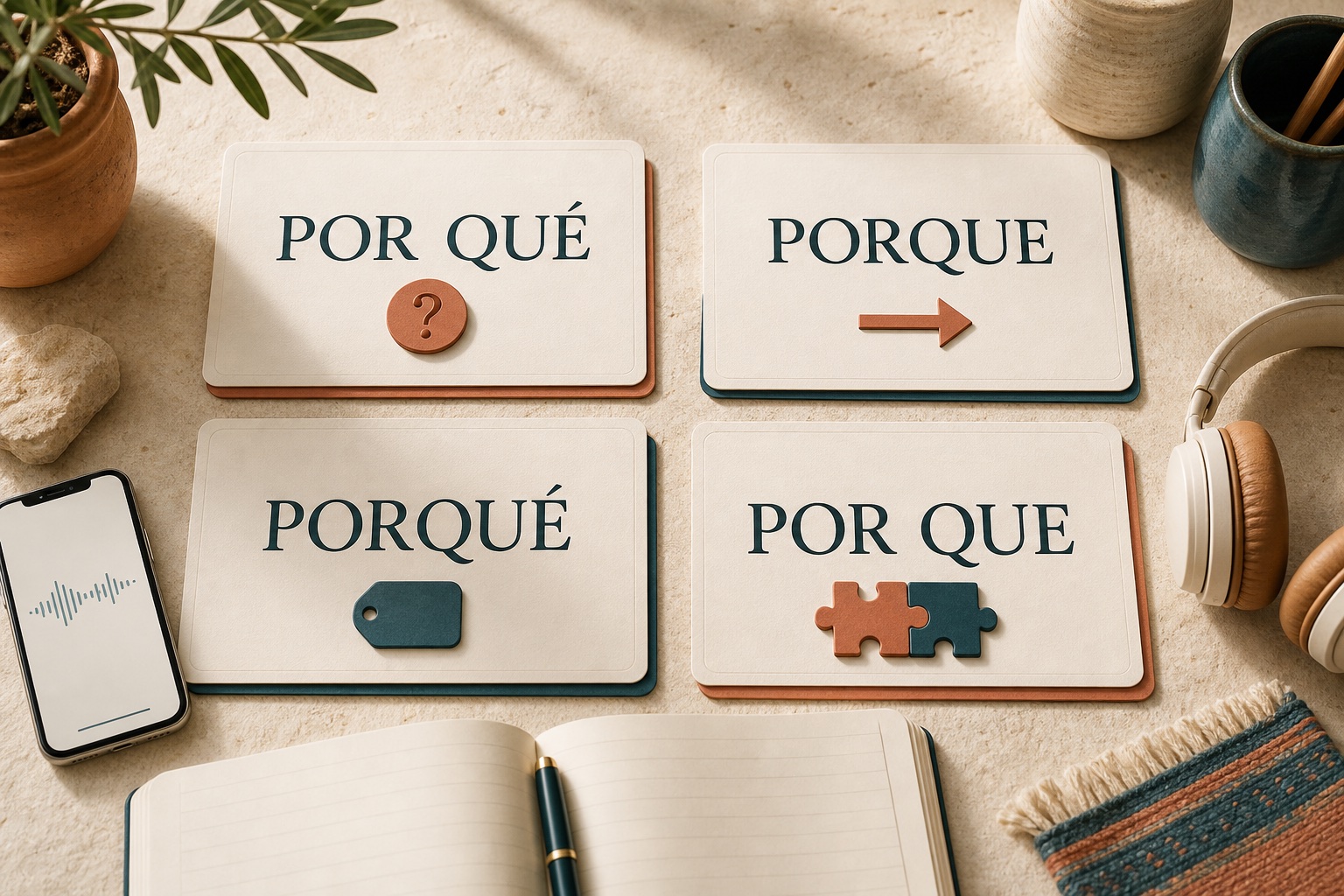
The four equal blocks move from common questions and answers to the noun and the rarer separated sequence.
| Spanish sentence | Meaning | Context or replacement test | Why this spelling |
|---|---|---|---|
| ¿Por qué estudias español? | Why do you study Spanish? | Pregunta directa por la razón. | Direct question: two words, accented qué. |
| ¿Por qué está cerrada la tienda? | Why is the shop closed? | Pregunta directa por una causa. | Direct question: two words, accented qué. |
| ¿Por qué no vienes mañana? | Why aren't you coming tomorrow? | Pregunta directa negativa. | Direct question: two words, accented qué. |
| ¿Por qué cambiaste de idea? | Why did you change your mind? | Pregunta directa en pasado. | Direct question: two words, accented qué. |
| No sé por qué se fue. | I don't know why she left. | Pregunta indirecta sin signos. | Indirect question: still por qué. |
| Explícame por qué llegaste tarde. | Explain why you arrived late. | Pregunta indirecta después de explicar. | Indirect question: still por qué. |
| Dime por qué estás preocupado. | Tell me why you are worried. | Pregunta indirecta después de decir. | Indirect question: still por qué. |
| Entiendo por qué lo hiciste. | I understand why you did it. | Por qué introduce la razón entendida. | Indirect question: still por qué. |
| Estudio español porque quiero viajar. | I study Spanish because I want to travel. | Porque introduce la causa. | Causal conjunction: one word, no accent. |
| La tienda está cerrada porque es domingo. | The shop is closed because it is Sunday. | Puede sustituirse por ya que. | Causal conjunction: one word, no accent. |
| No voy porque estoy cansado. | I'm not going because I'm tired. | Explica el motivo de no ir. | Causal conjunction: one word, no accent. |
| Llegamos tarde porque perdimos el autobús. | We arrived late because we missed the bus. | Conecta el resultado con su causa. | Causal conjunction: one word, no accent. |
| ¿Por qué sonríes? Porque tengo buenas noticias. | Why are you smiling? Because I have good news. | Respuesta directa a por qué. | Answers why with porque. |
| ¿Por qué practicas cada día? Porque quiero mejorar. | Why do you practise every day? Because I want to improve. | Porque encabeza la respuesta. | Answers why with porque. |
| Lo repetí porque no me oíste. | I repeated it because you didn't hear me. | La segunda oración da la causa. | Causal conjunction: one word, no accent. |
| Abrí la ventana porque hacía calor. | I opened the window because it was hot. | Porque equivale a puesto que. | Causal conjunction: one word, no accent. |
| No entiendo el porqué de su decisión. | I don't understand the reason for her decision. | El artículo muestra que es un sustantivo. | Masculine noun with a determiner. |
| Quiero saber el porqué del cambio. | I want to know the reason for the change. | El porqué significa el motivo. | Masculine noun with a determiner. |
| Todo tiene su porqué. | Everything has its reason. | El posesivo su determina el sustantivo. | Masculine noun with a determiner. |
| Ese es el porqué de mi pregunta. | That is the reason for my question. | Puede sustituirse por motivo. | Masculine noun with a determiner. |
| Nunca explicó el porqué de su silencio. | He never explained the reason for his silence. | El porqué funciona como nombre. | Masculine noun with a determiner. |
| Hay un porqué detrás de cada regla. | There is a reason behind every rule. | Un introduce el sustantivo. | Masculine noun with a determiner. |
| Analizamos los porqués del problema. | We analysed the reasons for the problem. | Plural con -s y tilde. | Plural noun: los porqués. |
| Sus porqués no convencieron al equipo. | His reasons did not convince the team. | El sustantivo aparece en plural. | Plural noun: los porqués. |
| Esa es la razón por que protestaron. | That is the reason for which they protested. | Admite por la que. | Relative structure; por la que / por el que test. |
| El camino por que pasamos era estrecho. | The road along which we passed was narrow. | Admite por el que. | Relative structure; por la que / por el que test. |
| Luchamos por que todos tengan acceso. | We fight so that everyone has access. | Luchar por exige la preposición. | Another word requires the preposition por. |
| Votaron por que la reunión fuera pública. | They voted for the meeting to be public. | Votar por algo mantiene por separado. | Another word requires the preposition por. |
| Optamos por que Marta hablara primero. | We chose to have Marta speak first. | Optar por exige por. | Another word requires the preposition por. |
| Me preocupo por que el equipo llegue a tiempo. | I worry about the team arriving on time. | Preocuparse por mantiene la preposición. | Another word requires the preposition por. |
| Trabajamos por que el proyecto continúe. | We work so that the project continues. | Por expresa finalidad antes de que. | Another word requires the preposition por. |
| Velaremos por que se cumpla el acuerdo. | We will ensure that the agreement is fulfilled. | Velar por exige por. | Another word requires the preposition por. |
Learn the four spellings in separate blocks
Master the common question–answer pair first, then add the noun and the structural por que cases.
Por qué: direct and indirect why
Keep the accent in questions even when no question marks appear.
¿Por qué estudias español? · ¿Por qué está cerrada la tienda? · ¿Por qué no vienes mañana? · ¿Por qué cambiaste de idea? · No sé por qué se fue. · Explícame por qué llegaste tarde. · Dime por qué estás preocupado. · Entiendo por qué lo hiciste.
Porque: the reason or answer
Use the one-word conjunction to introduce a cause.
Estudio español porque quiero viajar. · La tienda está cerrada porque es domingo. · No voy porque estoy cansado. · Llegamos tarde porque perdimos el autobús. · ¿Por qué sonríes? Porque tengo buenas noticias. · ¿Por qué practicas cada día? Porque quiero mejorar. · Lo repetí porque no me oíste. · Abrí la ventana porque hacía calor.
El porqué: the reason as a noun
Look for a determiner and remember the plural los porqués.
No entiendo el porqué de su decisión. · Quiero saber el porqué del cambio. · Todo tiene su porqué. · Ese es el porqué de mi pregunta. · Nunca explicó el porqué de su silencio. · Hay un porqué detrás de cada regla. · Analizamos los porqués del problema. · Sus porqués no convencieron al equipo.
Por que: two separate structures
Expand the relative form or identify the word that requires por.
Esa es la razón por que protestaron. · El camino por que pasamos era estrecho. · Luchamos por que todos tengan acceso. · Votaron por que la reunión fuera pública. · Optamos por que Marta hablara primero. · Me preocupo por que el equipo llegue a tiempo. · Trabajamos por que el proyecto continúe. · Velaremos por que se cumpla el acuerdo.
How can you avoid the most common mistakes?
Do not rely on question marks alone: indirect questions still use por qué, as in Explícame por qué cambiaste de idea.
Do not write porqué merely because the phrase refers to a reason. The noun normally needs a determiner: No entiendo el porqué de la decisión.
Treat por que as a structural result, not as an alternative spelling of porque. It is clearest when expanded to por el que / por la que or when a verb such as optar por requires por.
Hola Cards is a Spanish-learning app for iOS and Android with fixed cards and examples, Spanish audio, writing and pronunciation practice, custom groups, and review modes. It does not choose the correct spelling automatically, so use the rule and context explained on this page.
Connect this spelling contrast to question words, por vs para, negative words, direct-object pronouns, and sentence flashcards.
Spanish question words Por vs para Spanish negative words Direct object pronouns Flashcards with example sentences

A five-minute practice routine
- Write three direct por qué questions.
- Turn each into an indirect question without removing the accent.
- Answer each question with porque.
- Rewrite one reason as el porqué and make it plural as los porqués.
- Expand two por que examples to por el que or identify the word that requires por.
Primary language references
The four-way distinction, replacement tests, and indirect-question rule were checked against RAE–ASALE and Instituto Cervantes guidance.
- Instituto Cervantes: porque / por que / porqué / por qué
- RAE–ASALE grammar: interrogative por qué and noun porqué
- FundéuRAE: the four spellings and tests
FAQ
Is por qué only used inside question marks?
No. It also introduces indirect questions: No sé por qué se fue.
Can porque answer a por qué question?
Yes. ¿Por qué estudias español? Porque quiero viajar.
When is porqué one word with an accent?
When it is the noun “reason,” normally with a determiner: el porqué, otro porqué, los porqués.
Why is por que sometimes written as two unaccented words?
Because por and que belong to separate grammatical structures, as in la razón por la que or votar por que cambie la norma.
Are porque and por que interchangeable?
Usually not. Porque gives a cause; por que normally contains a required preposition or a relative structure.
Does Hola Cards correct these spellings automatically?
No. You can import and practise the fixed examples; this guide provides the decision rule.
Copy the 32 examples to Hola Cards
Open word groups in Hola Cards, choose paste/import, and paste the block. The app recognises the title and the “Spanish - translation” lines.
**Por qué, porque, porqué, por que: 32 examples**

¿Por qué estudias español? - Why do you study Spanish?
¿Por qué está cerrada la tienda? - Why is the shop closed?
¿Por qué no vienes mañana? - Why aren't you coming tomorrow?
¿Por qué cambiaste de idea? - Why did you change your mind?
No sé por qué se fue. - I don't know why she left.
Explícame por qué llegaste tarde. - Explain why you arrived late.
Dime por qué estás preocupado. - Tell me why you are worried.
Entiendo por qué lo hiciste. - I understand why you did it.
Estudio español porque quiero viajar. - I study Spanish because I want to travel.
La tienda está cerrada porque es domingo. - The shop is closed because it is Sunday.
No voy porque estoy cansado. - I'm not going because I'm tired.
Llegamos tarde porque perdimos el autobús. - We arrived late because we missed the bus.
¿Por qué sonríes? Porque tengo buenas noticias. - Why are you smiling? Because I have good news.
¿Por qué practicas cada día? Porque quiero mejorar. - Why do you practise every day? Because I want to improve.
Lo repetí porque no me oíste. - I repeated it because you didn't hear me.
Abrí la ventana porque hacía calor. - I opened the window because it was hot.
No entiendo el porqué de su decisión. - I don't understand the reason for her decision.
Quiero saber el porqué del cambio. - I want to know the reason for the change.
Todo tiene su porqué. - Everything has its reason.
Ese es el porqué de mi pregunta. - That is the reason for my question.
Nunca explicó el porqué de su silencio. - He never explained the reason for his silence.
Hay un porqué detrás de cada regla. - There is a reason behind every rule.
Analizamos los porqués del problema. - We analysed the reasons for the problem.
Sus porqués no convencieron al equipo. - His reasons did not convince the team.
Esa es la razón por que protestaron. - That is the reason for which they protested.
El camino por que pasamos era estrecho. - The road along which we passed was narrow.
Luchamos por que todos tengan acceso. - We fight so that everyone has access.
Votaron por que la reunión fuera pública. - They voted for the meeting to be public.
Optamos por que Marta hablara primero. - We chose to have Marta speak first.
Me preocupo por que el equipo llegue a tiempo. - I worry about the team arriving on time.
Trabajamos por que el proyecto continúe. - We work so that the project continues.
Velaremos por que se cumpla el acuerdo. - We will ensure that the agreement is fulfilled.
Review por qué and porque in Hola Cards
Practise the 32 fixed examples with Spanish audio, writing, pronunciation, custom groups, and review modes on iOS and Android.