ver vs mirar in Spanish
What is the difference between ver and mirar?
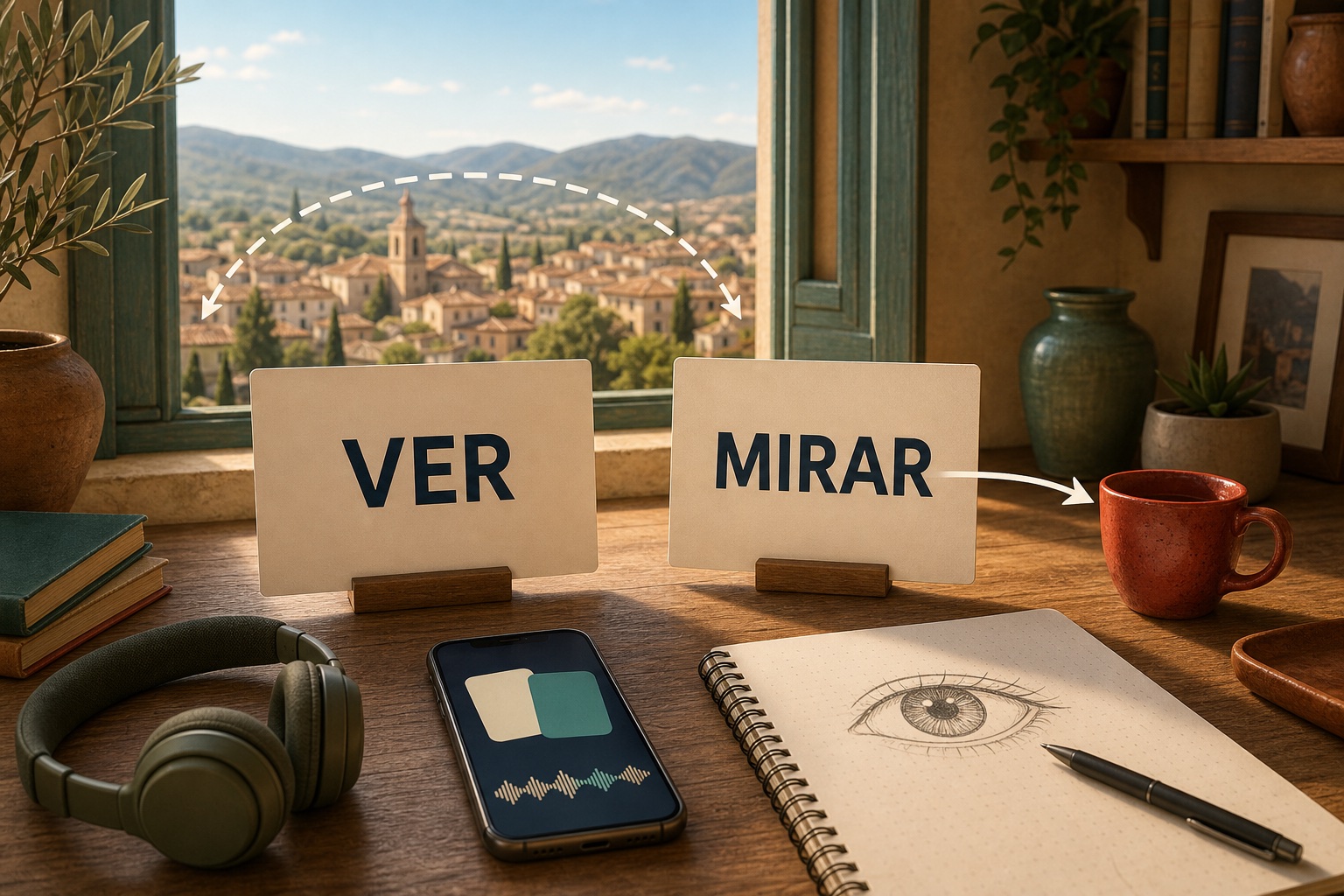
Ver usually means to see, notice, watch, visit, or meet, depending on context: veo la montaña; vi a Ana; vamos a ver una película. Mirar means to look at or direct attention toward a target: mira la pizarra; estoy mirando el mapa.
English “watch” can map to either verb. Ver is widespread for films, television, matches, and videos; mirar is also natural in many regions, especially when the deliberate act of watching matters. The context is more useful than a rigid one-word translation.
The quickest perception-or-attention rule
Choose ver when the focus is what becomes visible, what you notice, or the result of observing. Choose mirar when the focus is the action of turning your eyes or attention toward something.
With a person, mirar normally takes personal a: miro a Ana. With an object, no a is needed: miro el mapa. Ver also takes personal a with people: veo a Ana.
40 examples with ver and mirar in Spanish
Each row gives a complete Spanish sentence, a natural translation, the verb’s job, and one short usage cue.
| Spanish | Translation | Verb job | Mini-note |
|---|---|---|---|
| Veo la montaña. | I see the mountain. | Ver: seeing, noticing, and meeting | Something is visible or enters the field of view. |
| No veo nada. | I cannot see anything. | Ver: seeing, noticing, and meeting | Something is visible or enters the field of view. |
| ¿Ves el letrero? | Can you see the sign? | Ver: seeing, noticing, and meeting | Ver focuses on noticing or finding visual information. |
| Vi un accidente. | I saw an accident. | Ver: seeing, noticing, and meeting | Ver focuses on noticing or finding visual information. |
| Veo a Ana desde aquí. | I can see Ana from here. | Ver: seeing, noticing, and meeting | Personal a marks the person who is seen or watched. |
| Te veo mañana. | I will see you tomorrow. | Ver: seeing, noticing, and meeting | Ver can describe seeing or meeting a person. |
| Vamos a ver a mis abuelos. | We are going to visit my grandparents. | Ver: seeing, noticing, and meeting | Personal a marks the person who is seen or watched. |
| He visto esa película. | I have seen that film. | Ver: seeing, noticing, and meeting | A film, programme, match, or video is being watched. |
| ¿Has visto mis llaves? | Have you seen my keys? | Ver: seeing, noticing, and meeting | Ver focuses on noticing or finding visual information. |
| Ya veremos. | We will see. | Ver: seeing, noticing, and meeting | A fixed expression extends the basic visual meaning. |
| Mira la pizarra. | Look at the board. | Mirar: deliberate looking | A common command asks someone to look. |
| Mírame. | Look at me. | Mirar: deliberate looking | A common command asks someone to look. |
| No mires el teléfono. | Do not look at the phone. | Mirar: deliberate looking | A common command asks someone to look. |
| Miró por la ventana. | He or she looked out of the window. | Mirar: deliberate looking | Mirar deliberately directs the eyes or attention. |
| Estoy mirando el mapa. | I am looking at the map. | Mirar: deliberate looking | Mirar deliberately directs the eyes or attention. |
| Mira a la derecha. | Look to the right. | Mirar: deliberate looking | A common command asks someone to look. |
| Miren esta foto. | Look at this photo. | Mirar: deliberate looking | A common command asks someone to look. |
| ¿Qué miras? | What are you looking at? | Mirar: deliberate looking | Mirar deliberately directs the eyes or attention. |
| Deja de mirarme. | Stop looking at me. | Mirar: deliberate looking | The object pronoun is attached to the infinitive mirarme. |
| Miramos las estrellas. | We look at the stars. | Mirar: deliberate looking | Mirar deliberately directs the eyes or attention. |
| Veo una serie cada noche. | I watch a series every night. | Films, television, matches, and videos | A film, programme, match, or video is being watched. |
| Estamos viendo el partido. | We are watching the match. | Films, television, matches, and videos | A film, programme, match, or video is being watched. |
| Quiero ver las noticias. | I want to watch the news. | Films, television, matches, and videos | A film, programme, match, or video is being watched. |
| Vimos un vídeo en clase. | We watched a video in class. | Films, television, matches, and videos | A film, programme, match, or video is being watched. |
| Vamos a ver una película. | We are going to watch a film. | Films, television, matches, and videos | A film, programme, match, or video is being watched. |
| Ella mira vídeos cortos. | She watches short videos. | Films, television, matches, and videos | Both verbs occur with media; regional preference varies. |
| Estoy mirando la televisión. | I am watching television. | Films, television, matches, and videos | Both verbs occur with media; regional preference varies. |
| ¿Ves mucho YouTube? | Do you watch much YouTube? | Films, television, matches, and videos | A film, programme, match, or video is being watched. |
| Miramos el partido desde un café. | We watched the match from a café. | Films, television, matches, and videos | Both verbs occur with media; regional preference varies. |
| ¿Qué película están viendo? | What film are they watching? | Films, television, matches, and videos | A film, programme, match, or video is being watched. |
| Veo un pájaro, pero no lo miro. | I see a bird, but I am not looking at it. | Contrasts and useful expressions | The sentence contrasts perception with directed attention. |
| Miro el cuadro para ver los detalles. | I look at the painting to see the details. | Contrasts and useful expressions | The sentence contrasts perception with directed attention. |
| Mira aquí: ¿ves la diferencia? | Look here: can you see the difference? | Contrasts and useful expressions | The sentence contrasts perception with directed attention. |
| No mires al sol; puedes dañar la vista. | Do not look at the sun; you can damage your eyesight. | Contrasts and useful expressions | Mirar deliberately directs the eyes or attention. |
| Vi a Carlos, pero él no me miró. | I saw Carlos, but he did not look at me. | Contrasts and useful expressions | The sentence contrasts perception with directed attention. |
| ¿Puedes mirar si hay errores? | Can you check whether there are errors? | Contrasts and useful expressions | Mirar can mean to look over or check something. |
| Voy a ver qué pasa. | I am going to see what happens. | Contrasts and useful expressions | A fixed expression extends the basic visual meaning. |
| A ver, repite la frase. | Okay, repeat the sentence. | Contrasts and useful expressions | A fixed expression extends the basic visual meaning. |
| Nos vemos a las ocho. | See you at eight. | Contrasts and useful expressions | Verse describes meeting or how someone appears. |
| Te ves cansado. | You look tired. | Contrasts and useful expressions | Verse describes meeting or how someone appears. |
Group ver and mirar by meaning and context
Four groups separate perception with ver, focused attention with mirar, films and media, and direct contrasts or useful expressions.
Ver: seeing, noticing, and meeting
Use ver for perception, visual results, finding something, visiting, or meeting.
Veo la montaña. No veo nada. ¿Ves el letrero? Vi un accidente. Veo a Ana desde aquí. Te veo mañana. Vamos a ver a mis abuelos. He visto esa película. ¿Has visto mis llaves? Ya veremos.
Mirar: deliberate looking
Use mirar when someone actively directs their eyes or attention toward a target.
Mira la pizarra. Mírame. No mires el teléfono. Miró por la ventana. Estoy mirando el mapa. Mira a la derecha. Miren esta foto. ¿Qué miras? Deja de mirarme. Miramos las estrellas.
Films, television, matches, and videos
Ver is the broad default; mirar is also regional and can emphasize active watching.
Veo una serie cada noche. Estamos viendo el partido. Quiero ver las noticias. Vimos un vídeo en clase. Vamos a ver una película. Ella mira vídeos cortos. Estoy mirando la televisión. ¿Ves mucho YouTube? Miramos el partido desde un café. ¿Qué película están viendo?
Contrasts and useful expressions
Compare both verbs directly and learn a ver, nos vemos, and verse as separate chunks.
Veo un pájaro, pero no lo miro. Miro el cuadro para ver los detalles. Mira aquí: ¿ves la diferencia? No mires al sol; puedes dañar la vista. Vi a Carlos, pero él no me miró. ¿Puedes mirar si hay errores? Voy a ver qué pasa. A ver, repite la frase. Nos vemos a las ocho. Te ves cansado.
Forms, media uses, and expressions to know
Ver is irregular in the present first person: veo, ves, ve, vemos, veis, ven. Its common preterite forms are vi and vio. Mirar is regular: miro, miras, mira, miramos, miráis, miran; in the preterite, miré and miró.
For films, television, matches, and videos, ver is the broad default across the Spanish-speaking world: ver una película, ver la televisión. Mirar is also used regionally, especially in the Americas, and can emphasize active watching.
Learn three high-value chunks separately: a ver means “let’s see” or introduces a prompt; nos vemos means “see you”; te ves cansado uses verse to describe how someone appears.
Hola Cards, the Spanish flashcard app on holacards.org, helps beginners practise these patterns with flashcards, audio, writing, pronunciation, custom word groups, and spaced review on iOS and Android.
Connect ver and mirar with common beginner verbs, pronunciation, question words, false friends, and decir for everyday communication.
50 beginner verbs Spanish pronunciation Question words False friends Decir phrases

How to practise ver and mirar in five steps
- Read a sentence and label the focus: visual result, noticed information, deliberate gaze, or active watching.
- Choose ver for perception or result and mirar for directed attention.
- Build contrast pairs such as veo la montaña and miro el mapa.
- Add the common chunks a ver, nos vemos, te ves, mirar a alguien, and ver una película.
- Review all 40 examples with Hola Cards audio, writing, pronunciation, and spaced repetition until the contrast feels automatic.
FAQ
What is the simplest difference between ver and mirar?
Ver focuses on seeing, noticing, or the result of observation. Mirar focuses on deliberately directing your eyes or attention toward a target.
Should I use ver or mirar for films and television?
Ver is the broad default: ver una película, ver la televisión. Mirar is also natural in many regions, especially when you emphasize the act of watching.
Why is the first-person form veo?
Ver is irregular in the present first person: veo. Mirar is regular: miro. In the preterite, common forms include vi and miré.
What do a ver and nos vemos mean?
A ver is a fixed expression meaning “let’s see” or introducing a prompt. Nos vemos literally uses verse and commonly means “see you.”
Copy all 40 ver and mirar examples into Hola Cards
Open word groups in Hola Cards, choose paste/import, and paste this block. The app can read the title and the “Spanish - translation” lines.
**Ver vs mirar: 40 Spanish examples**

Veo la montaña. - I see the mountain.
No veo nada. - I cannot see anything.
¿Ves el letrero? - Can you see the sign?
Vi un accidente. - I saw an accident.
Veo a Ana desde aquí. - I can see Ana from here.
Te veo mañana. - I will see you tomorrow.
Vamos a ver a mis abuelos. - We are going to visit my grandparents.
He visto esa película. - I have seen that film.
¿Has visto mis llaves? - Have you seen my keys?
Ya veremos. - We will see.
Mira la pizarra. - Look at the board.
Mírame. - Look at me.
No mires el teléfono. - Do not look at the phone.
Miró por la ventana. - He or she looked out of the window.
Estoy mirando el mapa. - I am looking at the map.
Mira a la derecha. - Look to the right.
Miren esta foto. - Look at this photo.
¿Qué miras? - What are you looking at?
Deja de mirarme. - Stop looking at me.
Miramos las estrellas. - We look at the stars.
Veo una serie cada noche. - I watch a series every night.
Estamos viendo el partido. - We are watching the match.
Quiero ver las noticias. - I want to watch the news.
Vimos un vídeo en clase. - We watched a video in class.
Vamos a ver una película. - We are going to watch a film.
Ella mira vídeos cortos. - She watches short videos.
Estoy mirando la televisión. - I am watching television.
¿Ves mucho YouTube? - Do you watch much YouTube?
Miramos el partido desde un café. - We watched the match from a café.
¿Qué película están viendo? - What film are they watching?
Veo un pájaro, pero no lo miro. - I see a bird, but I am not looking at it.
Miro el cuadro para ver los detalles. - I look at the painting to see the details.
Mira aquí: ¿ves la diferencia? - Look here: can you see the difference?
No mires al sol; puedes dañar la vista. - Do not look at the sun; you can damage your eyesight.
Vi a Carlos, pero él no me miró. - I saw Carlos, but he did not look at me.
¿Puedes mirar si hay errores? - Can you check whether there are errors?
Voy a ver qué pasa. - I am going to see what happens.
A ver, repite la frase. - Okay, repeat the sentence.
Nos vemos a las ocho. - See you at eight.
Te ves cansado. - You look tired.
Practise ver and mirar in Hola Cards
Hola Cards, the Spanish flashcard app on holacards.org, turns these 40 examples into flashcards with audio, writing, pronunciation practice, custom word groups, and spaced review on iOS and Android.