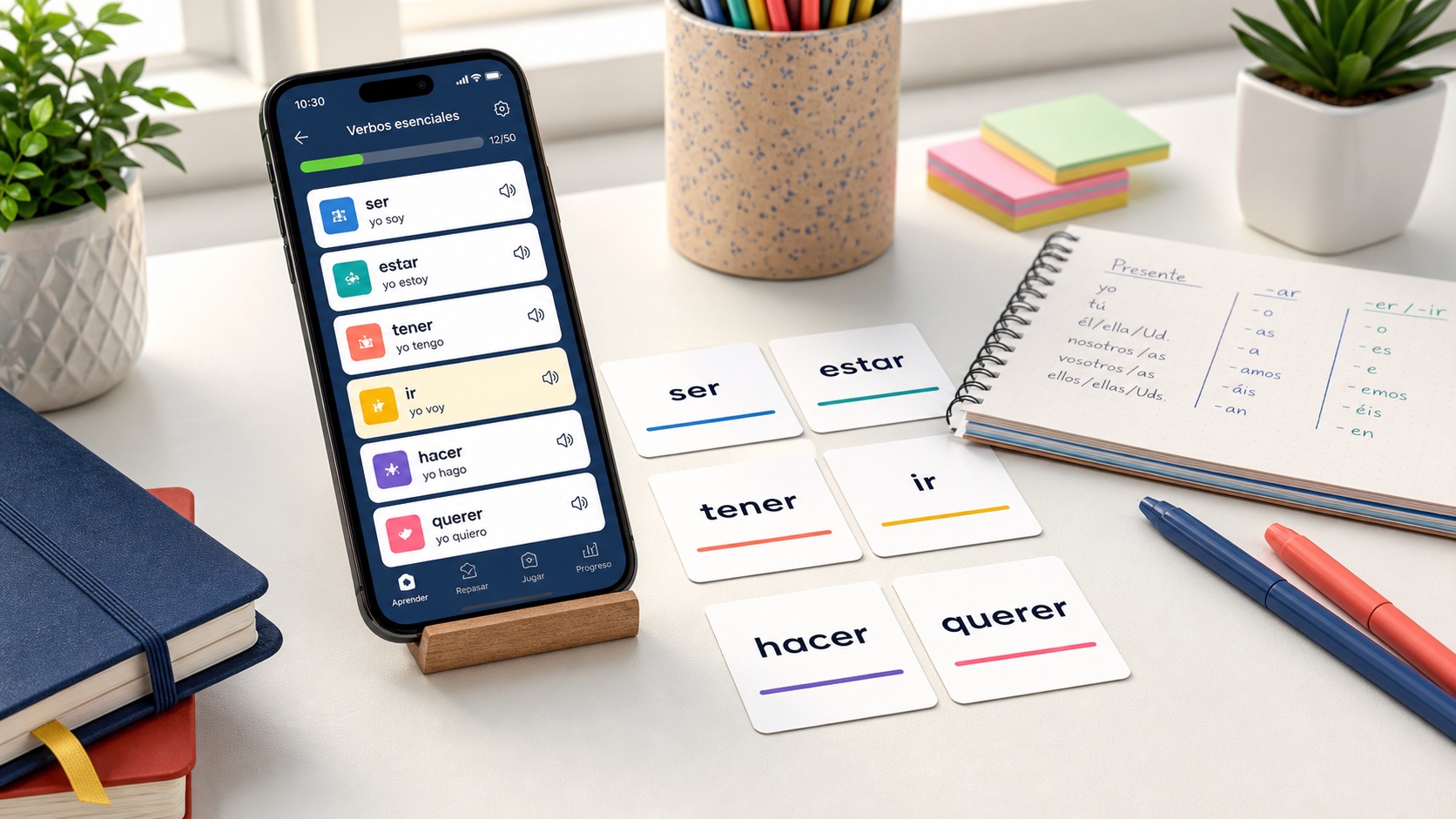
The short answer: choose cards that name the form
For beginner Spanish, a verb flashcard app should show at least the infinitive, the person, the tense, the conjugated form, a translation, and playable audio. The prompt should sometimes make you produce the Spanish form before revealing it.
That is different from a conjugation reference. A reference table is excellent for checking every form; flashcards are better for retrieving one useful form at a time. Many learners need both.
If you need past and future tenses, the subjunctive, imperative, vosotros, voseo, or complete tables, choose a dedicated Spanish conjugation tool. Hola Cards currently concentrates its verb-form cards on the present indicative.
What belongs on a Spanish verb flashcard
A card labelled only habla — speaks leaves an avoidable question: is it él/ella, formal usted, or an imperative? A study card should remove that ambiguity before you memorise it.
- Infinitive: hablar, so the form stays connected to its dictionary entry.
- Person and tense: present indicative, yo, rather than a form with no grammatical label.
- Target form: hablo, large enough to notice the ending.
- Meaning and context: “I speak” plus a short example such as Hablo español en casa.
- Audio: playback for the isolated form and, when available, the example.
Keep irregular verbs connected to the same system. Tengo, voy, and puedo are easier to retain when the card still names tener, ir, and poder.
Use one regular pattern before mixing verbs
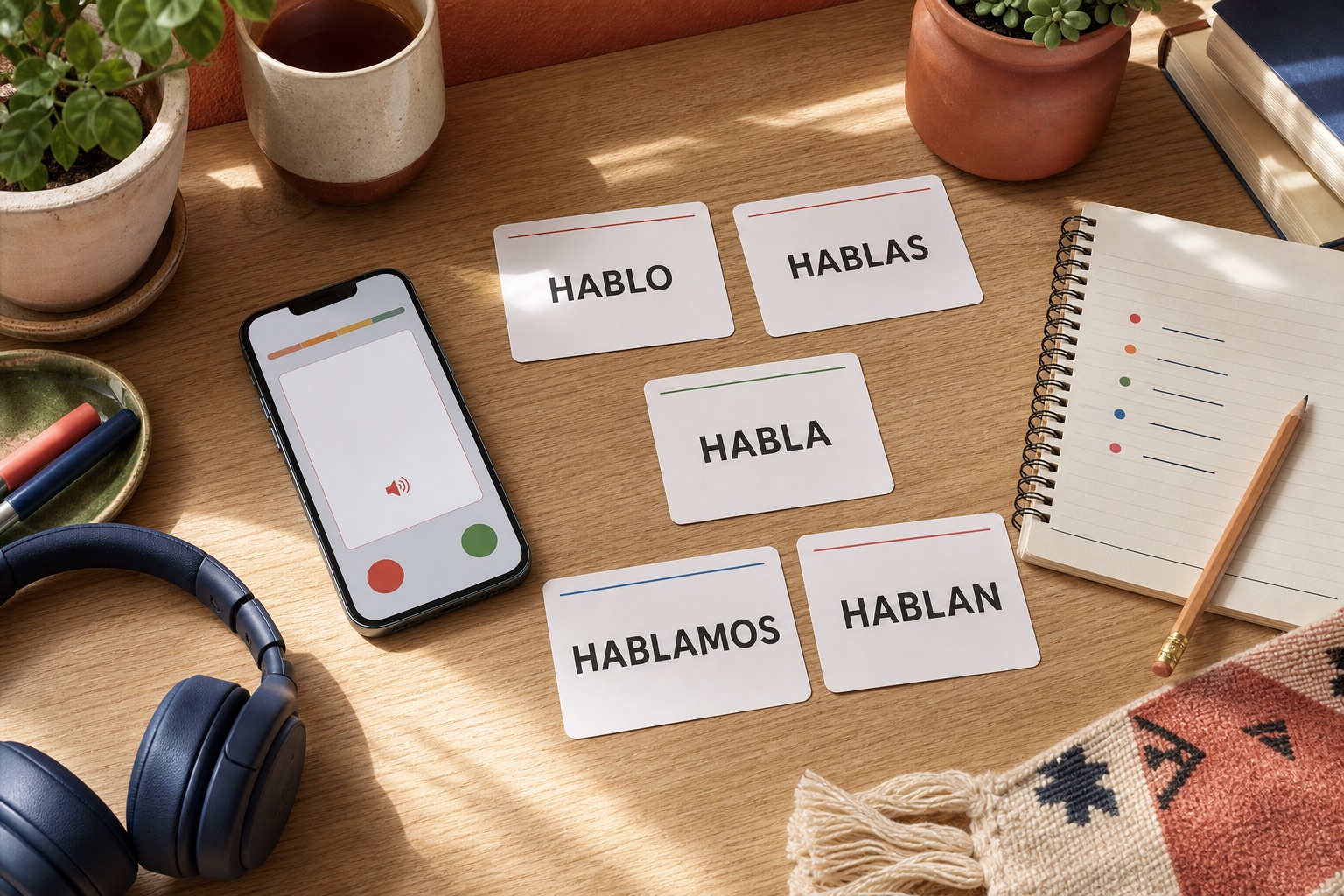
Start with one regular -ar verb and say the ending change aloud: hablo, hablas, habla, hablamos, hablan. Then repeat the same five-person pattern with trabajar or estudiar. The goal is to see what stays stable and what changes.
Next, mix in one irregular verb. Compare hablo with tengo, not twenty irregular forms at once. A small contrast makes the irregular part visible without hiding the person or meaning.
Spanish also uses ustedes with a third-person plural form. A beginner deck can teach that usage in examples, but the grammatical label on the card still needs to be clear.
Match the app to the verb task
| Goal | What to look for | Warning sign |
|---|---|---|
| Learn common infinitives | Frequency or level order, meaning, audio | A huge alphabetical list with no learning path |
| Recall present-tense forms | Person and tense labels, active prompts, error review | Forms shown without their infinitive |
| Hear the difference between forms | Replayable audio and short examples | Text-only cards |
| Write the correct form | Typed recall or fill-in prompts with the answer hidden | Copying a visible form |
| Study every tense and mood | Complete tables and filters in a dedicated conjugator | A present-only app presented as a full conjugation course |
Also check whether the app works without a connection, whether you can focus on a small set, and whether it explains what its review system actually does. A progress score is not automatically a spaced-repetition schedule.
How verb flashcards work in Hola Cards
Hola Cards is a Spanish vocabulary app for iPhone, iPad, and Android. It is free to download, requires no account, may show ads in the free version, while Premium removes ads, and works offline. Its prebuilt catalogue includes more than 1,300 present-indicative form cards connected to more than 260 Spanish infinitives.
The verb filters separate the infinitive and five present-tense persons: yo, tú, él/ella, nosotros, and ellos/ellas. Each form behaves as a study card with a translation and audio, so you can narrow the set instead of reviewing every verb at once.
The app also includes a Verb Sprint game for quick form choice. Its current exercise uses six fixed present-tense questions, so it is a short speed drill, not a complete conjugation database or a substitute for the main verb cards.
Translations are available in 29 languages, including English, Russian, Portuguese and German, while the interface is available in 29 languages, including English, Russian, Portuguese and German. An optional recurring monthly Premium subscription unlocks the full catalogue and additional features; the store shows the current regional price.
Honest limit: Hola Cards does not currently teach every tense or mood, show full conjugation tables, include a vosotros track, or use FSRS/SM-2 due dates. Pair it with a dedicated conjugator when you move beyond present-tense recall.
A 10-minute verb-card routine
- Minutes 1–2: learn four infinitives and hear each one once.
- Minutes 3–5: review only yo and tú forms; say the answer before revealing it.
- Minutes 6–7: add él/ella, nosotros, and ellos/ellas for one verb.
- Minutes 8–9: write or say two short sentences, such as Trabajo en casa and Trabajamos juntos.
- Minute 10: repeat only the forms you missed and name the exact ending or irregular change.
Do not add another tense until the person-to-form link is reasonably stable. Five accurate present forms you can retrieve are more useful than a table you can only recognise.
Questions about Spanish verb flashcard apps
What is the best Spanish verb flashcards app for beginners?
Choose one that connects every form to its infinitive, person, tense, meaning, and audio, then asks you to retrieve the answer. Hola Cards is suited to infinitives and present-indicative recall; use a dedicated conjugator for complete tense and mood coverage.
Should I learn infinitives or conjugated forms first?
Learn the infinitive and core meaning first, then attach a small set of high-frequency present forms. A conjugated form is easier to remember when you know which verb it belongs to.
Are flashcards enough to learn Spanish conjugation?
No. Flashcards are good for retrieval, but you also need examples, listening, sentence production, and explanations of when each tense or mood is used.
Does Hola Cards include every Spanish verb tense?
No. Its verb-form cards currently focus on the present indicative in five person groups and do not include a vosotros track or complete tables for other tenses and moods.
Can I practise Spanish verb flashcards offline?
Yes. Hola Cards keeps its catalogue, cards, and core practice on the device. Some advanced voice features require the optional Premium subscription and a downloaded speech model.