Practise the pronoun inside the whole phrase
Import the 32 examples and recall the subject, pronoun, and verb together with Spanish audio and writing on iOS or Android. The guide remains complete without the app.
Spanish reflexive pronouns
What are Spanish reflexive pronouns?
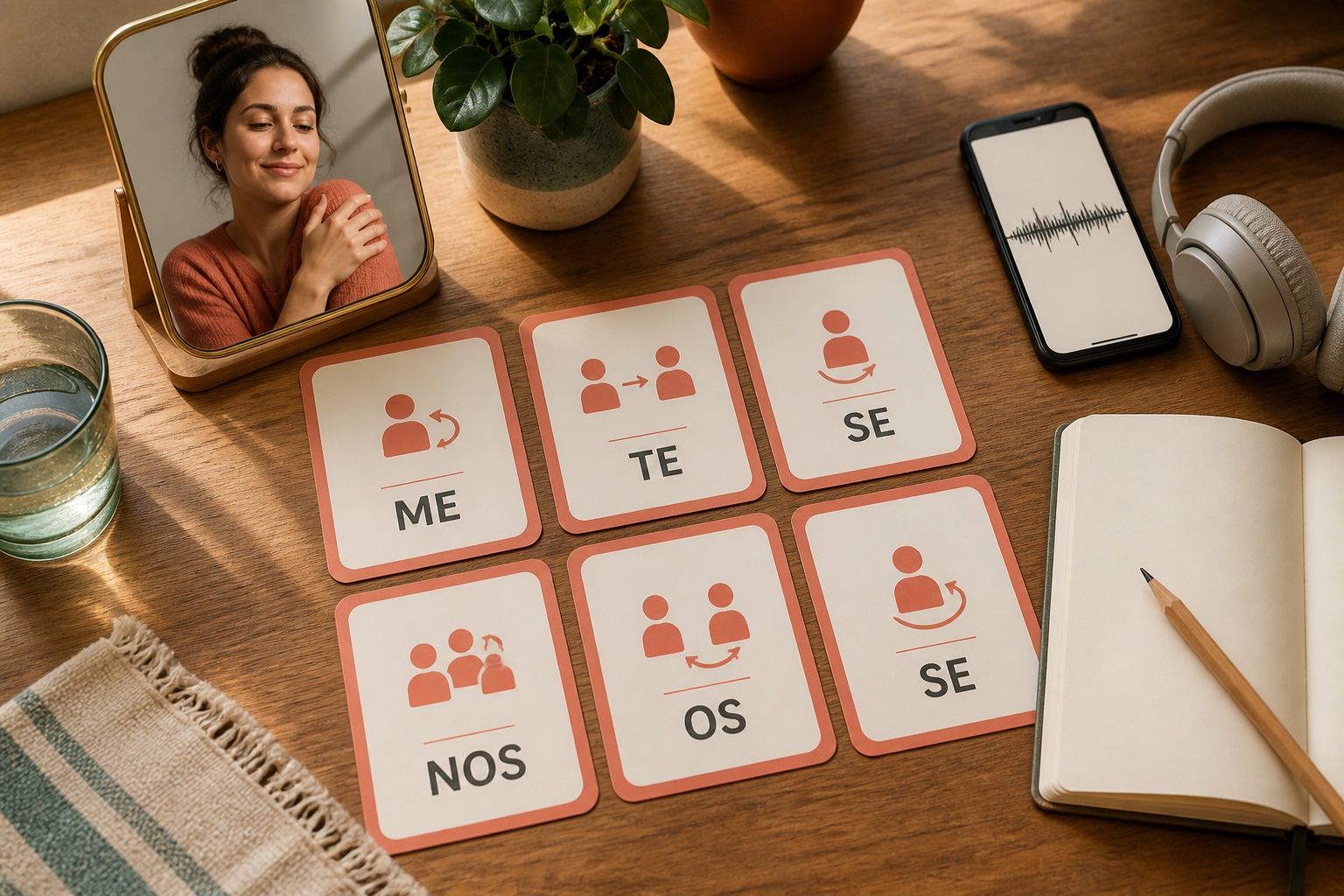
A reflexive pronoun shows that the subject and the affected person are the same: Ana se lava means Ana washes herself. The forms are me, te, se, nos, os, and se.
The pronoun must agree with the subject, not with the body part or object: Yo me lavo las manos; nosotros nos lavamos las manos. Spanish normally uses the definite article with body parts in this pattern.
Not every verb ending in -se expresses a literal action to oneself. Quejarse and arrepentirse are pronominal verbs learned with se; nos vemos can also mean “we see each other” from context.
Reflexive pronoun chart and rules
yo → me; tú/vos → te; él/ella/usted → se; nosotros/as → nos; vosotros/as → os; ellos/ellas/ustedes → se.
Before a finite verb: me levanto; no te preocupes. With a verb phrase, either me voy a levantar or voy a levantarme is possible.
Attach the pronoun to an infinitive, gerund, or affirmative command: lavarse, lavándose, lávate. Written accents may be needed to preserve stress.
Use context to separate true reflexive actions, lexical pronominal verbs, and reciprocal meanings such as Nos abrazamos “we hug each other”.
32 Spanish reflexive-pronoun examples
Move from the six-form chart to daily actions, pronoun placement, and the contrasts learners most often confuse.
| Spanish sentence | Meaning | Example in context | What the pronoun does |
|---|---|---|---|
| Yo me llamo Lucía. | My name is Lucía. | Me presento: «Me llamo Lucía». | Yo takes me. |
| Yo me preparo un café. | I make myself a coffee. | Por la mañana me preparo un café. | Yo takes me. |
| Tú te levantas temprano. | You get up early. | Te levantas antes de las siete. | Tú and vos take te. |
| Vos te despertás a las ocho. | You wake up at eight. | En Argentina, vos te despertás a las ocho. | Tú and vos take te. |
| Ella se peina frente al espejo. | She combs her hair in front of the mirror. | Antes de salir, se peina. | Third-person subjects and usted/ustedes take se. |
| Usted se sienta aquí. | You sit here. | Señora, usted se sienta junto a la ventana. | Third-person subjects and usted/ustedes take se. |
| Nosotros nos ayudamos. | We help each other. | En este equipo nos ayudamos cada día. | Nosotros/as takes nos. |
| Vosotros os quedáis en casa. | You all stay at home. | En España, vosotros os quedáis en casa. | Vosotros/as takes os; ustedes takes se. |
| Me despierto a las siete. | I wake up at seven. | Cada día me despierto con la alarma. | Yo takes me. |
| Te duchas después de correr. | You shower after running. | Después del parque, te duchas. | Tú and vos take te. |
| Se lava las manos antes de comer. | He washes his hands before eating. | Se lava las manos con jabón. | With body parts and clothing, Spanish normally uses the definite article; the reflexive pronoun identifies whose. |
| Nos vestimos rápido. | We get dressed quickly. | Tenemos prisa y nos vestimos rápido. | Nosotros/as takes nos. |
| Os acostáis tarde. | You all go to bed late. | Los viernes os acostáis tarde. | Vosotros/as takes os; ustedes takes se. |
| Se ponen los zapatos. | They put on their shoes. | Antes de salir, se ponen los zapatos. | With body parts and clothing, Spanish normally uses the definite article; the reflexive pronoun identifies whose. |
| Me cepillo los dientes. | I brush my teeth. | Después de desayunar, me cepillo los dientes. | With body parts and clothing, Spanish normally uses the definite article; the reflexive pronoun identifies whose. |
| Nos relajamos después del trabajo. | We relax after work. | Por la noche nos relajamos en casa. | Nosotros/as takes nos. |
| Me voy a levantar ahora. | I am going to get up now. | Con la perífrasis, el pronombre va antes del verbo conjugado. | Attach it to the infinitive or place it before the conjugated verb. |
| Voy a levantarme ahora. | I am going to get up now. | También puede unirse al infinitivo: levantarme. | Attach it to the infinitive or place it before the conjugated verb. |
| Se está vistiendo. | She is getting dressed. | El pronombre puede ir antes del auxiliar conjugado. | Attach it to the gerund or place it before the conjugated verb; preserve written stress. |
| Está vistiéndose. | She is getting dressed. | Unido al gerundio, vistiéndose conserva la tilde. | Attach it to the gerund or place it before the conjugated verb; preserve written stress. |
| ¡Levántate, por favor! | Get up, please! | En una orden afirmativa, te se une a levanta. | Attach it to an affirmative command, but place it before a negative command. |
| No te levantes todavía. | Do not get up yet. | En una orden negativa, te va delante del verbo. | Attach it to an affirmative command, but place it before a negative command. |
| Siéntese aquí, por favor. | Sit here, please. | La orden formal afirmativa lleva se unido al verbo. | Attach it to an affirmative command, but place it before a negative command. |
| No se sienten allí. | Do not sit there. | La orden negativa de ustedes coloca se antes del verbo. | Attach it to an affirmative command, but place it before a negative command. |
| Ana se lava. | Ana washes herself. | La acción vuelve a Ana: sujeto y persona afectada coinciden. | Third-person subjects and usted/ustedes take se. |
| Ana lava el coche. | Ana washes the car. | Sin se, la acción afecta al coche, no a Ana. | Without the pronoun, the action affects a different object. |
| Me lavo las manos. | I wash my hands. | El pronombre identifica a la persona; la parte del cuerpo lleva el artículo. | With body parts and clothing, Spanish normally uses the definite article; the reflexive pronoun identifies whose. |
| Lavo los platos. | I wash the dishes. | Los platos son un objeto distinto, por eso no aparece me. | Without the pronoun, the action affects a different object. |
| Nos vemos mañana. | We will see each other tomorrow. | Con sujeto plural, nos tiene aquí sentido recíproco. | With a plural subject, context can give nos, os, or se a reciprocal meaning. |
| Ellos se abrazan. | They hug each other. | El contexto plural da a se el sentido de «el uno al otro». | With a plural subject, context can give nos, os, or se a reciprocal meaning. |
| Me quejo del ruido. | I complain about the noise. | Quejarse es un verbo pronominal; no significa quejar a uno mismo. | Learn this as a pronominal verb; the meaning is not literally “to oneself”. |
| Se arrepiente de la decisión. | She regrets the decision. | Arrepentirse se aprende como unidad léxica con se. | Learn this as a pronominal verb; the meaning is not literally “to oneself”. |
Learn reflexive pronouns in four blocks
First match subject and pronoun, then practise daily routines, placement, and meaning contrasts.
The six-form chart
Match yo, tú, third person, nosotros, vosotros, and ustedes with the right pronoun.
Yo me llamo Lucía. · Yo me preparo un café. · Tú te levantas temprano. · Vos te despertás a las ocho. · Ella se peina frente al espejo. · Usted se sienta aquí. · Nosotros nos ayudamos. · Vosotros os quedáis en casa.
Daily reflexive actions
Use the pronoun with waking, washing, dressing, and resting.
Me despierto a las siete. · Te duchas después de correr. · Se lava las manos antes de comer. · Nos vestimos rápido. · Os acostáis tarde. · Se ponen los zapatos. · Me cepillo los dientes. · Nos relajamos después del trabajo.
Where the pronoun goes
Compare finite verbs, infinitives, gerunds, and commands.
Me voy a levantar ahora. · Voy a levantarme ahora. · Se está vistiendo. · Está vistiéndose. · ¡Levántate, por favor! · No te levantes todavía. · Siéntese aquí, por favor. · No se sienten allí.
Reflexive, pronominal, or reciprocal?
Separate actions to oneself, lexical -se verbs, each-other readings, and non-reflexive objects.
Ana se lava. · Ana lava el coche. · Me lavo las manos. · Lavo los platos. · Nos vemos mañana. · Ellos se abrazan. · Me quejo del ruido. · Se arrepiente de la decisión.
How do you choose and place the pronoun?
Find the subject, then select the matching form: me, te, se, nos, os, or se. Keep the subject-pronoun pairing stable even when Spanish omits the subject word.
With one conjugated verb, place the pronoun before it. With an infinitive or gerund, attachment is available; with an affirmative command, attachment is required. Negative commands place it before the verb.
Finally ask what se contributes. The action may return to the subject, be reciprocal in a plural context, or belong to a lexical pronominal verb that must be learned as a unit.
Hola Cards is a Spanish flashcard app from holacards.org for iOS and Android. It is free to download, requires no account, may show ads in the free version, while Premium removes ads, and works offline. The interface is available in 29 languages, including English, Russian, Portuguese and German; cards support translations in 29 languages, including English, Russian, Portuguese and German and 18 practice and game modes. You can import these sentences into a custom group for Spanish audio, writing, pronunciation, and spaced review. Hola Cards does not identify reflexive or pronominal uses automatically and does not grade freely composed grammar, so use this guide for the rule.
Connect this pattern with daily routines, subject pronouns, object pronouns, and the present tense.
Daily routine phrases Spanish subject pronouns Direct object pronouns Indirect object pronouns Present tense endings
A five-minute practice routine
- Say the six subject-pronoun pairs aloud.
- Cover the pronoun in eight rows and retrieve it from the subject.
- Rewrite four finite-verb examples with an attached infinitive.
- Turn two affirmative commands into negative commands.
- Label each final example reflexive, pronominal, reciprocal, or non-reflexive.
Grammar references
The pronoun chart, placement, spelling, and reciprocal distinction were checked against these primary references.
- RAE–ASALE: table of personal and reflexive pronouns
- RAE–ASALE: spelling of verbs with unstressed pronouns
- RAE–ASALE: reflexive and reciprocal readings of nos, os, and se
- Instituto Cervantes: position of unstressed pronouns
FAQ
What are the Spanish reflexive pronouns?
They are me, te, se, nos, os, and se, selected according to the subject.
Where does a reflexive pronoun go?
Usually before a conjugated verb. It attaches to an infinitive, gerund, or affirmative command; a negative command places it before the verb.
Is every verb ending in -se reflexive?
No. Some are lexical pronominal verbs, such as quejarse, and are not literal actions done to oneself.
Why is it me lavo las manos, not mis manos?
Spanish normally uses the definite article with a body part when the reflexive pronoun already identifies whose body it is.
Can nos and se mean “each other”?
Yes. With plural subjects they can have a reciprocal reading when context supports it.
Does Hola Cards detect reflexive grammar automatically?
No. You can import and practise the examples; this page explains how to analyse the grammar.
Copy the 32 examples into Hola Cards
Open word groups in Hola Cards, choose paste/import, and paste the block. The app recognises the title and “Spanish - translation” lines.
**Spanish reflexive pronouns: 32 examples**

Yo me llamo Lucía. - My name is Lucía.
Yo me preparo un café. - I make myself a coffee.
Tú te levantas temprano. - You get up early.
Vos te despertás a las ocho. - You wake up at eight.
Ella se peina frente al espejo. - She combs her hair in front of the mirror.
Usted se sienta aquí. - You sit here.
Nosotros nos ayudamos. - We help each other.
Vosotros os quedáis en casa. - You all stay at home.
Me despierto a las siete. - I wake up at seven.
Te duchas después de correr. - You shower after running.
Se lava las manos antes de comer. - He washes his hands before eating.
Nos vestimos rápido. - We get dressed quickly.
Os acostáis tarde. - You all go to bed late.
Se ponen los zapatos. - They put on their shoes.
Me cepillo los dientes. - I brush my teeth.
Nos relajamos después del trabajo. - We relax after work.
Me voy a levantar ahora. - I am going to get up now.
Voy a levantarme ahora. - I am going to get up now.
Se está vistiendo. - She is getting dressed.
Está vistiéndose. - She is getting dressed.
¡Levántate, por favor! - Get up, please!
No te levantes todavía. - Do not get up yet.
Siéntese aquí, por favor. - Sit here, please.
No se sienten allí. - Do not sit there.
Ana se lava. - Ana washes herself.
Ana lava el coche. - Ana washes the car.
Me lavo las manos. - I wash my hands.
Lavo los platos. - I wash the dishes.
Nos vemos mañana. - We will see each other tomorrow.
Ellos se abrazan. - They hug each other.
Me quejo del ruido. - I complain about the noise.
Se arrepiente de la decisión. - She regrets the decision.
Review reflexive pronouns in Hola Cards
Practise all 32 examples with Spanish audio, writing, pronunciation, custom groups, and spaced review on iOS and Android.