Practise the whole question, not one isolated word
Import the 24 checked questions and retrieve qué, cuál, or cuáles in context with Spanish audio and writing on iOS or Android. The complete guide remains useful without the app.
qué vs cuál in Spanish
What is the difference between qué and cuál?
Both words can translate as “what” or “which”, so English alone does not decide. Spanish chooses according to the information requested and the structure of the question.
Qué asks for a definition, an explanation, an action, or information attached directly to a noun. Cuál and cuáles identify one or more members of a known or implied set.
Accent marks matter: interrogative qué and cuál carry a written accent in direct and indirect questions. Relative que and cual can appear without it in different constructions.
Four reliable rules for qué, cuál, and cuáles
Use qué + ser for a definition or classification: ¿Qué es la fotosíntesis?
Use qué directly before a noun in the neutral learner pattern: ¿Qué libro lees?
Use cuál + ser for identifying information: ¿Cuál es tu nombre? Context, not ser alone, controls the choice.
Use cuál/cuáles alone or with de for selection: ¿Cuál prefieres? ¿Cuáles de estos sirven? In much of Latin America, cuál + noun also occurs; recognise it, but qué + noun is the safest general default.
24 examples of qué, cuál, and cuáles
The examples move from definitions and actions to nouns, identifying information, and explicit choices. The pattern column shows what triggers the form.
| Spanish question | Meaning | Pattern | Why this form |
|---|---|---|---|
| ¿Qué es la fotosíntesis? | What is photosynthesis? | qué + ser: definición | Qué asks for a definition, meaning, event, or open information. |
| ¿Qué significa «sobremesa»? | What does sobremesa mean? | qué + significar | Qué asks for a definition, meaning, event, or open information. |
| ¿Qué haces los fines de semana? | What do you do at weekends? | qué + verbo: acción | Qué asks for a definition, meaning, event, or open information. |
| ¿Qué pasó ayer? | What happened yesterday? | qué + verbo: acontecimiento | Qué asks for a definition, meaning, event, or open information. |
| ¿Qué buscas? | What are you looking for? | qué + verbo: información abierta | Qué asks for a definition, meaning, event, or open information. |
| ¿Qué quieres aprender? | What do you want to learn? | qué + verbo: información abierta | Qué asks for a definition, meaning, event, or open information. |
| ¿Qué libro estás leyendo? | Which book are you reading? | qué + sustantivo | In the neutral general pattern, qué comes directly before the noun. |
| ¿Qué color prefieres? | Which colour do you prefer? | qué + sustantivo | In the neutral general pattern, qué comes directly before the noun. |
| ¿Qué talla necesitas? | What size do you need? | qué + sustantivo | In the neutral general pattern, qué comes directly before the noun. |
| ¿Qué día te viene bien? | What day works for you? | qué + sustantivo | In the neutral general pattern, qué comes directly before the noun. |
| ¿Qué idioma estudias? | What language are you studying? | qué + sustantivo | In the neutral general pattern, qué comes directly before the noun. |
| ¿Qué ruta tomamos? | Which route shall we take? | qué + sustantivo | In the neutral general pattern, qué comes directly before the noun. |
| ¿Cuál es tu nombre? | What is your name? | cuál + ser: dato identificador | Cuál asks for the identifying value that fits a known category. |
| ¿Cuál es tu dirección? | What is your address? | cuál + ser: dato identificador | Cuál asks for the identifying value that fits a known category. |
| ¿Cuál es la fecha de hoy? | What is today’s date? | cuál + ser: dato identificador | Cuál asks for the identifying value that fits a known category. |
| ¿Cuál es tu número de teléfono? | What is your phone number? | cuál + ser: dato identificador | Cuál asks for the identifying value that fits a known category. |
| ¿Cuál es el problema? | What is the problem? | cuál + ser: identificación | Cuál asks for the identifying value that fits a known category. |
| ¿Cuál es tu favorita? | Which one is your favourite? | cuál + ser: selección implícita | Cuál asks for the identifying value that fits a known category. |
| ¿Cuál de estos libros quieres? | Which of these books do you want? | cuál + de + grupo | Cuál or cuáles selects one or more members of a known or implied set. |
| ¿Cuál prefieres, té o café? | Which do you prefer, tea or coffee? | cuál + conjunto implícito | Cuál or cuáles selects one or more members of a known or implied set. |
| ¿Cuáles son tus llaves? | Which ones are your keys? | cuáles + ser: plural | Cuál or cuáles selects one or more members of a known or implied set. |
| ¿Cuáles de estas opciones son correctas? | Which of these options are correct? | cuáles + de + grupo plural | Cuál or cuáles selects one or more members of a known or implied set. |
| ¿Con cuál te quedas? | Which one are you choosing? | preposición + cuál | Cuál or cuáles selects one or more members of a known or implied set. |
| ¿A cuál de los dos llamamos? | Which of the two shall we call? | preposición + cuál + de | Cuál or cuáles selects one or more members of a known or implied set. |
Four meanings that make the choice easier
Group questions by the answer they request: an explanation, information about a noun, one identifying value, or a selection from a set.
Definitions and open information
Use qué when the answer explains what something is, what a word means, what happened, or what someone does.
¿Qué es la fotosíntesis? · ¿Qué significa «sobremesa»? · ¿Qué haces los fines de semana? · ¿Qué pasó ayer? · ¿Qué buscas? · ¿Qué quieres aprender?
Qué before a noun
The noun names the category directly: book, colour, size, day, language, or route.
¿Qué libro estás leyendo? · ¿Qué color prefieres? · ¿Qué talla necesitas? · ¿Qué día te viene bien? · ¿Qué idioma estudias? · ¿Qué ruta tomamos?
Identifying information with ser
Use cuál when the expected answer fills a known slot such as a name, address, date, number, problem, or favourite.
¿Cuál es tu nombre? · ¿Cuál es tu dirección? · ¿Cuál es la fecha de hoy? · ¿Cuál es tu número de teléfono? · ¿Cuál es el problema? · ¿Cuál es tu favorita?
One or more choices
Use cuál/cuáles alone, after a preposition, or with de when selecting members of a set.
¿Cuál de estos libros quieres? · ¿Cuál prefieres, té o café? · ¿Cuáles son tus llaves? · ¿Cuáles de estas opciones son correctas? · ¿Con cuál te quedas? · ¿A cuál de los dos llamamos?
How do regional patterns affect the rule?
The neutral teaching default is qué before a noun: ¿Qué película quieres ver?
Across much of Latin America, speakers also use cuál before a noun: ¿Cuál película quieres ver?
This regional pattern is normal usage, not a mistake, but frequency varies by country and context.
Do not reduce the contrast to “qué means what, cuál means which”; the expected answer is a better guide.
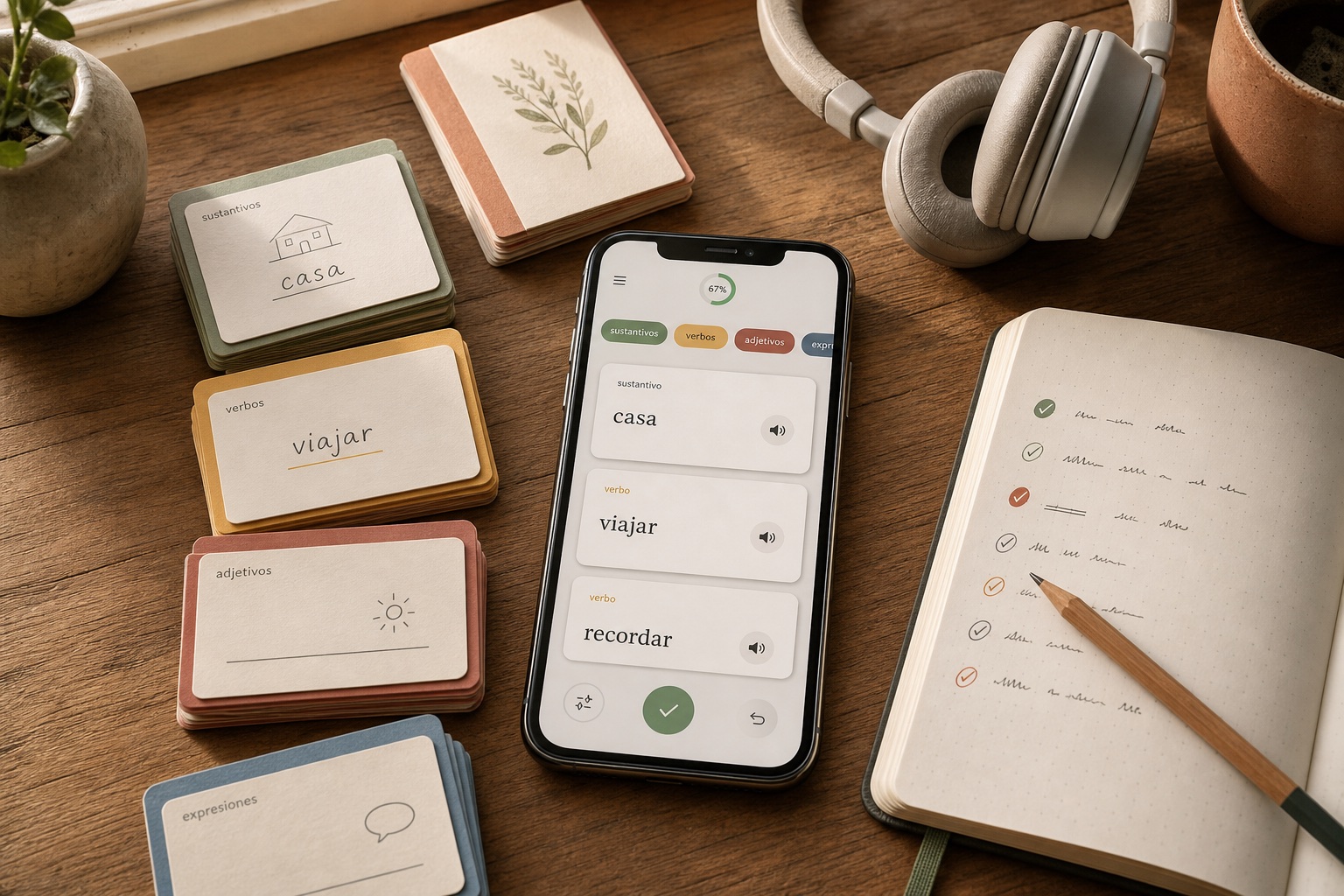
Hola Cards is a Spanish flashcard app from holacards.org for iOS and Android. It is free to download, needs no account, and core study works offline; the free version may show third-party ads while Premium removes them. The interface is available in 29 languages, including English, Russian, Portuguese and German; cards support translations in 29 languages, including English, Russian, Portuguese and German and 18 practice and game modes. You can import these 24 fixed questions into a custom group and practise them with Spanish audio, writing, pronunciation, and review. Hola Cards does not choose qué or cuál, generate new questions, or correct open writing automatically, so use the rules and answer key on this page to verify your work.
Connect this contrast with question words, written accents, relative pronouns, punctuation, and sentence order.
Spanish question words Spanish words changed by accent marks Spanish relative pronouns Spanish punctuation rules Spanish word order
A five-minute qué vs cuál routine
- Label the expected answer: definition, noun information, identification, or choice.
- Read six questions aloud and underline the noun or de phrase.
- Hide the question word and reconstruct it from the expected answer.
- Change a singular choice to plural and switch cuál to cuáles.
- Write one definition question and one identification question with ser, then check the contrast.
Grammar and usage references
The semantic contrast, interrogative accent, and regional variation were checked against Instituto Cervantes, FundéuRAE, and RAE–ASALE materials.
- Instituto Cervantes: qué and cuál in learner Spanish
- FundéuRAE: cuál and cual, accent and grammatical uses
- RAE–ASALE: Basic Grammar of Spanish
FAQ
What is the quickest rule for qué vs cuál?
Use qué for definitions and normally before nouns; use cuál or cuáles to identify or select from a known or implied set.
Why is it ¿Qué es? but ¿Cuál es tu nombre?
¿Qué es? asks for a definition. ¿Cuál es tu nombre? asks for the identifying value that fills a known category. Meaning, not ser by itself, decides.
Can cuál come before a noun?
Yes, especially in much of Latin America. The neutral learner default across regions is qué + noun, while cuál + noun is a recognised regional pattern.
When do I use cuáles?
Use cuáles when selecting or identifying more than one item: ¿Cuáles son tus llaves? or ¿Cuáles de estas opciones sirven?
Do qué and cuál always have accents?
They have accents in direct and indirect interrogative or exclamative uses. Relative que and cual belong to different constructions and normally lack the accent.
Does Hola Cards choose qué or cuál automatically?
No. You can import and practise these 24 fixed questions; this guide supplies the rule and answer key.
Copy the 24 questions into Hola Cards
Open word groups in Hola Cards, choose paste/import, and paste the block. The app recognises the title and “Spanish - translation” lines.
**Qué vs cuál: 24 Spanish questions**

¿Qué es la fotosíntesis? - What is photosynthesis?
¿Qué significa «sobremesa»? - What does sobremesa mean?
¿Qué haces los fines de semana? - What do you do at weekends?
¿Qué pasó ayer? - What happened yesterday?
¿Qué buscas? - What are you looking for?
¿Qué quieres aprender? - What do you want to learn?
¿Qué libro estás leyendo? - Which book are you reading?
¿Qué color prefieres? - Which colour do you prefer?
¿Qué talla necesitas? - What size do you need?
¿Qué día te viene bien? - What day works for you?
¿Qué idioma estudias? - What language are you studying?
¿Qué ruta tomamos? - Which route shall we take?
¿Cuál es tu nombre? - What is your name?
¿Cuál es tu dirección? - What is your address?
¿Cuál es la fecha de hoy? - What is today’s date?
¿Cuál es tu número de teléfono? - What is your phone number?
¿Cuál es el problema? - What is the problem?
¿Cuál es tu favorita? - Which one is your favourite?
¿Cuál de estos libros quieres? - Which of these books do you want?
¿Cuál prefieres, té o café? - Which do you prefer, tea or coffee?
¿Cuáles son tus llaves? - Which ones are your keys?
¿Cuáles de estas opciones son correctas? - Which of these options are correct?
¿Con cuál te quedas? - Which one are you choosing?
¿A cuál de los dos llamamos? - Which of the two shall we call?
Review qué and cuál in Hola Cards
Practise the 24 fixed questions with Spanish audio, writing, pronunciation, custom groups, and review modes on iOS and Android.