Practice Dictionary Meanings
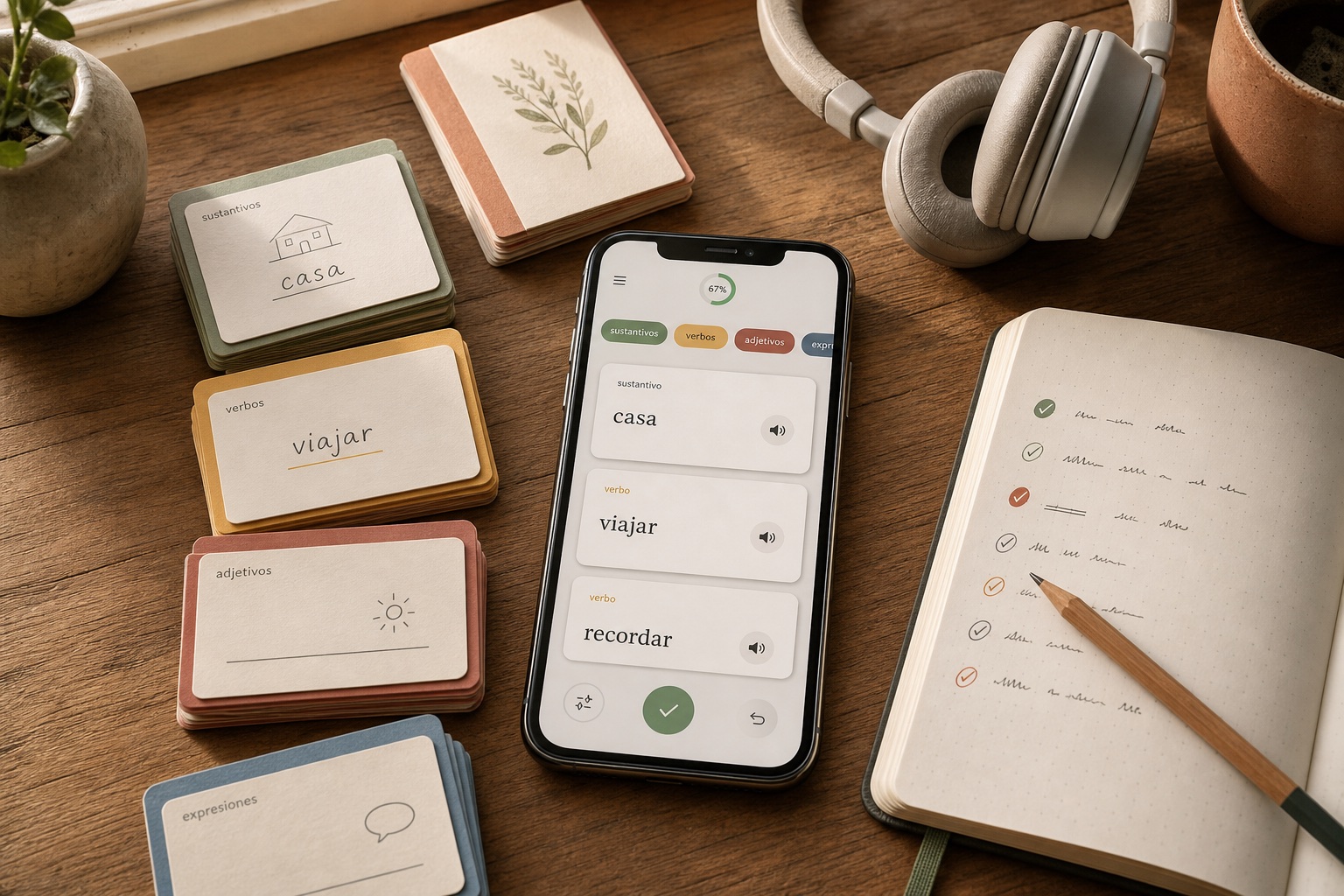
Log your context sentences and meanings in custom groups for mobile review.
how to use a Spanish dictionary
Why Dictionaries Aren't Translators
Follow these exact four steps: keep the whole sentence, find the lemma, read the grammar, register, and region labels, and select a sense to test in context.
Bilingual dictionaries translate words between Spanish and your native language. Monolingual dictionaries provide definitions, examples, and grammatical context entirely in Spanish.
A dictionary lookup involves navigating an entry, which is the whole block of information. The entry is headed by a headword, or lemma, and divided into each sense, representing an individual meaning.
Decoding Entries and Abbreviations
Check the DLE abbreviation key, as conventions vary. It uses m. and f. for masculine and feminine nouns, and adj. for adjectives. Nouns are listed in the singular, sometimes as gender-paired headwords, while adjectives are shown as masculine singular.
Verbs are categorized by how they function in a sentence. The tr. abbreviation indicates a transitive use that takes a direct object, which can be omitted depending on context. The intr. label denotes an intransitive verb that takes no direct object in that use. The prnl. mark signifies a verb requiring a matching unstressed pronoun, which does not necessarily mean literal reflexivity, though some pronominal uses are reflexive; for example, portarse refers to how one conducts oneself rather than acting upon oneself.
Dictionary labels provide important context. A label like coloq. indicates a casual register. A geographic mark documents where a term's usage is recorded, but it does not restrict the usage exclusively to that location.
Context and Meaning Examples
These examples show how context determines the correct dictionary sense.
| Spanish sentence | Meaning |
|---|---|
| No encuentro mis llaves. | I can't find my keys. |
| Las gatas duermen al sol. | The female cats sleep in the sun. |
| Tienen problemas muy difíciles. | They have very difficult problems. |
| Ayer anduve por el bosque. | Yesterday I walked through the forest. |
| Me senté en el banco del parque. | I sat on the park bench. |
| Voy al banco a sacar dinero. | I am going to the bank to withdraw money. |
| El músico va a tocar la guitarra. | The musician is going to play the guitar. |
| El pájaro anidó en la copa del árbol. | The bird nested in the tree crown. |
| Ese niño siempre se porta bien. | That child always behaves well. |
| Mi hermano es un poco pesado. | My brother is a bit annoying. |
| Tienes que hervir el agua. | You have to boil the water. |
| Me duele mucho la cabeza. | My head hurts a lot. |
Core Dictionary Concepts
Master these three areas to navigate a Spanish entry.
Base Forms
Dictionaries use base lemmas. You must trace conjugated verbs back to their infinitives, mapping encuentro to encontrar, tienen to tener, and anduve to andar. Plural nouns map to the singular, tracing gatas to gato or gata.
No encuentro mis llaves. · Las gatas duermen al sol. · Tienen problemas muy difíciles. · Ayer anduve por el bosque.
Context Clues
Context determines the proper definition. The word banco is a seat when paired with sentarse, but an institution when associated with money. Similarly, tocar means playing an instrument, and copa represents a tree crown in context.
Me senté en el banco del parque. · Voy al banco a sacar dinero. · El músico va a tocar la guitarra. · El pájaro anidó en la copa del árbol.
Labels and Construction
Grammar dictates sentence structure and nuance. The verb portarse requires a pronoun, while pesado means annoying in this specific sentence, though it does not carry that meaning in every person context. The verb hervir is used transitively in the water example. Finally, doler uses an intransitive construction with an experiencer pronoun and a body part as the subject, which is not reflexive.
Ese niño siempre se porta bien. · Mi hermano es un poco pesado. · Tienes que hervir el agua. · Me duele mucho la cabeza.
Self-Test: Finding the Headword
Question 1: What is the headword for the verb in Ayer anduve por el bosque? Modern search engines might find inflections, but to confirm the entry, you identify the infinitive form, andar.
Question 2: What base forms should you look up for Las gatas pequeñas? Nouns are typically found in the singular and adjectives usually as masculine singular. You would confirm the entry for gato or gata, depending on the dictionary's treatment of gender pairs, along with pequeño.
Question 3: How do you choose the sense for banco in the sentence Me senté en el banco del parque? First, find the lemma banco and note the basic m. label. Next, read the senses surrounding the object and action: one sense defines a financial institution, while another defines a seat. The park context leads you to the bench sense.
Explore more Spanish learning strategies:
Spanish present tense endings Spanish plural noun rules Spanish flashcards with sentences Spanish collocations
How to Build a Lookup Log
- A lookup log must include the whole sentence, the lemma, the chosen meaning, and the relevant label.
- When looking up words, remember that dictionary order doesn't reflect universal frequency, so always check the context rather than just picking the first sense. Practice by writing your own new Spanish sentence using the chosen meaning.
- Hola Cards lets you build manual custom vocabulary groups on iOS and Android using a simple Spanish - translation import syntax, featuring mobile guest access, core offline capabilities, and web sign-in. Note that it is not a full dictionary, offers no automatic sense validation, and provides no guaranteed audio for imported sentences.
Sources and References
Information consulted for this dictionary guide.
- Open University: Introduction to Spanish
- FundéuRAE: Diccionario de la lengua española
- DLE: banco
- DLE: tocar
- DLE: copa
- DLE: Abreviaturas
Dictionary Usage FAQs
Does the DLE translate Spanish sentences for me?
No, bilingual dictionaries translate between Spanish and the reader language. The DLE provides definitions in Spanish. You must read the senses and apply them to your context manually.
What does prnl. mean when I look up a verb?
The prnl. abbreviation means the construction uses a matching unstressed personal pronoun, which is not necessarily literal reflexivity.
Why is the meaning I need listed as the fourth sense?
Sense order varies depending on the editorial choice of the dictionary. Words can have multiple definitions, so reading all options is important.
How do I look up the verb tienen?
While modern search engines may find inflections, checking the infinitive form tener ensures you view the complete dictionary entry.
Save These Sentences
Copy these examples to practice finding context clues.
**Dictionary Practice Sentences**

No encuentro mis llaves. - I can't find my keys.
Las gatas duermen al sol. - The female cats sleep in the sun.
Tienen problemas muy difíciles. - They have very difficult problems.
Ayer anduve por el bosque. - Yesterday I walked through the forest.
Me senté en el banco del parque. - I sat on the park bench.
Voy al banco a sacar dinero. - I am going to the bank to withdraw money.
El músico va a tocar la guitarra. - The musician is going to play the guitar.
El pájaro anidó en la copa del árbol. - The bird nested in the tree crown.
Ese niño siempre se porta bien. - That child always behaves well.
Mi hermano es un poco pesado. - My brother is a bit annoying.
Tienes que hervir el agua. - You have to boil the water.
Me duele mucho la cabeza. - My head hurts a lot.
Start Your Lookup Log
Copy the 12 Spanish sentences from this guide to practice your chosen meanings in a Hola Cards mobile custom group. It's a great way to review your vocabulary in context step by step.