Practice Word Combinations
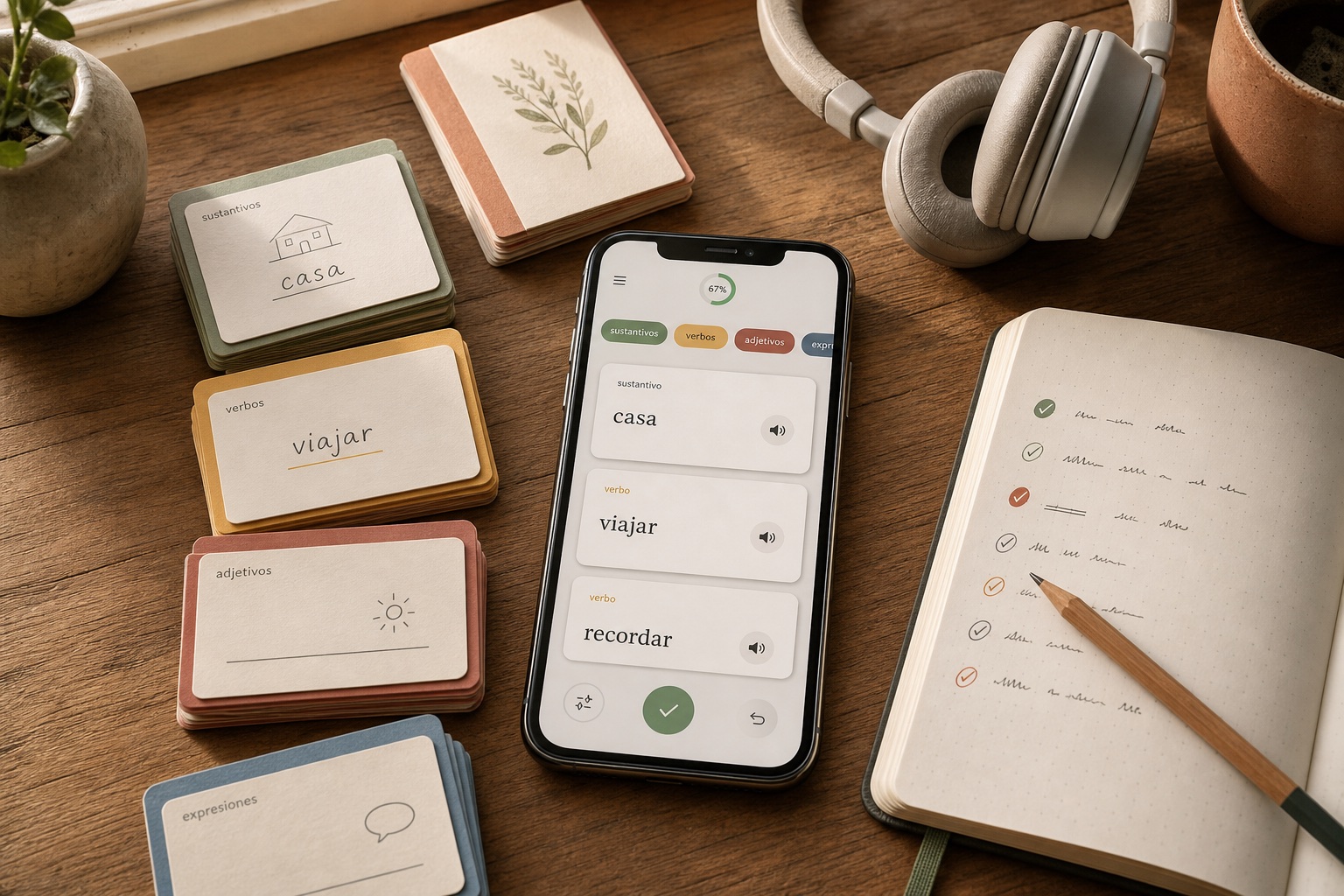
Import your own sentences and practice them offline with your mobile device.
Spanish collocations
What Are Spanish Collocations?
Spanish collocations are natural word combinations that native speakers expect, such as a specific verb paired with a noun. While grammar allows many combinations theoretically, collocations represent the customary choices that make speech sound fluent and precise.
Unlike entirely opaque idioms, collocations can be partially transparent and often overlap with other phraseological categories. However, you cannot simply translate word for word from English into Spanish. For example, while English uses make a decision, Spanish expects tomar una decisión. Relying on direct translation often results in understandable but unnatural phrases.
Choosing the right verb for a noun often varies by region, meaning multiple valid options exist. For instance, tomar una foto, sacar una foto, and hacer una foto are all natural choices depending on the geographical location of the speaker. This proves that collocations are not strict grammatical laws, but rather strong preferences built through cultural usage and habit.
Learning collocations in context supports vocabulary acquisition. Instead of memorizing lists of isolated verbs and nouns, practicing them together in complete, meaningful sentences builds familiarity with which words belong together. This contextual learning approach helps you recall the appropriate verb during a real conversation.
How to Choose and Verify Combinations
To choose a natural word combination, start by identifying the core noun you want to express and consider which verb best activates that concept. Rather than guessing the verb based on your native language, observe which verbs frequently appear alongside that noun in reading or conversation. If you need to express making a mistake, note that Spanish pairs the noun with cometer to form cometer un error. Training yourself to look for these verb and noun partnerships in your daily reading can aid your vocabulary selection.
Verify the combination in context to ensure it fits your intended meaning and formality level. Dictionaries and corpora are excellent aids for checking if a pair is widely used, but they do not list every possible natural combination or dictate absolute exclusivity. Always look at full example sentences to see how the words interact with prepositions and surrounding context. Relying solely on isolated word frequencies can lead you to adopt phrases that do not fit your specific situation.
Learn the pair as a single block of vocabulary and test your ability to transfer it to new situations. Write original sentences applying the collocation to your own life and experiences. This active practice supports the mental connection between the verb and the noun, making it easier to retrieve the phrase as a single unit during spontaneous conversation. By testing your combinations in new sentences, you confirm how the words function together.
Common Collocations in Context
Explore these twelve natural verb and noun combinations used in original Spanish sentences.
| Spanish sentence | Meaning |
|---|---|
| Nosotros debemos tomar una decisión antes del viernes. | We must make a decision before Friday. |
| El periodista va a hacer una pregunta muy difícil. | The journalist is going to ask a very difficult question. |
| Es normal cometer un error cuando aprendes algo nuevo. | It is normal to make a mistake when you learn something new. |
| Los líderes lograron llegar a un acuerdo de paz. | The leaders managed to reach a peace agreement. |
| Tienes que prestar atención a las señales de tráfico. | You have to pay attention to the traffic signs. |
| Ellos van a tomar en cuenta tu opinión para el proyecto. | They are going to take your opinion into account for the project. |
| Ese edificio antiguo puede dar la impresión de estar abandonado. | That old building can give the impression of being abandoned. |
| Siempre debes tener cuidado al cruzar esa avenida. | You must always be careful when crossing that avenue. |
| Me gusta dar un paseo por el parque cada mañana. | I like to take a walk through the park every morning. |
| Voy a tomar una foto de este hermoso paisaje. | I am going to take a photo of this beautiful landscape. |
| El autor intenta dar un ejemplo claro de su teoría. | The author tries to give a clear example of his theory. |
| Los niños ayudan a poner la mesa antes de cenar. | The children help to set the table before having dinner. |
Thematic Word Combinations
Review these combinations grouped by their practical application.
Decisions and Actions
Combinations involving choices, questions, and mistakes.
Nosotros debemos tomar una decisión antes del viernes. · El periodista va a hacer una pregunta muy difícil. · Es normal cometer un error cuando aprendes algo nuevo. · Los líderes lograron llegar a un acuerdo de paz.
Focus and Perception
Combinations related to paying attention and impressions.
Tienes que prestar atención a las señales de tráfico. · Ellos van a tomar en cuenta tu opinión para el proyecto. · Ese edificio antiguo puede dar la impresión de estar abandonado. · Siempre debes tener cuidado al cruzar esa avenida.
Daily Routines
Common pairings for everyday activities like walking and taking photos.
Me gusta dar un paseo por el parque cada mañana. · Voy a tomar una foto de este hermoso paisaje. · El autor intenta dar un ejemplo claro de su teoría. · Los niños ayudan a poner la mesa antes de cenar.
Test Your Collocation Knowledge
Complete this sentence about paying attention in class: Durante la clase de ciencias, es importante ___ al profesor. The correct answer is prestar atención, matching the noun with the verb typically used for directing mental focus toward someone or something.
Complete this sentence about asking a question: Si no entiendes las instrucciones, debes ___ al guía. The correct answer is hacer una pregunta, replacing the English verb ask with the Spanish verb used to construct and deliver questions.
Complete this sentence about giving an example: Para ilustrar su punto, el profesor decidió ___ de la vida real. The correct answer is dar un ejemplo, though poner un ejemplo is also a natural and accepted alternative that speakers use frequently.
Continue exploring Spanish vocabulary and practice strategies with these guides:
40 Spanish Hacer Phrases Tomar vs Beber Spanish Flashcards Spaced Repetition
A Verification Workflow for Collocations
- Step one: Search a reputable dictionary or a concordance like the RAE CORPES XXI for your target noun, such as decisión, rather than the verb. Look closely at the full-sentence examples and context filters provided under the noun entry to spot which verbs frequently appear near it in natural usage, keeping in mind that the verb does not always appear immediately before the noun.
- Step two: Compare the context of those examples against what you want to say in your own sentence. Because tools like the RAE CORPES XXI show how language is actually used in print and speech, you might find that different verbs change the nuance or reflect regional preferences rather than strict rules. Be aware that result availability varies depending on the specific noun you search.
- Step three: Draft your own sentence using the verified verb and noun combination, keeping the grammatical structure simple and direct. Remember that these verification tools are aids for finding customary pairings, not exhaustive databases that invalidate any unlisted combination. Natural language is flexible, and your goal is customary usage rather than rigid perfection.
Linguistic Sources
References discussing collocation theory and extraction methods:
Frequently Asked Questions
What makes Spanish collocations different from regular grammar?
Grammar dictates structural rules like conjugation and gender, whereas collocations are about customary word partnerships. You can create a grammatically flawless sentence that still sounds unnatural if you choose the wrong verb for a noun.
Why can I not translate English combinations directly into Spanish?
Languages categorize actions differently. A verb like make pairs with decision in English, but Spanish pairs take with decision to form tomar una decisión. Direct translation often misses these expected pairings.
Are there multiple correct collocations for the same idea?
Yes, regional variation and natural alternatives are common. You can use tomar una foto, sacar una foto, or hacer una foto depending on the country, and all are valid word combinations.
Does Hola Cards have a built-in feature to check my collocations?
No, Hola Cards does not include an automatic collocation checker or correction tool. The app allows you to import and practice your own sentences using a simple Spanish - translation format, but you must verify the accuracy of your phrases externally.
Export Collocations to Your Flashcards
Copy these sentences and import them directly into your study tool.
**Spanish Collocations**

Nosotros debemos tomar una decisión antes del viernes. - We must make a decision before Friday.
El periodista va a hacer una pregunta muy difícil. - The journalist is going to ask a very difficult question.
Es normal cometer un error cuando aprendes algo nuevo. - It is normal to make a mistake when you learn something new.
Los líderes lograron llegar a un acuerdo de paz. - The leaders managed to reach a peace agreement.
Tienes que prestar atención a las señales de tráfico. - You have to pay attention to the traffic signs.
Ellos van a tomar en cuenta tu opinión para el proyecto. - They are going to take your opinion into account for the project.
Ese edificio antiguo puede dar la impresión de estar abandonado. - That old building can give the impression of being abandoned.
Siempre debes tener cuidado al cruzar esa avenida. - You must always be careful when crossing that avenue.
Me gusta dar un paseo por el parque cada mañana. - I like to take a walk through the park every morning.
Voy a tomar una foto de este hermoso paisaje. - I am going to take a photo of this beautiful landscape.
El autor intenta dar un ejemplo claro de su teoría. - The author tries to give a clear example of his theory.
Los niños ayudan a poner la mesa antes de cenar. - The children help to set the table before having dinner.
Organize Your Vocabulary
Create custom groups in the Hola Cards iOS and Android apps using a simple Spanish - translation format. Please note there is no built-in collocation checker or guaranteed native phrase audio. Built-in audio targets existing vocabulary, and core features are available offline on mobile.