Practise complete singular and plural pairs
Import the 24 pairs and review them with audio and writing on iOS or Android. Hola Cards does not automatically explain plural rules or correct open-ended grammar sentences.
Spanish plural rules
How do you make Spanish nouns plural?
Add -s when a noun ends in an unstressed vowel or in stressed á, é, or ó: libro → libros, café → cafés. Many words ending in stressed í or ú accept more than one plural; common everyday forms include menús and champús.
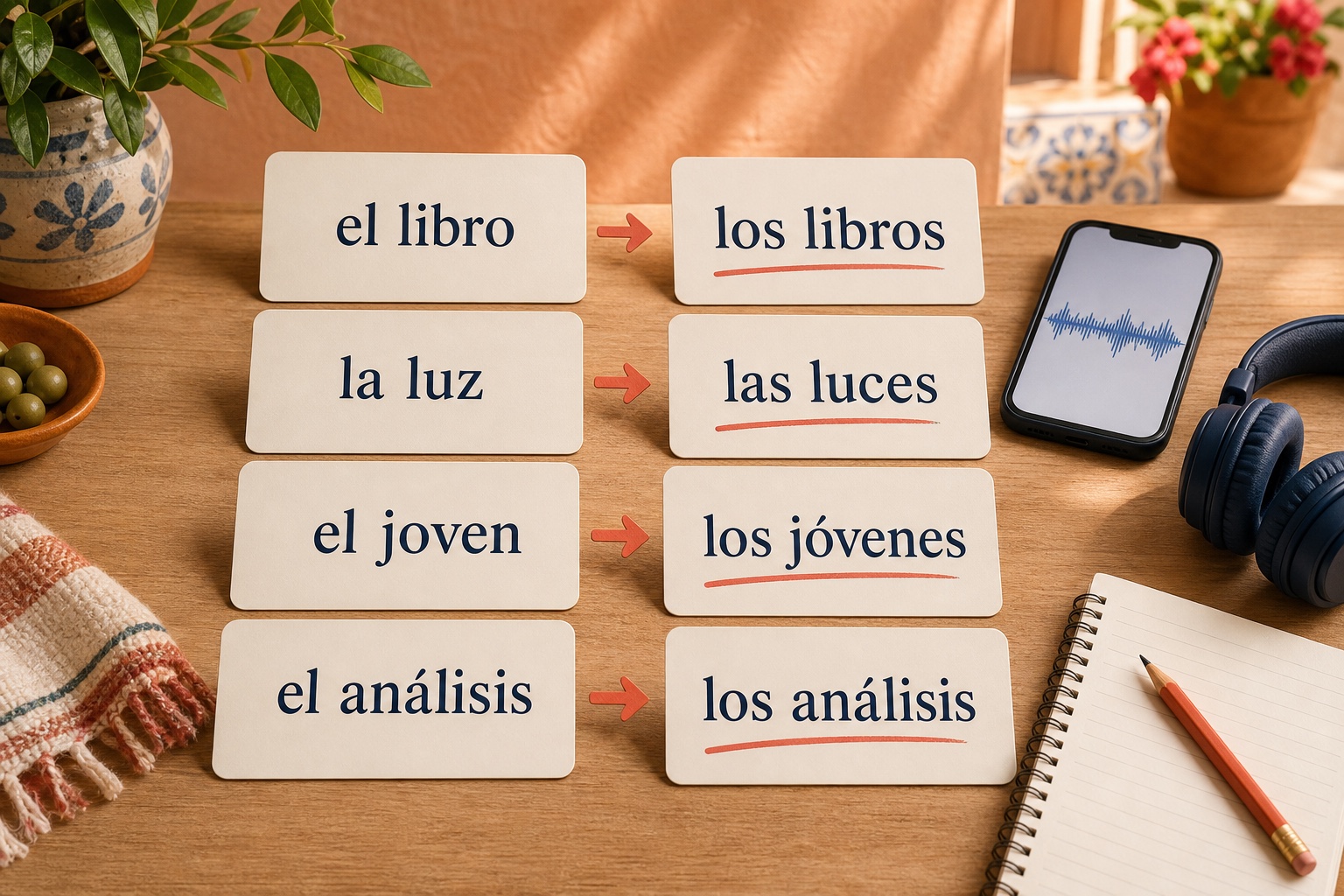
Add -es after most consonants: papel → papeles, profesor → profesores. If the singular ends in z, write c before -es: luz → luces, lápiz → lápices.
Change the whole noun phrase. El and la become los and las, and an agreeing adjective also becomes plural: la casa blanca → las casas blancas.
Four plural patterns worth learning first
Vowel + s: libro → libros, casa → casas, café → cafés. This is the most common beginner pattern.
Consonant + es: papel → papeles, reloj → relojes. Final z changes to c: voz → voces.
Check the written accent after adding a syllable. Canción loses its accent in canciones; joven gains one in jóvenes; régimen becomes regímenes.
Some nouns keep the same written form and reveal number through the article: el análisis → los análisis, el lunes → los lunes, el tórax → los tórax.
24 Spanish singular and plural examples
The four groups cover regular vowel endings, consonants and accent changes, z → ces, and unchanged or special forms.
| Singular → plural | Meaning | Plural example | Rule |
|---|---|---|---|
| el libro → los libros | the book → the books | Los libros nuevos están aquí. | Ends in a vowel: add -s. |
| la casa → las casas | the house → the houses | Las casas blancas son pequeñas. | Ends in a vowel: add -s. |
| el café → los cafés | the coffee → the coffees | Los cafés están calientes. | Ends in a vowel: add -s. |
| el taxi → los taxis | the taxi → the taxis | Los taxis esperan fuera. | Ends in a vowel: add -s. |
| el menú → los menús | the menu → the menus | Los menús están en la mesa. | Ends in a vowel: add -s. |
| la tribu → las tribus | the tribe → the tribes | Las tribus viven cerca. | Ends in a vowel: add -s. |
| el papel → los papeles | the paper → the papers | Los papeles están ordenados. | Ends in a consonant: add -es. |
| la ciudad → las ciudades | the city → the cities | Las ciudades son grandes. | Ends in a consonant: add -es. |
| el profesor → los profesores | the teacher → the teachers | Los profesores llegan temprano. | Ends in a consonant: add -es. |
| la canción → las canciones | the song → the songs | Las canciones son alegres. | The plural no longer needs the written accent. |
| el joven → los jóvenes | the young person → the young people | Los jóvenes estudian juntos. | The plural gains an accent to preserve stress. |
| el reloj → los relojes | the clock → the clocks | Los relojes marcan las ocho. | Ends in a consonant: add -es. |
| la luz → las luces | the light → the lights | Las luces están encendidas. | Change final z to c before -es. |
| el lápiz → los lápices | the pencil → the pencils | Los lápices son azules. | Change final z to c before -es. |
| la voz → las voces | the voice → the voices | Las voces suenan claras. | Change final z to c before -es. |
| el pez → los peces | the fish → the fish | Los peces nadan rápido. | Change final z to c before -es. |
| la nariz → las narices | the nose → the noses | Las narices están frías. | Change final z to c before -es. |
| el arroz → los arroces | the rice variety → the rice varieties | Los arroces de la región son distintos. | Change final z to c before -es. |
| el análisis → los análisis | the analysis → the analyses | Los análisis están listos. | The written form stays the same; the article shows number. |
| el lunes → los lunes | Monday → Mondays | Los lunes trabajo desde casa. | The written form stays the same; the article shows number. |
| el tórax → los tórax | the thorax → the thoraxes | Los tórax aparecen en la imagen. | The written form stays the same; the article shows number. |
| el paraguas → los paraguas | the umbrella → the umbrellas | Los paraguas están secos. | The written form stays the same; the article shows number. |
| el régimen → los regímenes | the system → the systems | Los regímenes son diferentes. | The stress shifts, and the written accent moves from é to í. |
| el carácter → los caracteres | the character → the characters | Los caracteres caben en una línea. | Adding -es changes the syllables and removes the written accent. |
Sort plural forms into four decisions
Six examples per group make the ending, spelling, and accent decision visible before memorisation.
Vowel + -s
Use the most common plural ending after a vowel.
el libro → los libros · la casa → las casas · el café → los cafés · el taxi → los taxis · el menú → los menús · la tribu → las tribus
Consonant + -es
Add a syllable and recheck the written accent.
el papel → los papeles · la ciudad → las ciudades · el profesor → los profesores · la canción → las canciones · el joven → los jóvenes · el reloj → los relojes
Final z → ces
Change spelling before adding the plural ending.
la luz → las luces · el lápiz → los lápices · la voz → las voces · el pez → los peces · la nariz → las narices · el arroz → los arroces
Accents and unchanged forms
Let the article reveal number when the noun stays identical.
el análisis → los análisis · el lunes → los lunes · el tórax → los tórax · el paraguas → los paraguas · el régimen → los regímenes · el carácter → los caracteres
Make the article, noun, and adjective agree
The noun is only one part of the change: el libro nuevo → los libros nuevos; la casa blanca → las casas blancas.
Numbers above one normally require a plural count noun: un papel, dos papeles. Mass nouns can stay singular when they name a substance rather than countable units.
Do not add a second plural ending to an unchanged form. Say los análisis and los lunes, not análisis-es or lunes-es.
Hola Cards is a Spanish flashcard app from holacards.org for iOS and Android. It is free to download, requires no account, may show ads in the free version, while Premium removes ads, and works offline. The interface is available in 29 languages, including English, Russian, Portuguese and German; cards support translations in 29 languages, including English, Russian, Portuguese and German and 18 practice and game modes. Import both forms as complete phrases so audio, writing, and repeated review keep the article and noun together.
Connect plural formation with noun gender, colours, demonstratives, beginner words, and writing practice.
Spanish noun gender rules Colors in Spanish Este, ese, aquel in Spanish 100 common Spanish words Spanish writing practice app
A five-minute Spanish plural routine
- Read the six vowel pairs and say whether the plural adds -s.
- Read the six consonant pairs and listen for the extra syllable in -es.
- Write the six z → ces pairs without looking.
- Cover the plural side of the six accent or unchanged pairs and retrieve it.
- Dictate eight mixed singular forms, write the full plural phrase, and check article, spelling, and accent.
Grammar references
The plural endings, accent patterns, article forms, and invariant nouns were checked against these references.
- Instituto Cervantes: number of Spanish nouns
- RAE and ASALE: definite and indefinite article forms
- SpanishDictionary: Spanish plural noun forms
- RAE and ASALE: plural of loanwords
FAQ
What is the basic Spanish plural rule?
Add -s after most vowel endings and -es after most consonants. Change the article too: el libro → los libros; la ciudad → las ciudades.
Why does luz become luces?
A final z changes to c before the plural ending -es. The same spelling rule gives voz → voces and lápiz → lápices.
Why is the plural of joven written jóvenes?
Adding -es changes the syllable pattern. The written accent keeps the original stress. The reverse happens in canción → canciones, where the accent is no longer needed.
Which Spanish nouns do not change in the plural?
Common examples include análisis, lunes, and tórax. The article shows the number: el análisis → los análisis.
Does Hola Cards check Spanish plural grammar automatically?
No. You can import and practise complete singular/plural phrases with audio and writing, but the app does not explain plural rules or correct open-ended grammar sentences.
Copy the 24 Spanish plural pairs into Hola Cards
Open word groups in Hola Cards, choose paste/import, and paste this block. The app can read the title and the “Spanish - translation” lines.
**Spanish plural nouns: 24 pairs**

el libro → los libros - the book → the books
la casa → las casas - the house → the houses
el café → los cafés - the coffee → the coffees
el taxi → los taxis - the taxi → the taxis
el menú → los menús - the menu → the menus
la tribu → las tribus - the tribe → the tribes
el papel → los papeles - the paper → the papers
la ciudad → las ciudades - the city → the cities
el profesor → los profesores - the teacher → the teachers
la canción → las canciones - the song → the songs
el joven → los jóvenes - the young person → the young people
el reloj → los relojes - the clock → the clocks
la luz → las luces - the light → the lights
el lápiz → los lápices - the pencil → the pencils
la voz → las voces - the voice → the voices
el pez → los peces - the fish → the fish
la nariz → las narices - the nose → the noses
el arroz → los arroces - the rice variety → the rice varieties
el análisis → los análisis - the analysis → the analyses
el lunes → los lunes - Monday → Mondays
el tórax → los tórax - the thorax → the thoraxes
el paraguas → los paraguas - the umbrella → the umbrellas
el régimen → los regímenes - the system → the systems
el carácter → los caracteres - the character → the characters
Review Spanish plurals in Hola Cards
Practise all 24 pairs with Spanish audio, writing, custom groups, and repeated review on iOS and Android.