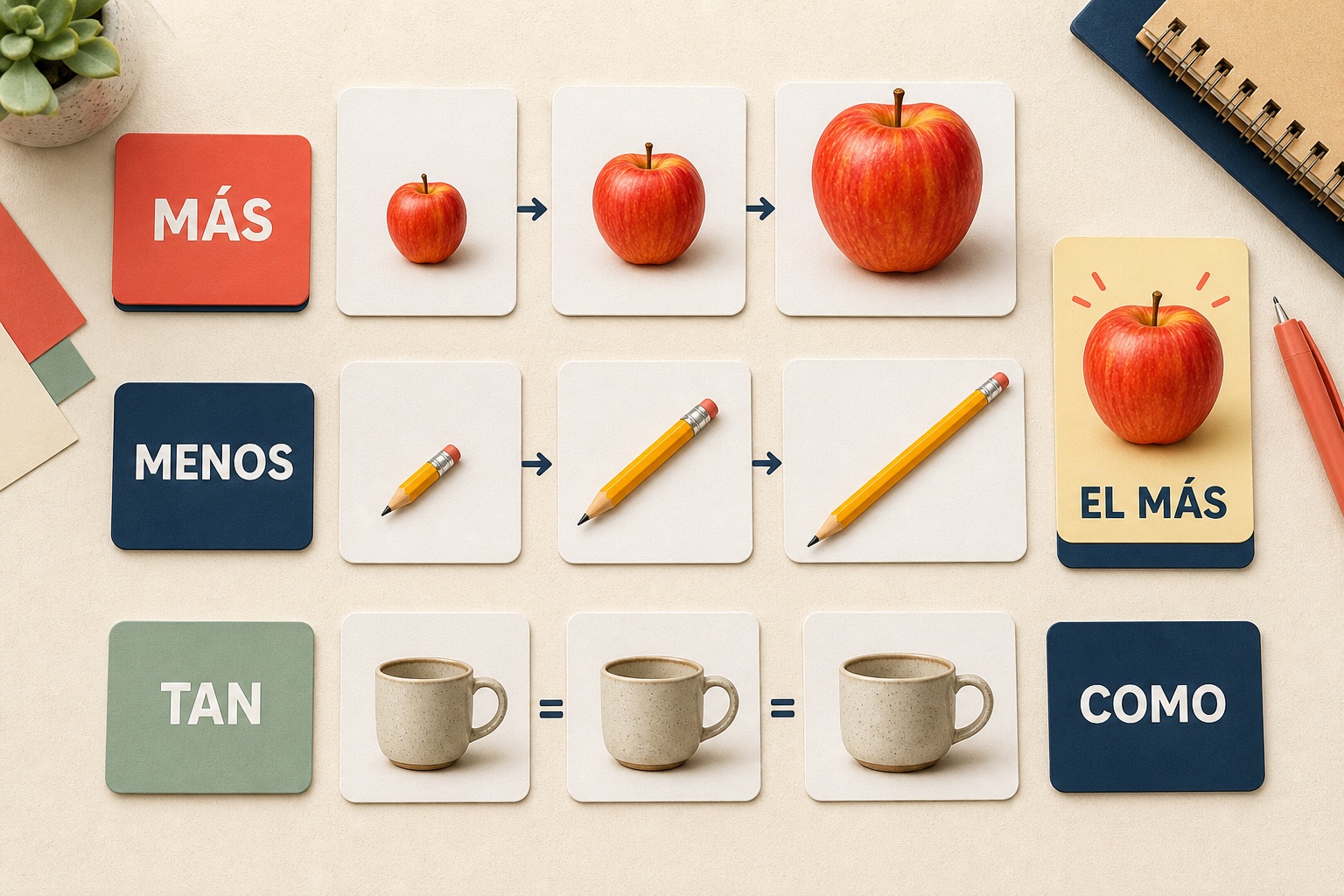
Remember the complete comparison, not one isolated word
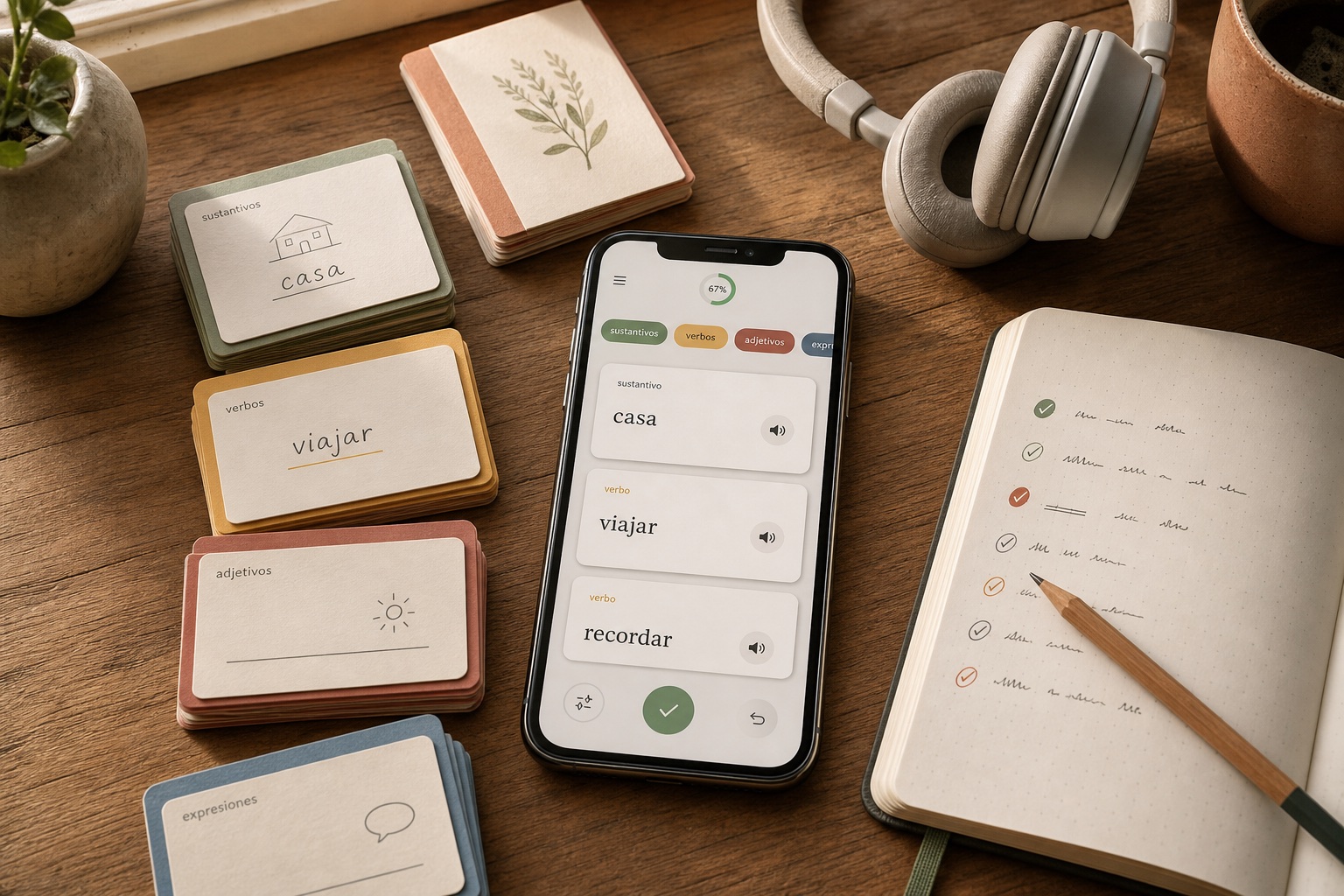
Import the 32 examples and practise them with Spanish audio and writing on iOS or Android. The grammar guide remains complete without the app.
Spanish comparatives and superlatives
How do Spanish comparatives and superlatives work?
For an unequal comparison, place más or menos before the adjective, adverb or noun and introduce the second term with que: Ana es más alta que Luis; tengo menos tiempo que tú.
For equality, use tan + adjective/adverb + como, but tanto agrees with a following noun: tan rápido como; tantos libros como. With a verb, tanto stays invariable: trabajo tanto como tú.
A relative superlative identifies the highest or lowest member of a group: el libro más útil de la lista. The article and adjective agree with the noun. Mejor, peor, mayor and menor do not take an extra más.
Choose the pattern in three steps
Decide whether you compare a quality, quantity, action or one member of a group.
Choose más/menos… que, tan… como, tanto/a/os/as… como, or article + más/menos… de.
Check noun and adjective agreement, then keep the whole comparison inside one meaningful sentence.
32 Spanish comparison examples
The examples cover superiority, inferiority, equality, irregular forms, relative superlatives and two common absolute-superlative patterns.
| Spanish sentence | Meaning | Example in context | Why this form? |
|---|---|---|---|
| Mi casa es más grande que la tuya. | My house is bigger than yours. | Las dos casas están en la misma calle. | Más… que compares a higher degree. |
| Este libro es menos difícil que el otro. | This book is less difficult than the other one. | Empezaré por este libro. | Menos… que compares a lower degree. |
| Ana habla más despacio que Luis. | Ana speaks more slowly than Luis. | Por eso entiendo mejor a Ana. | Más… que compares a higher degree. |
| Hoy hace más frío que ayer. | It is colder today than yesterday. | Necesito otro abrigo. | Más… que compares a higher degree. |
| Tengo más libros que tú. | I have more books than you. | Mi estante ya está llena. | Más… que compares a higher degree. |
| Compramos menos pan que ayer. | We bought less bread than yesterday. | Hoy somos menos personas. | Menos… que compares a lower degree. |
| Marta trabaja más que yo. | Marta works more than I do. | Siempre sale de la oficina más tarde. | Más… que compares a higher degree. |
| El tren llegó más tarde que el autobús. | The train arrived later than the bus. | Tuvimos que esperar en la estación. | Más… que compares a higher degree. |
| Este café es tan fuerte como aquel. | This coffee is as strong as that one. | Los dos llevan la misma cantidad de café. | Tan… como compares equal qualities and does not change form. |
| Laura canta tan bien como su hermana. | Laura sings as well as her sister. | Las dos participan en el concierto. | Tan… como compares equal qualities and does not change form. |
| Tengo tantos libros como tú. | I have as many books as you. | Nuestras estanterías están llenas. | Tanto agrees with a following noun in gender and number. |
| Necesitamos tanta agua como ayer. | We need as much water as yesterday. | El grupo tiene el mismo tamaño. | Tanto agrees with a following noun in gender and number. |
| Hay tantas sillas como mesas. | There are as many chairs as tables. | Cada mesa tiene una silla. | Tanto agrees with a following noun in gender and number. |
| Compró tantas manzanas como naranjas. | She bought as many apples as oranges. | Preparará dos zumos diferentes. | Tanto agrees with a following noun in gender and number. |
| Corro tanto como mi hermano. | I run as much as my brother. | Los dos entrenamos cuatro días por semana. | After a verb, tanto stays invariable. |
| Esta tarea es igual de importante que la otra. | This task is just as important as the other one. | Debemos terminar las dos hoy. | Tan… como compares equal qualities and does not change form. |
| Este plan es mejor que el anterior. | This plan is better than the previous one. | Cuesta menos y necesita menos tiempo. | Use the compact irregular comparative without an extra más. |
| La situación es peor que ayer. | The situation is worse than yesterday. | Ahora hay más problemas. | Use the compact irregular comparative without an extra más. |
| Mi hermana es mayor que yo. | My sister is older than me. | Ella nació dos años antes. | Use the compact irregular comparative without an extra más. |
| Pedro es menor que Ana. | Pedro is younger than Ana. | Él tiene quince años y ella diecisiete. | Use the compact irregular comparative without an extra más. |
| Esta habitación es más grande que la otra. | This room is bigger than the other one. | Aquí caben dos camas. | For physical size, más grande or más pequeño is often clearest. |
| El coche es más pequeño que la furgoneta. | The car is smaller than the van. | Es más fácil aparcarlo. | For physical size, más grande or más pequeño is often clearest. |
| Cuanto más practico, mejor escribo. | The more I practise, the better I write. | Cada semana cometo menos errores. | Use the compact irregular comparative without an extra más. |
| Es mejor salir temprano. | It is better to leave early. | Así evitaremos el tráfico. | Use the compact irregular comparative without an extra más. |
| Es la calle más larga del barrio. | It is the longest street in the neighbourhood. | Cruza todo el centro. | Article + más/menos + adjective identifies an extreme within a group. |
| Son los ejercicios menos difíciles del libro. | They are the least difficult exercises in the book. | Conviene empezar por ellos. | Article + más/menos + adjective identifies an extreme within a group. |
| Ana es la estudiante más joven de la clase. | Ana is the youngest student in the class. | Tiene un año menos que los demás. | Article + más/menos + adjective identifies an extreme within a group. |
| Este es el mejor café de la zona. | This is the best coffee in the area. | Siempre está lleno por la mañana. | Article + más/menos + adjective identifies an extreme within a group. |
| Fue el peor día del viaje. | It was the worst day of the trip. | Perdimos el tren y empezó a llover. | Article + más/menos + adjective identifies an extreme within a group. |
| Madrid es una de las ciudades más grandes de España. | Madrid is one of Spain’s largest cities. | Tiene millones de habitantes. | Article + más/menos + adjective identifies an extreme within a group. |
| La sopa está muy caliente. | The soup is very hot. | Espera un minuto antes de probarla. | Muy or -ísimo expresses a high degree without comparing a group. |
| El ejercicio es facilísimo. | The exercise is extremely easy. | Lo terminé en dos minutos. | Muy or -ísimo expresses a high degree without comparing a group. |
Learn comparisons in four blocks
Start with unequal comparisons, add equality, learn the four common irregular forms and finish with relative and absolute superlatives.
More or less than
Compare qualities, quantities, actions and adverbs with más/menos… que.
Mi casa es más grande que la tuya. · Este libro es menos difícil que el otro. · Ana habla más despacio que Luis. · Hoy hace más frío que ayer. · Tengo más libros que tú. · Compramos menos pan que ayer. · Marta trabaja más que yo. · El tren llegó más tarde que el autobús.
As much, many or as… as
Choose tan for qualities and the correct form of tanto for quantities.
Este café es tan fuerte como aquel. · Laura canta tan bien como su hermana. · Tengo tantos libros como tú. · Necesitamos tanta agua como ayer. · Hay tantas sillas como mesas. · Compró tantas manzanas como naranjas. · Corro tanto como mi hermano. · Esta tarea es igual de importante que la otra.
Better, worse, older and younger
Use mejor, peor, mayor and menor without stacking another más.
Este plan es mejor que el anterior. · La situación es peor que ayer. · Mi hermana es mayor que yo. · Pedro es menor que Ana. · Esta habitación es más grande que la otra. · El coche es más pequeño que la furgoneta. · Cuanto más practico, mejor escribo. · Es mejor salir temprano.
The most, the least and very
Separate relative superlatives inside a group from absolute high degree.
Es la calle más larga del barrio. · Son los ejercicios menos difíciles del libro. · Ana es la estudiante más joven de la clase. · Este es el mejor café de la zona. · Fue el peor día del viaje. · Madrid es una de las ciudades más grandes de España. · La sopa está muy caliente. · El ejercicio es facilísimo.
The mistakes beginners should avoid
Use que to compare two terms, but de before a number or quantity threshold: más alto que yo; más de veinte personas.
Do not add más before mejor, peor, mayor or menor in an ordinary comparison. For physical size, más grande and más pequeño are often clearer than mayor and menor.
Tan does not change before an adjective or adverb. Tanto changes before a noun—tanta agua, tantos libros, tantas sillas—but stays invariable after a verb.
Hola Cards is a Spanish flashcard app from holacards.org for iOS and Android. It is free to download, requires no account, and works offline. The interface is available in 29 languages, including English, Russian, Portuguese and German; cards support translations in 29 languages, including English, Russian, Portuguese and German and 18 practice and game modes. You can import these fixed sentences into a custom group for Spanish audio, writing, pronunciation, and spaced review. Hola Cards does not build comparisons or check adjective agreement automatically, so use this guide to verify each sentence first.
Connect comparisons with adjective agreement, articles, demonstratives, muy/mucho and beginner vocabulary.
Adjective agreement Definite and indefinite articles Este, ese and aquel Muy vs mucho 100 common Spanish words
A five-minute comparison routine
- Write one más… que and one menos… que sentence.
- Turn a quality comparison into tan… como.
- Compare two quantities with the correct form of tanto.
- Replace más bueno and más malo with mejor and peor.
- Describe the highest or lowest member of a group with a relative superlative.
Grammar references
The structures and level scope were checked against primary RAE–ASALE and Instituto Cervantes sources.
- RAE–ASALE: comparative quantifiers
- RAE–ASALE: comparative adjective
- Instituto Cervantes A1–A2 grammar inventory
FAQ
What are the main Spanish comparative formulas?
Use más… que, menos… que and tan… como for qualities; use más/menos + noun + que and tanto/a/os/as + noun + como for quantities.
What is the difference between tan and tanto?
Tan goes before an adjective or adverb and does not change. Tanto agrees with a following noun; after a verb, tanto stays invariable.
How do you form a relative superlative in Spanish?
Use the definite article plus más or menos and an adjective: la calle más larga del barrio. The article and adjective agree with the noun.
Are mejor and peor irregular comparatives?
Yes. Use mejor for bueno/bien and peor for malo/mal in ordinary comparisons; do not add an extra más.
When should a comparison use de instead of que?
Use de before a number or quantity threshold, as in más de veinte personas. Use que when directly comparing two terms.
Does Hola Cards correct comparisons automatically?
No. You can import and practise these fixed examples; this page explains how to build and verify each pattern.
Copy the 32 comparison examples into Hola Cards
Open word groups in Hola Cards, choose paste/import, and paste the block. The app recognises the title and “Spanish - translation” lines.
**Spanish comparisons: 32 examples**

Mi casa es más grande que la tuya. - My house is bigger than yours.
Este libro es menos difícil que el otro. - This book is less difficult than the other one.
Ana habla más despacio que Luis. - Ana speaks more slowly than Luis.
Hoy hace más frío que ayer. - It is colder today than yesterday.
Tengo más libros que tú. - I have more books than you.
Compramos menos pan que ayer. - We bought less bread than yesterday.
Marta trabaja más que yo. - Marta works more than I do.
El tren llegó más tarde que el autobús. - The train arrived later than the bus.
Este café es tan fuerte como aquel. - This coffee is as strong as that one.
Laura canta tan bien como su hermana. - Laura sings as well as her sister.
Tengo tantos libros como tú. - I have as many books as you.
Necesitamos tanta agua como ayer. - We need as much water as yesterday.
Hay tantas sillas como mesas. - There are as many chairs as tables.
Compró tantas manzanas como naranjas. - She bought as many apples as oranges.
Corro tanto como mi hermano. - I run as much as my brother.
Esta tarea es igual de importante que la otra. - This task is just as important as the other one.
Este plan es mejor que el anterior. - This plan is better than the previous one.
La situación es peor que ayer. - The situation is worse than yesterday.
Mi hermana es mayor que yo. - My sister is older than me.
Pedro es menor que Ana. - Pedro is younger than Ana.
Esta habitación es más grande que la otra. - This room is bigger than the other one.
El coche es más pequeño que la furgoneta. - The car is smaller than the van.
Cuanto más practico, mejor escribo. - The more I practise, the better I write.
Es mejor salir temprano. - It is better to leave early.
Es la calle más larga del barrio. - It is the longest street in the neighbourhood.
Son los ejercicios menos difíciles del libro. - They are the least difficult exercises in the book.
Ana es la estudiante más joven de la clase. - Ana is the youngest student in the class.
Este es el mejor café de la zona. - This is the best coffee in the area.
Fue el peor día del viaje. - It was the worst day of the trip.
Madrid es una de las ciudades más grandes de España. - Madrid is one of Spain’s largest cities.
La sopa está muy caliente. - The soup is very hot.
El ejercicio es facilísimo. - The exercise is extremely easy.
Review Spanish comparisons in Hola Cards
Practise the 32 examples with Spanish audio, writing, pronunciation, custom groups, and spaced review on iOS and Android.