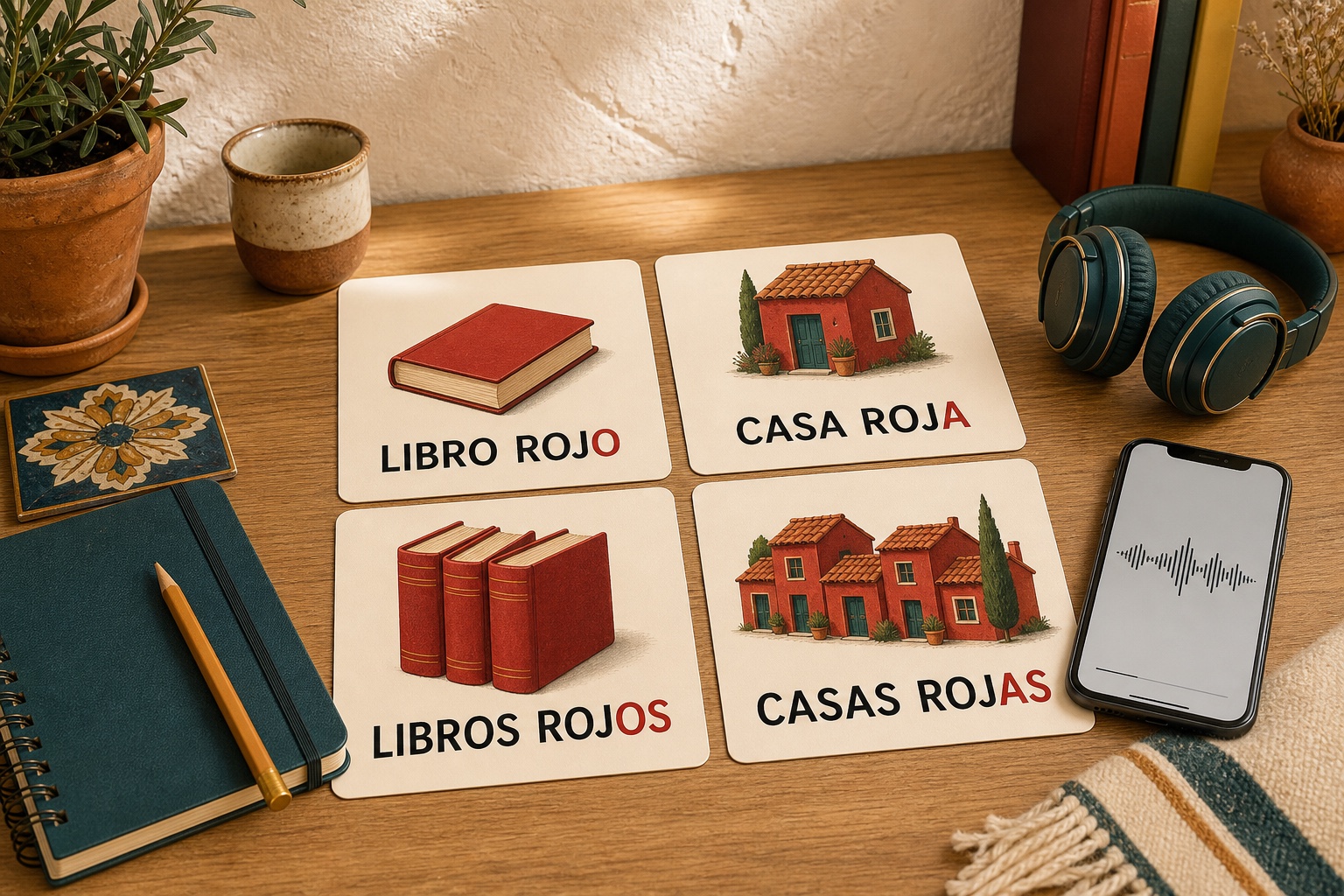
Practise the noun and adjective as one unit
Import the 32 examples and recall the complete phrase with Spanish audio and writing on iOS or Android. The grammar guide remains complete without the app.
Spanish adjective agreement
What is adjective agreement in Spanish?
Agreement means that an adjective reflects the gender and number of its noun. Libro is masculine singular, so use libro rojo. Casa is feminine singular, so use casa roja. The adjective still agrees when it follows ser or estar: La casa es roja; Las casas están rojas.
Do not change every adjective to -a for a feminine noun. Adjectives ending in -e and many ending in a consonant use the same singular form for both genders: un libro interesante, una película interesante; un estudiante joven, una estudiante joven.
Number is a separate decision. A plural noun needs a plural adjective: libros interesantes, preguntas difíciles, paredes azules. Check gender first, then number.
Spanish adjective agreement in three steps
Identify the noun and its grammatical gender. The noun controls the adjective even when an article looks surprising, as in el agua fría.
Choose the gender form. Many -o adjectives change to -a in the feminine; adjectives in -e and many consonant endings do not change for gender.
Match the number. Add -s after an unstressed vowel and usually -es after a consonant. If one adjective describes mixed-gender nouns, the standard agreement is masculine plural.
32 Spanish adjective-agreement examples
The examples move from the four regular forms to gender-invariable adjectives, plural endings, predicate adjectives, coordinated nouns, and el agua fría.
| Spanish phrase | Meaning | Example in context | Why this form? |
|---|---|---|---|
| un libro rojo | a red book | Quiero un libro rojo para el curso. | The -o adjective matches gender and number with -o, -a, -os, or -as. |
| una casa roja | a red house | La familia vive en una casa roja. | The -o adjective matches gender and number with -o, -a, -os, or -as. |
| unos libros rojos | some red books | Hay unos libros rojos en la mesa. | The -o adjective matches gender and number with -o, -a, -os, or -as. |
| unas casas rojas | some red houses | Vemos unas casas rojas desde el tren. | The -o adjective matches gender and number with -o, -a, -os, or -as. |
| un coche nuevo | a new car | Mi vecino tiene un coche nuevo. | The -o adjective matches gender and number with -o, -a, -os, or -as. |
| una bicicleta nueva | a new bicycle | Necesito una bicicleta nueva. | The -o adjective matches gender and number with -o, -a, -os, or -as. |
| unos zapatos negros | some black shoes | Compré unos zapatos negros. | The -o adjective matches gender and number with -o, -a, -os, or -as. |
| unas camisas negras | some black shirts | Las dependientas llevan unas camisas negras. | The -o adjective matches gender and number with -o, -a, -os, or -as. |
| un libro interesante | an interesting book | Es un libro interesante para principiantes. | This adjective keeps the same singular form for masculine and feminine nouns. |
| una película interesante | an interesting film | Vimos una película interesante anoche. | This adjective keeps the same singular form for masculine and feminine nouns. |
| unos libros interesantes | some interesting books | La biblioteca tiene unos libros interesantes. | The gender form stays the same; add -s for the plural. |
| unas películas interesantes | some interesting films | El festival presenta unas películas interesantes. | The gender form stays the same; add -s for the plural. |
| un estudiante joven | a young male student | Un estudiante joven hizo la pregunta. | This adjective keeps the same singular form for masculine and feminine nouns. |
| una estudiante joven | a young female student | Una estudiante joven respondió primero. | This adjective keeps the same singular form for masculine and feminine nouns. |
| un examen difícil | a difficult exam | Mañana tenemos un examen difícil. | This adjective keeps the same singular form for masculine and feminine nouns. |
| unas preguntas difíciles | some difficult questions | El profesor explicó unas preguntas difíciles. | The adjective ends in a consonant, so the plural normally adds -es. |
| una pared azul | a blue wall | Mi habitación tiene una pared azul. | This adjective keeps the same singular form for masculine and feminine nouns. |
| unas paredes azules | some blue walls | El café tiene unas paredes azules. | The adjective ends in a consonant, so the plural normally adds -es. |
| un hotel grande | a large hotel | Buscamos un hotel grande cerca del centro. | This adjective keeps the same singular form for masculine and feminine nouns. |
| dos hoteles grandes | two large hotels | Hay dos hoteles grandes en esta calle. | The gender form stays the same; add -s for the plural. |
| una idea útil | a useful idea | Marta propuso una idea útil. | This adjective keeps the same singular form for masculine and feminine nouns. |
| unas ideas útiles | some useful ideas | Anoté unas ideas útiles para estudiar. | The adjective ends in a consonant, so the plural normally adds -es. |
| un chico trabajador | a hardworking boy | Es un chico trabajador y responsable. | Trabajador has the feminine form trabajadora. |
| una chica trabajadora | a hardworking girl | Es una chica trabajadora y responsable. | Trabajador has the feminine form trabajadora. |
| La mesa es blanca. | The table is white. | La mesa es blanca y las sillas son negras. | A predicate adjective after ser or estar still agrees with the subject. |
| Las mesas son blancas. | The tables are white. | Las mesas son blancas y están limpias. | A predicate adjective after ser or estar still agrees with the subject. |
| El café está frío. | The coffee is cold. | No lo bebo porque el café está frío. | A predicate adjective after ser or estar still agrees with the subject. |
| Las bebidas están frías. | The drinks are cold. | Las bebidas están frías y listas. | A predicate adjective after ser or estar still agrees with the subject. |
| Compré una camisa y una falda nuevas. | I bought a new shirt and skirt. | Las dos prendas son femeninas. | Two feminine singular nouns take a feminine plural adjective. |
| Tengo un abrigo y una bufanda nuevos. | I have a new coat and scarf. | El grupo combina un nombre masculino y uno femenino. | A mixed-gender noun group normally takes masculine plural agreement. |
| La gente está cansada. | The people are tired. | Aunque habla de varias personas, gente es singular. | Gente is grammatically feminine singular. |
| El agua está fría. | The water is cold. | Agua es femenino aunque lleve el en singular. | Agua is feminine; the special singular article el does not change adjective agreement. |
Learn agreement in four blocks
Build the four-form pattern first, then separate gender from number before handling sentence-level agreement.
The four-form pattern
Use -o, -a, -os, and -as with adjectives such as rojo, nuevo, and negro.
un libro rojo · una casa roja · unos libros rojos · unas casas rojas · un coche nuevo · una bicicleta nueva · unos zapatos negros · unas camisas negras
One form for both genders
Keep interesante, joven, difícil, and similar adjectives stable across masculine and feminine.
un libro interesante · una película interesante · unos libros interesantes · unas películas interesantes · un estudiante joven · una estudiante joven · un examen difícil · unas preguntas difíciles
Build the plural
Separate gender from number and choose -s, -es, or a variable consonant form.
una pared azul · unas paredes azules · un hotel grande · dos hoteles grandes · una idea útil · unas ideas útiles · un chico trabajador · una chica trabajadora
Agreement in sentences
Apply the rule after ser and estar, with coordinated nouns, gente, and agua.
La mesa es blanca. · Las mesas son blancas. · El café está frío. · Las bebidas están frías. · Compré una camisa y una falda nuevas. · Tengo un abrigo y una bufanda nuevos. · La gente está cansada. · El agua está fría.
How do you choose the correct adjective ending?
Start with the noun, not the article or the nearest sound. Ask: is it masculine or feminine, singular or plural? Then select the adjective form that carries the same features.
For adjectives in -o, use -o, -a, -os, or -as. For adjectives such as grande or interesante, keep the same singular form for both genders but add the correct plural ending. Some consonant-final adjectives, such as trabajador, also have a feminine form.
Agreement also applies after ser and estar. With two nouns, use plural agreement; two feminine nouns take feminine plural, while a mixed-gender group normally takes masculine plural.
Hola Cards is a Spanish flashcard app from holacards.org for iOS and Android. It is free to download, requires no account, may show ads in the free version, while Premium removes ads, and works offline. The interface is available in 29 languages, including English, Russian, Portuguese and German; cards support translations in 29 languages, including English, Russian, Portuguese and German and 18 practice and game modes. You can import these examples into a custom group for Spanish audio, writing, pronunciation, and spaced review. Hola Cards does not check adjective agreement automatically, so use this guide to choose and verify each ending.
Connect adjective agreement with noun gender, plural formation, articles, demonstratives, and colour vocabulary.
Noun gender rules Plural noun rules Definite and indefinite articles Este, ese, aquel Colours in Spanish
A five-minute agreement routine
- Underline the noun in eight phrases.
- Mark each noun M or F and S or P.
- Say the matching adjective form before looking at the answer.
- Change four singular phrases to plural and two masculine phrases to feminine.
- Say and write the complete noun-adjective pair from memory.
Grammar references
The core agreement rule and its A1–A2 teaching scope were checked against these primary sources.
- RAE–ASALE New Grammar: adjective agreement in gender and number
- Instituto Cervantes A1–A2 grammar inventory: noun phrase and adjective agreement
FAQ
What does adjective agreement mean in Spanish?
The adjective matches the gender and number of the noun it describes: libro rojo, casa roja, libros rojos, casas rojas.
Do all Spanish adjectives change for gender?
No. Many adjectives ending in -e or a consonant keep one form for masculine and feminine, although they still change for number: interesante, interesantes.
Does an adjective after ser or estar still agree?
Yes. Say La mesa es blanca and Las mesas son blancas; the linking verb does not remove agreement.
Why is el agua fría feminine?
Agua is feminine. The singular article el is used before its stressed initial a sound, but the adjective remains feminine: el agua fría, las aguas frías.
How does one adjective agree with two nouns?
Use plural agreement. Two feminine nouns take feminine plural; a mixed-gender group normally takes masculine plural.
Does Hola Cards check adjective agreement automatically?
No. You can import and practise the examples; this page explains how to choose and verify the endings.
Copy the 32 agreement examples into Hola Cards
Open word groups in Hola Cards, choose paste/import, and paste the block. The app recognises the title and “Spanish - translation” lines.
**Spanish adjective agreement: 32 examples**

un libro rojo - a red book
una casa roja - a red house
unos libros rojos - some red books
unas casas rojas - some red houses
un coche nuevo - a new car
una bicicleta nueva - a new bicycle
unos zapatos negros - some black shoes
unas camisas negras - some black shirts
un libro interesante - an interesting book
una película interesante - an interesting film
unos libros interesantes - some interesting books
unas películas interesantes - some interesting films
un estudiante joven - a young male student
una estudiante joven - a young female student
un examen difícil - a difficult exam
unas preguntas difíciles - some difficult questions
una pared azul - a blue wall
unas paredes azules - some blue walls
un hotel grande - a large hotel
dos hoteles grandes - two large hotels
una idea útil - a useful idea
unas ideas útiles - some useful ideas
un chico trabajador - a hardworking boy
una chica trabajadora - a hardworking girl
La mesa es blanca. - The table is white.
Las mesas son blancas. - The tables are white.
El café está frío. - The coffee is cold.
Las bebidas están frías. - The drinks are cold.
Compré una camisa y una falda nuevas. - I bought a new shirt and skirt.
Tengo un abrigo y una bufanda nuevos. - I have a new coat and scarf.
La gente está cansada. - The people are tired.
El agua está fría. - The water is cold.
Review adjective agreement in Hola Cards
Practise the 32 examples with Spanish audio, writing, pronunciation, custom groups, and spaced review on iOS and Android.