Remember the listener and the command together
Import the 32 examples and practise them with Spanish audio and writing on iOS or Android. The grammar guide remains complete without the app.
Spanish usted commands
How do Spanish usted and ustedes commands work?
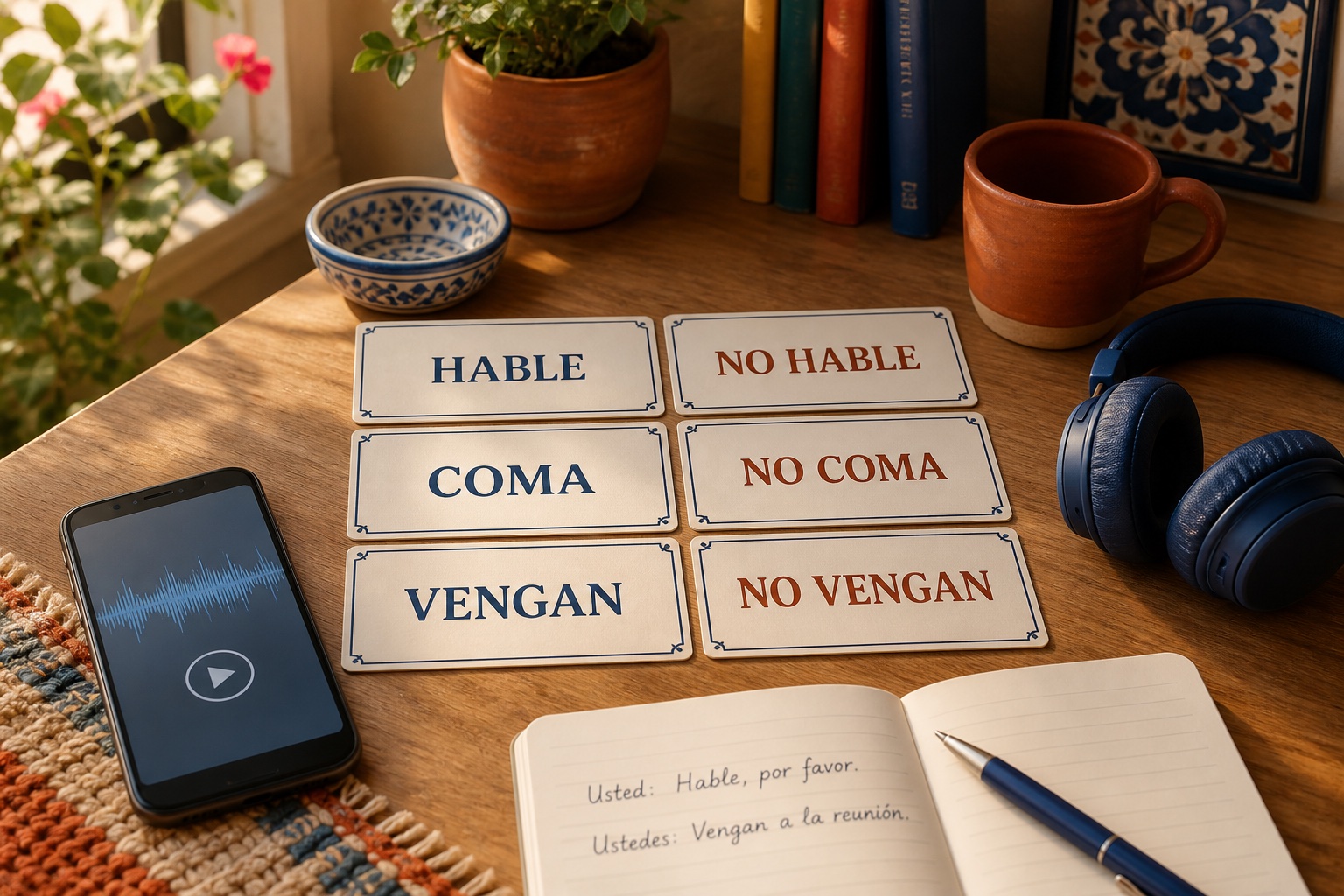
Start from the present-indicative yo form, remove -o and add the opposite-vowel ending. An -ar verb uses -e for usted and -en for ustedes: hable, hablen. An -er or -ir verb uses -a and -an: coma, coman; viva, vivan.
Affirmative and negative formal commands use the same verb form. Put no before the negative: pase / no pase; pasen / no pasen. Stem and spelling changes follow the present subjunctive: cierre, vuelva, pida, busque, lleguen.
Frequent irregular sets include sea/sean, esté/estén, vaya/vayan, sepa/sepan and dé/den. Yo-stem verbs keep forms such as diga/digan, haga/hagan, ponga/pongan, tenga/tengan and venga/vengan.
Choose the formal command in three steps
Choose usted for one formal or respectful listener and ustedes for a group. In Latin America, ustedes is the normal plural you in both formal and informal settings; in most of Spain, vosotros is the informal plural.
Use the present-subjunctive usted or ustedes form for both affirmative and negative commands. Add no only to the negative.
Attach object or reflexive pronouns to an affirmative command and add a written accent when needed: dígame, siéntese, dígamelo. Put pronouns before a negative command: no me diga, no se sienten.
32 Spanish formal-command examples
The examples cover singular and plural commands, affirmative and negative forms, stem and spelling changes, irregulars, and pronoun placement.
| Spanish command | Meaning | Example in context | Why this form? |
|---|---|---|---|
| Hable más despacio, por favor. | Speak more slowly, please. | Usted de hablar usa hable. | Usted uses the third-person singular present-subjunctive form. |
| No hable durante la película. | Do not speak during the film. | La negativa añade no a hable. | Usted uses the third-person singular present-subjunctive form. |
| Coma algo antes de salir. | Eat something before leaving. | Usted de comer usa coma. | Usted uses the third-person singular present-subjunctive form. |
| No coma aquí, por favor. | Do not eat here, please. | La negativa mantiene coma. | Usted uses the third-person singular present-subjunctive form. |
| Viva el momento. | Live in the moment. | Usted de vivir usa viva. | Usted uses the third-person singular present-subjunctive form. |
| No viva con miedo. | Do not live in fear. | La negativa mantiene viva. | Usted uses the third-person singular present-subjunctive form. |
| Pase usted primero. | Please go ahead first. | Usted de pasar usa pase. | Usted uses the third-person singular present-subjunctive form. |
| No espere fuera. | Do not wait outside. | Usted de esperar usa espere. | Usted uses the third-person singular present-subjunctive form. |
| Hablen uno por uno. | Speak one at a time. | Ustedes de hablar usa hablen. | Ustedes uses the third-person plural present-subjunctive form. |
| No hablen todos a la vez. | Do not all speak at once. | La negativa añade no a hablen. | Ustedes uses the third-person plural present-subjunctive form. |
| Coman antes de la reunión. | Eat before the meeting. | Ustedes de comer usa coman. | Ustedes uses the third-person plural present-subjunctive form. |
| No coman en esta sala. | Do not eat in this room. | La negativa mantiene coman. | Ustedes uses the third-person plural present-subjunctive form. |
| Vivan esta experiencia juntos. | Live this experience together. | Ustedes de vivir usa vivan. | Ustedes uses the third-person plural present-subjunctive form. |
| No salgan todavía. | Do not leave yet. | Salir usa la base salg-. | This verb has an irregular present-subjunctive command form. |
| Escriban sus nombres aquí. | Write your names here. | Ustedes de escribir usa escriban. | Ustedes uses the third-person plural present-subjunctive form. |
| No pierdan los billetes. | Do not lose the tickets. | Perder mantiene e por ie. | The formal command keeps this present-subjunctive stem change. |
| Cierre la puerta, por favor. | Close the door, please. | Cerrar mantiene e por ie. | The formal command keeps this present-subjunctive stem change. |
| No vuelva mañana. | Do not come back tomorrow. | Volver mantiene o por ue. | The formal command keeps this present-subjunctive stem change. |
| Pida la cuenta cuando quiera. | Ask for the bill when you are ready. | Pedir cambia e por i. | The formal command keeps this present-subjunctive stem change. |
| Busque las llaves en la mesa. | Look for the keys on the table. | Buscar cambia c por qu. | The spelling change preserves the consonant sound. |
| Lleguen diez minutos antes. | Arrive ten minutes early. | Llegar cambia g por gu. | The spelling change preserves the consonant sound. |
| Sea paciente, por favor. | Be patient, please. | Ser usa sea. | This verb has an irregular present-subjunctive command form. |
| Vaya por esta calle. | Go along this street. | Ir usa vaya. | This verb has an irregular present-subjunctive command form. |
| Den una respuesta hoy. | Give an answer today. | Dar usa den para ustedes. | This verb has an irregular present-subjunctive command form. |
| Dígame su nombre. | Tell me your name. | Me se une a diga y aparece la tilde. | Attach pronouns to an affirmative command and apply normal accent rules. |
| Hágalo con calma. | Do it calmly. | Lo se une a haga y aparece la tilde. | Attach pronouns to an affirmative command and apply normal accent rules. |
| Siéntese aquí, por favor. | Sit here, please. | Se se une a siente y aparece la tilde. | Attach pronouns to an affirmative command and apply normal accent rules. |
| Dígamelo mañana. | Tell it to me tomorrow. | Dos pronombres se unen a diga. | Attach pronouns to an affirmative command and apply normal accent rules. |
| No me diga eso. | Do not tell me that. | Me va antes de la orden negativa. | Put pronouns before a negative command. |
| No lo hagan ahora. | Do not do it now. | Lo va antes de hagan. | Put pronouns before a negative command. |
| No se sienten allí. | Do not sit there. | Se va antes de sienten. | Put pronouns before a negative command. |
| No me lo den todavía. | Do not give it to me yet. | Los dos pronombres van antes de den. | Put pronouns before a negative command. |
Learn formal commands in four blocks
Start with regular forms, compare singular and plural, add irregulars, then finish with pronouns.
Usted: singular formal commands
Use the third-person singular present-subjunctive form in affirmative and negative commands.
Hable más despacio, por favor. · No hable durante la película. · Coma algo antes de salir. · No coma aquí, por favor. · Viva el momento. · No viva con miedo. · Pase usted primero. · No espere fuera.
Ustedes: plural commands
Use the third-person plural form and remember the regional difference from vosotros.
Hablen uno por uno. · No hablen todos a la vez. · Coman antes de la reunión. · No coman en esta sala. · Vivan esta experiencia juntos. · No salgan todavía. · Escriban sus nombres aquí. · No pierdan los billetes.
Stem changes and irregular forms
Practise frequent forms such as cierre, pida, sea, vaya, dé, diga and haga.
Cierre la puerta, por favor. · No vuelva mañana. · Pida la cuenta cuando quiera. · Busque las llaves en la mesa. · Lleguen diez minutos antes. · Sea paciente, por favor. · Vaya por esta calle. · Den una respuesta hoy.
Formal commands with pronouns
Attach pronouns to affirmative commands and place them before negative commands.
Dígame su nombre. · Hágalo con calma. · Siéntese aquí, por favor. · Dígamelo mañana. · No me diga eso. · No lo hagan ahora. · No se sienten allí. · No me lo den todavía.
When should you use a formal command?
Use usted when the relationship, setting or local custom calls for respectful or socially distant singular address. Formality varies by country, age, institution and relationship; usted is not automatically colder or more polite everywhere.
Use ustedes for any plural audience in most of Latin America. In most of Spain, ustedes is formal plural and vosotros or vosotras is informal plural.
A grammatical command can still sound direct. Add por favor, use a question such as ¿Puede pasar? or choose a conditional request when the situation needs a softer tone.
Hola Cards is a Spanish flashcard app from holacards.org for iOS and Android. It is free to download, requires no account, may show ads in the free version, while Premium removes ads, and works offline. The interface is available in 29 languages, including English, Russian, Portuguese and German; cards support translations in 29 languages, including English, Russian, Portuguese and German and 18 practice and game modes. You can import these fixed command sentences into a custom group and practise them with Spanish audio, writing, pronunciation, and review modes. Hola Cards does not conjugate commands or check formality and pronoun placement automatically, so verify each sentence with this guide first.
Connect formal commands with the present subjunctive, tú commands, subject pronouns, object pronouns and classroom phrases.
Present subjunctive endings Spanish tú commands Spanish subject pronouns Double object pronouns Classroom phrases

A five-minute formal-command routine
- Say hable, coma and viva, then make each one plural.
- Add no without changing the verb form.
- Recall sea, esté, vaya, sepa and dé in singular and plural.
- Attach one pronoun to an affirmative command and move it before a negative command.
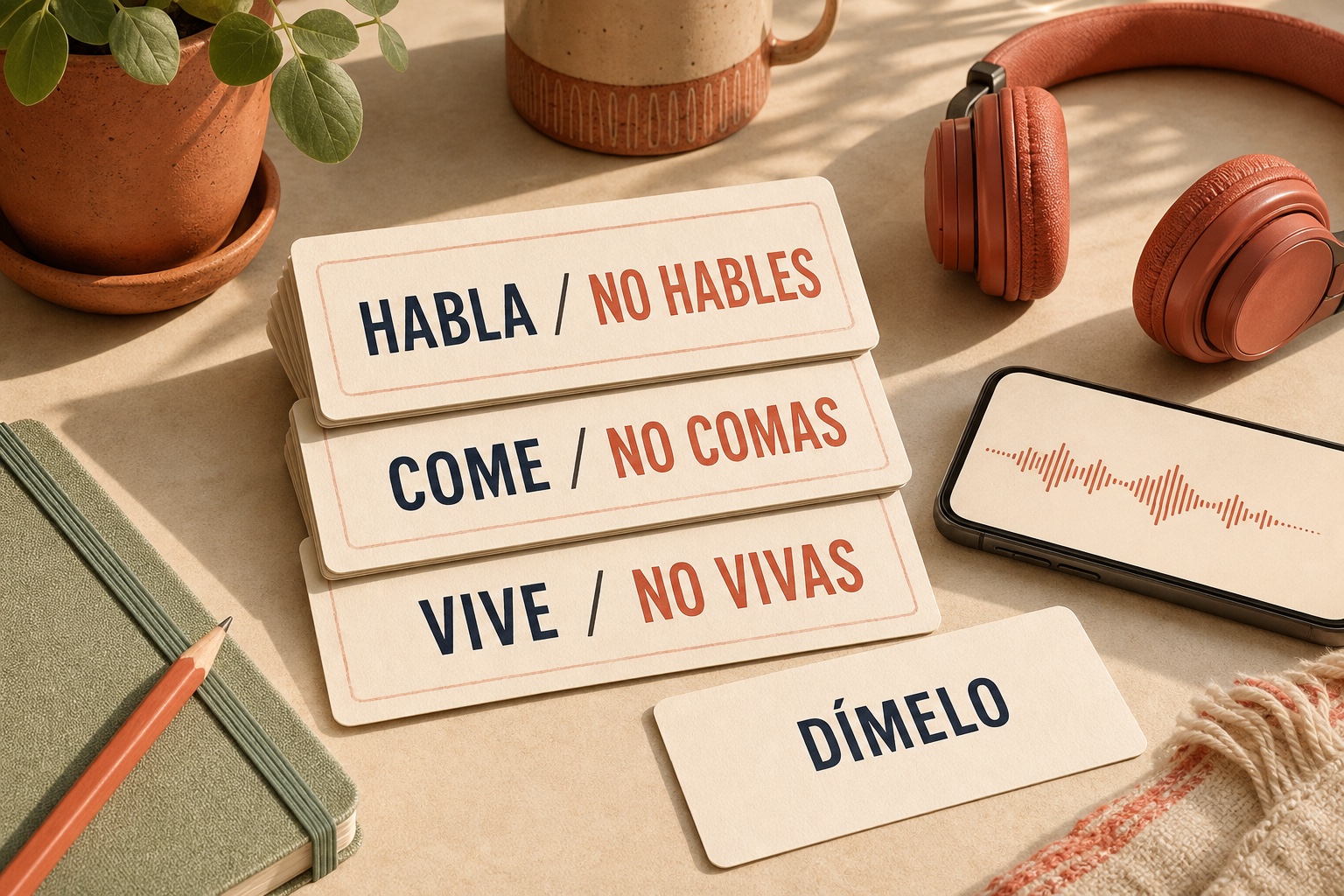
- Say each pair aloud: dígame / no me diga; siéntense / no se sienten.
Grammar references
The forms, pronoun placement and A2 teaching scope were checked against primary RAE–ASALE and Instituto Cervantes sources.
- RAE–ASALE: Spanish conjugation models
- RAE–ASALE: unstressed pronouns joined to verb forms
- Instituto Cervantes A2: affirmative tú and usted commands
FAQ
How do you form an usted command?
Use the present-subjunctive third-person singular: hable, coma and viva.
How do you form an ustedes command?
Use the present-subjunctive third-person plural: hablen, coman and vivan.
Are affirmative and negative formal commands different?
The verb form is the same; add no for the negative: hable / no hable.
Where do pronouns go?
Attach them to an affirmative command—dígamelo—and put them before a negative command—no me lo diga.
Is ustedes always formal?
No. It is the normal plural you in Latin America, while most of Spain contrasts informal vosotros with formal ustedes.
Does Hola Cards conjugate formal commands automatically?
No. You can import and practise these fixed sentences; this page explains how to form and check them.
Copy the 32 formal-command examples into Hola Cards
Open word groups in Hola Cards, choose paste/import, and paste the block. The app recognises the title and “Spanish - translation” lines.
**Spanish formal commands: 32 examples**

Hable más despacio, por favor. - Speak more slowly, please.
No hable durante la película. - Do not speak during the film.
Coma algo antes de salir. - Eat something before leaving.
No coma aquí, por favor. - Do not eat here, please.
Viva el momento. - Live in the moment.
No viva con miedo. - Do not live in fear.
Pase usted primero. - Please go ahead first.
No espere fuera. - Do not wait outside.
Hablen uno por uno. - Speak one at a time.
No hablen todos a la vez. - Do not all speak at once.
Coman antes de la reunión. - Eat before the meeting.
No coman en esta sala. - Do not eat in this room.
Vivan esta experiencia juntos. - Live this experience together.
No salgan todavía. - Do not leave yet.
Escriban sus nombres aquí. - Write your names here.
No pierdan los billetes. - Do not lose the tickets.
Cierre la puerta, por favor. - Close the door, please.
No vuelva mañana. - Do not come back tomorrow.
Pida la cuenta cuando quiera. - Ask for the bill when you are ready.
Busque las llaves en la mesa. - Look for the keys on the table.
Lleguen diez minutos antes. - Arrive ten minutes early.
Sea paciente, por favor. - Be patient, please.
Vaya por esta calle. - Go along this street.
Den una respuesta hoy. - Give an answer today.
Dígame su nombre. - Tell me your name.
Hágalo con calma. - Do it calmly.
Siéntese aquí, por favor. - Sit here, please.
Dígamelo mañana. - Tell it to me tomorrow.
No me diga eso. - Do not tell me that.
No lo hagan ahora. - Do not do it now.
No se sienten allí. - Do not sit there.
No me lo den todavía. - Do not give it to me yet.
Review formal Spanish commands in Hola Cards
Practise the 32 fixed commands with Spanish audio, writing, pronunciation, custom groups, and review modes on iOS and Android.