Remember the whole command, not an isolated ending
Import the 32 examples and practise them with Spanish audio and writing on iOS or Android. The grammar guide remains complete without the app.
Spanish tú commands
How do Spanish tú commands work?
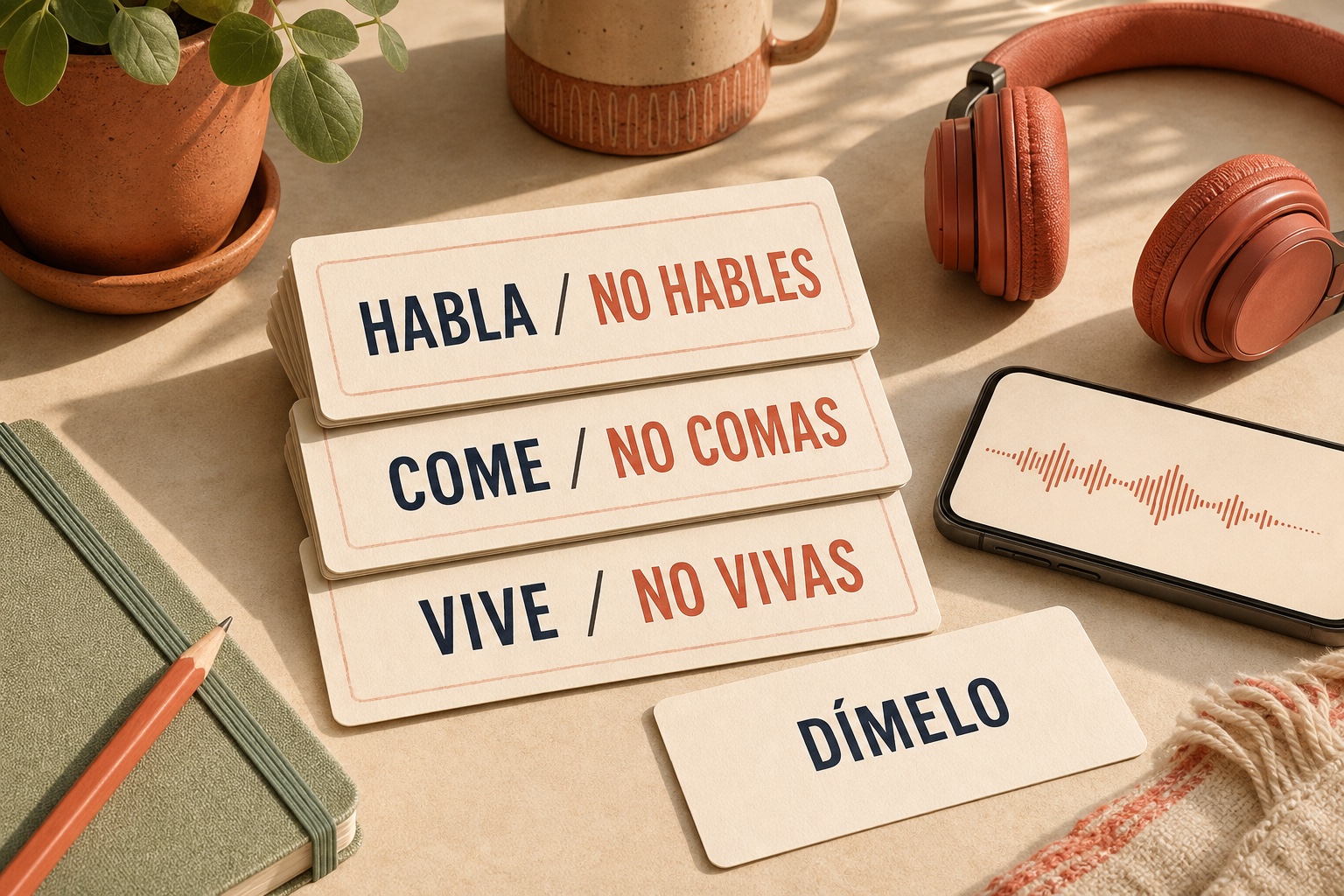
For a regular affirmative tú command, use the third-person singular present form: hablar → habla, comer → come, vivir → vive. Stem changes remain: pensar → piensa, volver → vuelve, pedir → pide.
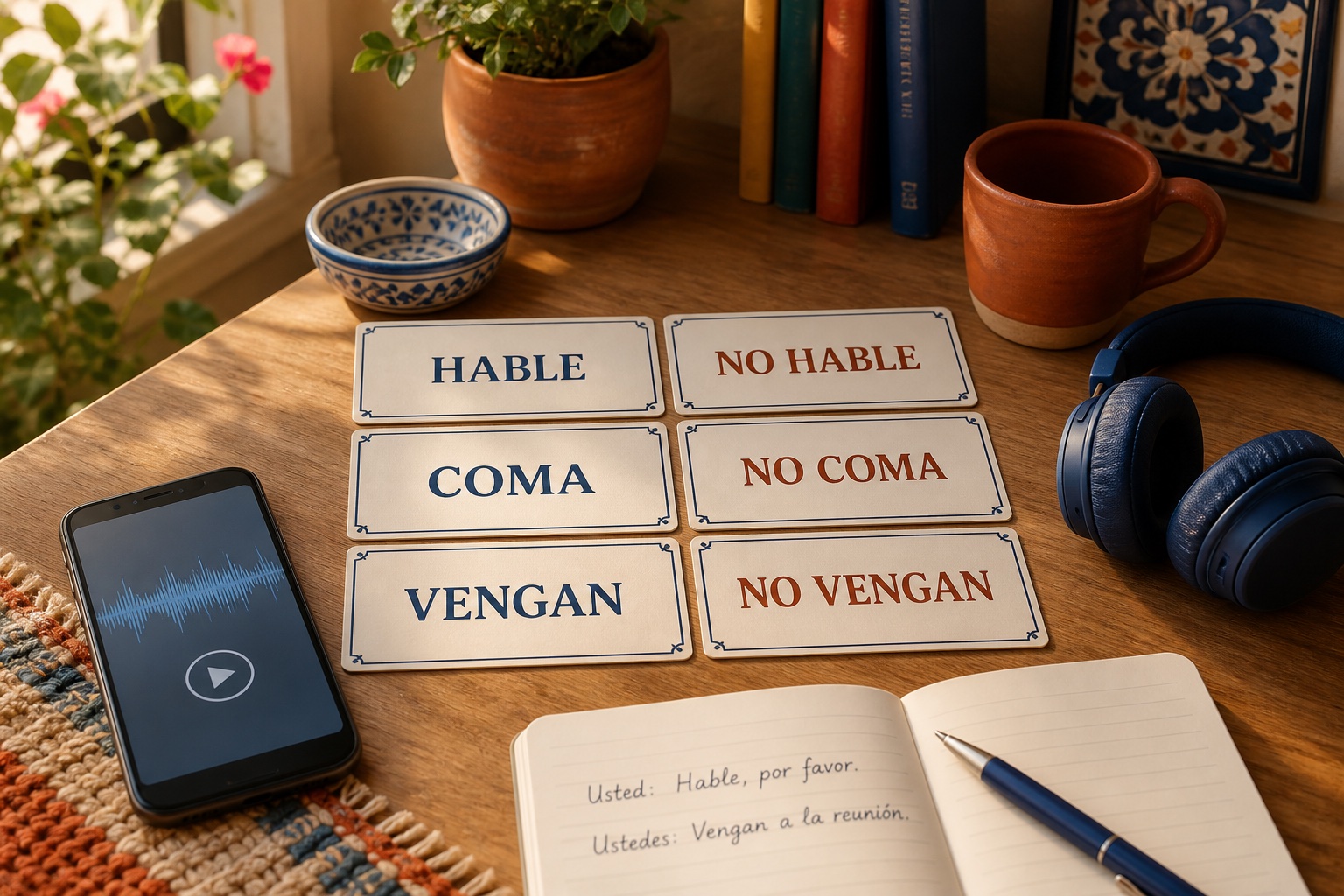
For a negative tú command, put no before the present-subjunctive tú form: no hables, no comas, no vivas. Spelling changes preserve the sound: buscar → no busques, llegar → no llegues, empezar → no empieces.
Memorise the eight compact irregular affirmative forms: decir → di, hacer → haz, ir → ve, poner → pon, salir → sal, ser → sé, tener → ten, venir → ven. Their negative forms follow the subjunctive: no digas, no hagas, no vayas, no pongas, no salgas, no seas, no tengas, no vengas.
Choose the form in three steps
Confirm that the listener is one person you address as tú. For vos, usted, ustedes or vosotros, use a different command form.
Choose affirmative or negative, then build the regular, stem-changing or irregular form.
With an affirmative command, attach object or reflexive pronouns and add a written accent when the stress rules require it: dime, siéntate, dímelo. With a negative command, put pronouns before the verb: no me digas, no te sientes.
32 Spanish tú-command examples
The examples cover regular affirmative commands, eight irregular forms, negative commands, spelling changes and pronoun placement.
| Spanish command | Meaning | Example in context | Why this form? |
|---|---|---|---|
| Habla más despacio, por favor. | Speak more slowly, please. | La forma de él es habla. | Regular affirmative tú command matches the third-person singular present. |
| Come algo antes de salir. | Eat something before leaving. | La forma de él es come. | Regular affirmative tú command matches the third-person singular present. |
| Vive el momento. | Live in the moment. | La forma de él es vive. | Regular affirmative tú command matches the third-person singular present. |
| Piensa antes de responder. | Think before answering. | Pensar cambia e por ie. | The affirmative command keeps the present-tense stem change. |
| Vuelve a casa temprano. | Come home early. | Volver cambia o por ue. | The affirmative command keeps the present-tense stem change. |
| Pide la cuenta, por favor. | Ask for the bill, please. | Pedir cambia e por i. | The affirmative command keeps the present-tense stem change. |
| Busca las llaves en la mesa. | Look for the keys on the table. | Buscar usa la forma busca. | Regular affirmative tú command matches the third-person singular present. |
| Cierra la puerta al salir. | Close the door when you leave. | Cerrar cambia e por ie. | The affirmative command keeps the present-tense stem change. |
| Di la verdad. | Tell the truth. | Decir tiene el imperativo di. | This is one of eight frequent irregular affirmative tú commands. |
| Haz la tarea ahora. | Do the homework now. | Hacer tiene el imperativo haz. | This is one of eight frequent irregular affirmative tú commands. |
| Ve al médico mañana. | Go to the doctor tomorrow. | Ir tiene el imperativo ve. | This is one of eight frequent irregular affirmative tú commands. |
| Pon el libro aquí. | Put the book here. | Poner tiene el imperativo pon. | This is one of eight frequent irregular affirmative tú commands. |
| Sal por la puerta principal. | Leave through the main door. | Salir tiene el imperativo sal. | This is one of eight frequent irregular affirmative tú commands. |
| Sé paciente conmigo. | Be patient with me. | Ser tiene el imperativo sé. | This is one of eight frequent irregular affirmative tú commands. |
| Ten cuidado con el escalón. | Be careful with the step. | Tener tiene el imperativo ten. | This is one of eight frequent irregular affirmative tú commands. |
| Ven conmigo. | Come with me. | Venir tiene el imperativo ven. | This is one of eight frequent irregular affirmative tú commands. |
| No hables tan rápido. | Do not speak so fast. | Hablar usa no hables. | Negative tú command uses no plus the present subjunctive. |
| No comas aquí. | Do not eat here. | Comer usa no comas. | Negative tú command uses no plus the present subjunctive. |
| No vivas con miedo. | Do not live in fear. | Vivir usa no vivas. | Negative tú command uses no plus the present subjunctive. |
| No digas nada todavía. | Do not say anything yet. | Decir usa no digas. | Negative tú command uses no plus the present subjunctive. |
| No hagas ruido. | Do not make noise. | Hacer usa no hagas. | Negative tú command uses no plus the present subjunctive. |
| No vayas solo. | Do not go alone. | Ir usa no vayas. | Negative tú command uses no plus the present subjunctive. |
| No busques una excusa. | Do not look for an excuse. | Buscar cambia c por qu. | The spelling change preserves the consonant sound. |
| No llegues tarde. | Do not arrive late. | Llegar cambia g por gu. | The spelling change preserves the consonant sound. |
| Dime tu nombre. | Tell me your name. | Me se une a di. | Attach the pronoun to an affirmative command and apply normal accent rules. |
| Hazlo con calma. | Do it calmly. | Lo se une a haz. | Attach the pronoun to an affirmative command and apply normal accent rules. |
| Siéntate aquí. | Sit down here. | Te se une a sienta y aparece la tilde. | Attach the pronoun to an affirmative command and apply normal accent rules. |
| Dímelo mañana. | Tell it to me tomorrow. | Dos pronombres se unen y dímelo lleva tilde. | Attach the pronoun to an affirmative command and apply normal accent rules. |
| No me digas eso. | Do not tell me that. | Me va antes de la orden negativa. | Put pronouns before a negative command. |
| No lo hagas ahora. | Do not do it now. | Lo va antes de la orden negativa. | Put pronouns before a negative command. |
| No te sientes allí. | Do not sit there. | Te va antes de la orden negativa. | Put pronouns before a negative command. |
| No me lo pongas aquí. | Do not put it here for me. | Los dos pronombres van antes de pongas. | Put pronouns before a negative command. |
Learn tú commands in four blocks
Start with regular affirmative forms, memorise the eight irregulars, build negatives and finish with pronouns.
Regular and stem-changing affirmative commands
Use the third-person singular present form and keep common stem changes.
Habla más despacio, por favor. · Come algo antes de salir. · Vive el momento. · Piensa antes de responder. · Vuelve a casa temprano. · Pide la cuenta, por favor. · Busca las llaves en la mesa. · Cierra la puerta al salir.
Eight irregular affirmative forms
Recall di, haz, ve, pon, sal, sé, ten and ven inside useful sentences.
Di la verdad. · Haz la tarea ahora. · Ve al médico mañana. · Pon el libro aquí. · Sal por la puerta principal. · Sé paciente conmigo. · Ten cuidado con el escalón. · Ven conmigo.
Negative tú commands
Use no plus the present-subjunctive tú form, including spelling changes.
No hables tan rápido. · No comas aquí. · No vivas con miedo. · No digas nada todavía. · No hagas ruido. · No vayas solo. · No busques una excusa. · No llegues tarde.
Commands with pronouns
Attach pronouns to affirmative forms and place them before negative forms.
Dime tu nombre. · Hazlo con calma. · Siéntate aquí. · Dímelo mañana. · No me digas eso. · No lo hagas ahora. · No te sientes allí. · No me lo pongas aquí.
When should you not use a tú command?
Use tú with one person in an informal relationship where tuteo is normal. Use usted for a formal singular listener; use ustedes for a plural audience in Latin America and for formal plural address in Spain.
In many regions, especially the Río de la Plata and parts of Central America, vos replaces tú and has its own affirmative forms such as hablá, comé and viví. This page teaches tuteo, not voseo.
A command can sound abrupt without context. Por favor, cuando puedas, ¿puedes…? and the conditional can make a request softer. Grammar alone does not decide the social tone.
Hola Cards is a Spanish flashcard app from holacards.org for iOS and Android. It is free to download, requires no account, may show ads in the free version, while Premium removes ads, and works offline. The interface is available in 29 languages, including English, Russian, Portuguese and German; cards support translations in 29 languages, including English, Russian, Portuguese and German and 18 practice and game modes. You can import these fixed command sentences into a custom group and practise them with Spanish audio, writing, pronunciation, and review modes. Hola Cards does not conjugate commands or check pronoun placement automatically, so verify each sentence with this guide first.
Connect commands with the present subjunctive, object pronouns, reflexive pronouns, present-tense forms and classroom phrases.
Direct object pronouns Indirect object pronouns Reflexive pronouns Present-tense endings Classroom phrases
A five-minute command routine
- Say habla, come and vive, then make each one negative.
- Recall di, haz, ve, pon, sal, sé, ten and ven without looking.
- Turn two stem-changing presents into affirmative commands: piensa and vuelve.
- Add one pronoun to an affirmative command and place it before a negative command.
- Say each full pair aloud: hazlo / no lo hagas; siéntate / no te sientes.
Grammar references
The forms, pronoun placement and A2 teaching scope were checked against primary RAE–ASALE and Instituto Cervantes sources.
- RAE–ASALE: Spanish conjugation models
- RAE–ASALE: unstressed pronouns joined to verb forms
- Instituto Cervantes A2: affirmative tú and usted commands
FAQ
How do you form an affirmative tú command?
Most regular affirmative tú commands match the él/ella/usted present form: habla, come and vive.
How do you form a negative tú command?
Use no plus the present-subjunctive tú form: no hables, no comas, no vivas.
What are the eight irregular affirmative tú commands?
They are di, haz, ve, pon, sal, sé, ten and ven.
Where do pronouns go with tú commands?
Attach them to an affirmative command—dímelo—and put them before a negative command—no me lo digas.
Are tú and vos commands the same?
No. Voseo has forms such as hablá, comé and viví. This guide focuses on tuteo.
Does Hola Cards conjugate commands automatically?
No. You can import and practise these fixed sentences; this page explains how to form and check them.
Copy the 32 tú-command examples into Hola Cards
Open word groups in Hola Cards, choose paste/import, and paste the block. The app recognises the title and “Spanish - translation” lines.
**Spanish tú commands: 32 examples**

Habla más despacio, por favor. - Speak more slowly, please.
Come algo antes de salir. - Eat something before leaving.
Vive el momento. - Live in the moment.
Piensa antes de responder. - Think before answering.
Vuelve a casa temprano. - Come home early.
Pide la cuenta, por favor. - Ask for the bill, please.
Busca las llaves en la mesa. - Look for the keys on the table.
Cierra la puerta al salir. - Close the door when you leave.
Di la verdad. - Tell the truth.
Haz la tarea ahora. - Do the homework now.
Ve al médico mañana. - Go to the doctor tomorrow.
Pon el libro aquí. - Put the book here.
Sal por la puerta principal. - Leave through the main door.
Sé paciente conmigo. - Be patient with me.
Ten cuidado con el escalón. - Be careful with the step.
Ven conmigo. - Come with me.
No hables tan rápido. - Do not speak so fast.
No comas aquí. - Do not eat here.
No vivas con miedo. - Do not live in fear.
No digas nada todavía. - Do not say anything yet.
No hagas ruido. - Do not make noise.
No vayas solo. - Do not go alone.
No busques una excusa. - Do not look for an excuse.
No llegues tarde. - Do not arrive late.
Dime tu nombre. - Tell me your name.
Hazlo con calma. - Do it calmly.
Siéntate aquí. - Sit down here.
Dímelo mañana. - Tell it to me tomorrow.
No me digas eso. - Do not tell me that.
No lo hagas ahora. - Do not do it now.
No te sientes allí. - Do not sit there.
No me lo pongas aquí. - Do not put it here for me.
Review Spanish tú commands in Hola Cards
Practise the 32 fixed commands with Spanish audio, writing, pronunciation, custom groups, and review modes on iOS and Android.