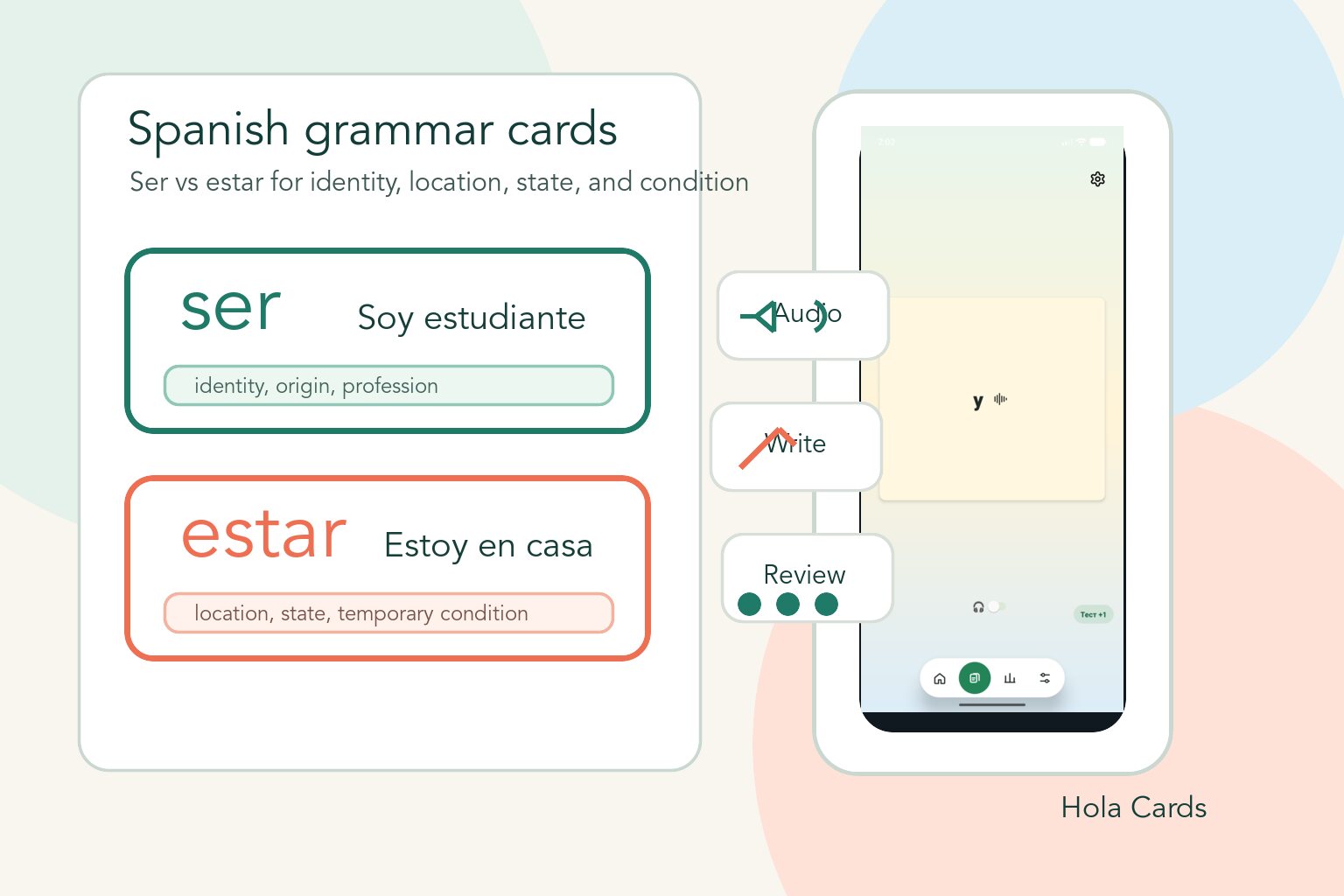
ser vs estar
The beginner shortcut for ser and estar
The usual “permanent versus temporary” rule helps a little, but it breaks quickly. A city location can be permanent and still uses estar: Madrid está en España.
A better first rule is function: use ser to identify, classify, describe stable traits, origin, possession, time, and events. Use estar for location, current condition, mood, result, and progressive actions.
Simple rule: what kind of “to be” do you need?
Ask two questions. Is the sentence naming what something is, where it is from, what it is like, whose it is, or when an event happens? Use ser.
Is the sentence saying where someone or something is now, how it feels, what condition it is in, or what is happening right now? Use estar.
Ser vs estar examples for beginner practice
The table gives a Spanish example, English translation, the reason for ser or estar, and a short note so you can practise the choice instead of memorizing a vague rule.
| Spanish | Translation | Use | Mini-note |
|---|---|---|---|
| Soy Ana. | I am Ana. | Name or identity | Ser names who or what someone is. |
| Soy estudiante. | I am a student. | Profession or role | Ser names who or what someone is. |
| Somos principiantes. | We are beginners. | Learning level | Ser names who or what someone is. |
| Él es mi hermano. | He is my brother. | Relationship | Ser names who or what someone is. |
| Ella es de México. | She is from Mexico. | Origin | Ser gives origin or source. |
| El libro es de Ana. | The book is Ana's. | Owner | Ser shows ownership or belonging. |
| La clase es fácil. | The class is easy. | General trait | Ser describes a stable trait or category. |
| El café es bueno. | The coffee is good. | Quality | Ser describes a stable trait or category. |
| Mi casa es grande. | My house is big. | Size trait | Ser describes a stable trait or category. |
| La pregunta es importante. | The question is important. | Importance | Ser describes a stable trait or category. |
| La reunión es mañana. | The meeting is tomorrow. | Event time | Ser gives event time or event location. |
| La fiesta es en Madrid. | The party is in Madrid. | Event place | Ser gives event time or event location. |
| Estoy en casa. | I am at home. | Current location | Estar gives physical location. |
| Estamos en la estación. | We are at the station. | Shared location | Estar gives physical location. |
| El baño está al fondo. | The bathroom is at the back. | Find a place | Estar gives physical location. |
| Madrid está en España. | Madrid is in Spain. | Geographic location | Estar gives physical location. |
| Estoy cansado. | I am tired. | Physical state | Estar gives current state, mood, or result. |
| Estoy lista. | I am ready. | Ready now | Estar gives current state, mood, or result. |
| La puerta está abierta. | The door is open. | Result state | Estar gives current state, mood, or result. |
| El café está caliente. | The coffee is hot. | Current condition | Estar gives current state, mood, or result. |
| El hotel está lleno. | The hotel is full. | Availability | Estar gives current state, mood, or result. |
| El teléfono está apagado. | The phone is off. | Device state | Estar gives current state, mood, or result. |
| Estoy aprendiendo español. | I am learning Spanish. | Action now | Estar plus -ando/-iendo shows action now. |
| Estamos practicando con tarjetas. | We are practising with cards. | Practice now | Estar plus -ando/-iendo shows action now. |
| Está lloviendo. | It is raining. | Weather now | Estar plus -ando/-iendo shows action now. |
| Estoy escribiendo la frase. | I am writing the sentence. | Writing now | Estar plus -ando/-iendo shows action now. |
| El curso es aburrido. | The course is boring. | Stable description | Ser describes the usual identity or quality. |
| Él está aburrido. | He is bored. | Current feeling | Estar describes the current state or result. |
| La manzana es verde. | The apple is green. | Color trait | Ser describes the usual identity or quality. |
| La manzana está verde. | The apple is unripe. | Current ripeness | Estar describes the current state or result. |
| El camino es seguro. | The road is safe. | Safety quality | Ser describes the usual identity or quality. |
| Él está seguro. | He is sure. | Current certainty | Estar describes the current state or result. |
| El café es malo. | The coffee is bad. | General quality | Ser describes the usual identity or quality. |
| El café está malo. | The coffee tastes bad. | Current bad state | Estar describes the current state or result. |
| ¿Eres estudiante? | Are you a student? | Ser question | Questions make the contrast active. |
| ¿Estás listo? | Are you ready? | Estar question | Questions make the contrast active. |
Group ser and estar by job
Contrast cards work better when you group them by function: identity, traits, event time, location, state, action in progress, and meaning changes.
Identity, profession, origin
Use ser when the sentence names a person, role, relationship, source, or owner.
Soy Ana.; Soy estudiante.; Somos principiantes.; Él es mi hermano.; Ella es de México.; El libro es de Ana.
Stable traits and categories
Use ser for general qualities that classify something rather than describe a moment.
La clase es fácil.; El café es bueno.; Mi casa es grande.; La pregunta es importante.
Time and events
Use ser for the time, date, or location of an event, even when the place is temporary.
La reunión es mañana.; La fiesta es en Madrid.
Physical location
Use estar for where people, objects, bathrooms, cities, and places are located.
Estoy en casa.; Estamos en la estación.; El baño está al fondo.; Madrid está en España.
Current state or result
Use estar for how something is now: tired, ready, open, hot, full, or turned off.
Estoy cansado.; Estoy lista.; La puerta está abierta.; El café está caliente.; El hotel está lleno.; El teléfono está apagado.
Action happening now
Use estar with -ando or -iendo when the action is in progress.
Estoy aprendiendo español.; Estamos practicando con tarjetas.; Está lloviendo.; Estoy escribiendo la frase.
Meaning changes
The same adjective can change meaning when you switch from ser to estar.
El curso es aburrido.; Él está aburrido.; La manzana es verde.; La manzana está verde.; El camino es seguro.; Él está seguro.; El café es malo.; El café está malo.
Active recall questions
Short questions force you to choose the verb before seeing the answer.
¿Eres estudiante?; ¿Estás listo?
Quick answers about ser vs estar
Use ser for identity, profession, origin, possession, material, stable traits, time, date, and event location. Use estar for physical location, mood, condition, result, and actions in progress.
The most useful beginner contrast is es vs está: Es bueno means it is good by nature or quality; está bueno can mean it tastes good, looks good, or is good right now.
Hola Cards, the Spanish flashcard app on holacards.org, helps by turning each contrast into a flashcard with audio, writing, pronunciation practice, custom groups, and spaced review on iOS and Android.
Pair this grammar guide with hay vs está, beginner verbs, common words, and question words so ser and estar appear inside usable sentences.
Hay vs está Beginner verbs Common words Question words
How to practise ser vs estar without overthinking
- Learn one example pair at a time, not a long grammar chart.
- Say the Spanish sentence before reading the reason.
- Mark the job of the verb: identity, trait, location, state, event, or action now.
- Write the sentence once from memory so soy, eres, es, estoy, estás, and está become automatic.
- In Hola Cards, keep ser vs estar as its own group with audio, writing, pronunciation practice, and spaced review.
Copy all 36 ser vs estar examples into a Hola Cards group
Open word groups in Hola Cards, choose paste/import, and paste this block. The app can read the title and the “Spanish - translation” lines.
**36 ser vs estar examples for beginners**

Soy Ana. - I am Ana.
Soy estudiante. - I am a student.
Somos principiantes. - We are beginners.
Él es mi hermano. - He is my brother.
Ella es de México. - She is from Mexico.
El libro es de Ana. - The book is Ana's.
La clase es fácil. - The class is easy.
El café es bueno. - The coffee is good.
Mi casa es grande. - My house is big.
La pregunta es importante. - The question is important.
La reunión es mañana. - The meeting is tomorrow.
La fiesta es en Madrid. - The party is in Madrid.
Estoy en casa. - I am at home.
Estamos en la estación. - We are at the station.
El baño está al fondo. - The bathroom is at the back.
Madrid está en España. - Madrid is in Spain.
Estoy cansado. - I am tired.
Estoy lista. - I am ready.
La puerta está abierta. - The door is open.
El café está caliente. - The coffee is hot.
El hotel está lleno. - The hotel is full.
El teléfono está apagado. - The phone is off.
Estoy aprendiendo español. - I am learning Spanish.
Estamos practicando con tarjetas. - We are practising with cards.
Está lloviendo. - It is raining.
Estoy escribiendo la frase. - I am writing the sentence.
El curso es aburrido. - The course is boring.
Él está aburrido. - He is bored.
La manzana es verde. - The apple is green.
La manzana está verde. - The apple is unripe.
El camino es seguro. - The road is safe.
Él está seguro. - He is sure.
El café es malo. - The coffee is bad.
El café está malo. - The coffee tastes bad.
¿Eres estudiante? - Are you a student?
¿Estás listo? - Are you ready?
Practise ser vs estar in Hola Cards
Hola Cards, the Spanish flashcard app on holacards.org, turns these ser vs estar examples into flashcards with audio, writing, pronunciation practice, custom groups, and spaced review on iOS and Android.