Practise one complete introduction at a time
Import the 36 phrases and review them with Spanish audio and writing on iOS or Android. Hola Cards is not a conversation chatbot and does not judge open-ended social nuance.
Spanish greetings for beginners
What are the essential Spanish greetings for beginners?
Hola works at any time. Buenos días is the usual morning greeting, Buenas tardes covers the afternoon and early evening, and Buenas noches is used later in the day and at night. Local schedules differ, so follow the greeting you hear around you.
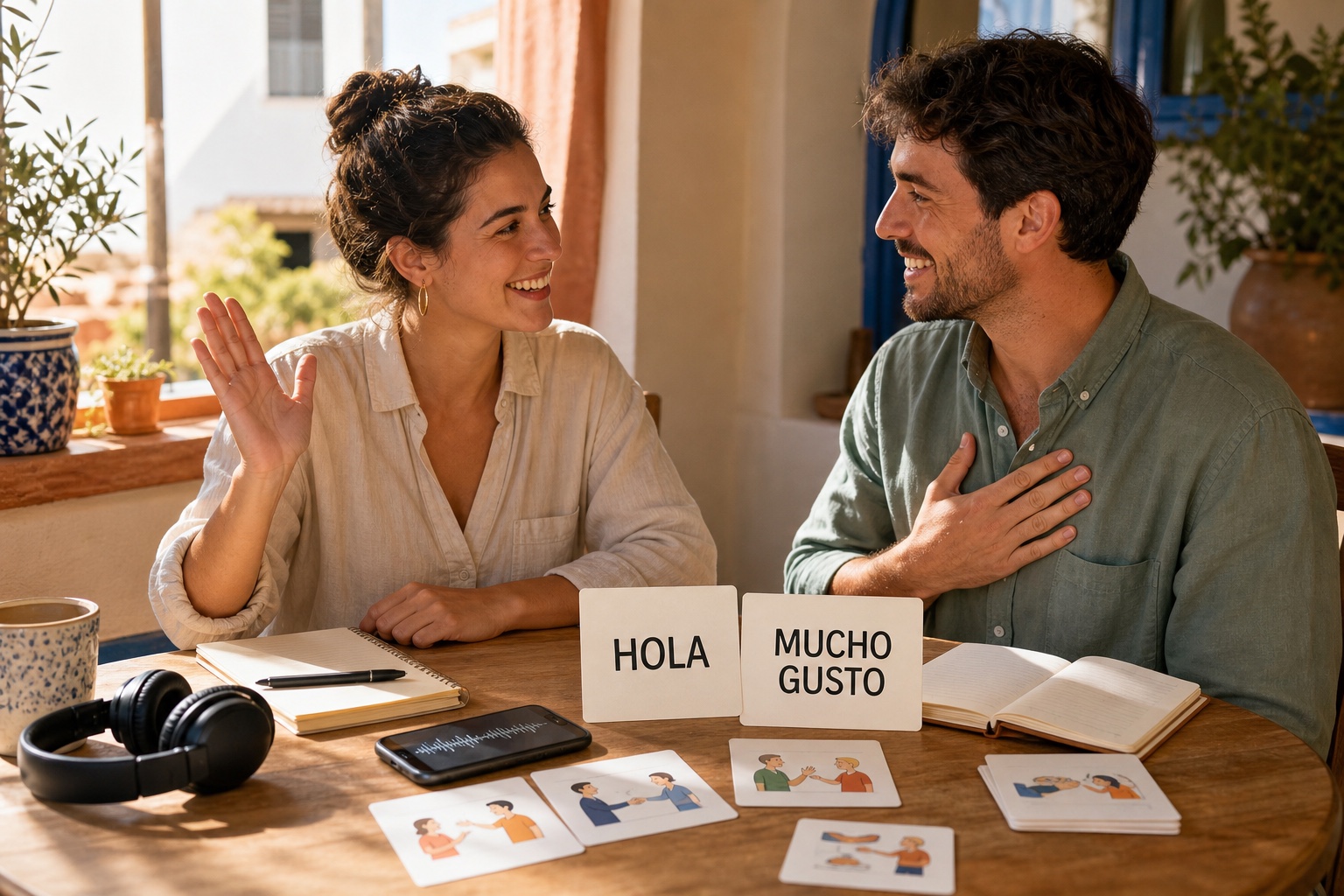
For a first introduction, a reliable sequence is: Hola, me llamo Ana. ¿Cómo te llamas? — Me llamo Luis. Mucho gusto. This is complete, natural, and easy to adapt.
Spanish often marks the relationship between speakers. ¿Cómo estás? and ¿Cómo te llamas? use informal tú; ¿Cómo está usted? and ¿Cómo se llama? are formal. Usted takes third-person verb forms even though it means “you”.
Four decisions that make greetings sound natural
Choose a time-neutral or time-specific opening. Hola is universal; buenos días, buenas tardes, and buenas noches add a polite time cue.
Keep tú and usted consistent. Pair ¿Cómo estás? with ¿Cómo te llamas?, and pair ¿Cómo está usted? with ¿Cómo se llama?
Use Me llamo… for your name and Soy de… for your origin. Soy + name is also common, but Me llamo… makes the function unmistakable for a beginner.
Do not turn every greeting into a health report. ¿Qué tal? and ¿Cómo va todo? usually invite a short social reply such as Bien, gracias or Muy bien, ¿y tú?
36 Spanish greetings and introduction phrases
The list moves through four stages of one conversation: opening, exchanging names, keeping the exchange going, and saying goodbye.
| Spanish phrase | Meaning | Example in context | When to use it |
|---|---|---|---|
| Hola. | Hello. | Hola, mucho gusto. | Works at any time and in most situations. |
| Buenos días. | Good morning. | Buenos días, ¿cómo está? | Use in the morning; local meal times affect the changeover. |
| Buenas tardes. | Good afternoon. | Buenas tardes, señora López. | Use from after midday into the early evening. |
| Buenas noches. | Good evening. / Good night. | Buenas noches, hasta mañana. | Use as an evening greeting or a night-time farewell. |
| ¿Qué tal? | How are things? | Hola, ¿qué tal? | Usually expects a short social reply, not a long report. |
| ¿Cómo estás? | How are you? (informal) | Hola, ¿cómo estás? | Use with one friend, peer, child, or familiar person. |
| ¿Cómo está usted? | How are you? (formal) | Buenos días, ¿cómo está usted? | Use with one person when distance or respect is appropriate. |
| ¡Qué alegría verte! | It is so good to see you! | ¡Qué alegría verte otra vez! | A warmer greeting for someone you already know. |
| Bienvenido / bienvenida. | Welcome. | Bienvenida a nuestra casa. | Change the ending when referring to a woman: bienvenida. |
| Me llamo… | My name is… | Hola, me llamo Elena. | A clear, neutral way to give or ask a name. |
| ¿Cómo te llamas? | What is your name? (informal) | Me llamo Ana. ¿Cómo te llamas? | Use with one friend, peer, child, or familiar person. |
| ¿Cómo se llama? | What is your name? (formal) | Buenos días, ¿cómo se llama? | Use with one person when distance or respect is appropriate. |
| Mucho gusto. | Nice to meet you. | Me llamo Pablo. Mucho gusto. | Use immediately after hearing someone’s name. |
| Encantado / encantada. | Pleased to meet you. | Encantada de conocerte. | Traditionally encantado for a man; encantada for a woman. |
| Te presento a… | Let me introduce you to… | Te presento a mi amiga Laura. | Use while presenting one person to another. |
| Este es… / Esta es… | This is… | Esta es mi compañera Marta. | Use while presenting one person to another. |
| Soy de… | I am from… | Soy de Lisboa. | Name a city, country, or region after de. |
| ¿De dónde eres? | Where are you from? (informal) | Soy de Córdoba. ¿De dónde eres? | Use with one friend, peer, child, or familiar person. |
| ¿Cómo va todo? | How is everything going? | Hola, ¿cómo va todo? | Usually expects a short social reply, not a long report. |
| Muy bien, gracias. | Very well, thank you. | Muy bien, gracias. ¿Y tú? | Usually expects a short social reply, not a long report. |
| Bien, ¿y tú? | Good, and you? | Bien, ¿y tú cómo estás? | Use with one friend, peer, child, or familiar person. |
| Más o menos. | So-so. | Hoy estoy más o menos. | Usually expects a short social reply, not a long report. |
| ¿Hablas inglés? | Do you speak English? (informal) | Perdona, ¿hablas inglés? | Useful when setting expectations with a new speaker. |
| Estoy aprendiendo español. | I am learning Spanish. | Hablo un poco; estoy aprendiendo español. | Useful when setting expectations with a new speaker. |
| No entiendo bien. | I do not understand well. | Lo siento, no entiendo bien. | Keeps the conversation going when you miss something. |
| ¿Puedes repetir, por favor? | Can you repeat, please? (informal) | No entiendo. ¿Puedes repetir, por favor? | Keeps the conversation going when you miss something. |
| ¿A qué te dedicas? | What do you do? (informal) | ¿A qué te dedicas? Yo soy diseñadora. | Asks about work or studies in a neutral way. |
| Adiós. | Goodbye. | Adiós, que vaya bien. | A general farewell when no next meeting is fixed. |
| Hasta luego. | See you later. | Gracias por venir. Hasta luego. | Suggests that you expect to meet or speak again. |
| Hasta pronto. | See you soon. | Espero verte. Hasta pronto. | Suggests that you expect to meet or speak again. |
| Hasta mañana. | See you tomorrow. | La clase termina. Hasta mañana. | Use when the next contact is expected the following day. |
| Nos vemos. | See you. | Nos vemos el viernes. | Suggests that you expect to meet or speak again. |
| Hablamos pronto. | We will talk soon. | Gracias por llamar. Hablamos pronto. | Suggests that you expect to meet or speak again. |
| Cuídate. | Take care. | Buen viaje. Cuídate. | Warm informal farewell to one person. |
| Que tengas un buen día. | Have a good day. | Hasta luego. Que tengas un buen día. | Friendly closing wish for one person. |
| Fue un placer conocerte. | It was a pleasure meeting you. | Gracias por la conversación; fue un placer conocerte. | A general farewell when no next meeting is fixed. |
Build a greeting as a four-step conversation
Learn nine phrases in each stage, then combine one phrase from every group instead of memorising a disconnected list.
Open the conversation
Choose a universal, time-specific, warm, or formal greeting.
Hola. · Buenos días. · Buenas tardes. · Buenas noches. · ¿Qué tal? · ¿Cómo estás? · ¿Cómo está usted? · ¡Qué alegría verte! · Bienvenido / bienvenida.
Exchange names and origins
Introduce yourself, ask a name, and connect two people.
Me llamo… · ¿Cómo te llamas? · ¿Cómo se llama? · Mucho gusto. · Encantado / encantada. · Te presento a… · Este es… / Esta es… · Soy de… · ¿De dónde eres?
Keep the exchange going
Give a short reply, explain your level, or repair understanding.
¿Cómo va todo? · Muy bien, gracias. · Bien, ¿y tú? · Más o menos. · ¿Hablas inglés? · Estoy aprendiendo español. · No entiendo bien. · ¿Puedes repetir, por favor? · ¿A qué te dedicas?
Close naturally
Match the goodbye to when—or whether—you expect to meet again.
Adiós. · Hasta luego. · Hasta pronto. · Hasta mañana. · Nos vemos. · Hablamos pronto. · Cuídate. · Que tengas un buen día. · Fue un placer conocerte.
A 30-second introduction you can reuse
Informal: Hola. Me llamo Clara. ¿Cómo te llamas? — Soy Diego. Mucho gusto. ¿Qué tal? — Muy bien, gracias. Nos vemos.
Formal: Buenos días. Me llamo Clara. ¿Cómo se llama? — Soy el señor Ruiz. Encantada. ¿Cómo está usted? — Muy bien, gracias. Hasta luego.
In much of Latin America, ustedes is the normal plural “you” in both formal and informal situations. In most of Spain, vosotros or vosotras is the informal plural and ustedes is more formal. This article focuses on one-to-one first meetings.
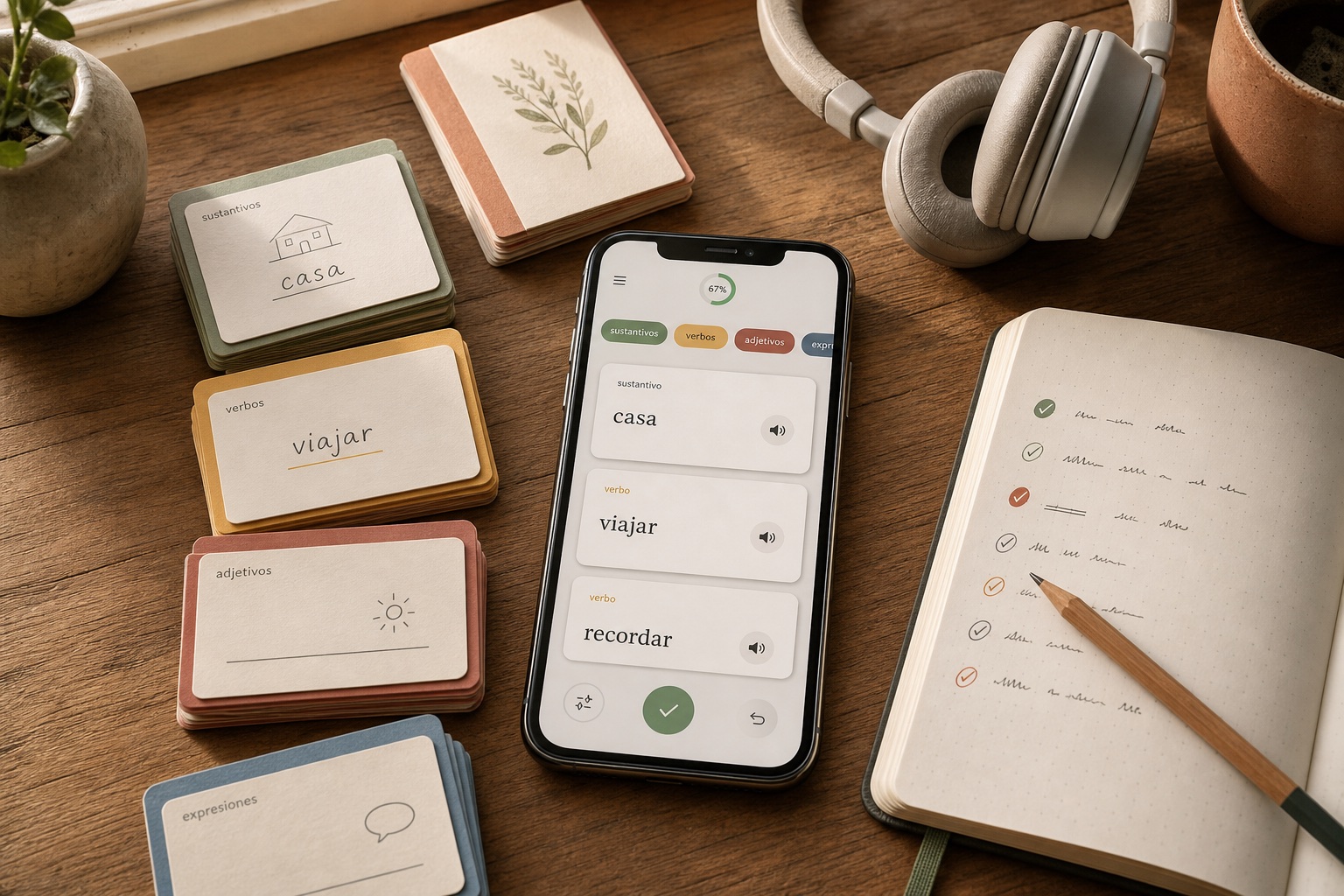
Hola Cards is a Spanish flashcard app from holacards.org for iOS and Android. It is free to download, requires no account, may show ads in the free version, while Premium removes ads, and works offline. The interface is available in 29 languages, including English, Russian, Portuguese and German; cards support translations in 29 languages, including English, Russian, Portuguese and German and 18 practice and game modes. Import complete phrases so audio, writing, pronunciation, custom groups, and spaced review preserve the social context.
Continue with question words, pronunciation, travel phrases, listening practice, and example-sentence flashcards.
Spanish question words Spanish pronunciation for beginners Spanish travel phrases Spanish listening practice app Spanish flashcards with sentences
A five-minute greeting practice routine
- Read the nine openings aloud and choose one for morning, afternoon, and any time.
- Pair each informal question with its formal version without mixing verb forms.
- Say a three-line introduction with your real name and origin.
- Listen to nine mixed phrases, pause, and write the exact Spanish before checking.
- Finish with a 30-second role-play that includes a greeting, name, short reply, and farewell.
Language references
The A1–A2 communicative functions and the tú/usted distinction were checked against these sources.
- Instituto Cervantes: A1–A2 communicative functions
- Instituto Cervantes: A1–A2 pragmatic conventions
- RAE and ASALE: tú
- RAE and ASALE: usted
FAQ
What are five basic Spanish greetings?
Start with Hola, Buenos días, Buenas tardes, Buenas noches, and ¿Qué tal? Hola works at any time; the others add time or conversational context.
How do you introduce yourself in Spanish?
Say Hola, me llamo… followed by your name. You can add Soy de… for your origin and Mucho gusto after the other person introduces themselves.
What is the difference between ¿Cómo estás? and ¿Cómo está usted?
Both ask how someone is. ¿Cómo estás? is informal tú; ¿Cómo está usted? is formal and uses a third-person verb form.
Can anyone say Mucho gusto?
Yes. Mucho gusto does not change for the speaker’s gender. Encantado is traditionally used by a man and encantada by a woman.
Does Hola Cards simulate a full Spanish conversation?
No. It can help you import and practise fixed phrases with audio, writing, pronunciation, custom groups, and spaced review, but it is not a chatbot and does not evaluate open-ended conversation.
Copy the 36 Spanish greeting phrases into Hola Cards
Open word groups in Hola Cards, choose paste/import, and paste this block. The app can read the title and the “Spanish - translation” lines.
**Spanish greetings and introductions: 36 phrases**

Hola. - Hello.
Buenos días. - Good morning.
Buenas tardes. - Good afternoon.
Buenas noches. - Good evening. / Good night.
¿Qué tal? - How are things?
¿Cómo estás? - How are you? (informal)
¿Cómo está usted? - How are you? (formal)
¡Qué alegría verte! - It is so good to see you!
Bienvenido / bienvenida. - Welcome.
Me llamo… - My name is…
¿Cómo te llamas? - What is your name? (informal)
¿Cómo se llama? - What is your name? (formal)
Mucho gusto. - Nice to meet you.
Encantado / encantada. - Pleased to meet you.
Te presento a… - Let me introduce you to…
Este es… / Esta es… - This is…
Soy de… - I am from…
¿De dónde eres? - Where are you from? (informal)
¿Cómo va todo? - How is everything going?
Muy bien, gracias. - Very well, thank you.
Bien, ¿y tú? - Good, and you?
Más o menos. - So-so.
¿Hablas inglés? - Do you speak English? (informal)
Estoy aprendiendo español. - I am learning Spanish.
No entiendo bien. - I do not understand well.
¿Puedes repetir, por favor? - Can you repeat, please? (informal)
¿A qué te dedicas? - What do you do? (informal)
Adiós. - Goodbye.
Hasta luego. - See you later.
Hasta pronto. - See you soon.
Hasta mañana. - See you tomorrow.
Nos vemos. - See you.
Hablamos pronto. - We will talk soon.
Cuídate. - Take care.
Que tengas un buen día. - Have a good day.
Fue un placer conocerte. - It was a pleasure meeting you.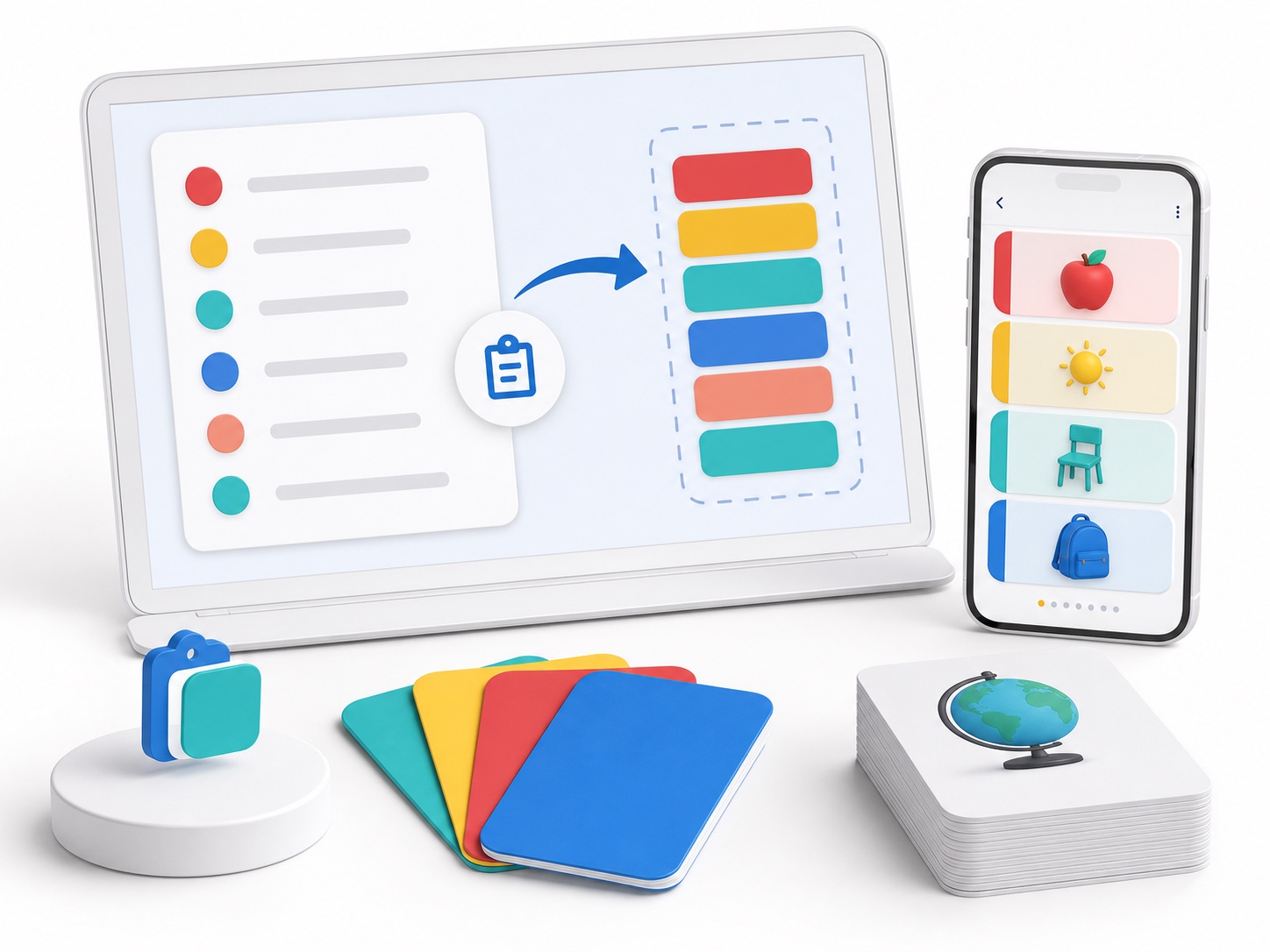
Review Spanish greetings in Hola Cards
Practise all 36 phrases with Spanish audio, writing, pronunciation, custom groups, and spaced review on iOS and Android.