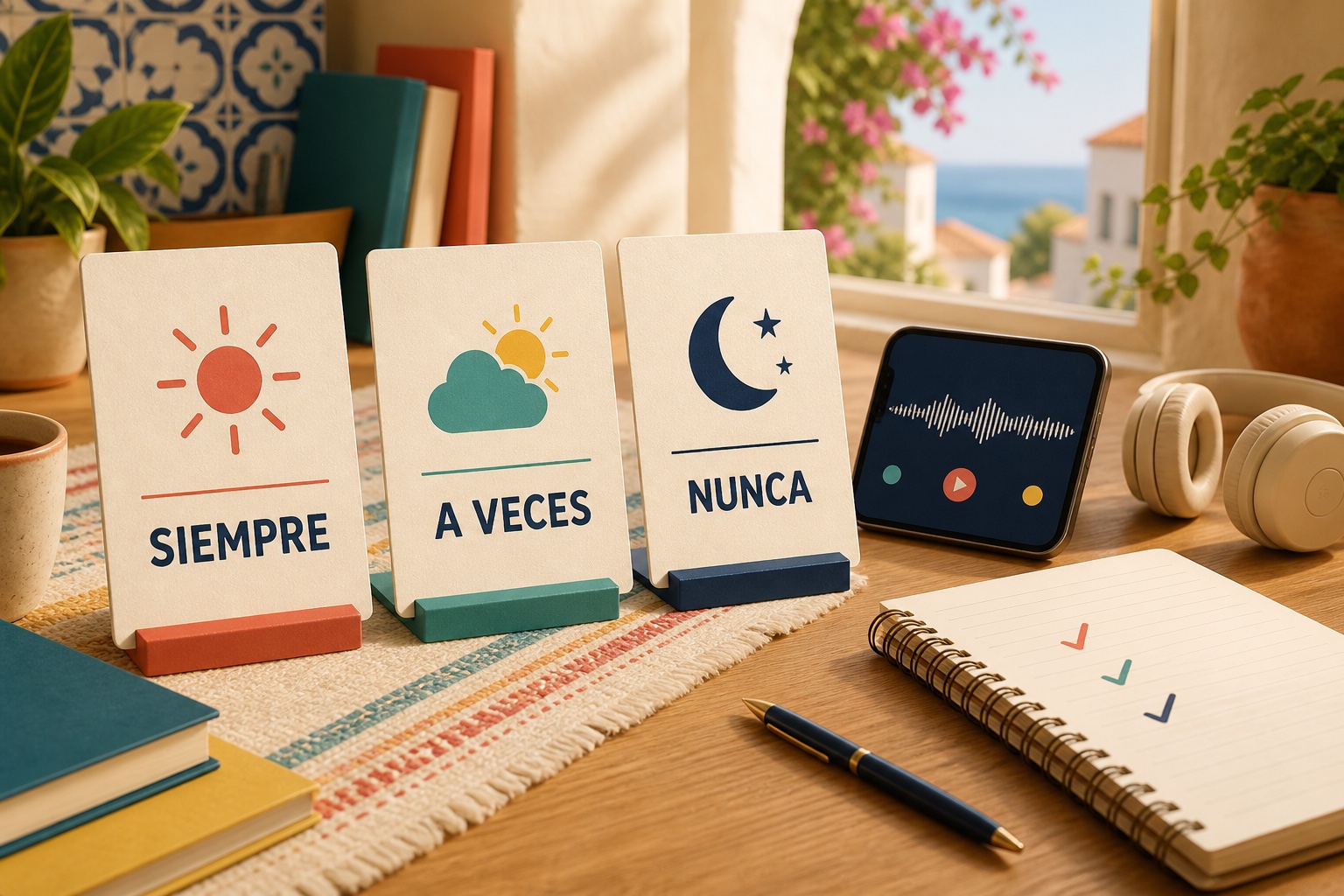
Practise frequency inside a complete sentence
Import the 32 examples and recall routines with Spanish audio and writing on iOS or Android. The guide remains complete without the app.
Spanish adverbs of frequency
What are the main Spanish adverbs of frequency?
The core scale runs from siempre and casi siempre through normalmente, a menudo, a veces, de vez en cuando, rara vez, casi nunca, and nunca. These words describe a habit without naming an exact count.
For an exact count, use una vez, dos veces, or another number + veces, followed by al día, a la semana, al mes, or al año. Use cada with a time period for “every”: cada día, cada semana, cada dos días.
A neutral position is often after the conjugated verb: Estudio normalmente por la tarde. Beginning position adds a frame or emphasis: Normalmente estudio por la tarde. Siempre and nunca also commonly appear before the verb: Siempre desayuno; Nunca fumo.
Frequency in Spanish at a glance
Always or almost always: siempre, casi siempre.
Usually or often: normalmente, por lo general, a menudo, con frecuencia, muchas veces.
Sometimes or rarely: a veces, de vez en cuando, en ocasiones, pocas veces, rara vez.
Never or an exact schedule: casi nunca, nunca; una vez al día, dos veces a la semana, cada mes.
32 Spanish frequency examples
Move from the frequency scale to exact schedules, natural word order, negative patterns, and useful questions.
| Spanish sentence | Meaning | Context | Frequency note |
|---|---|---|---|
| Siempre desayuno en casa. | I always eat breakfast at home. | Es mi rutina de todos los días. | High frequency, but not an exact percentage. |
| Casi siempre llego a tiempo. | I almost always arrive on time. | Solo hay pocas excepciones. | High frequency, but not an exact percentage. |
| Normalmente estudio por la mañana. | I normally study in the morning. | Describe una rutina habitual. | High frequency, but not an exact percentage. |
| Por lo general, cenamos a las ocho. | We generally have dinner at eight. | La locución abre y enmarca la frase. | The opening position frames the whole sentence. |
| A menudo escucho pódcast en español. | I often listen to podcasts in Spanish. | La acción se repite con frecuencia. | High frequency, but not an exact percentage. |
| Muchas veces camino al trabajo. | I often walk to work. | Muchas veces expresa repetición frecuente. | High frequency, but not an exact percentage. |
| Con frecuencia cocinamos juntos. | We frequently cook together. | La locución aparece después del verbo. | This short adverb stays close to the conjugated verb. |
| A veces trabajo desde casa. | I sometimes work from home. | No indica un número exacto. | A flexible mid-frequency expression; context decides how often. |
| De vez en cuando salimos a cenar. | From time to time we go out for dinner. | Presenta una acción ocasional. | A flexible mid-frequency expression; context decides how often. |
| En ocasiones viajo por trabajo. | On occasion I travel for work. | Es una alternativa algo más formal. | A flexible mid-frequency expression; context decides how often. |
| Pocas veces compro comida preparada. | I rarely buy prepared food. | Expresa baja frecuencia. | Low frequency, without a fixed numerical value. |
| Rara vez veo la televisión. | I rarely watch television. | Rara vez suele ir antes del verbo. | Low frequency, without a fixed numerical value. |
| Casi nunca uso efectivo. | I almost never use cash. | Hay excepciones, pero son muy pocas. | Low frequency, without a fixed numerical value. |
| Nunca fumo. | I never smoke. | Nunca delante del verbo niega sin no. | After the verb use no…nunca; before the verb use nunca without no. |
| Todos los días leo diez minutos. | Every day I read for ten minutes. | Todos los días fija una rutina diaria. | An exact or calendar-based schedule. |
| Cada mañana hago café. | Every morning I make coffee. | Cada señala repetición regular. | An exact or calendar-based schedule. |
| Una vez al día reviso mis tarjetas. | Once a day I review my cards. | Una vez usa el singular vez. | An exact or calendar-based schedule. |
| Dos veces a la semana voy al gimnasio. | Twice a week I go to the gym. | Después de dos se usa veces. | An exact or calendar-based schedule. |
| Tres veces al mes llamamos a la familia. | Three times a month we call the family. | El número da una frecuencia exacta. | An exact or calendar-based schedule. |
| Los fines de semana cocinamos juntos. | On weekends we cook together. | La expresión marca un calendario habitual. | An exact or calendar-based schedule. |
| Los lunes tengo clase de español. | On Mondays I have Spanish class. | El plural los lunes indica cada lunes. | An exact or calendar-based schedule. |
| Cada dos días riego las plantas. | Every two days I water the plants. | Cada + número expresa un intervalo fijo. | An exact or calendar-based schedule. |
| Una vez al año visitamos Madrid. | Once a year we visit Madrid. | Al año indica el periodo de referencia. | An exact or calendar-based schedule. |
| Varias veces al día miro el correo. | Several times a day I check my email. | Varias veces cuenta sin fijar el número. | An exact or calendar-based schedule. |
| Siempre escucho música al cocinar. | I always listen to music while cooking. | Siempre va antes o muy cerca del verbo. | This short adverb stays close to the conjugated verb. |
| Escucho música siempre que cocino. | I listen to music whenever I cook. | Siempre que significa cada vez que. | This short adverb stays close to the conjugated verb. |
| Normalmente voy en autobús. | I normally go by bus. | La posición inicial destaca la rutina. | The opening position frames the whole sentence. |
| Voy normalmente en autobús. | I normally go by bus. | La posición postverbal también es natural. | This short adverb stays close to the conjugated verb. |
| No llego nunca tarde. | I never arrive late. | Nunca después del verbo requiere no delante. | After the verb use no…nunca; before the verb use nunca without no. |
| Nunca llego tarde. | I never arrive late. | Nunca antes del verbo niega sin no. | After the verb use no…nunca; before the verb use nunca without no. |
| ¿Con qué frecuencia haces ejercicio? | How often do you exercise? | Pregunta abierta sobre la frecuencia. | Ask about frequency; answer with an adverb or an exact schedule. |
| ¿Cuántas veces a la semana estudias español? | How many times a week do you study Spanish? | Pide un número o intervalo exacto. | Ask about frequency; answer with an adverb or an exact schedule. |
Learn frequency in four practical blocks
Build the scale first, then add exact schedules, word order, and questions you can answer about your own routine.
From always to never
Build a useful scale without inventing exact percentages.
Siempre desayuno en casa. · Casi siempre llego a tiempo. · Normalmente estudio por la mañana. · Por lo general, cenamos a las ocho. · A menudo escucho pódcast en español. · Muchas veces camino al trabajo. · Con frecuencia cocinamos juntos. · A veces trabajo desde casa. · De vez en cuando salimos a cenar. · En ocasiones viajo por trabajo. · Pocas veces compro comida preparada. · Rara vez veo la televisión. · Casi nunca uso efectivo. · Nunca fumo.
Exact schedules
Count repetitions with vez/veces or use calendar expressions.
Todos los días leo diez minutos. · Cada mañana hago café. · Una vez al día reviso mis tarjetas. · Dos veces a la semana voy al gimnasio. · Tres veces al mes llamamos a la familia. · Los fines de semana cocinamos juntos. · Los lunes tengo clase de español. · Cada dos días riego las plantas. · Una vez al año visitamos Madrid. · Varias veces al día miro el correo.
Natural word order
Compare opening, preverbal, and postverbal positions.
Siempre escucho música al cocinar. · Escucho música siempre que cocino. · Normalmente voy en autobús. · Voy normalmente en autobús.
Questions and negative patterns
Ask how often and contrast nunca with no…nunca.
No llego nunca tarde. · Nunca llego tarde. · ¿Con qué frecuencia haces ejercicio? · ¿Cuántas veces a la semana estudias español?
Where do frequency adverbs go?
Put a short adverb before or after the conjugated verb according to focus: Siempre desayuno; Desayuno siempre en casa. Beginning position is especially natural with normalmente, generalmente, a veces, and de vez en cuando.
Do not force every expression into one slot. Longer phrases often frame the sentence: Los fines de semana salimos; Dos veces a la semana voy al gimnasio.
With nunca after the verb, keep no before the verb: No llego nunca tarde. With nunca before the verb, normally omit no: Nunca llego tarde.
Hola Cards is a Spanish flashcard app from holacards.org for iOS and Android. It is free to download, requires no account, may show ads in the free version, while Premium removes ads, and works offline. The interface is available in 29 languages, including English, Russian, Portuguese and German; cards support translations in 29 languages, including English, Russian, Portuguese and German and 18 practice and game modes. You can import these complete examples into a custom group for Spanish audio, writing, pronunciation, and spaced review. Hola Cards does not choose the adverb position or estimate a percentage automatically, so use this guide to check each sentence.
Connect frequency with daily routines, the present tense, negative words, time expressions, and sentence-based flashcards.
Daily routine vocabulary Present tense endings Spanish negative words Numbers, dates, and time Flashcards with sentences
A five-minute frequency routine
- Choose eight actions from your real week.
- Say each action with siempre, a veces, or nunca.
- Replace three vague adverbs with exact schedules.
- Move the frequency phrase to the beginning and notice the emphasis.
- Ask and answer ¿Con qué frecuencia…? from memory.
Grammar references
The A1–A2 frequency inventory, word order, and habitual present were checked against these primary sources.
- Instituto Cervantes A1–A2 inventory: frequency expressions and examples
- Instituto Cervantes A1–A2 grammar inventory: siempre and nunca
- RAE–ASALE grammar: habitual present and frequency adverbs
FAQ
What are the most useful Spanish adverbs of frequency?
Start with siempre, casi siempre, normalmente, a menudo, a veces, de vez en cuando, rara vez, casi nunca, and nunca.
Where does siempre go?
It commonly goes before the conjugated verb: Siempre desayuno. It can also follow the verb when that placement sounds natural or adds focus: Desayuno siempre en casa.
What is the difference between a veces and de vez en cuando?
Both mean “sometimes.” De vez en cuando often suggests a more occasional habit, but neither expression gives an exact percentage.
How do I say twice a week?
Say dos veces a la semana. Use una vez for once and veces after other numbers.
Can I say no…nunca?
Yes when nunca comes after the verb: No llego nunca tarde. If nunca comes before the verb, normally omit no: Nunca llego tarde.
Does Hola Cards place frequency adverbs automatically?
No. You can import and practise the examples; this page explains natural positions and exact schedule patterns.
Copy the 32 examples into Hola Cards
Open word groups in Hola Cards, choose paste/import, and paste the block. The app recognises the title and “Spanish - translation” lines.
**Spanish adverbs of frequency: 32 examples**

Siempre desayuno en casa. - I always eat breakfast at home.
Casi siempre llego a tiempo. - I almost always arrive on time.
Normalmente estudio por la mañana. - I normally study in the morning.
Por lo general, cenamos a las ocho. - We generally have dinner at eight.
A menudo escucho pódcast en español. - I often listen to podcasts in Spanish.
Muchas veces camino al trabajo. - I often walk to work.
Con frecuencia cocinamos juntos. - We frequently cook together.
A veces trabajo desde casa. - I sometimes work from home.
De vez en cuando salimos a cenar. - From time to time we go out for dinner.
En ocasiones viajo por trabajo. - On occasion I travel for work.
Pocas veces compro comida preparada. - I rarely buy prepared food.
Rara vez veo la televisión. - I rarely watch television.
Casi nunca uso efectivo. - I almost never use cash.
Nunca fumo. - I never smoke.
Todos los días leo diez minutos. - Every day I read for ten minutes.
Cada mañana hago café. - Every morning I make coffee.
Una vez al día reviso mis tarjetas. - Once a day I review my cards.
Dos veces a la semana voy al gimnasio. - Twice a week I go to the gym.
Tres veces al mes llamamos a la familia. - Three times a month we call the family.
Los fines de semana cocinamos juntos. - On weekends we cook together.
Los lunes tengo clase de español. - On Mondays I have Spanish class.
Cada dos días riego las plantas. - Every two days I water the plants.
Una vez al año visitamos Madrid. - Once a year we visit Madrid.
Varias veces al día miro el correo. - Several times a day I check my email.
Siempre escucho música al cocinar. - I always listen to music while cooking.
Escucho música siempre que cocino. - I listen to music whenever I cook.
Normalmente voy en autobús. - I normally go by bus.
Voy normalmente en autobús. - I normally go by bus.
No llego nunca tarde. - I never arrive late.
Nunca llego tarde. - I never arrive late.
¿Con qué frecuencia haces ejercicio? - How often do you exercise?
¿Cuántas veces a la semana estudias español? - How many times a week do you study Spanish?
Review Spanish frequency in Hola Cards
Practise all 32 examples with Spanish audio, writing, pronunciation, custom groups, and spaced review on iOS and Android.