Turn familiar-looking words into active vocabulary
Import 32 checked pairs and recall the Spanish word from its meaning. This guide remains fully useful without the app.
Spanish cognates
What is a Spanish cognate?
In the strict linguistic sense, cognates descend from the same historical source. In language learning, the label often highlights pairs that are related, look similar, and share a useful meaning.
Some pairs are identical in writing, such as hospital and hotel. Others follow visible shifts: family → familia, music → música, information → información.
A familiar shape helps you guess, not skip verification. Learn the Spanish pronunciation, article, gender, and real context with the word.
Four safe ways to recognise useful cognates
Start with identical or nearly identical international words, but pronounce them with Spanish sounds and stress.
Notice small regular changes such as family → familia, music → música, and group → grupo.
English nouns in -tion often match Spanish feminine nouns in -ción: información, educación, organización.
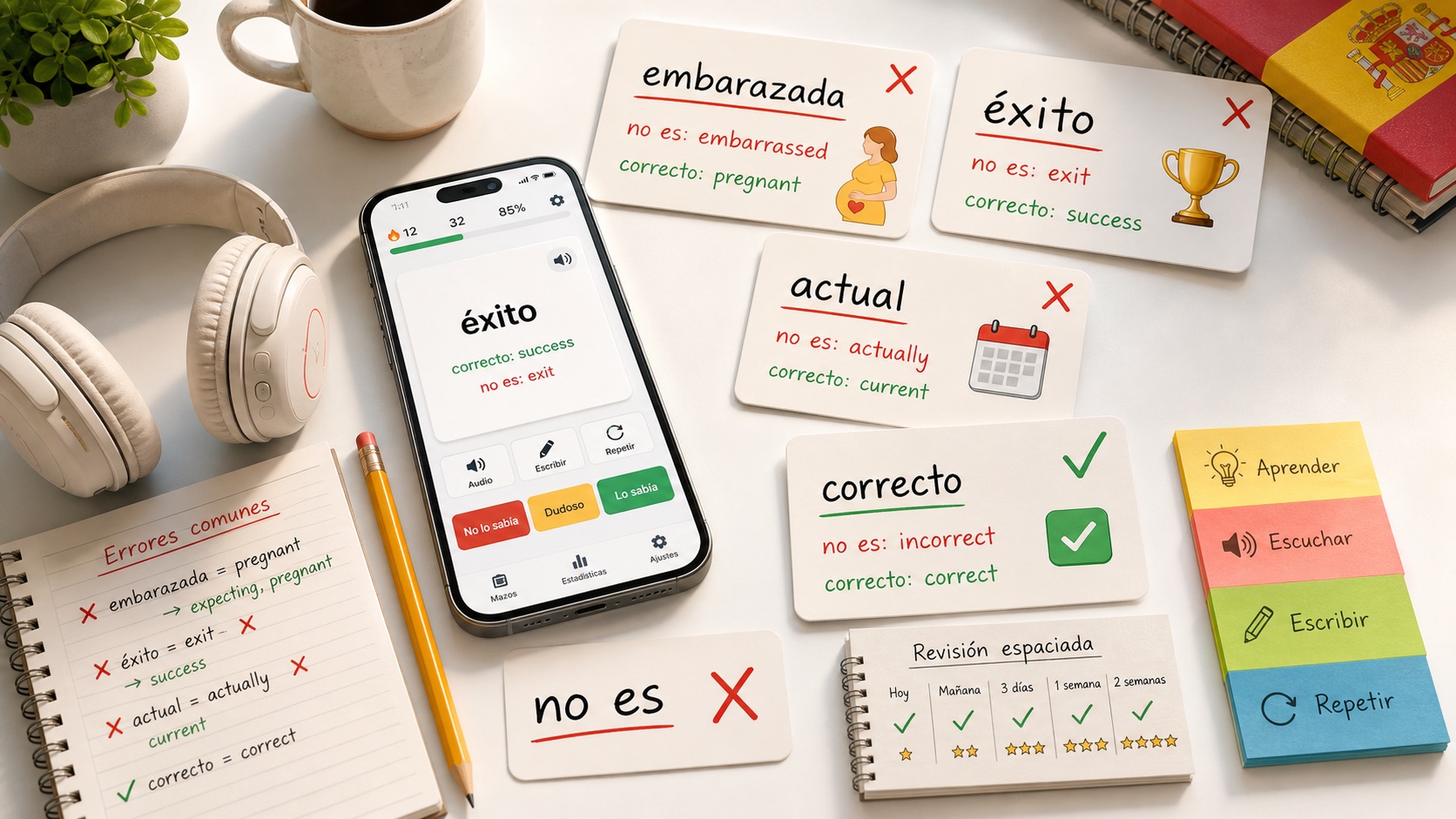
Check meaning in context before trusting a look-alike. Keep true cognates separate from false friends such as éxito and exit.
32 useful Spanish cognates
The list moves from identical-looking words to small spelling shifts, -ción nouns, and familiar international adjectives.
| Spanish word | Meaning | Example | Pattern |
|---|---|---|---|
| animal | animal | El animal duerme. | The written form is identical or nearly identical; Spanish pronunciation still changes. |
| color | color | El color es azul. | The written form is identical or nearly identical; Spanish pronunciation still changes. |
| doctor | doctor | El doctor trabaja aquí. | The written form is identical or nearly identical; Spanish pronunciation still changes. |
| hospital | hospital | El hospital está cerca. | The written form is identical or nearly identical; Spanish pronunciation still changes. |
| hotel | hotel | El hotel tiene piscina. | The written form is identical or nearly identical; Spanish pronunciation still changes. |
| radio | radio | Escucho la radio. | The written form is identical or nearly identical; Spanish pronunciation still changes. |
| taxi | taxi | Vamos en taxi. | The written form is identical or nearly identical; Spanish pronunciation still changes. |
| idea | idea | Es una buena idea. | The written form is identical or nearly identical; Spanish pronunciation still changes. |
| familia | family | Mi familia vive aquí. | A small, visible spelling change links the pair. |
| problema | problem | Tenemos un problema. | A small, visible spelling change links the pair. |
| música | music | Me gusta la música. | A small, visible spelling change links the pair. |
| cultura | culture | La cultura cambia con el tiempo. | A small, visible spelling change links the pair. |
| grupo | group | El grupo empieza hoy. | A small, visible spelling change links the pair. |
| secreto | secret | Es un secreto. | A small, visible spelling change links the pair. |
| parque | park | El parque está abierto. | A small, visible spelling change links the pair. |
| minuto | minute | Espera un minuto. | A small, visible spelling change links the pair. |
| acción | action | La acción empieza ahora. | The related noun uses Spanish -ción and is feminine. |
| información | information | Necesito más información. | The related noun uses Spanish -ción and is feminine. |
| comunicación | communication | La comunicación es importante. | The related noun uses Spanish -ción and is feminine. |
| educación | education | La educación abre puertas. | The related noun uses Spanish -ción and is feminine. |
| situación | situation | La situación es difícil. | The related noun uses Spanish -ción and is feminine. |
| organización | organization | La organización ayuda a estudiantes. | The related noun uses Spanish -ción and is feminine. |
| tradición | tradition | La tradición continúa. | The related noun uses Spanish -ción and is feminine. |
| nación | nation | Madrid es la capital de la nación. | The related noun uses Spanish -ción and is feminine. |
| natural | natural | Es algo natural. | The international adjective keeps a familiar form and shared core meaning. |
| social | social | La vida social es activa. | The international adjective keeps a familiar form and shared core meaning. |
| personal | personal | Es una decisión personal. | The international adjective keeps a familiar form and shared core meaning. |
| central | central | La estación central está cerrada. | The international adjective keeps a familiar form and shared core meaning. |
| local | local | Busco un restaurante local. | The international adjective keeps a familiar form and shared core meaning. |
| material | material | El material es resistente. | The international adjective keeps a familiar form and shared core meaning. |
| original | original | La versión original es mejor. | The international adjective keeps a familiar form and shared core meaning. |
| popular | popular | Es una canción popular. | The international adjective keeps a familiar form and shared core meaning. |
Learn cognates by visible pattern
Grouping the pairs by spelling change makes new words easier to decode without treating every resemblance as proof.
Identical-looking words
Easy to recognise, but not a licence to use English pronunciation.
animal · color · doctor · hospital · hotel · radio · taxi · idea
Small spelling shifts
One visible change connects a familiar word to Spanish.
familia · problema · música · cultura · grupo · secreto · parque · minuto
Nouns ending in -ción
A productive recognition pattern with feminine Spanish nouns.
acción · información · comunicación · educación · situación · organización · tradición · nación
International adjectives
Familiar forms that still need Spanish agreement in sentences.
natural · social · personal · central · local · material · original · popular
How should a beginner study cognates?
Say the Spanish word aloud before looking at the familiar translation. Identical spelling does not mean identical pronunciation.
Store the noun with its article when useful and keep written accents: la información, la música.
Add one short Spanish sentence so the shared meaning is tied to real usage, not only to appearance.
Hola Cards is a Spanish flashcard app from holacards.org for iOS and Android. It is free to download, requires no account, may show ads in the free version, while Premium removes ads, and works offline. The interface is available in 29 languages, including English, Russian, Portuguese and German; cards support translations in 29 languages, including English, Russian, Portuguese and German and 18 practice and game modes. You can import these 32 fixed pairs into a custom group and practise them with Spanish audio, writing, pronunciation, and review modes. Hola Cards does not identify cognates or validate arbitrary word pairs automatically.
Connect true cognates with false friends, accent marks, pronunciation, common vocabulary, and vocabulary practice.
Spanish false friends Words that change meaning with accents Spanish pronunciation for beginners 100 common Spanish words Spanish vocabulary builder app
A five-minute cognate drill
- Choose eight words from one pattern.
- Cover the translation and predict the meaning.
- Say the Spanish word with Spanish vowels and stress.
- Read the example and name the spelling pattern.
- Mix in two false friends and explain why they do not belong.
Language references
The definition and the distinction from false friends were checked with Instituto Cervantes and RAE; the learning patterns were cross-checked with current language-teaching guidance.
FAQ
What is a Spanish cognate?
A cognate shares a historical origin with a word in another language. For learners, the most useful pairs also have similar forms and a shared core meaning.
Are all similar Spanish and English words cognates?
No. Similar spelling can hide a different meaning. Embarazada means pregnant, while éxito means success; these are common false friends for English speakers.
Do Spanish cognates sound the same as English words?
Usually not. Even identical spellings follow Spanish vowels, consonants, and stress, so hospital and radio should be practised with Spanish audio.
Why do many English -tion words end in Spanish -ción?
Many related learned words came through Latin. The Spanish form is normally feminine and keeps a written accent: la información, la educación.
Should I learn the article with a cognate?
Yes for nouns. The article adds gender and makes the word easier to place in a sentence: el problema, la situación.
Can Hola Cards find cognates automatically?
No. It can import and practise these fixed pairs, but this guide and its references establish why the examples belong.
Copy 32 Spanish cognates into Hola Cards
Open word groups in Hola Cards, choose paste/import, and paste the block. Each line uses “Spanish - translation”.
**Spanish cognates: 32 useful words**

animal - animal
color - color
doctor - doctor
hospital - hospital
hotel - hotel
radio - radio
taxi - taxi
idea - idea
familia - family
problema - problem
música - music
cultura - culture
grupo - group
secreto - secret
parque - park
minuto - minute
acción - action
información - information
comunicación - communication
educación - education
situación - situation
organización - organization
tradición - tradition
nación - nation
natural - natural
social - social
personal - personal
central - central
local - local
material - material
original - original
popular - popular
Review Spanish cognates in Hola Cards
Practise 32 fixed words with Spanish audio, writing, pronunciation, custom groups, and review modes on iOS and Android.