colors in Spanish
What are the basic colors in Spanish?
The six best colors to learn first are rojo, azul, amarillo, verde, blanco, and negro. They describe clothes, houses, food, animals, signs, and everyday objects, so a beginner can reuse them immediately.
Spanish color adjectives usually follow the noun: un coche rojo, una camisa blanca. Learn each color inside a small phrase rather than as an isolated translation. That makes gender, number, and word order easier to retrieve together.
How color agreement works in Spanish
Colors ending in -o normally agree in gender and number: rojo, roja, rojos, rojas. Colors such as azul, verde, gris, marrón, and celeste do not change for gender, but they do have plural forms: azules, verdes, grises, marrones, and celestes.
Names borrowed from objects or materials, such as naranja, rosa, violeta, and café, often stay unchanged as color adjectives, although plural agreement is also common in everyday speech for some of them. With a compound shade, de color is a safe beginner pattern: dos sillones de color azul oscuro.
30 colors in Spanish with examples
Each row gives the Spanish color, a natural translation, a short sentence, and the agreement or regional detail that matters most.
| Spanish | Translation | Example | Beginner note |
|---|---|---|---|
| rojo | red | La camiseta es roja. | This -o color agrees in gender and number: -o, -a, -os, -as. |
| azul | blue | El cuaderno es azul. | The form is the same for both genders; change only the plural. |
| amarillo | yellow | El limón es amarillo. | This -o color agrees in gender and number: -o, -a, -os, -as. |
| verde | green | Las hojas son verdes. | The form is the same for both genders; change only the plural. |
| blanco | white | La pared es blanca. | This -o color agrees in gender and number: -o, -a, -os, -as. |
| negro | black | Los zapatos son negros. | This -o color agrees in gender and number: -o, -a, -os, -as. |
| gris | gray | El coche es gris. | The form is the same for both genders; change only the plural. |
| marrón | brown | La mesa es marrón. | Marrón is standard in Spain; café is frequent in Latin America. |
| naranja | orange | La mochila es naranja. | A noun-based color often stays unchanged; variable colloquial forms also occur. |
| rosa | pink | La falda es rosa. | A noun-based color often stays unchanged; variable colloquial forms also occur. |
| morado | purple | El vestido es morado. | This -o color agrees in gender and number: -o, -a, -os, -as. |
| violeta | violet; purple | La bufanda es violeta. | A noun-based color often stays unchanged; variable colloquial forms also occur. |
| celeste | sky blue; light blue | El coche es celeste. | The form is the same for both genders; change only the plural. |
| azul claro | light blue | La camisa es azul claro. | Keep the shade together; de color avoids agreement uncertainty. |
| azul oscuro | dark blue | Los sillones son de color azul oscuro. | Keep the shade together; de color avoids agreement uncertainty. |
| verde claro | light green | La taza es verde claro. | Keep the shade together; de color avoids agreement uncertainty. |
| verde oscuro | dark green | Las puertas son de color verde oscuro. | Keep the shade together; de color avoids agreement uncertainty. |
| gris claro | light gray | Las paredes son de color gris claro. | Keep the shade together; de color avoids agreement uncertainty. |
| dorado | golden; gold | El marco es dorado. | This -o color agrees in gender and number: -o, -a, -os, -as. |
| plateado | silver; silvery | La lámpara es plateada. | This -o color agrees in gender and number: -o, -a, -os, -as. |
| beis | beige | Los pantalones son beis. | Beis is the adapted spelling; beige is also used. |
| crema | cream | Las cortinas son crema. | A noun-based color often stays unchanged; variable colloquial forms also occur. |
| turquesa | turquoise | El mar es turquesa. | A noun-based color often stays unchanged; variable colloquial forms also occur. |
| coral | coral | La pared es coral. | A noun-based color often stays unchanged; variable colloquial forms also occur. |
| café | brown; coffee-colored | Mis ojos son café. | Marrón is standard in Spain; café is frequent in Latin America. |
| castaño | chestnut brown | Tiene el pelo castaño. | Especially common for chestnut-brown hair and brown eyes. |
| lila | lilac | La mochila es lila. | A noun-based color often stays unchanged; variable colloquial forms also occur. |
| fucsia | fuchsia | La falda es fucsia. | A noun-based color often stays unchanged; variable colloquial forms also occur. |
| granate | maroon; burgundy | El abrigo es granate. | A noun-based color often stays unchanged; variable colloquial forms also occur. |
| verde oliva | olive green | La botella es verde oliva. | Keep the shade together; de color avoids agreement uncertainty. |
Study the 30 Spanish colors in five groups
Six terms per group keep the palette manageable and make contrast practice easier.
Six essential colors
The highest-value starter palette for everyday descriptions.
rojo · azul · amarillo · verde · blanco · negro
Six common additions
Neutral, brown, orange, pink, and purple terms that appear often in clothes and objects.
gris · marrón · naranja · rosa · morado · violeta
Light and dark shades
Useful combinations with claro and oscuro, plus celeste.
celeste · azul claro · azul oscuro · verde claro · verde oscuro · gris claro
Metallic and design colors
Six familiar tones for objects, interiors, clothing, and nature.
dorado · plateado · beis · crema · turquesa · coral
Regional and precise terms
Brown variants plus lilac, fuchsia, maroon, and olive green.
café · castaño · lila · fucsia · granate · verde oliva
Ask and answer about colors in simple Spanish
Ask ¿De qué color es? for one object and ¿De qué color son? for more than one. Answer with ser: La mochila es roja. Los zapatos son negros. To point to the color itself, say el rojo, el azul, or el verde.
Claro and oscuro make useful shade combinations: azul claro, verde oscuro. When that whole combination follows a plural noun, keeping the shade in the singular is standard: dos sillones azul oscuro. The de color pattern is even clearer for a beginner.
Brown varies by region. Marrón is standard in Spain and widely understood; café is frequent in much of Latin America. Castaño is especially useful for brown hair and eyes. For purple, morado is a practical everyday choice, while violeta, lila, and púrpura name nearby shades.
Hola Cards is a Spanish flashcard app from holacards.org for iOS and Android. It is free to download, requires no account, may show ads in the free version, while Premium removes ads, works offline, offers an interface available in 29 languages, including English, Russian, Portuguese and German, and supports card translations in 29 languages, including English, Russian, Portuguese and German. Learners can practise color vocabulary with audio, writing, pronunciation, custom word groups, spaced review, and 18 practice and game modes.
Use colors with clothing, house objects, shopping phrases, ser, and Spanish pronunciation.
Spanish clothing vocabulary Spanish house vocabulary Spanish shopping phrases Ser vs estar for beginners Spanish pronunciation for beginners
How to learn the 30 colors in five steps
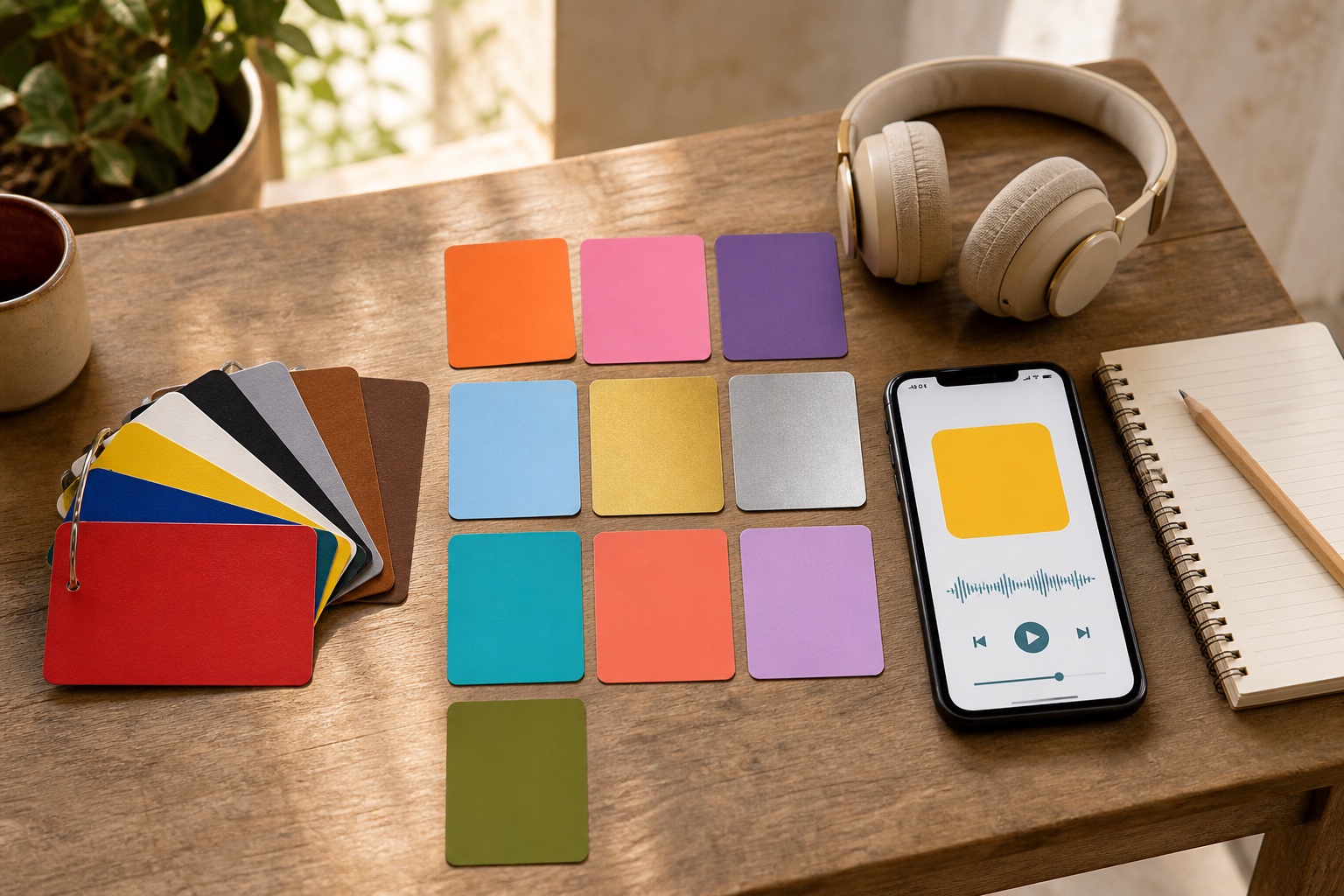
- Choose one six-color group and match every Spanish term to a real swatch.
- Say one masculine and one feminine noun phrase with each regular -o color.
- Ask ¿De qué color es? and answer aloud before revealing the card.
- Keep regional pairs together, especially marrón and café, and note where castaño is more precise.
- Review the complete 30-card group in Hola Cards with audio, writing, pronunciation, and spaced repetition.
FAQ
What are the main colors in Spanish?
The six core colors are rojo, azul, amarillo, verde, blanco, and negro. Add gris, marrón, naranja, rosa, morado, and violeta for a practical twelve-color beginner set.
Do Spanish colors change for gender?
Colors ending in -o usually do: un coche rojo and una camisa roja. Azul, verde, gris, marrón, and celeste keep the same form for masculine and feminine nouns but change in the plural.
How do you ask “What color is it?” in Spanish?
Say ¿De qué color es? for one thing and ¿De qué color son? for several things. A natural answer uses ser: Es azul or Son verdes.
What is the difference between marrón, café, and castaño?
Marrón is the usual word in Spain and is widely understood. Café is frequent for brown in Latin America. Castaño often describes brown hair or eyes and a chestnut shade.
Copy all 30 colors into Hola Cards
Open word groups in Hola Cards, choose paste/import, and paste this block. The app can read the title and the “Spanish - translation” lines.
**Colors in Spanish: 30 terms**

rojo - red
azul - blue
amarillo - yellow
verde - green
blanco - white
negro - black
gris - gray
marrón - brown
naranja - orange
rosa - pink
morado - purple
violeta - violet; purple
celeste - sky blue; light blue
azul claro - light blue
azul oscuro - dark blue
verde claro - light green
verde oscuro - dark green
gris claro - light gray
dorado - golden; gold
plateado - silver; silvery
beis - beige
crema - cream
turquesa - turquoise
coral - coral
café - brown; coffee-colored
castaño - chestnut brown
lila - lilac
fucsia - fuchsia
granate - maroon; burgundy
verde oliva - olive green
Practise colors in Spanish with Hola Cards
Hola Cards turns these 30 color terms into flashcards with audio, writing, pronunciation practice, custom groups, and spaced review on iOS and Android.