Remember the ending inside a complete future sentence
Import the 32 examples and practise them with Spanish audio and writing on iOS or Android. The grammar guide remains complete without the app.
Spanish future tense endings
What are the Spanish future tense endings?
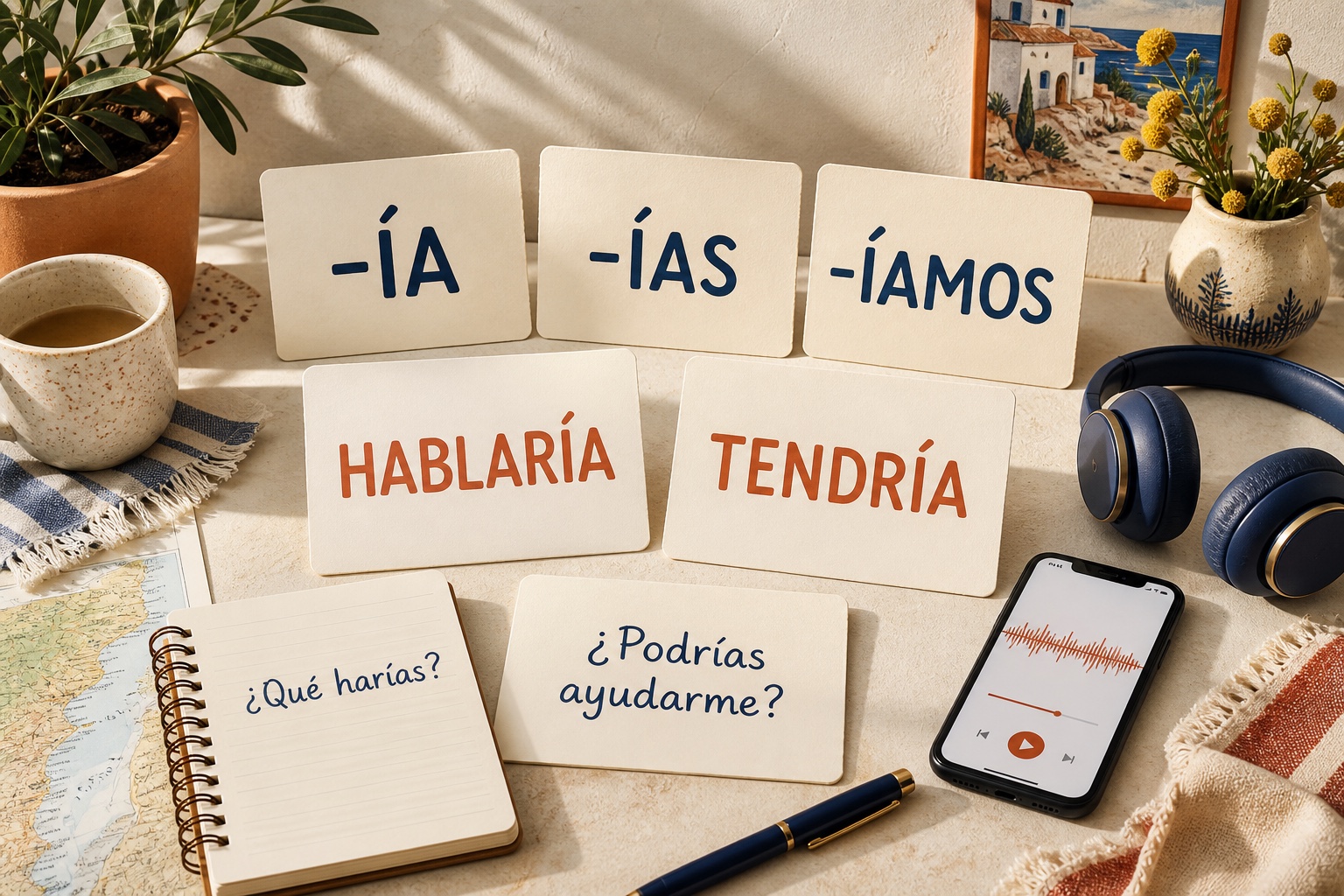
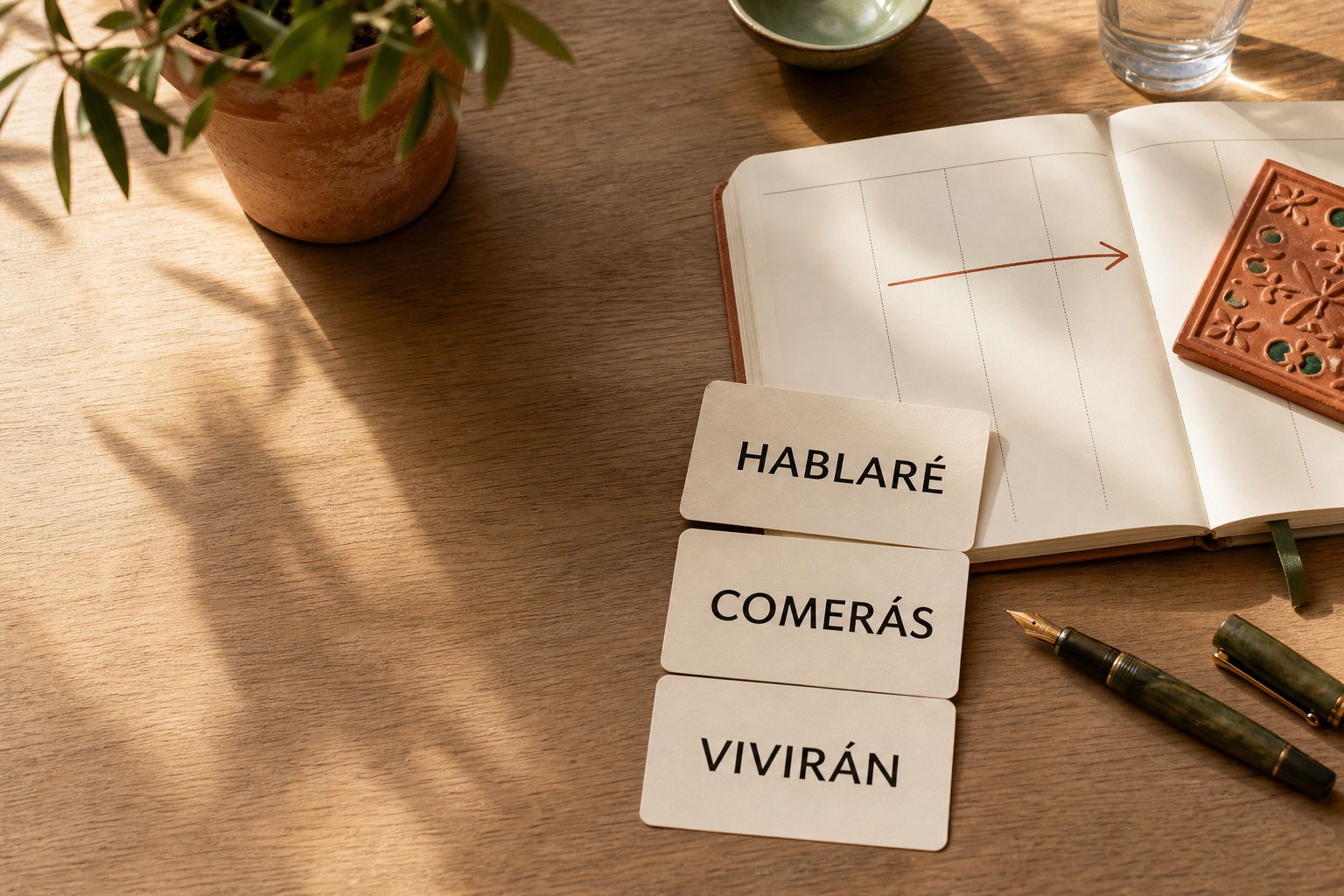
Keep the whole infinitive and add -é, -ás, -á, -emos, -éis or -án. Hablar gives hablaré; comer gives comerás; vivir gives vivirán. The same chart works for -ar, -er and -ir verbs.
The written accents matter in five of the six forms. Only nosotros ends in unaccented -emos. Vosotros is used mainly in Spain; ustedes takes the third-person plural form ending in -án.
A small group changes the stem before the same endings: tener → tendr-, poder → podr-, hacer → har-, decir → dir-, salir → saldr-, venir → vendr-, poner → pondr-, saber → sabr-, querer → querr- and haber → habr-.
Form the simple future in three steps
Start with the complete infinitive; do not remove -ar, -er or -ir.
Use the regular infinitive or, for an irregular verb, its future stem.
Add -é, -ás, -á, -emos, -éis or -án to match the subject.
32 Spanish simple-future examples
The examples cover all six persons, all three infinitive groups, frequent irregular stems, practical uses and the contrast with ir a + infinitive.
| Spanish sentence | Meaning | Example in context | Why this form? |
|---|---|---|---|
| Hablaré con Ana mañana. | I will speak with Ana tomorrow. | La forma de yo conserva el infinitivo. | Yo uses the full infinitive plus -é. |
| Estudiarás esta noche. | You will study tonight. | La forma de tú termina en -ás. | Tú uses -ás. |
| María trabajará desde casa. | María will work from home. | La tercera persona termina en -á. | Él/ella/usted uses -á. |
| Viajaremos juntos en junio. | We will travel together in June. | Nosotros añade -emos al infinitivo. | Nosotros uses -emos without a written accent. |
| Compraréis los billetes mañana. | You all will buy the tickets tomorrow. | Vosotros usa -éis. | Vosotros uses -éis, mainly in Spain. |
| Llegarán antes de las ocho. | They will arrive before eight. | La tercera persona plural termina en -án. | Ellos/ustedes uses -án. |
| Comeré después de la reunión. | I will eat after the meeting. | Los verbos en -er mantienen el infinitivo. | Yo uses the full infinitive plus -é. |
| Beberás agua después de correr. | You will drink water after running. | -Er recibe el mismo final -ás. | Tú uses -ás. |
| Vivirá cerca del mar. | She will live near the sea. | -Ir recibe el mismo final -á. | Él/ella/usted uses -á. |
| Aprenderemos nuevas expresiones. | We will learn new expressions. | -Er usa -emos con nosotros. | Nosotros uses -emos without a written accent. |
| Escribiréis la respuesta. | You all will write the answer. | -Ir usa -éis con vosotros. | Vosotros uses -éis, mainly in Spain. |
| Abrirán la tienda a las nueve. | They will open the shop at nine. | -Ir usa -án con ellos. | Ellos/ustedes uses -án. |
| Tendré más tiempo el viernes. | I will have more time on Friday. | Tener cambia a tendr-. | The irregular stem keeps the regular future ending. |
| Podrás venir conmigo. | You will be able to come with me. | Poder cambia a podr-. | The irregular stem keeps the regular future ending. |
| Hará buen tiempo mañana. | The weather will be good tomorrow. | Hacer cambia a har-. | The irregular stem keeps the regular future ending. |
| Diremos la verdad. | We will tell the truth. | Decir cambia a dir-. | The irregular stem keeps the regular future ending. |
| Saldréis después de comer. | You all will leave after lunch. | Salir cambia a saldr-. | The irregular stem keeps the regular future ending. |
| Vendrán en tren. | They will come by train. | Venir cambia a vendr-. | The irregular stem keeps the regular future ending. |
| Pondré las llaves aquí. | I will put the keys here. | Poner cambia a pondr-. | The irregular stem keeps the regular future ending. |
| Sabremos el resultado mañana. | We will know the result tomorrow. | Saber cambia a sabr-. | The irregular stem keeps the regular future ending. |
| Querrán descansar al llegar. | They will want to rest on arrival. | Querer cambia a querr-. | The irregular stem keeps the regular future ending. |
| Habrá una reunión el lunes. | There will be a meeting on Monday. | Haber cambia a habr-; hay pasa a habrá. | The irregular stem keeps the regular future ending. |
| Te llamaré esta tarde. | I will call you this afternoon. | El hablante hace una promesa futura. | The simple future states a future event, promise or prediction. |
| Algún día viajaremos por Sudamérica. | One day we will travel around South America. | Expresa un plan futuro no inmediato. | The simple future states a future event, promise or prediction. |
| El curso terminará en diciembre. | The course will end in December. | Presenta un hecho situado en el futuro. | The simple future states a future event, promise or prediction. |
| Creo que mañana lloverá. | I think it will rain tomorrow. | Expresa una predicción. | The simple future states a future event, promise or prediction. |
| ¿Dónde estará Ana? | Where could Ana be? | El futuro expresa una conjetura presente. | The future here expresses a guess about the present. |
| Serán las ocho. | It is probably eight o’clock. | El futuro estima la hora actual. | The future here expresses a guess about the present. |
| Tendrá unos treinta años. | He is probably about thirty. | El futuro estima una edad actual. | The future here expresses a guess about the present. |
| Voy a llamar ahora. | I am going to call now. | Ir a + infinitivo presenta un plan inmediato. | Ir a + infinitive presents an immediate plan or intention. |
| Este verano vamos a visitar Madrid. | This summer we are going to visit Madrid. | Ir a + infinitivo presenta una intención ya definida. | Ir a + infinitive presents an immediate plan or intention. |
| No te preocupes: volveré. | Do not worry: I will return. | El futuro simple refuerza una promesa. | The simple future states a future event, promise or prediction. |
Learn the future in four blocks
Begin with the shared chart, then learn irregular stems, useful meanings and the near-future contrast.
One ending set for every verb
Keep the full infinitive and practise all six persons across -ar, -er and -ir.
Hablaré con Ana mañana. · Estudiarás esta noche. · María trabajará desde casa. · Viajaremos juntos en junio. · Compraréis los billetes mañana. · Llegarán antes de las ocho. · Comeré después de la reunión. · Beberás agua después de correr. · Vivirá cerca del mar. · Aprenderemos nuevas expresiones. · Escribiréis la respuesta. · Abrirán la tienda a las nueve.
Irregular future stems
Change the stem, then attach the same regular endings.
Tendré más tiempo el viernes. · Podrás venir conmigo. · Hará buen tiempo mañana. · Diremos la verdad. · Saldréis después de comer. · Vendrán en tren. · Pondré las llaves aquí. · Sabremos el resultado mañana. · Querrán descansar al llegar. · Habrá una reunión el lunes.
Events, promises and predictions
Use complete sentences to connect form and future meaning.
Te llamaré esta tarde. · Algún día viajaremos por Sudamérica. · El curso terminará en diciembre. · Creo que mañana lloverá.
Future, present guesses and near future
Distinguish a neutral future, a present-time guess and ir a + infinitive.
¿Dónde estará Ana? · Serán las ocho. · Tendrá unos treinta años. · Voy a llamar ahora. · Este verano vamos a visitar Madrid. · No te preocupes: volveré.
When should you use the simple future?
Use it for future facts, plans, promises or predictions: Mañana trabajaré desde casa; te llamaré; algún día viajaremos juntos.
Use it to make a guess about the present: ¿Dónde estará Ana? means “Where could Ana be?” and Serán las ocho means “It is probably eight.”
For an immediate plan or clear intention, ir a + infinitive is often natural: Voy a llamar ahora. The simple future is still correct, but choice depends on meaning and region; it is especially common for predictions, promises and more neutral future statements.
Hola Cards is a Spanish flashcard app from holacards.org for iOS and Android. It is free to download, requires no account, may show ads in the free version, while Premium removes ads, and works offline. The interface is available in 29 languages, including English, Russian, Portuguese and German; cards support translations in 29 languages, including English, Russian, Portuguese and German and 18 practice and game modes. You can import these fixed sentences into a custom group for Spanish audio, writing, pronunciation, and spaced review. Hola Cards does not conjugate verbs or decide between the simple future and ir a + infinitive automatically, so build and check the form with this guide first.
Connect the simple future with ir, present endings, subject pronouns, time words and beginner verbs.
Ir and ir a + infinitive Present-tense endings Subject pronouns Numbers, dates and time 50 beginner verbs
A five-minute future routine
- Write the six endings from memory.
- Add them to hablar, comer and vivir without removing the infinitive ending.
- Write five irregular stems and attach the same endings.
- Contrast one prediction with one immediate ir a + infinitive plan.
- Hear and rewrite eight full sentences without looking at the chart.
Grammar references
The forms and uses were checked against primary RAE–ASALE and Instituto Cervantes sources.
- RAE–ASALE: simple future indicative
- RAE–ASALE: Spanish conjugation models
- Instituto Cervantes A2: talking about the future
FAQ
What are the Spanish future endings?
They are -é, -ás, -á, -emos, -éis and -án. Add them to the full infinitive: hablaré, comerás, vivirán.
Do -ar, -er and -ir verbs use different future endings?
No. All three groups use the same six endings.
Which future forms have written accents?
Five forms do: -é, -ás, -á, -éis and -án. Only nosotros -emos has no written accent.
What are the main irregular future stems?
Frequent stems include tendr-, podr-, har-, dir-, saldr-, vendr-, pondr-, sabr-, querr- and habr-. They still take the regular endings.
What is the difference between hablaré and voy a hablar?
Both refer to the future. Voy a hablar often presents an immediate plan or intention; hablaré is common for predictions, promises and neutral future statements. Usage varies by context and region.
Does Hola Cards conjugate a verb automatically?
No. You can import and practise these fixed examples; this page explains how to build and check each future form.
Copy the 32 future examples into Hola Cards
Open word groups in Hola Cards, choose paste/import, and paste the block. The app recognises the title and “Spanish - translation” lines.
**Spanish future: 32 examples**

Hablaré con Ana mañana. - I will speak with Ana tomorrow.
Estudiarás esta noche. - You will study tonight.
María trabajará desde casa. - María will work from home.
Viajaremos juntos en junio. - We will travel together in June.
Compraréis los billetes mañana. - You all will buy the tickets tomorrow.
Llegarán antes de las ocho. - They will arrive before eight.
Comeré después de la reunión. - I will eat after the meeting.
Beberás agua después de correr. - You will drink water after running.
Vivirá cerca del mar. - She will live near the sea.
Aprenderemos nuevas expresiones. - We will learn new expressions.
Escribiréis la respuesta. - You all will write the answer.
Abrirán la tienda a las nueve. - They will open the shop at nine.
Tendré más tiempo el viernes. - I will have more time on Friday.
Podrás venir conmigo. - You will be able to come with me.
Hará buen tiempo mañana. - The weather will be good tomorrow.
Diremos la verdad. - We will tell the truth.
Saldréis después de comer. - You all will leave after lunch.
Vendrán en tren. - They will come by train.
Pondré las llaves aquí. - I will put the keys here.
Sabremos el resultado mañana. - We will know the result tomorrow.
Querrán descansar al llegar. - They will want to rest on arrival.
Habrá una reunión el lunes. - There will be a meeting on Monday.
Te llamaré esta tarde. - I will call you this afternoon.
Algún día viajaremos por Sudamérica. - One day we will travel around South America.
El curso terminará en diciembre. - The course will end in December.
Creo que mañana lloverá. - I think it will rain tomorrow.
¿Dónde estará Ana? - Where could Ana be?
Serán las ocho. - It is probably eight o’clock.
Tendrá unos treinta años. - He is probably about thirty.
Voy a llamar ahora. - I am going to call now.
Este verano vamos a visitar Madrid. - This summer we are going to visit Madrid.
No te preocupes: volveré. - Do not worry: I will return.
Review Spanish future forms in Hola Cards
Practise the 32 examples with Spanish audio, writing, pronunciation, custom groups, and spaced review on iOS and Android.