Hear Spanish D and T inside complete words
Import the 24 examples and practise with Spanish audio, writing, and word-level recognition on iOS or Android. Recognition can check which word was heard; it does not score tongue position, [d] versus [ð̞], consonant strength, or an accent.
Spanish d pronunciation
When is Spanish D hard or soft?
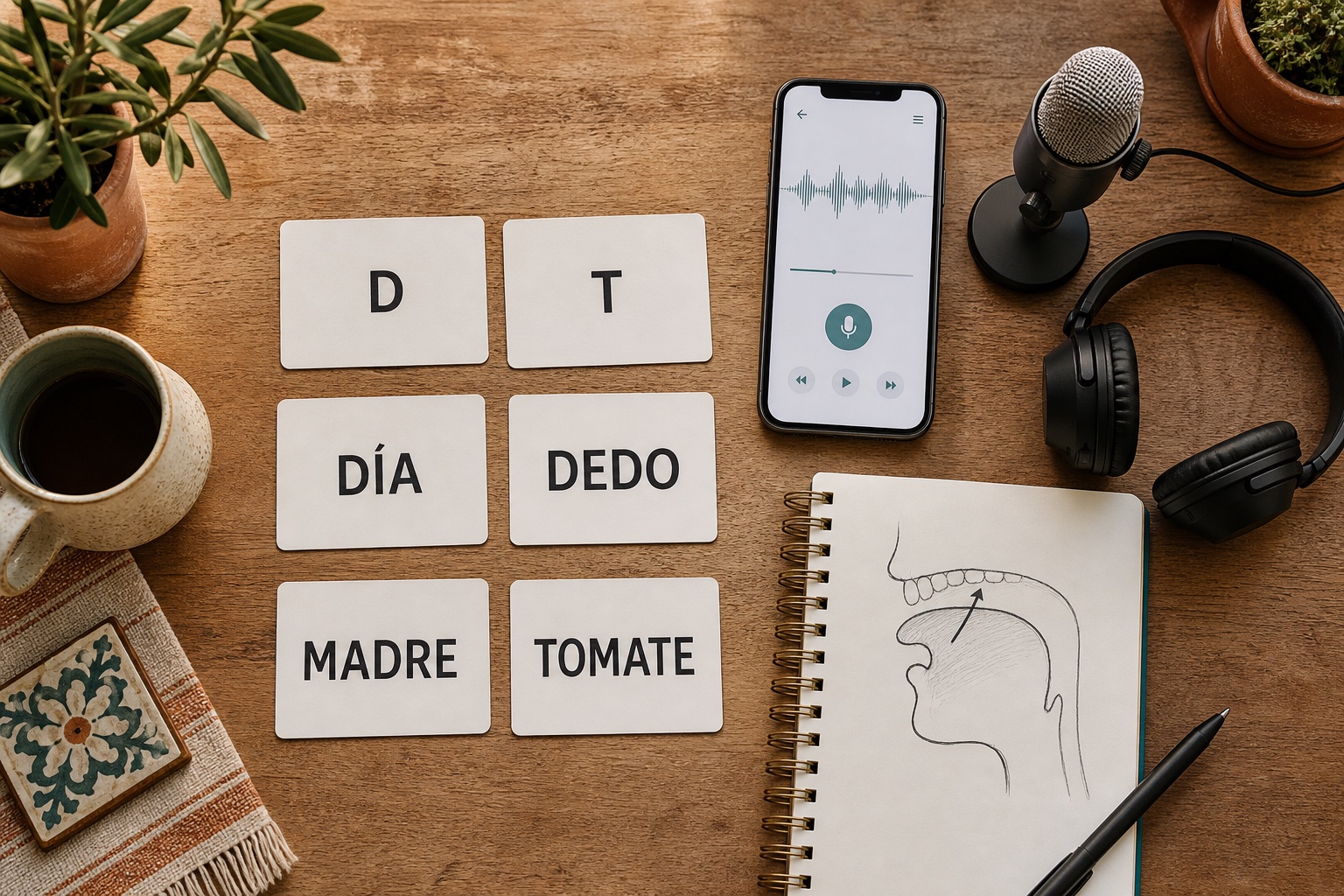
Use a complete dental closure [d] after a pause and after n or l: día, un día, el día. The tongue is lower and closer to the upper teeth than for a typical English d, which is made farther back on the ridge.
In most other positions, keep the tongue contact lighter so air continues around it: dedo, cada, madre, verde. This approximant [ð̞] is related to English voiced th, but Spanish contact is often briefer and less forceful.
Final d and the d of -ado often weaken in natural speech. You may hear verdad, salud, Madrid or cansado with a very light d, and some regional or casual speakers omit it. Treat those forms as listening variants, not a reason to delete every d. Spanish t stays voiceless, dental and usually unaspirated: taza, tomate, teatro.
Choose the sound from the position, not the spelling alone
After a pause, n or l, close the airflow briefly at the upper teeth for [d]: dónde, un día, el dedo. Voice the sound; do not turn it into t.
In most other contexts, use soft [ð̞]: cada, madre, verde, la duda. Let the tongue approach the teeth without a firm stop.
Expect regional weakening between vowels, especially in -ado, and at the end of a word. For careful beginner speech, keep a light audible d and learn to recognize weaker native variants.
For t, use the same dental contact without vocal-cord vibration and without the strong aspiration common in English: tomar, tarde, teatro, tomate.
24 Spanish D and T pronunciation examples
The four groups move from full dental [d] to soft [ð̞], natural weakening, and unaspirated dental [t]. Repeat each complete example instead of isolating the letter.
| Spanish | Meaning | Example | Pronunciation cue |
|---|---|---|---|
| día | day | Hoy es un buen día. | Use full dental [d] after a pause, n or l. |
| dar | to give | Dar una respuesta ayuda. | Use full dental [d] after a pause, n or l. |
| domingo | Sunday | Nos vemos el domingo. | Use full dental [d] after a pause, n or l. |
| un día | one day | Un día quiero viajar. | Use full dental [d] after a pause, n or l. |
| el día | the day | El día empieza temprano. | Use full dental [d] after a pause, n or l. |
| dónde | where | ¿Dónde estás? | Use full dental [d] after a pause, n or l. |
| dedo | finger | Me duele el dedo. | Use light [ð̞] without a complete closure. |
| cada | each | Estudio cada mañana. | Use light [ð̞] without a complete closure. |
| madre | mother | Mi madre vive aquí. | Use light [ð̞] without a complete closure. |
| verde | green | La puerta es verde. | Use light [ð̞] without a complete closure. |
| nada | nothing | No pasa nada. | Use light [ð̞] without a complete closure. |
| la duda | the doubt | Tengo la misma duda. | Use light [ð̞] without a complete closure. |
| cansado | tired | Estoy cansado hoy. | Keep a light d; expect regional weakening in casual speech. |
| hablado | spoken | Ya hemos hablado. | Keep a light d; expect regional weakening in casual speech. |
| pescado | fish | Quiero pescado a la plancha. | Keep a light d; expect regional weakening in casual speech. |
| verdad | truth | Es verdad. | Keep a light d; expect regional weakening in casual speech. |
| salud | health | La salud es importante. | Keep a light d; expect regional weakening in casual speech. |
| Madrid | Madrid | Madrid está en España. | Keep a light d; expect regional weakening in casual speech. |
| taza | cup | La taza está caliente. | Touch the upper teeth and release without strong aspiration. |
| tomar | to take; drink | Voy a tomar agua. | Touch the upper teeth and release without strong aspiration. |
| teatro | theatre | Vamos al teatro. | Touch the upper teeth and release without strong aspiration. |
| tarde | afternoon; late | Llegaré esta tarde. | Touch the upper teeth and release without strong aspiration. |
| atleta | athlete | La atleta corre rápido. | Touch the upper teeth and release without strong aspiration. |
| tomate | tomato | Necesito un tomate. | Touch the upper teeth and release without strong aspiration. |
Practise four position-based decisions
Six examples per group keep careful learner targets separate from regional listening variants.
Full dental D
After a pause, n or l, make a brief voiced closure at the teeth.
día · dar · domingo · un día · el día · dónde
Soft D: [ð̞]
In most other positions, keep airflow moving past a light dental approach.
dedo · cada · madre · verde · nada · la duda
Weak and final D
Learn to hear regional weakening without deleting every d.
cansado · hablado · pescado · verdad · salud · Madrid
Dental T
Use voiceless dental contact with no strong puff of air.
taza · tomar · teatro · tarde · atleta · tomate
Build the contrast without overpronouncing it
Touch the back of the upper teeth for día, un día and el día; keep the closure brief and voiced.
Alternate dedo–cada–madre–verde with a lighter middle d and no complete stop.
Listen for several careful and casual speakers saying cansado, hablado, verdad and Madrid. Notice variation without copying deletion automatically.
Hola Cards is a Spanish flashcard app from holacards.org for iOS and Android. It is free to download, requires no account, may show ads in the free version, while Premium removes ads, and works offline. Its interface is available in 29 languages, including English, Russian, Portuguese and German; cards support translations in 29 languages, including English, Russian, Portuguese and German and 18 practice and game modes. Audio supplies a word model, writing fixes spelling, and on-device recognition offers only a limited word-level check.
Connect D and T with the full pronunciation map, vowel clarity, B/V allophones, listening practice and the pronunciation-app guide.
Spanish pronunciation for beginners Spanish vowel sounds Spanish B and V pronunciation Spanish listening practice app Flashcard app with pronunciation
A five-minute D and T routine
- Repeat the six full-D examples after a pause and after n or l.
- Repeat the six soft-D examples with continuous airflow.
- Listen to the six weak/final-D examples in careful and casual recordings.
- Read the six T examples with dental contact and no strong puff of air.
- Write six mixed words from dictation and mark why each consonant is full, soft or variable.
Pronunciation references
The articulation, position rules and regional listening notes were checked against these references.
- Instituto Cervantes A1–A2 pronunciation inventory
- Instituto Cervantes C1–C2 pronunciation inventory
- Saarland University: Spanish D and T
- SpanishDictionary: D and T pronunciation
FAQ
How is d pronounced in Spanish?
After a pause and after n or l, Spanish d normally has full dental closure [d]. In most other contexts it is the softer approximant [ð̞].
Why does Spanish d sometimes sound like th?
The soft [ð̞] keeps airflow moving past a light dental contact. It resembles the voiced th in English “this”, although Spanish articulation is usually lighter and shorter.
Is the d silent in cansado or Madrid?
It may weaken greatly or disappear in some casual and regional speech, especially in -ado and word-final position. A clear light d is a safe beginner target.
How is Spanish t different from English t?
Spanish t is dental and normally unaspirated: the tongue touches the upper teeth and releases without a strong puff of air.
Can Hola Cards judge my Spanish D or T?
No. Hola Cards can play and recognize whole words on the device. It does not score individual consonants, tongue position, aspiration or accents.
Copy the 24 D and T examples into Hola Cards
Open word groups in Hola Cards, choose paste/import, and paste this block. The app can read the title and the “Spanish - translation” lines.
**Spanish D and T: 24 examples**

día - day
dar - to give
domingo - Sunday
un día - one day
el día - the day
dónde - where
dedo - finger
cada - each
madre - mother
verde - green
nada - nothing
la duda - the doubt
cansado - tired
hablado - spoken
pescado - fish
verdad - truth
salud - health
Madrid - Madrid
taza - cup
tomar - to take; drink
teatro - theatre
tarde - afternoon; late
atleta - athlete
tomate - tomato
Practise Spanish D and T in Hola Cards
Review the 24 examples with Spanish audio, writing, custom groups, repeated practice and word-level recognition on iOS and Android.