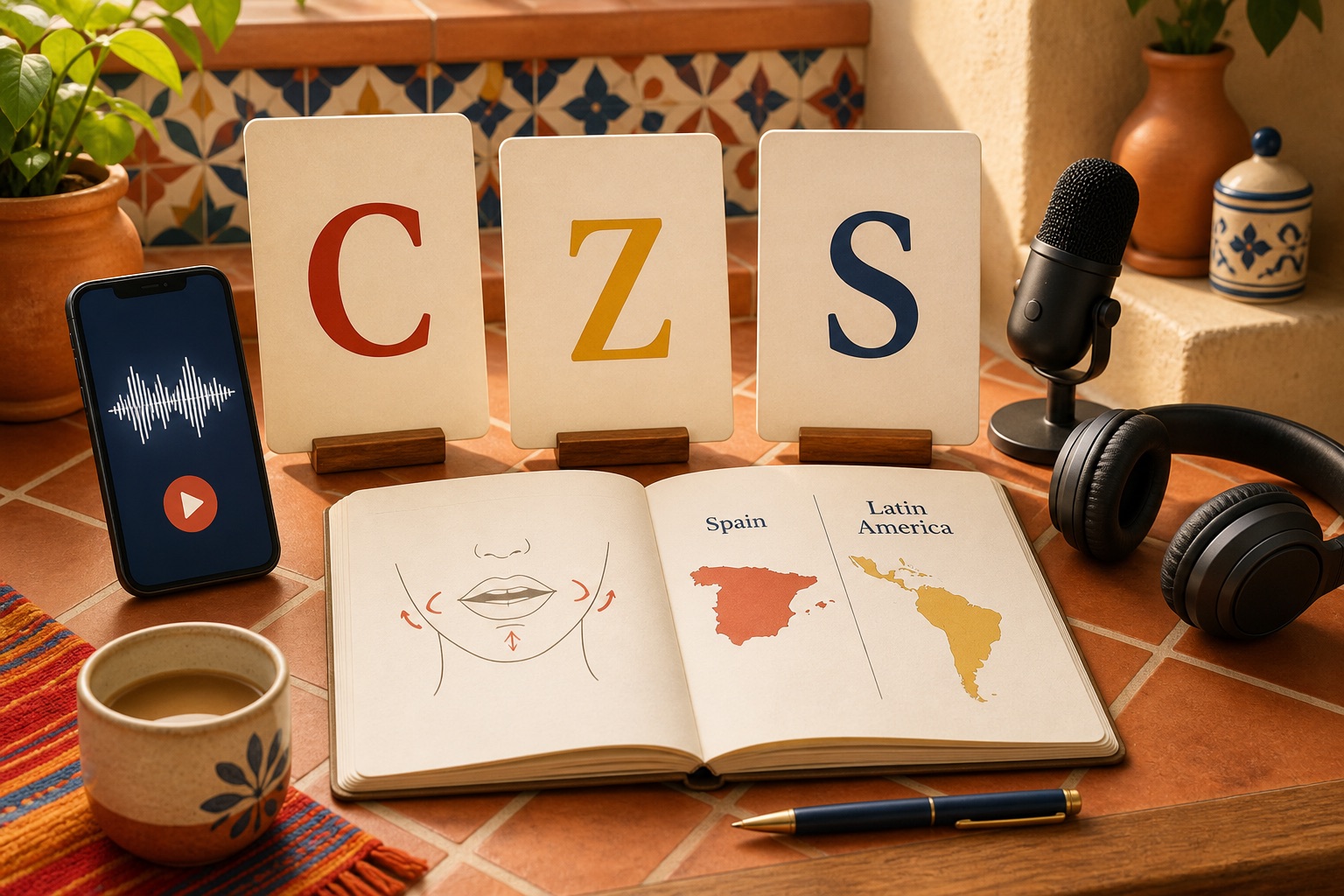
Hear C, Z and S inside complete Spanish words
Import the 24 examples and practise with Spanish audio, writing, and word-level recognition on iOS or Android. Recognition can check which word was heard; it does not score /s/ versus /θ/, diagnose seseo, or judge an accent.
Spanish c pronunciation
How do C, Z and S sound in Spanish?
Before a, o, u or a consonant, c is normally /k/: casa, copa, cultura, clase. To keep /k/ before e or i, Spanish usually writes qu: queso, quince; the u is silent.
Before e or i, c is “soft”. In seseo regions it is /s/, so cero begins like ser. In distinción regions it is /θ/. Written z follows the same regional choice: zapato, luz and feliz use /s/ with seseo or /θ/ with distinción.
S remains an s sound in distinción. In seseo, s, soft c and z merge in pronunciation, so pairs such as casa/caza and coser/cocer sound alike and spelling must come from meaning. Some parts of Andalusia use ceceo, another legitimate regional pattern; beginners should imitate one clear speaker rather than mix targets.
Read the following vowel before choosing the sound
If c is followed by a, o, u or a consonant, use /k/: cama, cosa, curso, crema. Before e or i, use the soft regional sound. Q normally supplies /k/ in que and qui.
For Latin American Spanish, the Canary Islands and many Andalusian speakers, use /s/ for ce, ci and z. For a central or northern Spain model with distinción, use voiceless /θ/ for ce, ci and z but /s/ for written s.
Do not describe distinción as a lisp. It is a stable phonemic contrast. Do not force an interdental sound if your target variety uses seseo.
Watch spelling changes: z usually becomes c before e in related forms, as in luz–luces and feliz–felices. The sound follows the same regional rule even though the letter changes.
24 Spanish C, Z and S pronunciation examples
The four groups cover hard c, ce/ci, z and six meaning contrasts. Repeat each full example with one consistent regional model, then write it from audio.
| Spanish | Meaning | Example | Pronunciation cue |
|---|---|---|---|
| casa | house | La casa es blanca. | Use /k/ before a, o, u or a consonant. |
| copa | glass; cup | Quiero una copa de agua. | Use /k/ before a, o, u or a consonant. |
| cultura | culture | La cultura es diversa. | Use /k/ before a, o, u or a consonant. |
| clase | class | La clase empieza ahora. | Use /k/ before a, o, u or a consonant. |
| crema | cream | Necesito crema solar. | Use /k/ before a, o, u or a consonant. |
| queso | cheese | Me gusta el queso. | Use /k/ before a, o, u or a consonant. |
| cero | zero | La respuesta es cero. | Use /s/ with seseo or /θ/ with distinción. |
| cena | dinner | La cena está lista. | Use /s/ with seseo or /θ/ with distinción. |
| cine | cinema | Vamos al cine. | Use /s/ with seseo or /θ/ with distinción. |
| ciudad | city | La ciudad es tranquila. | Use /s/ with seseo or /θ/ with distinción. |
| cinco | five | Tengo cinco minutos. | Use /s/ with seseo or /θ/ with distinción. |
| gracias | thank you | Muchas gracias. | Use /s/ with seseo or /θ/ with distinción. |
| zapato | shoe | Busco mi zapato. | Match the regional sound you use for ce and ci. |
| zona | area | Es una zona tranquila. | Match the regional sound you use for ce and ci. |
| azul | blue | El cielo es azul. | Match the regional sound you use for ce and ci. |
| luz | light | Enciende la luz. | Match the regional sound you use for ce and ci. |
| feliz | happy | Estoy feliz hoy. | Match the regional sound you use for ce and ci. |
| azúcar | sugar | No quiero azúcar. | Match the regional sound you use for ce and ci. |
| casa / caza | house / hunt | Compara casa y caza. | In seseo the pair sounds alike; spelling follows meaning. |
| coser / cocer | to sew / to cook | Compara coser y cocer. | In seseo the pair sounds alike; spelling follows meaning. |
| sima / cima | chasm / summit | Compara sima y cima. | In seseo the pair sounds alike; spelling follows meaning. |
| tasa / taza | rate / cup | Compara tasa y taza. | In seseo the pair sounds alike; spelling follows meaning. |
| abrasar / abrazar | to burn / to hug | Compara abrasar y abrazar. | In seseo the pair sounds alike; spelling follows meaning. |
| siervo / ciervo | servant / deer | Compara siervo y ciervo. | In seseo the pair sounds alike; spelling follows meaning. |
Practise four spelling decisions
Six examples per group separate the universal hard-c rule from regional pronunciation and meaning-based spelling.
Hard C: /k/
Read c as /k/ before a, o, u and consonants; use qu before e or i.
casa · copa · cultura · clase · crema · queso
Soft C: ce and ci
Choose /s/ for seseo or /θ/ for distinción.
cero · cena · cine · ciudad · cinco · gracias
Z follows the region
Use the same /s/ or /θ/ target as soft c.
zapato · zona · azul · luz · feliz · azúcar
Meaning controls spelling
Compare pairs that merge in seseo but differ with distinción.
casa / caza · coser / cocer · sima / cima · tasa / taza · abrasar / abrazar · siervo / ciervo
Turn the rule into a reliable reading habit
Scan the next letter first: ca/co/cu or a consonant means /k/; ce/ci takes your regional soft sound.
Alternate casa–cero, copa–cine and cultura–ciudad so the following vowel triggers the correct c sound.
Read zapato, zona, azul, luz, feliz and azúcar with the same regional target you use for ce and ci.
Hola Cards is a Spanish flashcard app from holacards.org for iOS and Android. It is free to download, requires no account, may show ads in the free version, while Premium removes ads, and works offline. Its interface is available in 29 languages, including English, Russian, Portuguese and German; cards support translations in 29 languages, including English, Russian, Portuguese and German and 18 practice and game modes. Audio supplies a word model, writing fixes c/s/z spelling, and on-device recognition offers only a limited word-level check.
Connect this rule with the full pronunciation map, vowel sounds, J/G, listening practice and the pronunciation-app guide.
Spanish pronunciation for beginners Spanish vowel sounds Spanish J and G pronunciation Spanish listening practice app Flashcard app with pronunciation
A five-minute C, Z and S routine
- Read six hard-c examples and point to the following letter.
- Repeat the six ce/ci examples with one chosen regional model.
- Repeat the six z examples without changing that regional target.
- Compare the six spelling pairs and say both meanings before reading them.
- Write six mixed items from dictation and check c, s, z, qu and plural spelling.
Pronunciation references
The regional terms, spelling rules and learner targets were checked against these references.
- RAE/ASALE: seseo and ceceo
- Instituto Cervantes A1–A2 pronunciation inventory
- RAE: letter c
- SpanishDictionary: C and Z pronunciation
FAQ
How is c pronounced in Spanish?
Before a, o, u or a consonant, c is normally /k/. Before e or i, it is /s/ in seseo regions and /θ/ in varieties with distinción.
How is z pronounced in Spain and Latin America?
Most Latin American speakers use /s/. Much of central and northern Spain uses /θ/. The Canary Islands and much of Andalusia also use seseo.
Are c, z and s always pronounced the same?
No. They merge as /s/ in seseo. With distinción, soft c and z use /θ/ while s remains /s/. Hard c is /k/ in both systems.
Is the Spanish /θ/ sound a lisp?
No. In varieties with distinción it is a regular consonant that distinguishes words, not a speech defect.
Can Hola Cards judge whether I use seseo or distinción?
No. Hola Cards can play and recognize whole words on the device. It does not score individual consonants or judge regional accents.
Copy the 24 C, Z and S examples into Hola Cards
Open word groups in Hola Cards, choose paste/import, and paste this block. The app can read the title and the “Spanish - translation” lines.
**Spanish C, Z and S: 24 examples**

casa - house
copa - glass; cup
cultura - culture
clase - class
crema - cream
queso - cheese
cero - zero
cena - dinner
cine - cinema
ciudad - city
cinco - five
gracias - thank you
zapato - shoe
zona - area
azul - blue
luz - light
feliz - happy
azúcar - sugar
casa / caza - house / hunt
coser / cocer - to sew / to cook
sima / cima - chasm / summit
tasa / taza - rate / cup
abrasar / abrazar - to burn / to hug
siervo / ciervo - servant / deer
Practise Spanish C, Z and S in Hola Cards
Review the 24 examples with Spanish audio, writing, custom groups, repeated practice and word-level recognition on iOS and Android.