Hear B and V in real Spanish words
Import the 24-example group and practise with Spanish audio, writing, and word-level recognition on iOS or Android. Recognition can check which word was heard; it does not score [b] or [β̞] or diagnose lip position.
Spanish b and v pronunciation
Are b and v pronounced differently in Spanish?
For the standard pronunciation, no: b and v represent the same phoneme. Native spelling keeps two letters, but switching from written b to written v does not create the English contrast in bat and vat. This is why tubo and tuvo sound alike even though their meanings and spellings differ.
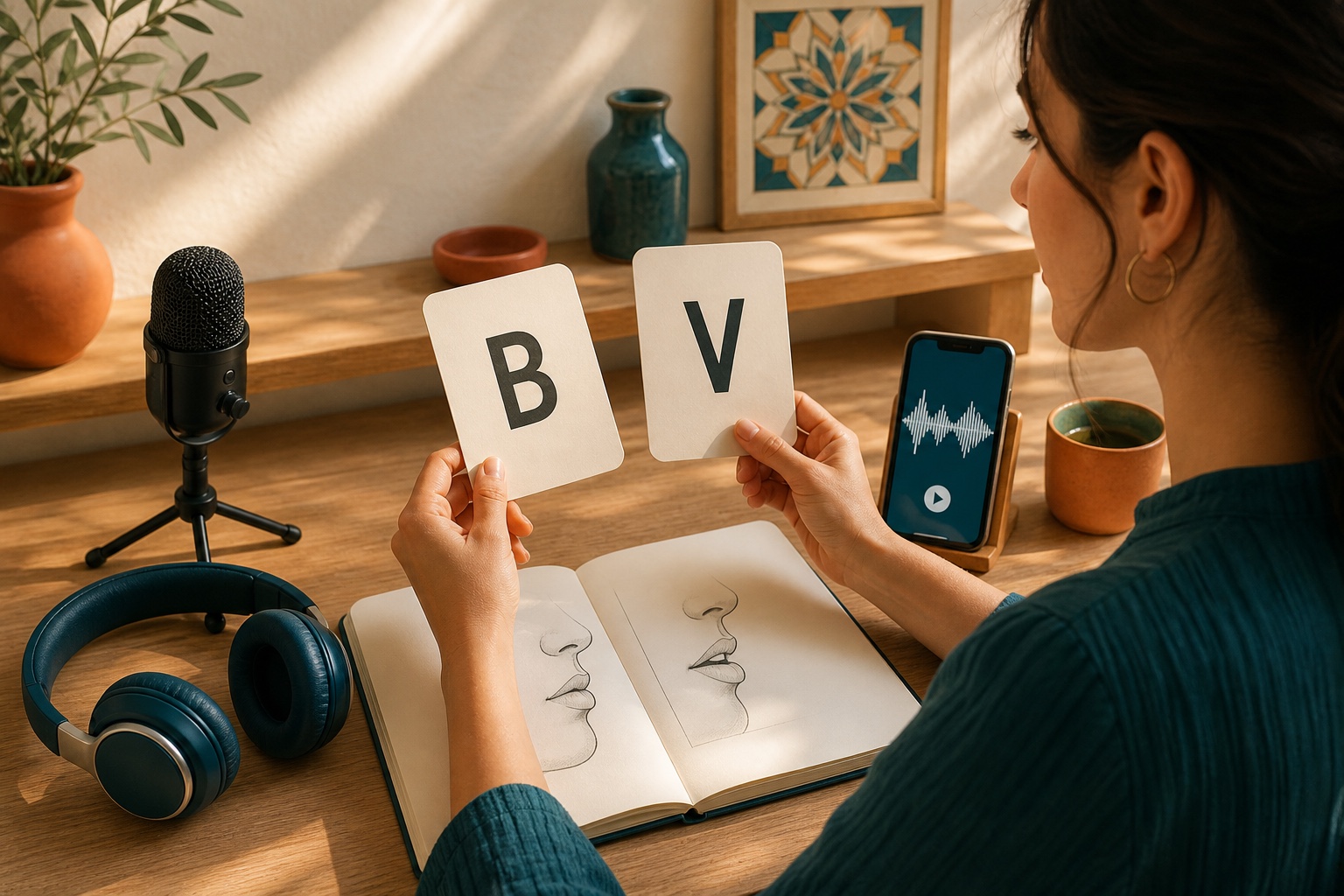
The shared phoneme has common positional variants. After a pause and after a nasal sound, the lips normally close completely for [b]. In most other contexts, the lips approach each other without a full closure, producing the softer approximant [β̞]. These are variants of one Spanish sound, not separate “B sound” and “V sound” rules.
Use both lips, then let the phrase choose the variant
For the closed [b], bring both lips together briefly, build a little pressure, and release without the strong puff common in English. Practise boca and vaso after a pause, then ambos and enviar after m or n.
For [β̞], keep the lips relaxed and leave a narrow opening. Air and voice continue without friction from the upper teeth. Practise saber, vivir, la boca, and a ver. The lower lip should not touch the upper teeth as it does for English /v/.
Apply the rule across word boundaries. Vaso starts with [b] when said alone, but the consonant usually softens in mi vaso. Listen to whole short phrases rather than assigning one permanent sound to each spelling.
24 Spanish B and V pronunciation examples
The four groups move from full closure to the softer sound in words and connected speech. Read each example as a complete phrase, not as isolated spelling.
| Spanish word or phrase | Meaning | Example | Pronunciation cue |
|---|---|---|---|
| boca | mouth | Di: boca. | After a pause, both spellings normally begin with a light, fully closed [b]. |
| vaso | glass | Di: vaso. | After a pause, both spellings normally begin with a light, fully closed [b]. |
| bebé | baby | Di: bebé. | After a pause, both spellings normally begin with a light, fully closed [b]. |
| vino | wine | Di: vino. | After a pause, both spellings normally begin with a light, fully closed [b]. |
| blanco | white | Di: blanco. | After a pause, both spellings normally begin with a light, fully closed [b]. |
| verde | green | Di: verde. | After a pause, both spellings normally begin with a light, fully closed [b]. |
| ambos | both | Ambos vienen hoy. | After m or n, close both lips completely for [b]. |
| cambio | change | Necesito un cambio. | After m or n, close both lips completely for [b]. |
| enviar | to send | Voy a enviar el mensaje. | After m or n, close both lips completely for [b]. |
| invierno | winter | El invierno es frío. | After m or n, close both lips completely for [b]. |
| un beso | a kiss | Te mando un beso. | After m or n, close both lips completely for [b]. |
| un vaso | a glass | Quiero un vaso de agua. | After m or n, close both lips completely for [b]. |
| saber | to know | Quiero saber la verdad. | In most other positions, keep a narrow gap for the softer [β̞]. |
| vivir | to live | Quiero vivir aquí. | In most other positions, keep a narrow gap for the softer [β̞]. |
| caballo | horse | El caballo corre. | In most other positions, keep a narrow gap for the softer [β̞]. |
| joven | young | Es muy joven. | In most other positions, keep a narrow gap for the softer [β̞]. |
| arriba | upstairs, above | Está arriba. | In most other positions, keep a narrow gap for the softer [β̞]. |
| nueve | nine | Son las nueve. | In most other positions, keep a narrow gap for the softer [β̞]. |
| la boca | the mouth | Abre la boca. | Apply the same positional rule across linked word boundaries. |
| mi vaso | my glass | Este es mi vaso. | Apply the same positional rule across linked word boundaries. |
| a ver | let us see | A ver qué pasa. | Apply the same positional rule across linked word boundaries. |
| de viaje | travelling | Estoy de viaje. | Apply the same positional rule across linked word boundaries. |
| dos vasos | two glasses | Necesito dos vasos. | Apply the same positional rule across linked word boundaries. |
| tu bebida | your drink | Aquí está tu bebida. | Apply the same positional rule across linked word boundaries. |
Practise four sound contexts
Six examples per context make the positional rule audible while keeping written b and v mixed together.
After a pause
Mix written b and v while keeping the same closed start.
boca · vaso · bebé · vino · blanco · verde
After m or n
A preceding nasal triggers full lip closure.
ambos · cambio · enviar · invierno · un beso · un vaso
Soft sound inside words
Keep voicing and a narrow opening between both lips.
saber · vivir · caballo · joven · arriba · nueve
Connected speech
The preceding sound can change the variant across a word boundary.
la boca · mi vaso · a ver · de viaje · dos vasos · tu bebida
Contrast positions, not letters
Say boca–vaso and bebé–vino after a pause. The initial consonant should be the same kind of closed [b] even though the spelling changes.
Now link mi vaso, la boca, a ver, and de viaje. Keep both lips close but not sealed. Avoid touching the lower lip to the upper teeth or forcing a hiss.
Alternate vaso said alone with mi vaso in one breath. This single contrast teaches more than memorising “b is hard, v is soft”, because that spelling rule is false in standard Spanish.
Hola Cards is a Spanish flashcard app from holacards.org for iOS and Android. It is free to download, requires no account, may show ads in the free version, while Premium removes ads, and works offline. Its interface is available in 29 languages, including English, Russian, Portuguese and German; cards support translations in 29 languages, including English, Russian, Portuguese and German and 18 practice and game modes. Audio supplies a word model, writing reinforces the two spellings, and on-device recognition offers only a limited word-level check.
Connect this focused rule with the full sound map, J/G and R/RR practice, and the pronunciation-app checklist.
Spanish pronunciation for beginners Spanish J and G pronunciation Spanish R and RR pronunciation Flashcard app with pronunciation
A five-minute Spanish B and V routine
- Say boca, vaso, bebé, and vino after a short pause with the same light full closure.
- Say ambos, cambio, enviar, and invierno, keeping full closure after the nasal.
- Say saber, vivir, caballo, and joven with relaxed lips and no teeth contact.
- Alternate vaso with mi vaso, then boca with la boca, listening for the positional change.
- Record one short phrase, compare it with a clear Spanish model, and focus on continuity rather than exaggerating either variant.
Pronunciation references
The shared phoneme, positional variants, and articulation notes were checked against these references.
- RAE student orthography: b and v
- SpanishDictionary: pronunciation of Spanish b and v
- University of Iowa Sounds of Speech: Spanish labial sounds
FAQ
Do Spanish b and v sound the same?
Yes in standard Spanish. Both spellings represent the same phoneme and follow the same positional pronunciation pattern.
When is Spanish b or v pronounced as a closed [b]?
A full bilabial closure normally appears after a pause and after a nasal sound, as in bien, un beso, ambos, and enviar.
When is the softer [β̞] used?
It normally appears in most other positions, including between vowels and across linked words: saber, vivir, la boca, and mi vaso.
Should Spanish v touch the upper teeth?
No for the standard Spanish sound. Both b and v are bilabial, using the two lips; the English labiodental /v/ uses the lower lip and upper teeth.
Can Hola Cards grade my B or V sound?
No. Hola Cards can play a word and use on-device recognition to check which word was recognized. It does not score individual phonemes or diagnose articulation.
Copy the 24 B and V examples into Hola Cards
Open word groups in Hola Cards, choose paste/import, and paste this block. The app can read the title and the “Spanish - translation” lines.
**Spanish B and V pronunciation: 24 examples**

boca - mouth
vaso - glass
bebé - baby
vino - wine
blanco - white
verde - green
ambos - both
cambio - change
enviar - to send
invierno - winter
un beso - a kiss
un vaso - a glass
saber - to know
vivir - to live
caballo - horse
joven - young
arriba - upstairs, above
nueve - nine
la boca - the mouth
mi vaso - my glass
a ver - let us see
de viaje - travelling
dos vasos - two glasses
tu bebida - your drink
Practise Spanish B and V in Hola Cards
Review the 24 examples with Spanish audio, writing, custom groups, spaced review, and word-level recognition on iOS and Android.