Hear each Spanish vowel inside a complete word
Import the 24-example group and practise with Spanish audio, writing, and word-level recognition on iOS or Android. Recognition can check which word was heard; it does not score an individual vowel, mouth position, or accent.
Spanish vowel sounds
What are the five Spanish vowel sounds?
The basic targets are a /a/, e /e/, i /i/, o /o/, and u /u/. Exact openness changes slightly with speaker and context, but each letter keeps a much more stable sound category than its English equivalent. Do not turn e into “ay”, o into “oh-oo”, or final unstressed vowels into schwa.
Stress makes one syllable more prominent, but it does not create a new set of reduced vowel qualities. Compare mapa, papel, amigo, comida, futuro, and tomate: every written vowel should remain identifiable even outside the stressed syllable.
Adjacent vowels need a second rule. A, e, and o are traditionally called strong vowels; i and u are weak. An unstressed weak vowel can join another vowel in one syllable, while two strong vowels or a stressed weak vowel marked with an accent normally form a hiatus across two syllables.
Use one steady target, then count syllables
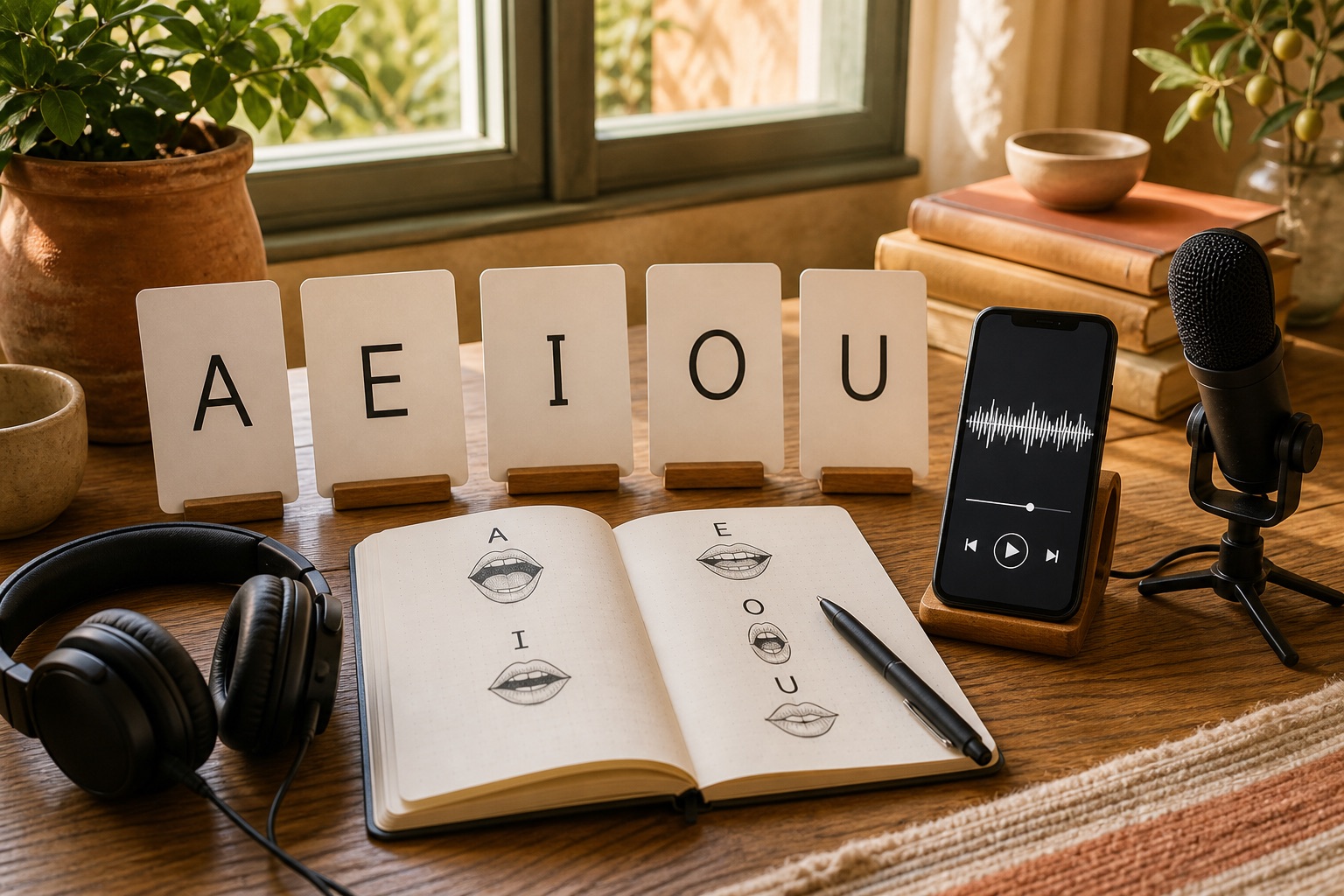
For a, lower the jaw and keep the sound open. For e and i, keep the lips unrounded and move the tongue forward. For o and u, round the lips without adding a final glide. Hold each sound briefly: a–e–i–o–u.
Practise unstressed vowels without weakening them: mapa, papel, amigo, comida, futuro, tomate. The goal is not equal loudness; the goal is to preserve the vowel category while stress changes prominence.
In aire, causa, peine, hoy, ciudad, and bueno, move smoothly through one syllable. In día, país, río, teatro, poeta, and continúa, make the vowel boundary audible across two syllables.
Copy one clear regional audio model. Spanish vowel categories are stable, but rhythm and fine phonetic detail still vary; an IPA symbol is a target map, not a substitute for listening.
24 Spanish vowel pronunciation examples
The four groups move from single-vowel targets to unstressed clarity, diphthongs, and hiatus. Repeat the complete example and then write it from audio.
| Spanish word | Meaning | Example | Pronunciation cue |
|---|---|---|---|
| casa | house | La casa es blanca. | Keep the highlighted vowel short and steady. |
| mesa | table | La mesa es grande. | Keep the highlighted vowel short and steady. |
| vino | wine | El vino es de España. | Keep the highlighted vowel short and steady. |
| poco | a little | Hablo un poco de español. | Keep the highlighted vowel short and steady. |
| luna | moon | La luna está llena. | Keep the highlighted vowel short and steady. |
| teléfono | telephone | Mi teléfono está aquí. | Keep the highlighted vowel short and steady. |
| mapa | map | Mira el mapa. | Preserve every written vowel even outside the stressed syllable. |
| papel | paper | Necesito papel. | Preserve every written vowel even outside the stressed syllable. |
| amigo | friend | Mi amigo vive cerca. | Preserve every written vowel even outside the stressed syllable. |
| comida | food | La comida está lista. | Preserve every written vowel even outside the stressed syllable. |
| futuro | future | Pienso en el futuro. | Preserve every written vowel even outside the stressed syllable. |
| tomate | tomato | Quiero un tomate. | Preserve every written vowel even outside the stressed syllable. |
| aire | air | Necesito aire fresco. | Move through the adjacent vowels inside one syllable. |
| causa | cause | No sé la causa. | Move through the adjacent vowels inside one syllable. |
| peine | comb | Busco mi peine. | Move through the adjacent vowels inside one syllable. |
| hoy | today | Hoy tengo tiempo. | Move through the adjacent vowels inside one syllable. |
| ciudad | city | La ciudad es tranquila. | Move through the adjacent vowels inside one syllable. |
| bueno | good | Es un buen ejemplo. | Move through the adjacent vowels inside one syllable. |
| día | day | Buenos días. | Make the vowel boundary audible across two syllables. |
| país | country | Es un país grande. | Make the vowel boundary audible across two syllables. |
| río | river | El río está cerca. | Make the vowel boundary audible across two syllables. |
| teatro | theatre | Vamos al teatro. | Make the vowel boundary audible across two syllables. |
| poeta | poet | Ella es poeta. | Make the vowel boundary audible across two syllables. |
| continúa | continues | La clase continúa. | Make the vowel boundary audible across two syllables. |
Practise four vowel decisions
Six examples per group separate vowel quality from stress and syllable structure.
Five steady targets
Set a clear A, E, I, O or U without an English-style glide.
casa · mesa · vino · poco · luna · teléfono
No vowel reduction
Change prominence, not the identity of an unstressed vowel.
mapa · papel · amigo · comida · futuro · tomate
Diphthongs
Join the vowel sequence smoothly inside one syllable.
aire · causa · peine · hoy · ciudad · bueno
Hiatus
Keep adjacent vowels in two separate syllables.
día · país · río · teatro · poeta · continúa
Move from clean vowels to connected words
Say casa–mesa–vino–poco–luna slowly, then repeat at normal speed without adding English glides.
Mark the stressed syllable in mapa, papel, amigo, comida, futuro, and tomate. Keep every other vowel clear rather than replacing it with “uh”.
Tap once for the joined vowel sequence in aire, causa, peine, hoy, ciudad, and bueno; tap twice across the vowel boundary in día, país, río, teatro, poeta, and continúa.
Hola Cards is a Spanish flashcard app from holacards.org for iOS and Android. It is free to download, requires no account, may show ads in the free version, while Premium removes ads, and works offline. Its interface is available in 29 languages, including English, Russian, Portuguese and German; cards support translations in 29 languages, including English, Russian, Portuguese and German and 18 practice and game modes. Audio supplies a word model, writing preserves accents and spelling, and on-device recognition offers only a limited word-level check.
Connect this vowel guide with the full pronunciation map, R/RR, J/G, LL/Y, and the pronunciation-app checklist.
Spanish pronunciation for beginners Spanish R and RR pronunciation Spanish J and G pronunciation Spanish LL and Y pronunciation Flashcard app with pronunciation
A five-minute Spanish vowel routine
- Hold a, e, i, o, u for one second each without changing the sound.
- Say the six unstressed-vowel words and underline the stressed syllable.
- Repeat the six diphthong words with one smooth syllable at the vowel sequence.
- Repeat the six hiatus words and make the two-syllable boundary audible.
- Write six mixed words from dictation, then compare accents and vowel letters.
Pronunciation references
The vowel inventory, diphthong and hiatus rules, and learner targets were checked against these references.
- Instituto Cervantes A1–A2 pronunciation inventory
- RAE: diptongo
- RAE: hiato
- SpanishDictionary: Spanish vowels
FAQ
How many vowel sounds does Spanish have?
Standard descriptions use five core vowel phonemes: /a, e, i, o, u/. Their exact realization varies slightly, but the five categories remain distinct.
Are Spanish vowels the same as English vowels?
No. Spanish vowels are generally shorter and steadier and do not normally use the diphthongal movement or unstressed schwa common in English.
Do unstressed Spanish vowels become schwa?
Normally no. Stress changes prominence, but an unstressed written vowel generally keeps a recognizable a, e, i, o, or u quality.
What is the difference between a diphthong and a hiatus?
A diphthong places adjacent vowels in one syllable. A hiatus places them in separate syllables, as in dí-a or pa-ís.
Can Hola Cards grade each vowel sound?
No. Hola Cards can play a word and use on-device recognition to check which word was recognized. It does not score individual phonemes, mouth position, or accent.
Copy the 24 vowel examples into Hola Cards
Open word groups in Hola Cards, choose paste/import, and paste this block. The app can read the title and the “Spanish - translation” lines.
**Spanish vowel sounds: 24 examples**

casa - house
mesa - table
vino - wine
poco - a little
luna - moon
teléfono - telephone
mapa - map
papel - paper
amigo - friend
comida - food
futuro - future
tomate - tomato
aire - air
causa - cause
peine - comb
hoy - today
ciudad - city
bueno - good
día - day
país - country
río - river
teatro - theatre
poeta - poet
continúa - continues
Practise Spanish vowel sounds in Hola Cards
Review the 24 examples with Spanish audio, writing, custom groups, repeated practice, and word-level recognition on iOS and Android.