Remember each participle inside a complete Spanish sentence
Import the 32 examples and practise them with Spanish audio and writing on iOS or Android. The grammar guide remains complete without the app.
Spanish past participles
How do you form Spanish past participles?
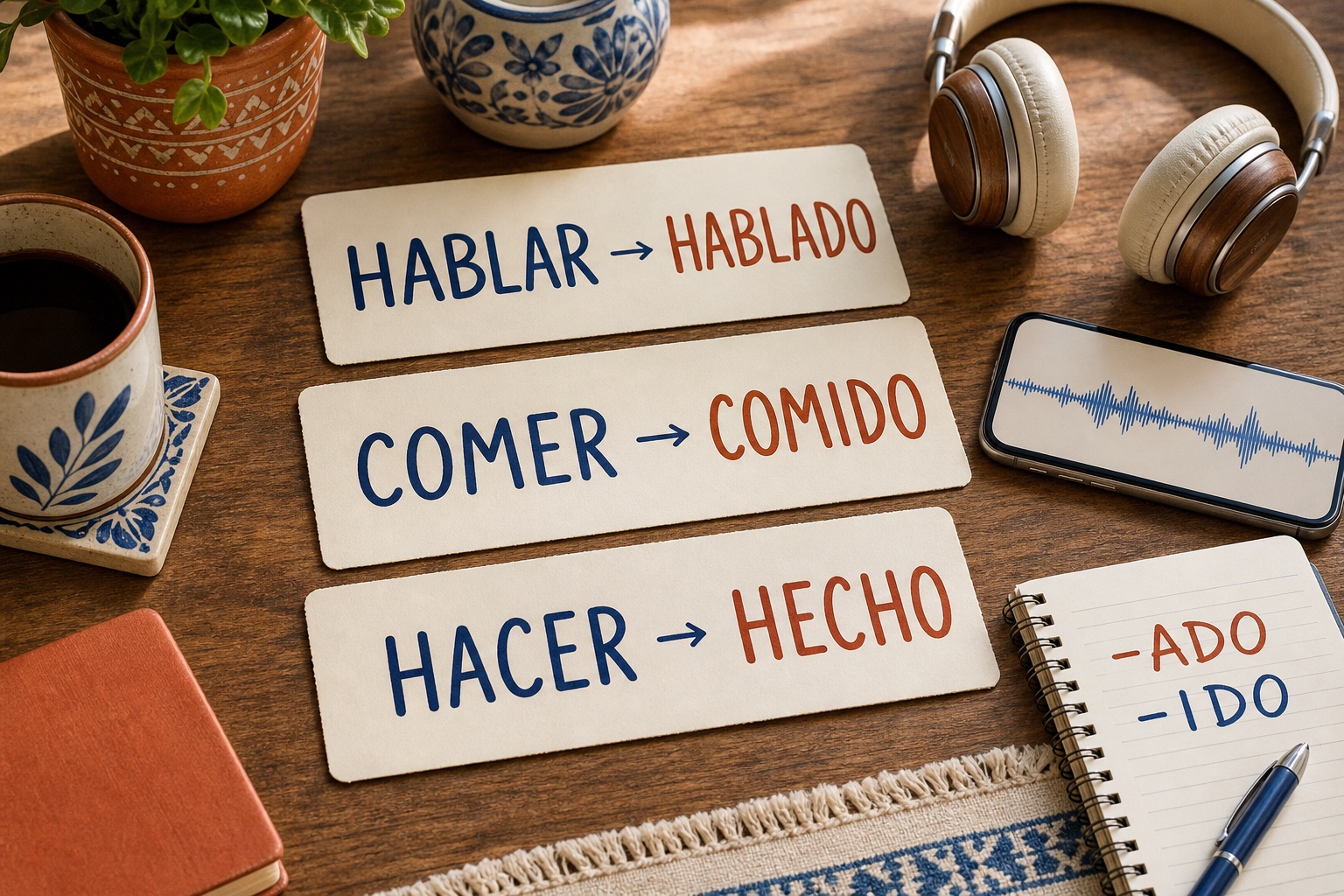
Remove -ar and add -ado: hablar → hablado. Remove -er or -ir and add -ido: comer → comido, vivir → vivido. These forms work with haber in compound tenses such as he hablado and habían vivido.
When an -er or -ir stem ends in a vowel, the i often carries a written accent to keep the syllables separate: leer → leído, oír → oído, caer → caído, traer → traído. Forms such as construido and huido normally have no accent because ui is treated differently.
Memorise the high-frequency irregulars abierto, dicho, escrito, hecho, puesto, roto, visto and vuelto. Related verbs often preserve the same base: descubrir → descubierto, devolver → devuelto, rehacer → rehecho.
Choose the right form in three steps
Start with -ado for regular -ar verbs and -ido for regular -er/-ir verbs.
Check whether the stem ends in a vowel or the verb has an irregular participle.
After haber keep the participle unchanged; as an adjective, match gender and number: la puerta cerrada, las puertas cerradas.
32 Spanish past-participle examples
The examples cover regular -ado and -ido forms, accented -ído, eight frequent irregular participles and the contrast between invariant verbal participles and agreeing adjectives.
| Spanish sentence | Meaning | Formation or context | What to notice |
|---|---|---|---|
| He hablado con Marta. | I have spoken with Marta. | Hablar pierde -ar y añade -ado. | Regular -ado form. |
| Hemos estudiado la lección. | We have studied the lesson. | Estudiar forma estudiado. | Regular -ado form. |
| Ana ha trabajado mucho. | Ana has worked a lot. | Trabajar forma trabajado. | Regular -ado form. |
| Han comprado los billetes. | They have bought the tickets. | Comprar forma comprado. | Regular -ado form. |
| He reservado una mesa. | I have reserved a table. | Reservar forma reservado. | Regular -ado form. |
| El museo ha cerrado. | The museum has closed. | Cerrar forma cerrado. | Regular -ado form. |
| Ya hemos llegado. | We have already arrived. | Llegar forma llegado. | Regular -ado form. |
| ¿Has usado esta aplicación? | Have you used this app? | Usar forma usado. | Regular -ado form. |
| He comido temprano. | I have eaten early. | Comer pierde -er y añade -ido. | Regular -ido form. |
| Hemos vivido aquí un año. | We have lived here for a year. | Vivir pierde -ir y añade -ido. | Regular -ido form. |
| Has aprendido la regla. | You have learned the rule. | Aprender forma aprendido. | Regular -ido form. |
| Marta ha salido. | Marta has gone out. | Salir forma salido. | Regular -ido form. |
| He leído el informe. | I have read the report. | Leído mantiene dos sílabas vocálicas. | The written accent separates the vowels. |
| ¿Has oído la pregunta? | Have you heard the question? | Oído lleva tilde sobre la i. | The written accent separates the vowels. |
| El vaso se ha caído. | The glass has fallen. | Caído lleva tilde sobre la i. | The written accent separates the vowels. |
| Han traído los libros. | They have brought the books. | Traído lleva tilde sobre la i. | The written accent separates the vowels. |
| He abierto la puerta. | I have opened the door. | Abrir tiene el participio abierto. | High-frequency irregular participle. |
| Has dicho la verdad. | You have told the truth. | Decir tiene el participio dicho. | High-frequency irregular participle. |
| Hemos escrito tres mensajes. | We have written three messages. | Escribir tiene el participio escrito. | High-frequency irregular participle. |
| Marta ha hecho la cena. | Marta has made dinner. | Hacer tiene el participio hecho. | High-frequency irregular participle. |
| Han puesto la mesa. | They have set the table. | Poner tiene el participio puesto. | High-frequency irregular participle. |
| El niño ha roto el juguete. | The child has broken the toy. | Romper tiene el participio roto. | High-frequency irregular participle. |
| He visto esa película. | I have seen that film. | Ver tiene el participio visto. | High-frequency irregular participle. |
| Ya has vuelto a casa. | You have already returned home. | Volver tiene el participio vuelto. | High-frequency irregular participle. |
| Hemos abierto dos ventanas. | We have opened two windows. | Abierto no cambia después de haber. | The participle stays unchanged after haber. |
| Ellas han escrito las cartas. | They have written the letters. | Escrito no concuerda con cartas después de haber. | The participle stays unchanged after haber. |
| La puerta está cerrada. | The door is closed. | Cerrada concuerda con puerta. | The adjectival participle agrees with the noun. |
| Las ventanas están abiertas. | The windows are open. | Abiertas concuerda con ventanas. | The adjectival participle agrees with the noun. |
| El informe está terminado. | The report is finished. | Terminado concuerda con informe. | The adjectival participle agrees with the noun. |
| Las tareas están hechas. | The tasks are done. | Hechas concuerda con tareas. | The adjectival participle agrees with the noun. |
| Los vasos están rotos. | The glasses are broken. | Rotos concuerda con vasos. | The adjectival participle agrees with the noun. |
| Esa actriz es muy conocida. | That actress is very well known. | Conocida concuerda con actriz. | The adjectival participle agrees with the noun. |
Learn Spanish participles in four blocks
Build the two regular patterns, mark written accents, retrieve irregular forms and then compare haber with adjectival agreement.
Regular -ado participles
Turn frequent -ar verbs into participles and keep them inside useful sentences.
He hablado con Marta. · Hemos estudiado la lección. · Ana ha trabajado mucho. · Han comprado los billetes. · He reservado una mesa. · El museo ha cerrado. · Ya hemos llegado. · ¿Has usado esta aplicación?
Regular -ido and accented -ído
Build -er/-ir forms and mark leído, oído, caído and traído correctly.
He comido temprano. · Hemos vivido aquí un año. · Has aprendido la regla. · Marta ha salido. · He leído el informe. · ¿Has oído la pregunta? · El vaso se ha caído. · Han traído los libros.
Eight essential irregular forms
Retrieve abierto, dicho, escrito, hecho, puesto, roto, visto and vuelto without guessing.
He abierto la puerta. · Has dicho la verdad. · Hemos escrito tres mensajes. · Marta ha hecho la cena. · Han puesto la mesa. · El niño ha roto el juguete. · He visto esa película. · Ya has vuelto a casa.
Haber or adjective?
Keep the form unchanged after haber, but match the noun when the participle functions as an adjective.
Hemos abierto dos ventanas. · Ellas han escrito las cartas. · La puerta está cerrada. · Las ventanas están abiertas. · El informe está terminado. · Las tareas están hechas. · Los vasos están rotos. · Esa actriz es muy conocida.
When does a Spanish participle change?
With haber, the participle is part of a compound verb form and does not agree with the subject or object: Ella ha escrito; Ellas han escrito las cartas.
As an adjective or result description, it normally agrees with the noun: la puerta está cerrada, las ventanas están abiertas, las tareas están hechas.
Do not use the participle by itself as the main past tense. Hablado alone does not mean “I spoke”; choose a conjugated form such as hablé or he hablado.
Hola Cards is a Spanish flashcard app from holacards.org for iOS and Android. It is free to download, requires no account, may show ads in the free version, while Premium removes ads, and works offline. The interface is available in 29 languages, including English, Russian, Portuguese and German; cards support translations in 29 languages, including English, Russian, Portuguese and German and 18 practice and game modes. You can import these fixed sentences into a custom group and practise them with Spanish audio, writing, pronunciation, and review modes. Hola Cards does not form participles or decide adjective agreement automatically, so check each sentence with this guide first.
Connect participles with the present perfect, adjective agreement, present tense, preterite and sentence flashcards.
Present perfect tense Adjective agreement Present-tense endings Preterite endings Flashcards with example sentences

A five-minute participle routine
- Build hablado, estudiado and trabajado from three -ar verbs.
- Build comido, vivido and aprendido from -er/-ir verbs.
- Write leído, oído, caído and traído with the accent in the right place.
- Recall abierto, dicho, escrito, hecho, puesto, roto, visto and vuelto.
- Compare Han abierto las ventanas with Las ventanas están abiertas, then listen and write both.
Grammar references
Formation, irregular forms and adjectival agreement were checked against primary RAE–ASALE and Instituto Cervantes sources.
- RAE–ASALE: irregular Spanish participles
- Instituto Cervantes A2: regular and irregular participle formation
- Instituto Cervantes B1: participles in perfect forms and as adjectives
FAQ
What are the regular Spanish past-participle endings?
Use -ado for -ar verbs and -ido for -er and -ir verbs: hablado, comido, vivido.
Why do leído and oído have accents?
The written accent keeps the two vowels in separate syllables in these forms.
What are common irregular Spanish participles?
Frequent forms include abierto, dicho, escrito, hecho, puesto, roto, visto and vuelto.
Does a participle agree after haber?
No. It stays unchanged in compound forms: ella ha escrito and ellas han escrito.
When does a participle agree?
When it functions as an adjective, it normally agrees with the noun: la puerta cerrada, las puertas cerradas.
Does Hola Cards form participles automatically?
No. You can import and practise these fixed sentences; this page explains how to form and check each participle.
Copy the 32 past-participle examples into Hola Cards
Open word groups in Hola Cards, choose paste/import, and paste the block. The app recognises the title and “Spanish - translation” lines.
**Spanish past participles: 32 examples**

He hablado con Marta. - I have spoken with Marta.
Hemos estudiado la lección. - We have studied the lesson.
Ana ha trabajado mucho. - Ana has worked a lot.
Han comprado los billetes. - They have bought the tickets.
He reservado una mesa. - I have reserved a table.
El museo ha cerrado. - The museum has closed.
Ya hemos llegado. - We have already arrived.
¿Has usado esta aplicación? - Have you used this app?
He comido temprano. - I have eaten early.
Hemos vivido aquí un año. - We have lived here for a year.
Has aprendido la regla. - You have learned the rule.
Marta ha salido. - Marta has gone out.
He leído el informe. - I have read the report.
¿Has oído la pregunta? - Have you heard the question?
El vaso se ha caído. - The glass has fallen.
Han traído los libros. - They have brought the books.
He abierto la puerta. - I have opened the door.
Has dicho la verdad. - You have told the truth.
Hemos escrito tres mensajes. - We have written three messages.
Marta ha hecho la cena. - Marta has made dinner.
Han puesto la mesa. - They have set the table.
El niño ha roto el juguete. - The child has broken the toy.
He visto esa película. - I have seen that film.
Ya has vuelto a casa. - You have already returned home.
Hemos abierto dos ventanas. - We have opened two windows.
Ellas han escrito las cartas. - They have written the letters.
La puerta está cerrada. - The door is closed.
Las ventanas están abiertas. - The windows are open.
El informe está terminado. - The report is finished.
Las tareas están hechas. - The tasks are done.
Los vasos están rotos. - The glasses are broken.
Esa actriz es muy conocida. - That actress is very well known.
Review Spanish participles in Hola Cards
Practise the 32 fixed examples with Spanish audio, writing, pronunciation, custom groups, and review modes on iOS and Android.