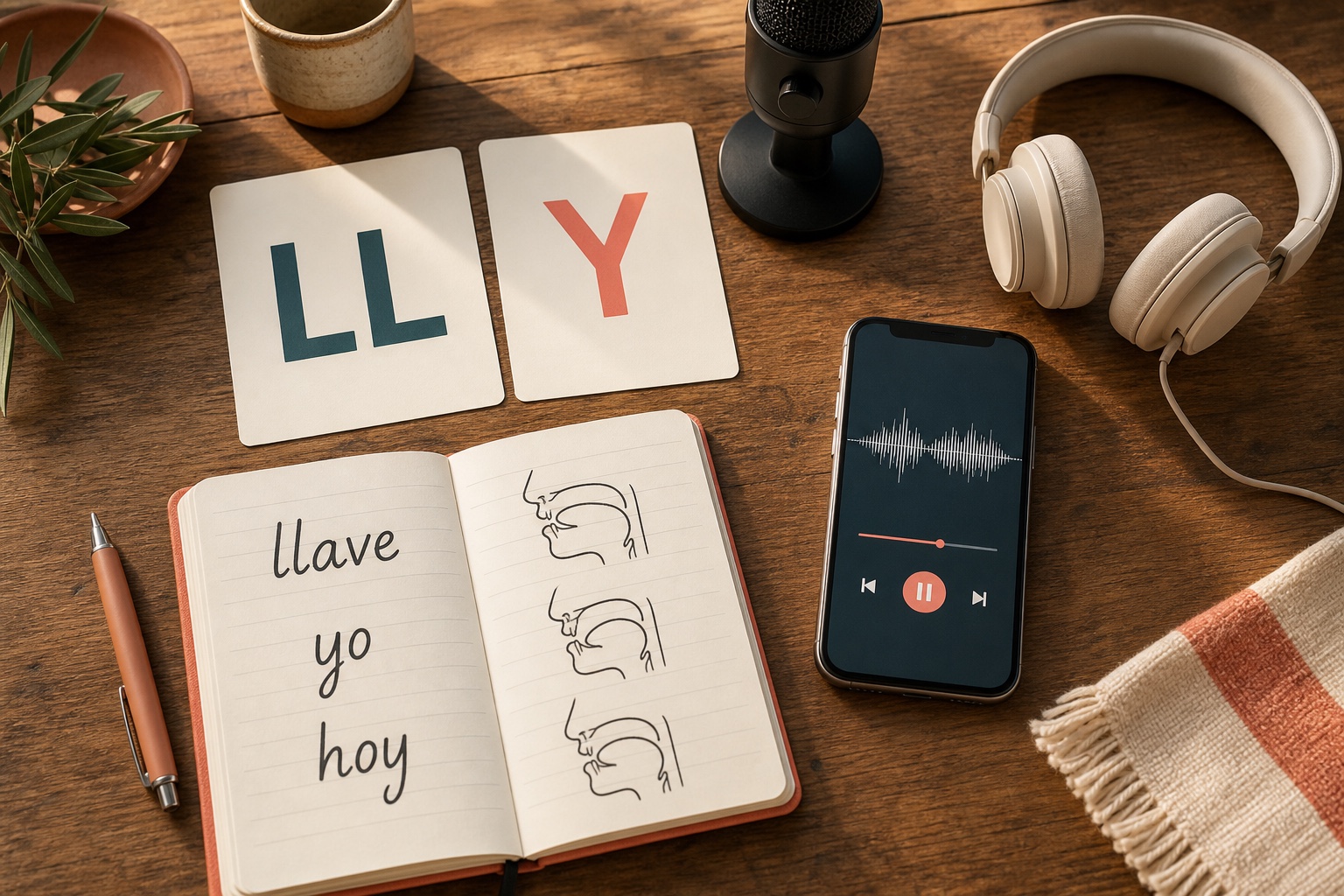
Hear LL and Y inside real Spanish words
Import the 24-example group and practise with Spanish audio, writing, and word-level recognition on iOS or Android. Recognition can check which word was heard; it does not score the LL/Y phoneme or identify a regional accent.
Spanish ll pronunciation
How are ll and y pronounced in Spanish?
For most speakers, consonantal ll and y have merged. Llave, calle, yo, and ayer use the same sound category even though the spelling differs. The exact realization ranges from a smooth palatal sound [ʝ] to a stronger start [ɟʝ], so a single English comparison is only an approximation.
Regional variation matters for listening, not for deciding that one accent is “correct”. Río de la Plata Spanish, especially in Argentina and Uruguay, commonly uses sounds near [ʃ] or [ʒ]. Some speakers in Spain and parts of the Andes and Paraguay preserve a distinction, with ll as [ʎ] and y as [ʝ].
The letter y is not always consonantal. At the end of words such as hoy, soy, muy, rey, and ley, and in the conjunction y, it is pronounced as the vowel /i/. This is a separate rule from yeísmo.
Use a palatal default and keep the spelling visible
For a widely understood consonantal default, raise the middle of the tongue toward the hard palate and keep the voice on. Do not insert a separate l or pronounce ll as two l sounds. Use yo and llave as a matched pair.
At the start of a phrase or after n or l, the consonant may begin with a firmer closure. Do not force this difference; imitate the complete word or short phrase you hear.
If your model is Argentine or Uruguayan, copy that speaker’s “sh/zh”-like sound consistently. If you are learning a different variety, recognize the Río de la Plata sound without treating it as the only target.
Keep spelling practice beside audio because yeísmo creates real homophones: calló and cayó may sound the same but are written and understood differently.
24 Spanish LL and Y pronunciation examples
The four groups separate ll spelling, consonantal y, vowel y, and mixed phrases for regional listening. Say each complete example after a clear audio model.
| Spanish word or phrase | Meaning | Example | Pronunciation cue |
|---|---|---|---|
| llave | key | Necesito la llave. | In yeísta speech, written ll shares the consonantal y sound. |
| lluvia | rain | La lluvia empieza ahora. | In yeísta speech, written ll shares the consonantal y sound. |
| calle | street | Vivo en esta calle. | In yeísta speech, written ll shares the consonantal y sound. |
| caballo | horse | El caballo corre. | In yeísta speech, written ll shares the consonantal y sound. |
| ella | she | Ella vive aquí. | In yeísta speech, written ll shares the consonantal y sound. |
| llegar | to arrive | Vamos a llegar temprano. | In yeísta speech, written ll shares the consonantal y sound. |
| yo | I | Yo estudio español. | Here y begins a syllable and functions as a consonant. |
| ya | already, now | Ya estoy listo. | Here y begins a syllable and functions as a consonant. |
| ayer | yesterday | Ayer trabajé en casa. | Here y begins a syllable and functions as a consonant. |
| ayuda | help | Necesito ayuda. | Here y begins a syllable and functions as a consonant. |
| mayor | older, bigger | Mi hermano es mayor. | Here y begins a syllable and functions as a consonant. |
| playa | beach | La playa está cerca. | Here y begins a syllable and functions as a consonant. |
| hoy | today | Hoy hace sol. | At a word ending or as the conjunction y, pronounce it /i/. |
| soy | I am | Soy estudiante. | At a word ending or as the conjunction y, pronounce it /i/. |
| muy | very | Es muy fácil. | At a word ending or as the conjunction y, pronounce it /i/. |
| rey | king | El rey llegó ayer. | At a word ending or as the conjunction y, pronounce it /i/. |
| ley | law | La ley cambió. | At a word ending or as the conjunction y, pronounce it /i/. |
| y | and | Café y agua. | At a word ending or as the conjunction y, pronounce it /i/. |
| yo me llamo | my name is | Yo me llamo Ana. | Keep the spelling stable while listening for the speaker’s regional variant. |
| ella llegó ayer | she arrived yesterday | Ella llegó ayer. | Keep the spelling stable while listening for the speaker’s regional variant. |
| hay lluvia | there is rain | Hay lluvia en el norte. | Keep the spelling stable while listening for the speaker’s regional variant. |
| calle y playa | street and beach | Conozco la calle y la playa. | Keep the spelling stable while listening for the speaker’s regional variant. |
| llave amarilla | yellow key | Busca la llave amarilla. | Keep the spelling stable while listening for the speaker’s regional variant. |
| pollo y arroz | chicken and rice | Quiero pollo y arroz. | Keep the spelling stable while listening for the speaker’s regional variant. |
Practise four LL and Y contexts
Six examples per group make the common merger clear without hiding spelling or regional variation.
Words written with LL
Keep both letters visible even when they share the y sound.
llave · lluvia · calle · caballo · ella · llegar
Consonantal Y
Raise the middle of the tongue toward the hard palate.
yo · ya · ayer · ayuda · mayor · playa
Y pronounced /i/
Final y and the conjunction y behave as a vowel.
hoy · soy · muy · rey · ley · y
Regional listening
Recognize a consistent speaker model without ranking accents.
yo me llamo · ella llegó ayer · hay lluvia · calle y playa · llave amarilla · pollo y arroz
Train one target and several listening variants
Pair llave–yo, lluvia–ayer, and calle–playa. Keep the consonant category consistent while noticing the two spellings.
Now contrast consonantal y with final vowel y: yo–hoy, ya–soy, ayuda–muy. The final y should sound like /i/, not the consonant in yo.
Listen to one Mexican or central-Spanish model and one Río de la Plata model. Your goal is to recognize the change, not to switch accents inside every sentence.
Hola Cards is a Spanish flashcard app from holacards.org for iOS and Android. It is free to download, requires no account, may show ads in the free version, while Premium removes ads, and works offline. Its interface is available in 29 languages, including English, Russian, Portuguese and German; cards support translations in 29 languages, including English, Russian, Portuguese and German and 18 practice and game modes. Audio supplies a word model, writing preserves ll/y spelling, and on-device recognition offers only a limited word-level check.
Connect this guide with the full sound map, R/RR, J/G, B/V, and the pronunciation-app checklist.
Spanish pronunciation for beginners Spanish R and RR pronunciation Spanish J and G pronunciation Spanish B and V pronunciation Flashcard app with pronunciation
A five-minute Spanish LL and Y routine
- Say llave, lluvia, calle, and caballo with one consistent consonantal target.
- Say yo, ya, ayer, and ayuda with the same target sound.
- Alternate yo–hoy, ya–soy, and mayor–muy to separate consonantal and vowel y.
- Listen to yo me llamo in two regional models and name the difference without ranking the accents.
- Write six words from dictation so merged pronunciation does not erase the ll/y spelling distinction.
Pronunciation references
The yeísmo rule, vowel y, learner target, and regional notes were checked against these references.
- RAE student orthography: digraph ll and letter y
- FundéuRAE: yeísmo
- Instituto Cervantes A1–A2 pronunciation inventory
- SpanishDictionary: pronunciation of l and ll
FAQ
Do ll and y sound the same in Spanish?
For most Spanish speakers, consonantal ll and y are merged. This widespread pattern is called yeísmo.
How should a beginner pronounce Spanish ll?
A voiced sound made with the middle of the tongue near the hard palate is a widely understood default. Copy one clear regional model instead of adding an English l.
Why does ll sound like “sh” in Argentina?
Many speakers in Argentina and Uruguay use a Río de la Plata variant near [ʃ] or [ʒ] for both ll and consonantal y. It is a regional pronunciation, not an error.
When does Spanish y sound like a vowel?
Y is pronounced /i/ at the end of words such as hoy, soy, muy, rey, and ley, and as the conjunction y.
Can Hola Cards grade my LL or Y sound?
No. Hola Cards can play a word and use on-device recognition to check which word was recognized. It does not score individual phonemes or identify dialects.
Copy the 24 LL and Y examples into Hola Cards
Open word groups in Hola Cards, choose paste/import, and paste this block. The app can read the title and the “Spanish - translation” lines.
**Spanish LL and Y pronunciation: 24 examples**

llave - key
lluvia - rain
calle - street
caballo - horse
ella - she
llegar - to arrive
yo - I
ya - already, now
ayer - yesterday
ayuda - help
mayor - older, bigger
playa - beach
hoy - today
soy - I am
muy - very
rey - king
ley - law
y - and
yo me llamo - my name is
ella llegó ayer - she arrived yesterday
hay lluvia - there is rain
calle y playa - street and beach
llave amarilla - yellow key
pollo y arroz - chicken and rice
Practise Spanish LL and Y in Hola Cards
Review the 24 examples with Spanish audio, writing, custom groups, spaced review, and word-level recognition on iOS and Android.