Hear, mark, and recall the stressed syllable
Import 32 checked examples and compare spelling with audio. This guide remains fully useful without the app.
Spanish word stress
How do you know which syllable is stressed?
First look for a written acute accent: teléfono is stressed on lé and canción on ción.
If there is no written accent, a final vowel, n, or s normally sends stress to the next-to-last syllable: casa, joven, lunes.
Any other final consonant normally keeps stress on the last syllable: hotel, papel, ciudad.
Four decisions that solve most words
A written accent directly marks the stressed vowel: café, árbol, música.
Without a written accent, words ending in a vowel, n, or s normally stress the penultimate syllable.
Without a written accent, words ending in another consonant normally stress the final syllable.
Separate spoken stress from the written accent: every lexical word has stress, but only some words need the mark.
32 Spanish word-stress examples
Start with the two unmarked defaults, then see written accents and contrasts where stress changes form or meaning.
| Spanish word or contrast | Meaning | Stress cue | Why it works |
|---|---|---|---|
| casa | house | ca-sa → CA-sa | No written accent: a final vowel, n, or s normally gives penultimate stress. |
| mesa | table | me-sa → ME-sa | No written accent: a final vowel, n, or s normally gives penultimate stress. |
| amigo | friend | a-mi-go → a-MI-go | No written accent: a final vowel, n, or s normally gives penultimate stress. |
| ventana | window | ven-ta-na → ven-TA-na | No written accent: a final vowel, n, or s normally gives penultimate stress. |
| examen | exam | e-xa-men → e-XA-men | No written accent: a final vowel, n, or s normally gives penultimate stress. |
| joven | young | jo-ven → JO-ven | No written accent: a final vowel, n, or s normally gives penultimate stress. |
| lunes | Monday | lu-nes → LU-nes | No written accent: a final vowel, n, or s normally gives penultimate stress. |
| hablan | they speak | ha-blan → HA-blan | No written accent: a final vowel, n, or s normally gives penultimate stress. |
| hotel | hotel | ho-tel → ho-TEL | No written accent: another final consonant normally gives final stress. |
| papel | paper | pa-pel → pa-PEL | No written accent: another final consonant normally gives final stress. |
| reloj | clock or watch | re-loj → re-LOJ | No written accent: another final consonant normally gives final stress. |
| ciudad | city | ciu-dad → ciu-DAD | No written accent: another final consonant normally gives final stress. |
| profesor | teacher | pro-fe-sor → pro-fe-SOR | No written accent: another final consonant normally gives final stress. |
| español | Spanish | es-pa-ñol → es-pa-ÑOL | No written accent: another final consonant normally gives final stress. |
| cantar | to sing | can-tar → can-TAR | No written accent: another final consonant normally gives final stress. |
| feliz | happy | fe-liz → fe-LIZ | No written accent: another final consonant normally gives final stress. |
| café | coffee | ca-fé → ca-FÉ | The written accent directly identifies the stressed vowel. |
| canción | song | can-ción → can-CIÓN | The written accent directly identifies the stressed vowel. |
| compás | beat or compass | com-pás → com-PÁS | The written accent directly identifies the stressed vowel. |
| árbol | tree | ár-bol → ÁR-bol | The written accent directly identifies the stressed vowel. |
| lápiz | pencil | lá-piz → LÁ-piz | The written accent directly identifies the stressed vowel. |
| fácil | easy | fá-cil → FÁ-cil | The written accent directly identifies the stressed vowel. |
| teléfono | telephone | te-lé-fo-no → te-LÉ-fo-no | The written accent directly identifies the stressed vowel. |
| música | music | mú-si-ca → MÚ-si-ca | The written accent directly identifies the stressed vowel. |
| hábito, habito, habitó | habit, I inhabit, he or she inhabited | HÁ-bi-to / ha-BI-to / ha-bi-TÓ | A change in stress can change a word form or meaning and may add or remove the written accent. |
| práctico, practico, practicó | practical, I practise, he or she practised | PRÁC-ti-co / prac-TI-co / prac-ti-CÓ | A change in stress can change a word form or meaning and may add or remove the written accent. |
| término, termino, terminó | term, I finish, he or she finished | TÉR-mi-no / ter-MI-no / ter-mi-NÓ | A change in stress can change a word form or meaning and may add or remove the written accent. |
| canto, cantó | I sing, he or she sang | CAN-to / can-TÓ | A change in stress can change a word form or meaning and may add or remove the written accent. |
| hablo, habló | I speak, he or she spoke | HA-blo / ha-BLÓ | A change in stress can change a word form or meaning and may add or remove the written accent. |
| joven, jóvenes | young singular, young plural | JO-ven / JÓ-ve-nes | A change in stress can change a word form or meaning and may add or remove the written accent. |
| canción, canciones | song, songs | can-CIÓN / can-CIO-nes | A change in stress can change a word form or meaning and may add or remove the written accent. |
| examen, exámenes | exam, exams | e-XA-men / e-XÁ-me-nes | A change in stress can change a word form or meaning and may add or remove the written accent. |
Read stress in four passes
Use the ending first, then confirm exceptions and meaningful contrasts.
Penultimate by default
Read vowel, n, and s endings without adding an unnecessary accent mark.
casa · mesa · amigo · ventana · examen · joven · lunes · hablan
Final by default
Keep final stress after other consonants.
hotel · papel · reloj · ciudad · profesor · español · cantar · feliz
Written accents
Let the acute accent override the default ending pattern.
café · canción · compás · árbol · lápiz · fácil · teléfono · música
Stress contrasts
Compare related forms whose stress and spelling move together.
hábito, habito, habitó · práctico, practico, practicó · término, termino, terminó · canto, cantó · hablo, habló · joven, jóvenes · canción, canciones · examen, exámenes
What are aguda, llana and esdrújula?
An aguda has final stress: hotel, reloj, canción. It takes a written accent when it ends in a vowel, n, or s.
A llana or grave has penultimate stress: casa, joven, árbol. It takes a written accent when it ends in a consonant other than n or s.
An esdrújula has antepenultimate stress and always carries a written accent: teléfono, música, médico.
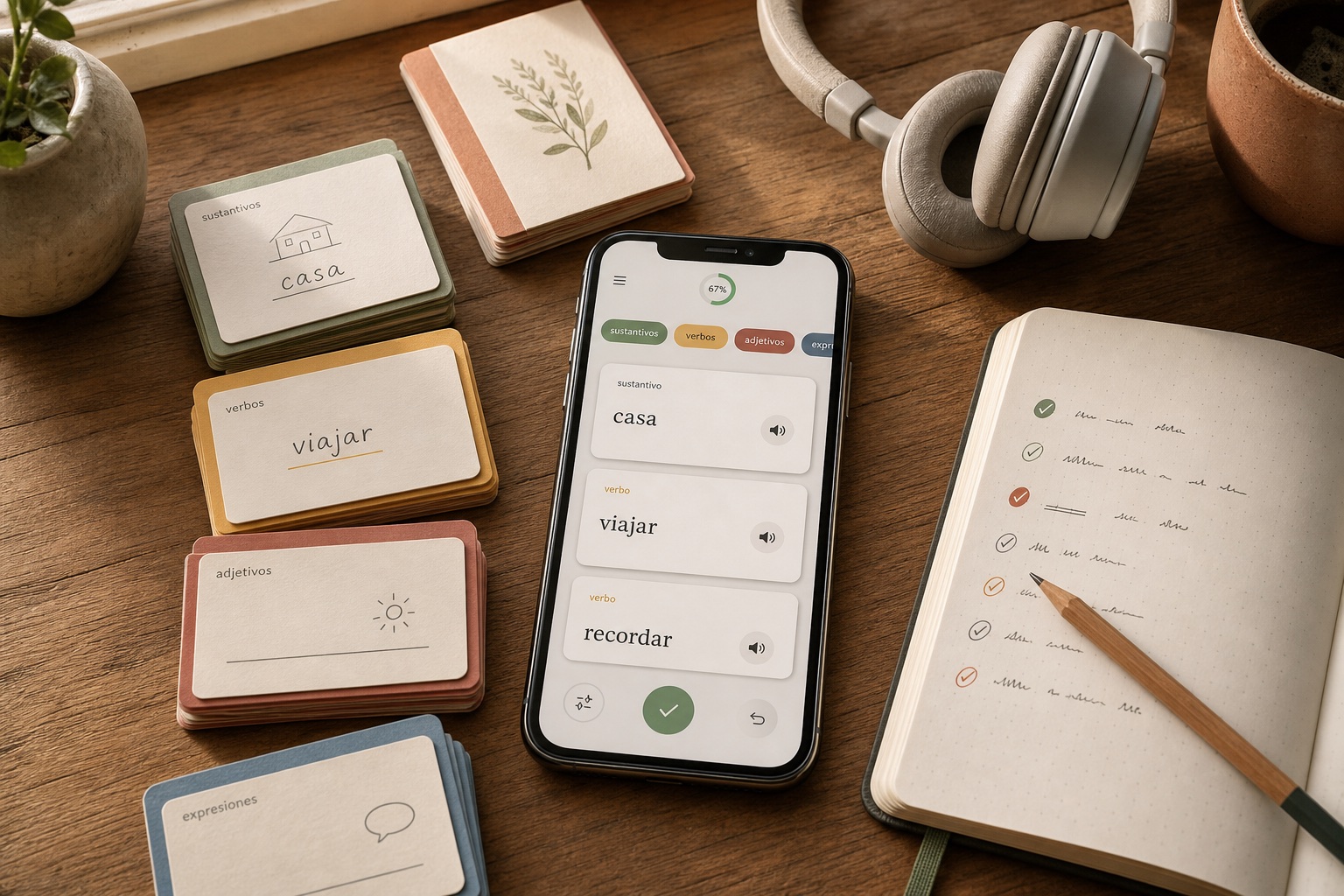
Hola Cards is a Spanish flashcard app from holacards.org for iOS and Android. It is free to download, requires no account, may show ads in the free version, while Premium removes ads, and works offline. The interface is available in 29 languages, including English, Russian, Portuguese and German; cards support translations in 29 languages, including English, Russian, Portuguese and German and 18 practice and game modes. You can import these 32 fixed examples into a custom group and practise them with Spanish audio, writing, pronunciation, and review modes. Word-level recognition can check which word was recognised, but Hola Cards does not grade the exact stressed syllable, rhythm, or individual phonemes.
Connect stress with pronunciation basics, vowel sequences, written accents, meaning contrasts, and writing practice.
Spanish pronunciation for beginners Spanish vowel sounds Words that change meaning with accents Spanish capitalization rules Spanish writing practice app

A five-minute stress drill
- Cover the stress cue and read the word once.
- Check for a written accent.
- If there is none, apply the ending rule.
- Tap once on the stressed syllable while saying the word.
- Write the word from audio and compare the accent mark.
Language references
The definition of the stressed syllable and the general accent rules were checked against RAE–ASALE and Instituto Cervantes.
- RAE–ASALE: stress and written-accent rules
- RAE–ASALE: vowel sequences and written accents
- Instituto Cervantes: Spanish prosody
FAQ
What are the basic Spanish stress rules?
Stress a written accent. Without one, stress the penultimate syllable after a vowel, n, or s; otherwise stress the final syllable.
Does every Spanish word have a written accent?
No. Every lexical word has spoken stress, but a written accent appears only when spelling rules or a contrast require it.
What is an aguda word?
An aguda is stressed on the final syllable, such as hotel or canción.
What is a llana or grave word?
It is stressed on the penultimate syllable, such as casa, joven, or árbol.
Why do esdrújulas always have an accent?
Their antepenultimate stress falls outside the two unmarked defaults, so words such as teléfono and música always show it.
Can Hola Cards score my exact word stress?
No. It provides audio and word-level recognition for practice, but it does not grade exact syllable prominence, rhythm, or individual phonemes.
Copy 32 stress examples into Hola Cards
Open word groups in Hola Cards, choose paste/import, and paste the block. Each line uses “Spanish - translation”.
**Spanish word stress: 32 examples**

casa - house
mesa - table
amigo - friend
ventana - window
examen - exam
joven - young
lunes - Monday
hablan - they speak
hotel - hotel
papel - paper
reloj - clock or watch
ciudad - city
profesor - teacher
español - Spanish
cantar - to sing
feliz - happy
café - coffee
canción - song
compás - beat or compass
árbol - tree
lápiz - pencil
fácil - easy
teléfono - telephone
música - music
hábito, habito, habitó - habit, I inhabit, he or she inhabited
práctico, practico, practicó - practical, I practise, he or she practised
término, termino, terminó - term, I finish, he or she finished
canto, cantó - I sing, he or she sang
hablo, habló - I speak, he or she spoke
joven, jóvenes - young singular, young plural
canción, canciones - song, songs
examen, exámenes - exam, exams
Review Spanish stress patterns in Hola Cards
Practise 32 fixed examples with Spanish audio, writing, pronunciation, custom groups, and review modes on iOS and Android.