24 Practical Spanish Idioms Grouped by Context
The table below organizes 24 practical Spanish idioms across four communicative situations, pairing each expression with its contextual English meaning and an illustrative sentence example. Usage and familiarity vary by region and speaker; these selections are illustrative, not ranked.
| Expression | Meaning and example |
|---|---|
| tomar el pelo | To tease or pull someone's leg playfully |
| estar hasta las narices | To be fed up or sick and tired of a situation |
| costar un ojo de la cara | To be extremely expensive; to cost an arm and a leg |
| echar una mano | To lend a helping hand; to assist someone |
| dormir a pierna suelta | To sleep deeply and soundly without interruption |
| hacer la vista gorda | To turn a blind eye; to pretend not to notice an infraction |
| quedarse de piedra | To be stunned, astonished, or petrified with surprise |
| ponerse las pilas | To get one's act together and start working actively |
| perder los estribos | To lose one's temper, composure, or self-control |
| estar en las nubes | To be daydreaming, absent-minded, or lost in thought |
| caer el alma a los pies | To feel deeply crestfallen, disheartened, or disappointed |
| temblar como un flan | To shake like a leaf; to tremble visibly from anxiety or nerves |
| irse por las ramas | To beat around the bush; to divert from the main point |
| no tener pelos en la lengua | To speak one's mind bluntly without hesitation or sugarcoating |
| hablar por los codos | To talk incessantly; to chatter without stopping |
| meter la pata | To put one's foot in one's mouth; to make an embarrassing mistake |
| dar en el clavo | To hit the nail on the head; to identify the exact solution |
| ir al grano | To get straight to the point without wasting time |
| ahogarse en un vaso de agua | To make a mountain out of a molehill; to panic over minor setbacks |
| tirar la toalla | To throw in the towel; to surrender or abandon an effort |
| estar entre la espada y la pared | To be between a rock and a hard place; facing two difficult alternatives |
| cambiar de chip | To change one's mindset; to switch mental focus to a new activity |
| hacer castillos en el aire | To build castles in the sky; to make unrealistic or fanciful plans |
| empezar la casa por el tejado | To put the cart before the horse; to do things in reverse or ill-advised order |
Practice Spanish Idioms with Custom Study Groups
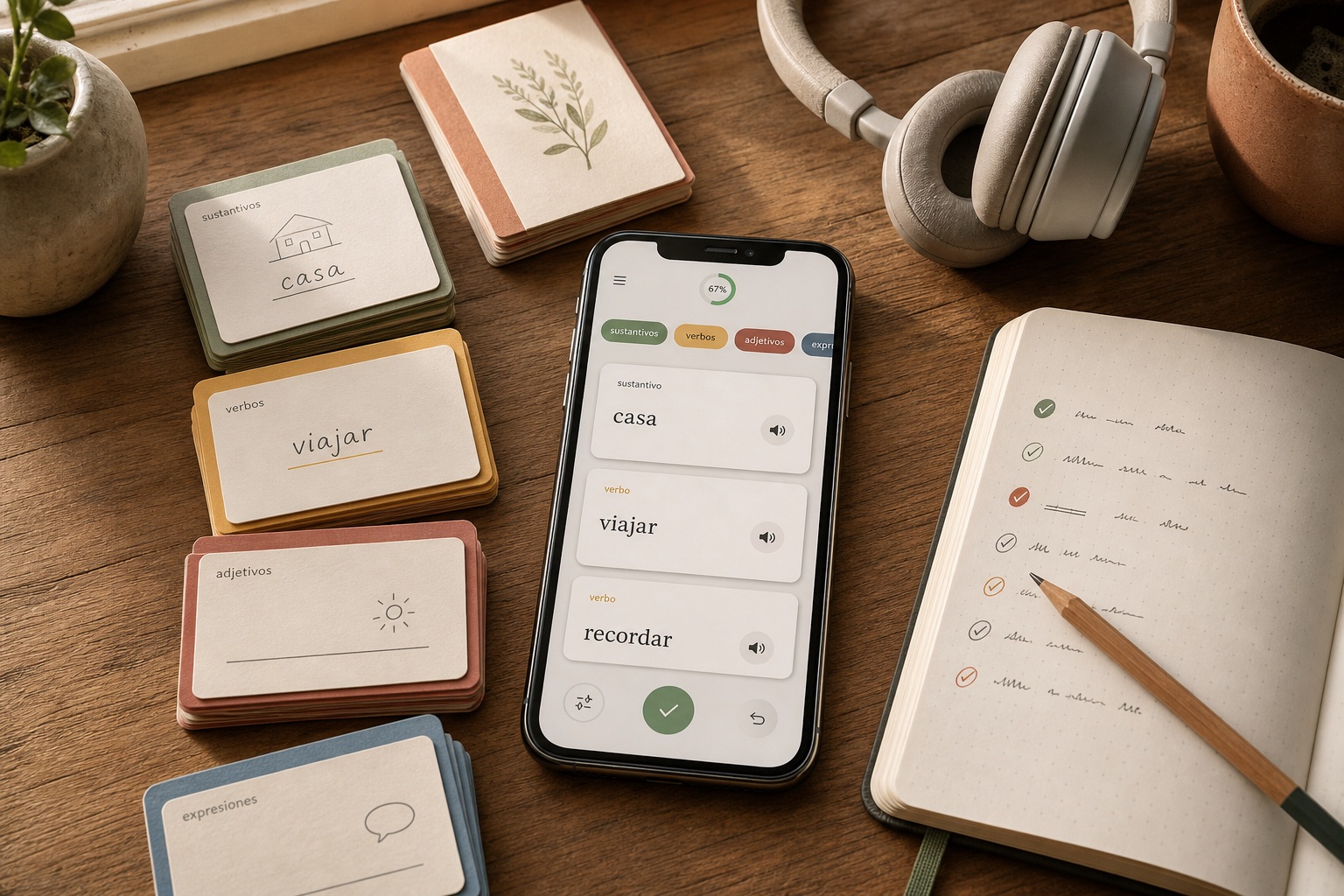
Organize Spanish idioms into custom study groups, listen to Spanish audio, and track progress on iOS and Android with mobile guest and offline use.
Spanish idioms by context
Why Situational Context Matters for Spanish Idioms
Idiomatic expressions present a unique challenge for Spanish learners because their figurative meanings cannot be assembled by translating individual words in isolation. When a friend mentions that they need to ponerse las pilas or a colleague warns against irse por las ramas, relying on literal vocabulary creates confusion. By anchoring each expression to a concrete communicative setting—such as reacting to sudden news, navigating a work project, or chatting casually at dinner—learners can better understand the communicative intention and tone behind the words. Furthermore, Spanish phraseology reflects regional nuances and register distinctions. Because usage and familiarity vary by region and speaker, an expression common in one community may sound unfamiliar or overly colloquial in another. Grounding your study in real-life communicative contexts helps you choose expressions suited to the social setting.
Distinguishing Idioms, Proverbs, and Collocations
To navigate Spanish phraseology effectively, it is helpful to recognize three related categories of multi-word units without turning taxonomy into an obstacle. 1. Idiomatic Locutions (locuciones): Multi-word expressions whose aggregate meaning cannot be deduced from their individual components (for example, meter la pata meaning to make a blunder, or echar una mano meaning to help). While verbal idioms inflect with the sentence, their core wording and prepositions are generally conventional. They function grammatically as units within a sentence (verbal, adverbial, or adjectival locutions). 2. Proverbs (refranes): Independent, complete sentences that convey folk wisdom, moral guidance, or cultural observations, often featuring rhyme or parallel structure (such as A quien madruga, Dios le ayuda). Proverbs offer philosophical commentary rather than functioning as internal sentence clauses. 3. Collocations (colocaciones): Conventional pairings of words that frequently occur together without losing their literal meanings (such as prestar atención or hacer una pregunta). For language learners, idioms require attention because their non-literal meaning functions as a unit, while verbal idioms inflect directly within standard sentence syntax. Because usage and register vary by phrase and region, learners should check a reliable dictionary and observe local usage.
Four Practical Conversational Themes
We have organized these 24 idioms into four communicative categories: everyday situations, emotional reactions, conversation, and work planning. Because usage and familiarity vary by region and speaker, these illustrative examples demonstrate how each phrase functions naturally in context.
Conversation and Discussion
Conversational locutions manage dialogue flow, tone, and interpersonal candor: Por favor, no te vayas por las ramas y explícanos el motivo exacto del retraso. warns against beating around the bush instead of stating the main issue. When a speaker is uncompromisingly direct, Marta no tiene pelos en la lengua y siempre expresa su opinión con total franqueza. shows speaking one's mind plainly without sugarcoating. In lively social exchanges, Mi hermano menor habla por los codos y apenas nos permite intervenir durante el almuerzo. describes talking incessantly. When an embarrassing social error occurs, Metí la pata al felicitarla por su boda sin saber que el compromiso se había roto. illustrates putting one's foot in one's mouth. When someone provides the precise answer, Tu sugerencia sobre la reorganización del equipo dio exactamente en el clavo. means hitting the nail on the head. Finally, in time-sensitive situations, Tenemos solo diez minutos antes de la llamada con el cliente, así que vamos directo al grano. urges getting straight to the point.
irse por las ramas · no tener pelos en la lengua · hablar por los codos · meter la pata · dar en el clavo · ir al grano
Everyday Situations
Everyday idioms express routines, interpersonal dynamics, and common frustrations: No le creas lo que dice sobre el nuevo trabajo; solo te está tomando el pelo. illustrates teasing or pulling someone's leg in casual banter. When delays test your patience, Llevo tres horas esperando en la oficina de correos y ya estoy hasta las narices. communicates being fed up or irritated. To describe steep costs, Ese billete de avión de última hora me costó un ojo de la cara. means an item was exceedingly expensive. In cooperative moments, ¿Podrías echarme una mano con estas bolsas pesadas antes de entrar? is a polite way to ask for assistance. After an exhausting journey, Después de caminar todo el día por el centro histórico, dormí a pierna suelta. depicts sleeping deeply and soundly. Finally, El encargado hizo la vista gorda cuando llegamos unos minutos después del cierre. conveys turning a blind eye by pretending not to notice a minor rule infraction.
tomar el pelo · estar hasta las narices · costar un ojo de la cara · echar una mano · dormir a pierna suelta · hacer la vista gorda
Reactions and Emotions
Emotional idioms describe spontaneous physiological and psychological states: Toda la sala se quedó de piedra cuando Carlos anunció su renuncia inesperada. conveys being stunned or petrified by shocking news. To encourage prompt effort, Los exámenes finales empiezan el lunes, así que tenemos que ponernos las pilas desde hoy. emphasizes getting one's act together and getting to work. When frustration boils over, Intentó mantener la calma en todo momento, pero al final perdió los estribos por las quejas continuas. describes losing one's temper and composure. For daydreaming or distraction, El profesor le hizo una pregunta sencilla, pero Elena estaba en las nubes y no respondió. portrays being lost in thought. To convey crushing disappointment, Se me cayó el alma a los pies al enterarme de que habían cancelado el festival. reflects feeling utterly disheartened. Lastly, Antes de subir al escenario para dar el discurso inaugural, estaba temblando como un flan. describes trembling visibly from acute anxiety.
quedarse de piedra · ponerse las pilas · perder los estribos · estar en las nubes · caer el alma a los pies · temblar como un flan
Work, Decisions, and Plans
Idioms in professional planning guide problem-solving, resilience, and realistic strategy: El error en el documento tiene fácil arreglo, de modo que no te ahogues en un vaso de agua. advises against making a mountain out of a molehill over minor issues. In challenging projects, A pesar de las complicaciones técnicas del software, los desarrolladores se negaron a tirar la toalla. exemplifies refusing to surrender or throw in the towel. When facing conflicting dilemmas, La gerencia está entre la espada y la pared: debe reducir el presupuesto o aplazar la expansión. describes being caught between a rock and a hard place. At the end of the workday, Ya terminamos las reuniones laborales, así que ahora toca cambiar de chip y disfrutar del fin de semana. means switching mental gears to rest. In strategic thinking, Tener grandes metas es positivo, pero no conviene hacer castillos en el aire sin calcular los recursos disponibles. cautions against making fanciful, ungrounded plans. Lastly, Contratar nuevo personal antes de definir las funciones del departamento es empezar la casa por el tejado. warns against putting the cart before the horse by executing steps in reverse order.
ahogarse en un vaso de agua · tirar la toalla · estar entre la espada y la pared · cambiar de chip · hacer castillos en el aire · empezar la casa por el tejado
Grammatical Structure, Agreement, and Register Awareness
Using Spanish idioms accurately requires paying attention to both grammatical flexibility and conversational register. - Verb Conjugation and Syntactic Agreement: Many verbal idioms inflect with the sentence to match the subject, tense, and mood (for example, meter la pata becomes metí la pata in the preterite or no metas la pata in the negative imperative). While verbs conjugate with the sentence, core wording and prepositions are generally conventional, so learners should avoid arbitrary lexical substitutions. - Register and Formality: Idiomatic register spans from informal conversation to neutral professional dialogue, but expressions are not strictly limited to friends or family. While phrases like ir al grano (to get to the point) and estar entre la espada y la pared (to be between a rock and a hard place) are well suited to workplace discussions and journalistic writing, colloquial expressions like estar hasta las narices (to be fed up) or hablar por los codos (to chatter non-stop) are typical of informal settings. Because register and appropriateness can vary by phrase and region, learners should check a reliable dictionary and observe local usage. - Regional Variations: Usage and familiarity vary by region and speaker across the Spanish-speaking world. The expressions presented in this guide are illustrative rather than ranked by frequency. Because usage can vary by phrase and region, learners should check a reliable dictionary and observe local usage in their community.
Continue strengthening your Spanish language skills with these focused learning guides:
Spanish Flashcards with Sentences Spanish Collocations
How to Practice Spanish Idioms in Context
- Mastering Spanish idioms requires active, situational practice rather than passive vocabulary memorization. Here are four practical techniques for studying idioms in context: 1. Learn in Complete Contextual Sentences: Avoid studying idioms as isolated infinitive phrases. Always study an idiom embedded in a complete, realistic sentence that highlights who is speaking and why. 2. Associate Idioms with Emotional Triggers: Connect each expression to a personal memory or scenario. When practicing quedarse de piedra, visualize a moment when unexpected news left you speechless. 3. Group by Conversational Situation: Organize your study notes around themes like workplace discussions, social storytelling, or daily errands rather than alphabetical order. 4. Utilize Flashcards with Custom Study Sets: Use digital flashcards to review idioms systematically. With Hola Cards, you can organize custom study groups, listen to Spanish audio, track progress, and practice on mobile with guest and offline use.
Editorial Sources and Lexicographical References
This educational guide draws upon lexicographical definitions and phraseological research from authoritative language resources. These reference works outline phraseological structures and baseline definitions; they do not imply uniform geographic frequency, as usage and familiarity vary by region and speaker. The expressions here are illustrative, not ranked.
- Instituto Cervantes CVC, Biblioteca fraseológica y paremiológica
- Instituto Cervantes CVC, Refranero multilingüe: observaciones sobre contexto e intención
- CVC, Estudio sobre conocimiento contextual y uso de expresiones idiomáticas y refranes en español L2
- RAE–ASALE, Diccionario de la lengua española (DLE)
Frequently Asked Questions about Spanish Idioms
Why does literal word-by-word translation fail when learning Spanish idioms?
Literal word-by-word translation fails because Spanish idioms possess holistic figurative meanings that differ from the literal definitions of their component words. For instance, translating 'costar un ojo de la cara' literally produces 'to cost an eye of the face,' obscuring the communicative equivalent of 'costing an arm and a leg.' Treating idioms as single phraseological units prevents misunderstanding and helps learners understand their intended meaning in context.
Are these Spanish idioms used universally across all Spanish-speaking regions?
No, usage and familiarity vary by region and speaker across the Spanish-speaking world. The 24 expressions presented in this guide are illustrative rather than ranked by frequency. Because usage and register can vary by phrase and region, learners should treat these idioms as practical models and check a reliable dictionary or observe local usage.
When is it appropriate to use informal Spanish idioms?
Appropriateness depends on the specific phrase, setting, and region. While colloquial idioms suit informal social interactions and formal writing often requires neutral vocabulary, expressions are not strictly limited to friends or family. Many idioms appear naturally in professional conversations or news media. Because register can vary by phrase and region, learners should consult a reliable dictionary and observe local usage.
Does Hola Cards explain idiom meanings and provide sentence audio?
Hola Cards includes Spanish audio, custom study groups, and progress tracking, but it does not grade pronunciation. On iOS and Android, mobile guest and offline use is supported, while web practice requires Firebase sign-in. The app does not include features beyond these capabilities, so learners should consult reliable dictionaries and language resources for in-depth lexicographical explanations.
How do Spanish idioms differ from proverbs (refranes) and common collocations?
Spanish idioms differ from proverbs and collocations primarily in their grammatical function and degree of figurative meaning. An idiom (locución) is a multi-word expression that integrates into sentence syntax with a non-literal meaning (such as 'meter la pata'). While verbal idioms inflect with the sentence, their core wording and prepositions are generally conventional. A proverb (refrán) is an independent, complete sentence conveying folk wisdom or moral advice (such as 'A quien madruga, Dios le ayuda'). A collocation is a conventional pairing of words that frequently co-occur while retaining their literal meanings (such as 'prestar atención').
Copy the 24 Spanish Idioms and Examples
Copy all 24 situational idioms with their English definitions and complete Spanish example sentences to paste directly into your study notebook or personal flashcards.
**Thematic Idiom Study Set**

tomar el pelo - To tease or pull someone's leg playfully
estar hasta las narices - To be fed up or sick and tired of a situation
costar un ojo de la cara - To be extremely expensive; to cost an arm and a leg
echar una mano - To lend a helping hand; to assist someone
dormir a pierna suelta - To sleep deeply and soundly without interruption
hacer la vista gorda - To turn a blind eye; to pretend not to notice an infraction
quedarse de piedra - To be stunned, astonished, or petrified with surprise
ponerse las pilas - To get one's act together and start working actively
perder los estribos - To lose one's temper, composure, or self-control
estar en las nubes - To be daydreaming, absent-minded, or lost in thought
caer el alma a los pies - To feel deeply crestfallen, disheartened, or disappointed
temblar como un flan - To shake like a leaf; to tremble visibly from anxiety or nerves
irse por las ramas - To beat around the bush; to divert from the main point
no tener pelos en la lengua - To speak one's mind bluntly without hesitation or sugarcoating
hablar por los codos - To talk incessantly; to chatter without stopping
meter la pata - To put one's foot in one's mouth; to make an embarrassing mistake
dar en el clavo - To hit the nail on the head; to identify the exact solution
ir al grano - To get straight to the point without wasting time
ahogarse en un vaso de agua - To make a mountain out of a molehill; to panic over minor setbacks
tirar la toalla - To throw in the towel; to surrender or abandon an effort
estar entre la espada y la pared - To be between a rock and a hard place; facing two difficult alternatives
cambiar de chip - To change one's mindset; to switch mental focus to a new activity
hacer castillos en el aire - To build castles in the sky; to make unrealistic or fanciful plans
empezar la casa por el tejado - To put the cart before the horse; to do things in reverse or ill-advised order
Practice Spanish Idioms with Hola Cards
Create custom study groups, listen to Spanish audio, track progress, and practice on iOS and Android with mobile guest and offline use.