Export Market Practice Sentences
Copied sentences provide written practice and personal adaptation, distinct from recorded word cards.
comprehensible input vs grammar Spanish
Input and Grammar in Spanish
In language learning, input broadly encompasses target language available to a learner, whether understood or not, while comprehensible input refers to language understood for communicative meaning. Stephen Krashen theorized in his input hypothesis that acquisition occurs when learners receive messages slightly beyond their current competence, termed i+1. As this guide explains, drawing on pedagogical definitions from the Centro Virtual Cervantes, this formulation serves as a theoretical concept rather than a precise mathematical metric, without demonstrating that studying grammar causes harm.
A practical learning routine balances comprehensible Spanish input with targeted grammar attention. Explicit grammar explanations address specific comprehension roadblocks rather than assuming rules automatically produce spontaneous speech. While memorizing rules does not guarantee fluency, studying grammatical structures helps clarify confusing patterns encountered during reading and listening.
Market Narrative: From Meaning to Observation
Consider this market mini-story: Ana va al mercado central por la mañana. Ella busca pan fresco en la panadería. Ana compra pan caliente y habla con el vendedor. Question: Where does Ana go, and what does she buy? Precisely, Ana visits the market and buys warm bread. Grammatical observation: Regular present third-person singular -ar verbs in compra and habla end in -a for subject Ana.
Adapt one sentence: Yo compro pan en el mercado de mi barrio. If content is unintelligible, simplify it. If you understand but cannot reuse sentences, practice brief retrieval. If grammar consumes your time, return to the story. No level diagnosis is needed.
12 Examples of Market Sentences for Meaning, Noticing, and Reuse
Review twelve market sentences connecting narrative comprehension, structural noticing, and personal adaptation.
| Spanish | Meaning |
|---|---|
| Ana camina al mercado. | Ana walks to the market. |
| El panadero vende pan caliente. | The baker sells warm bread. |
| Los vecinos compran fruta fresca. | Neighbors buy fresh fruit. |
| El vendedor habla con clientes. | The vendor talks with customers. |
| Ana compra pan en la tienda. | Ana buys bread at the shop. |
| Yo compro pan en el mercado. | I buy bread at the market. |
| ¿Tú compras pan dulce aquí? | Do you buy sweet bread here? |
| Ellos compran verduras para almorzar. | They buy vegetables for lunch. |
| Yo camino por el mercado local hoy. | I walk through the local market today. |
| Nosotros buscamos comida fresca. | We look for fresh food. |
| ¿Tú preguntas el precio? | Do you ask the price? |
| Ella compra pan caliente. | She buys warm bread. |
Three Steps for Combining Input and Grammar
Connect narrative comprehension, structural observation, and personal expression.
Focusing on Comprehensible Meaning
Process story messages without parsing grammar first. When reading Ana camina al mercado, visualize the scene. Narrative context links words to communication before inspecting mechanics.
Ana camina al mercado. · El panadero vende pan caliente. · Los vecinos compran fruta fresca. · El vendedor habla con clientes.
Noticing Grammatical Agreements
Observe how endings reflect subject agreement. In our story, the verb in Ana compra pan ends in -a for third person. Contrasting yo compro and ellos compran avoids assuming all present forms end in -a.
Ana compra pan en la tienda. · Yo compro pan en el mercado. · ¿Tú compras pan dulce aquí? · Ellos compran verduras para almorzar.
Reusing Sentence Structures
Adapt observed sentence frames to daily life. After reading Ana busca pan fresco, write adaptations like yo busco pan fresco. Brief written production bridges understanding and active use without drills.
Yo camino por el mercado local hoy. · Nosotros buscamos comida fresca. · ¿Tú preguntas el precio? · Ella compra pan caliente.
Focus on Form and Instruction Research
According to the Centro Virtual Cervantes, integrated focus on form draws learner attention to grammatical, lexical, or phonetic elements while prioritizing communicative meaning. In contrast, focus on forms organizes instruction around preselected linguistic structures, which can include structured grammar lessons rather than strictly isolated drills. Meaning-first reading and listening can benefit from brief, specific grammatical explanations when difficulties arise, although pedagogical definitions do not promise an optimal instructional dose.
In their 2015 meta-analysis chapter, “Implicit and explicit instruction in L2 learning: Norris & Ortega (2000) revisited and updated,” Goo, Granena, Yilmaz, and Novella examined thirty-four samples comparing explicit and implicit instruction. Based solely on the publisher abstract, explicit instruction showed an overall advantage on studied outcome measures. However, because only the publisher abstract was reviewed, this abstract does not establish a practical Spanish self-study input/grammar time allocation rule or evidence for the current Hola Cards app.
Explore related guides on language learning methods and retention.
Intensive vs. Extensive Reading in Spanish Spanish Subtitles for Language Learning Spanish Shadowing Practice Guide Spaced Repetition for Spanish Vocabulary
An Illustrative Ten-Minute Routine
Learners can combine input and grammar using an illustrative 3/2/5-minute routine, designed as an adjustable example rather than a fixed prescription. Spend three minutes reading for meaning, two minutes noticing grammatical forms like compra, and five minutes writing short adaptations like yo compro pan.
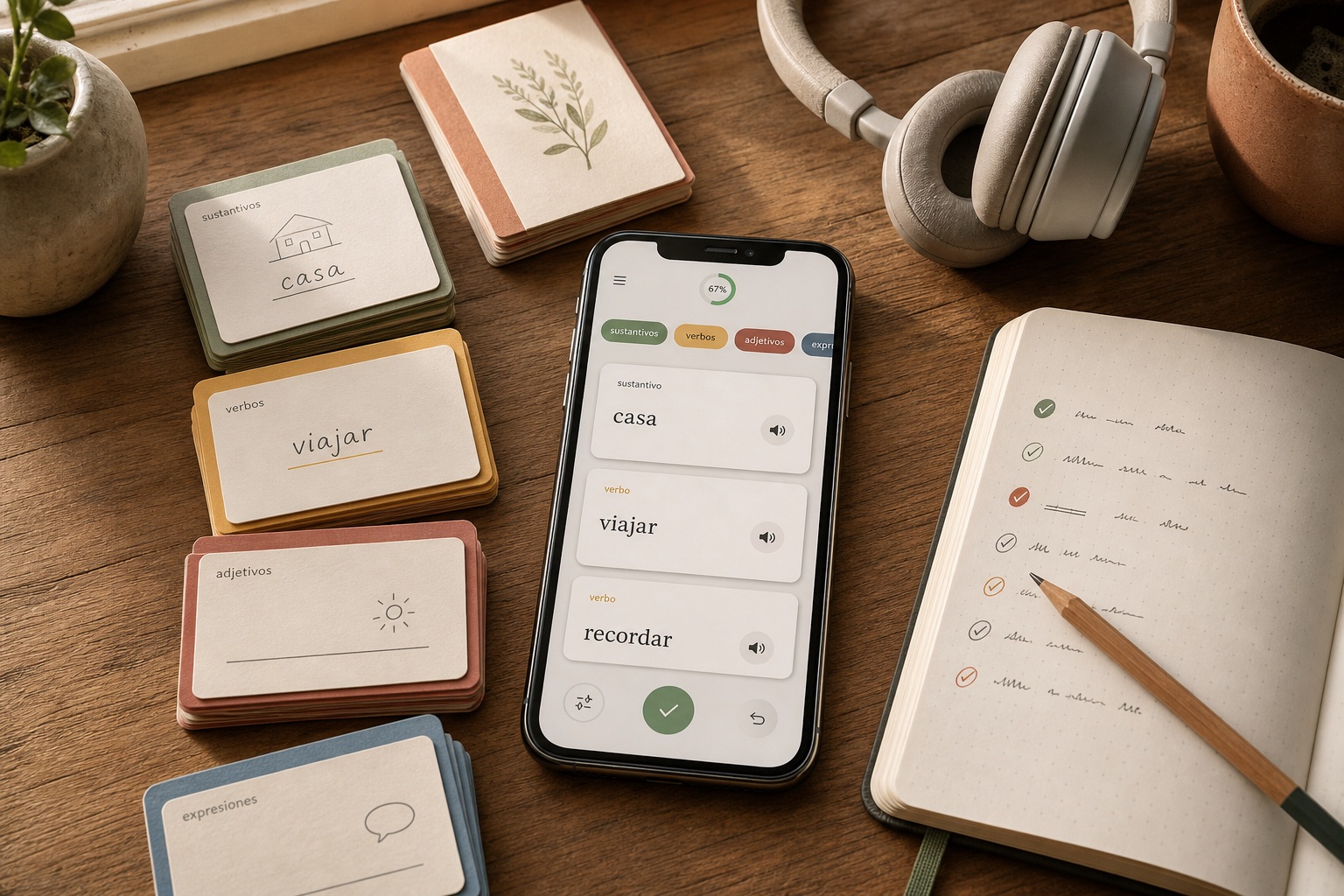
Input sources remain separate and should be found through Spanish books, articles, or podcasts. For optional vocabulary practice, Hola Cards offers individual word cards with pronunciation audio, writing exercises, and spaced review, rather than hosting full media. Practicing targeted words can reinforce vocabulary encountered during input.
Referenced Pedagogical Definitions and Research
This guide cites official pedagogical dictionaries and research abstracts.
- Centro Virtual Cervantes: Hipótesis del input
- Centro Virtual Cervantes: Atención a la forma
- John Benjamins: Explicit and Implicit Instruction Meta-Analysis (2015 Abstract)
Frequently Asked Questions
Does comprehensible input exclude grammar study?
No. Understandable input provides essential exposure to authentic Spanish, while brief attention to grammar can clarify confusing forms without conflicting with comprehension-focused study.
Can grammar rules alone create fluency?
No. Grammar rules can help learners monitor accuracy, but conscious knowledge of rules does not automatically translate into spontaneous communication.
Is there a validated input-to-grammar ratio?
No. Available research sources do not establish a universal ratio. A practical guideline is to dedicate most study time to comprehensible input, using brief moments for targeted grammar questions.
What if Spanish listening is too difficult?
Choose simpler material. Audio that cannot be understood from context does not provide comprehensible input. Selecting slower, contextualized content makes Spanish intelligible before analyzing grammar.
Export Market Practice Sentences
Copied sentences provide written practice and personal adaptation, distinct from recorded word cards.
**Market Story Practice Sentences**

Ana camina al mercado. - Ana walks to the market.
El panadero vende pan caliente. - The baker sells warm bread.
Los vecinos compran fruta fresca. - Neighbors buy fresh fruit.
El vendedor habla con clientes. - The vendor talks with customers.
Ana compra pan en la tienda. - Ana buys bread at the shop.
Yo compro pan en el mercado. - I buy bread at the market.
¿Tú compras pan dulce aquí? - Do you buy sweet bread here?
Ellos compran verduras para almorzar. - They buy vegetables for lunch.
Yo camino por el mercado local hoy. - I walk through the local market today.
Nosotros buscamos comida fresca. - We look for fresh food.
¿Tú preguntas el precio? - Do you ask the price?
Ella compra pan caliente. - She buys warm bread.
Strengthen Word Retention with Hola Cards
Spanish input resources must be found separately through books and podcasts; Hola Cards supports word practice. The mobile app offers offline review and guest mode; web access provides cloud sign-in. Review vocabulary cards, listen to existing native word audio, practice pronunciation, write terms, organize groups, and use spaced review. Copied sentences provide written practice, not recorded word cards.