Start Your Review Schedule
Practice active recall with Spanish flashcards using the Hola Cards app on iOS or Android.
spaced repetition Spanish vocabulary
Understanding the Spaced Repetition Approach
Reviewing the material at strategically increasing intervals is a way to remember Spanish vocabulary. This concept, known as spaced repetition, helps you build a lasting vocabulary. Rather than studying it all at once, you distribute your practice. This approach prioritizes delayed recall.
Active recall requires you to prompt yourself to retrieve the information, rather than simply looking at a list. When using Spanish flashcards, you must look at a prompt in your own language and actively search your memory for the Spanish phrase, or look at the Spanish phrase and recall its meaning in your own language. This mental effort is what builds retention over time.
A successful study approach does not rely on passive exposure; it demands that you test yourself repeatedly. By combining the retrieval effort of active recall with a structured vocabulary system, you build a solid foundation. This consistent practice supports your broader language learning goals and helps maintain your progress.
Building a Realistic Review Schedule
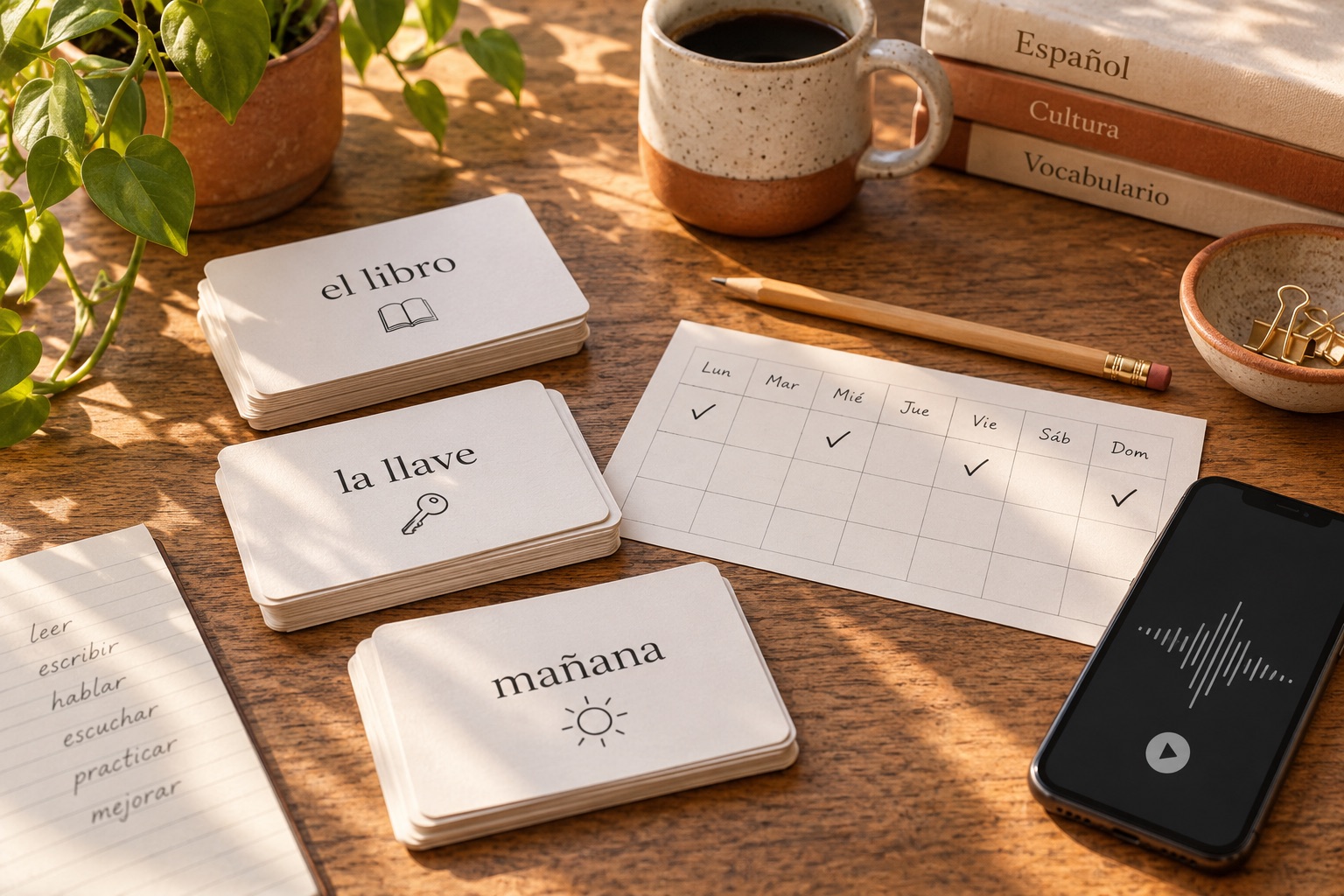
Creating a realistic Spanish vocabulary review schedule requires personal calibration rather than rigidly adhering to a specific formula. You should find a rhythm that fits into your daily life. A practical, adjustable one-week routine can help you build consistency without overwhelming yourself with too many new words.
On Monday, you can introduce a small set of new words and test yourself on them immediately. On Tuesday, perform your first review of Monday's words, focusing heavily on active recall. Avoid adding new batches of words every day to keep your review queue manageable.
On Thursday, you review Monday's batch again to reinforce the material. By Sunday, you can perform a comprehensive review of all the words practiced during the week. This is merely a baseline example. You must adjust the schedule based on your own retention and daily availability.
If Thursday's review is too difficult, you might need to review them on Wednesday instead. Conversely, if a word is easily recalled, push its next review further out. The goal is to introduce deliberate delays between study sessions, spacing your practice to improve long-term recall.
A laboratory study of word learning by Karpicke and Bauernschmidt supports repeated spaced retrieval for delayed retention. Note that this was not a Spanish-specific or app trial, and it does not offer proof of a single best schedule. You must adapt intervals to your own needs.
Practice Vocabulary Set
Here is a small set of vocabulary you can use to test your new review routine. Focus on unambiguous meanings and practicing both directions of recall.
| Spanish phrase | Meaning |
|---|---|
| Me despierto temprano todos los días. | I wake up early every day. |
| Preparo el desayuno en la cocina. | I prepare breakfast in the kitchen. |
| Salgo para el trabajo ahora. | I leave for work now. |
| Regreso a casa por la tarde. | I return home in the afternoon. |
| Busco la estación de tren. | I look for the train station. |
| Giro a la izquierda en la esquina. | I turn left at the corner. |
| Camino dos cuadras en línea recta. | I walk two blocks in a straight line. |
| Cruzo la calle con cuidado. | I cross the street carefully. |
| Propongo cenar juntos el viernes. | I propose having dinner together on Friday. |
| Confirmo la reserva del restaurante. | I confirm the restaurant reservation. |
| Llego al lugar acordado. | I arrive at the agreed place. |
| Cancelo la reunión de mañana. | I cancel tomorrow's meeting. |
Core Principles of Effective Review
Applying these three concepts will help you maximize the benefits of your study sessions.
Active Recall
Prompting yourself to retrieve the target language from memory without looking strengthens your retention.
Me despierto temprano todos los días. · Preparo el desayuno en la cocina. · Salgo para el trabajo ahora. · Regreso a casa por la tarde.
Strategic Delays
Introducing time between review sessions allows you to practice recalling words across separate days.
Busco la estación de tren. · Giro a la izquierda en la esquina. · Camino dos cuadras en línea recta. · Cruzo la calle con cuidado.
Independent Practice
Encountering and using your studied vocabulary outside of structured flashcards helps you apply what you learn.
Propongo cenar juntos el viernes. · Confirmo la reserva del restaurante. · Llego al lugar acordado. · Cancelo la reunión de mañana.
Managing the Challenges of Spaced Repetition
When you forget a word entirely, do not view it as a failure. Simply treat it as a new word and reset its review interval. Forgetting is a normal part of the learning process, and identifying the words that require more effort is the exact purpose of the review system.
If you accumulate a massive backlog of cards, the most effective strategy is to tackle them in manageable chunks. Avoid attempting a marathon session that leads to burnout. Cap your daily reviews at a realistic number and gradually work through the backlog over several days.
A robust study habit must include practicing both directions of recall. While producing the English meaning when reading a Spanish phrase is useful, you must also practice generating the Spanish equivalent from English. Ensure your flashcards are configured to test you in both directions.
Beyond your structured sessions, engaging in independent practice is vital for cementing the vocabulary in your mind. Seeing and using the words in novel contexts builds flexibility. Try to incorporate the words from your review schedule into simple sentences throughout your day to reinforce your learning.
Explore these related guides to further improve how you study:
Spanish words for beginners Spanish flashcards with example sentences Anki alternative for Spanish
Creating Your Custom Study Flow
- Try to recall the Spanish word from memory before you look at the translation or flip the card.
- Check your answer immediately against the correct solution to confirm accuracy and identify any specific mistakes.
- Review your vocabulary across separate days, introducing deliberate delays instead of cramming all practice into one session.
- Adjust your review schedule after misses, bringing difficult words back sooner to reinforce them during your next session.
- Practice vocabulary in both directions, translating from Spanish to English and from English to Spanish for balance.
Research and Evidence
Our approach to delayed retention is informed by cognitive psychology research.
Frequently Asked Questions
How many new Spanish words should I add to my spaced repetition routine each day?
Start with five to ten new words. The challenge is the compounding daily reviews, not the initial learning. A small number grows quickly. Focus on consistency rather than volume, and adjust upwards only if you easily complete daily reviews. There is no universal interval that works for everyone.
Does Hola Cards automatically schedule my reviews using FSRS?
Hola Cards does not use FSRS/SM-2 due dates; users can apply this example routine to custom groups. The app provides adaptive practice without relying on these specific scheduling algorithms.
Should I delete words from my Spanish flashcards once I know them well?
We recommend occasional checking of useful familiar words to maintain your memory. However, there is no universal rule, and you can remove irrelevant or error cards at any time.
Copy to Your Device
Select these phrases to begin practicing immediately.
**Spaced Repetition Starter Set**

Me despierto temprano todos los días. - I wake up early every day.
Preparo el desayuno en la cocina. - I prepare breakfast in the kitchen.
Salgo para el trabajo ahora. - I leave for work now.
Regreso a casa por la tarde. - I return home in the afternoon.
Busco la estación de tren. - I look for the train station.
Giro a la izquierda en la esquina. - I turn left at the corner.
Camino dos cuadras en línea recta. - I walk two blocks in a straight line.
Cruzo la calle con cuidado. - I cross the street carefully.
Propongo cenar juntos el viernes. - I propose having dinner together on Friday.
Confirmo la reserva del restaurante. - I confirm the restaurant reservation.
Llego al lugar acordado. - I arrive at the agreed place.
Cancelo la reunión de mañana. - I cancel tomorrow's meeting.
Build Your Custom Group Today
Copy this small set of phrases into a custom group in Hola Cards and start practicing with spaced repetition. The app supports writing and word recognition practice on iOS and Android. A free tier is available which may show ads, while Premium removes ads. Web learning requires sign-in.