24 Essential Spanish Discourse Markers by Conversational Function
The following reference table outlines 24 practical expressions alongside a primary communicative function for each row, followed by four conversational scenarios that illustrate them in context. While individual markers often serve multiple pragmatic purposes in practice, each entry highlights a core communicative function informed by Instituto Cervantes curricular descriptions.
| Expression | Natural English Function |
|---|---|
| A ver... | Let's see (securing a brief moment to check information or order a thought) |
| Bueno... | Well... (initiating a response while calibrating tone or stance) |
| Pues... | Well / You see (maintaining your conversational turn while formulating an answer) |
| Mira... | Look / Listen (directing the listener's attention while establishing time to speak) |
| En primer lugar... | First of all (marking the initial point in an orderly presentation of ideas) |
| Por una parte... | On the one hand (signaling the first half of a balanced argument or observation) |
| Por otra parte... | On the other hand (introducing a complementary or contrasting perspective) |
| Para empezar... | To begin with (establishing a starting premise for a wider explanation) |
| Además... | Furthermore / In addition (attaching supplementary evidence or detail to an argument) |
| Por cierto... | By the way (introducing an associated thought or relevant side topic) |
| Dicho esto... | That being said (pivoting smoothly to a counterpoint after acknowledging an initial fact) |
| A propósito... | Speaking of which / Incidentally (transitioning to a connected matter inspired by the topic) |
| O sea... | In other words / Meaning that (rephrasing an idea for casual clarity or explanation) |
| Es decir... | That is to say (re-stating an idea with formal accuracy and precision) |
| Mejor dicho... | Rather / Or better said (correcting or refining an imprecise word choice) |
| En otras palabras... | Put another way (translating a concept into more accessible phrasing) |
| En realidad... | Actually / In fact (rectifying a misconception or highlighting objective reality) |
| La verdad es que... | To be honest / The truth is that (introducing a candid observation or nuanced reservation) |
| Hasta cierto punto... | To a certain extent (qualifying a statement to avoid making an absolute claim) |
| En principio... | In theory / As a baseline (signaling an intended plan that remains subject to change) |
| En fin... | All in all / Anyway (summarizing an exchange or preparing to wrap up a tangent) |
| Total, que... | So basically (distilling a lengthy narrative down to its core takeaway) |
| A lo que iba... | Getting back to my point (reclaiming the central thread after an interruption or detour) |
| Para terminar... | To conclude (announcing the closing remark of a monologue or contribution) |
Export Study List: 24 Conversational Discourse Markers
Copy this complete reference list of 24 Spanish expressions and functional descriptions to import directly into your preferred review deck or personal study notebook.
Spanish filler words
Why Discourse Markers Matter More Than Empty Fillers
When language learners explore Spanish filler words, they often expect a simple list of vocal crutches equivalent to English sounds like 'um' or 'uh'. In linguistic reality, spoken Spanish distinguishes spontaneous hesitation sounds from an established system of discourse markers. According to Hispanic linguistics and curricular descriptions from the Instituto Cervantes, these markers fulfill specific communicative tasks: they mark boundaries, manage turn-taking, indicate hesitation, structure comments, and signal reformulations. Crucially, a single expression can carry multiple pragmatic functions depending on its syntactic position, intonation, conversational context, and regional variety. Pausing to formulate thought is an ordinary, necessary part of speech rather than a conversational defect. Furthermore, no single marker operates with identical frequency or universal neutrality across all Spanish-speaking communities. Rather than seeking a single standard expression or attempting to adopt unfamiliar regional mannerisms, speakers benefit from observing how register, position, and communicative purpose shape the use of discourse markers in real interaction.
Three Essential Guidelines for Using Spanish Hesitation Markers
First, prioritize communicative function over literal translation: identify whether your immediate purpose is to gain planning time, organize a sequence of points, or reformulate an earlier statement, keeping in mind that a single expression can serve several functions depending on placement and intonation. Second, observe social register: formal contexts tend to employ explicit connectors such as es decir and en primer lugar, whereas everyday colloquial conversations frequently feature particles such as o sea or total, que. Third, exercise editorial moderation: discourse markers support verbal structuring alongside natural pauses, without any need to eliminate silent hesitation or mimic regional mannerisms that feel unfamiliar.
Discourse Markers in Action: 4 Everyday Scenarios
Examine how speakers deploy hesitation phrases and discourse markers in realistic conversational contexts to pace their speech and organize thoughts.
Workplace Project Review
Elena and Marcos review their department's quarterly schedule in a quiet office meeting. When Marcos asks whether the final logistics report can be distributed immediately, Elena pauses thoughtfully instead of offering an unverified estimate: «A ver, el borrador está completo; en principio podemos enviarlo hoy, pero, por otra parte, falta que el equipo de control valide los inventarios». Marcos nods and reformulates his question to confirm the timeline: «Es decir, ¿necesitamos cuarenta y ocho horas adicionales antes del envío general?». Elena qualifies the plan with professional clarity: «En realidad, sí. Dicho esto, adelantaremos la comunicación con los proveedores para ahorrar tiempo». By utilizing functional markers alongside natural pauses, both colleagues sustain a focused, collaborative exchange.
A ver... · Bueno... · Pues... · Mira... · En primer lugar... · Por una parte... · Por otra parte... · Para empezar...
Casual Sidewalk Exchange
Beatriz meets her longtime neighbor Javier outside a neighborhood market. Javier asks about the progress of her recent residential move. Beatriz smiles wearily and gathers her thoughts before detailing the experience: «Bueno, ha sido una semana caótica. Para empezar, la furgoneta llegó con dos horas de retraso. Total, que terminamos de descargar cajas casi a medianoche». Javier laughs sympathetically and asks if the new flat is fully furnished. Beatriz clarifies her current living situation: «O sea, tenemos lo indispensable para dormir y cocinar, pero el resto sigue embalado. La verdad es que preferimos descansar este fin de semana antes de desembalar todo». The conversational markers reflect a relaxed, informal exchange.
Además... · Por cierto... · Dicho esto... · A propósito...
Architectural Design Meeting
Sofia presents preliminary building sketches to her client, Daniel, inside a design studio. Daniel examines the materials list and hesitates over the projected budget. Sofia observes his reaction and intervenes constructively: «Mira, entiendo perfectamente la duda sobre el coste de la piedra exterior. Por una parte, la inversión inicial es mayor; además, ofrece una durabilidad térmica insuperable». Daniel considers the explanation and checks his understanding: «En otras palabras, ¿el aislamiento adicional compensará la inversión durante las primeras dos temporadas?». Sofia qualifies the prediction responsibly: «Hasta cierto punto, sí, dependiendo del tipo de climatización seleccionado. Para terminar, revisaremos dos opciones de acabado sintético antes de tomar una decisión definitiva».
O sea... · Es decir... · Mejor dicho... · En otras palabras... · En realidad... · La verdad es que... · Hasta cierto punto... · En principio...
University Research Debrief
Mateo and Camila compare notes following an advanced postgraduate literature colloquium. Mateo begins to summarize an extended digression raised by an audience member: «El ponente habló largamente sobre las ediciones facsímiles... pero bueno, a lo que iba: los registros documentales del siglo diecisiete confirman nuestro planteamiento inicial». Camila agrees while organizing her own methodological feedback: «En primer lugar, los datos lexicográficos coinciden con los manuscritos que consultamos; por cierto, encontré un ensayo reciente en la hemeroteca digital. Mejor dicho, encontré dos monografías comparativas que refuerzan la conclusión». Mateo responds with relief: «En fin, disponemos de suficiente respaldo empírico para estructurar el informe final sin demoras».
En fin... · Total, que... · A lo que iba... · Para terminar...
Formality, Pragmatic Nuance, and Regional Awareness
Discourse markers and hesitation sounds are closely tied to social context, communicative intent, and geographic setting. For instance, explanatory reformulators like o sea frequently appear in informal spoken registers, yet their tone and frequency vary, whereas expressions such as es decir or en otras palabras are more characteristic of formal or written exposition. Similarly, markers such as pues or bueno exhibit distinct pragmatic nuances and intonation patterns across different regional varieties, and a single marker can serve multiple functions depending on its placement within a sentence. Linguistic descriptions do not identify any single expression as universally neutral or standard across all Spanish-speaking areas. Rather than attempting to apply a single formula, speakers benefit from observing local conversational habits and adapting their word choices to the specific register of the interaction.
Deepen your conversational Spanish foundation with our practical companion guides:
Spanish Pronunciation for Beginners Spanish Question Words and Beginner Questions Spanish Shadowing Practice Spanish Idioms by Context
How to Practice and Internalize Spanish Hesitation Phrases
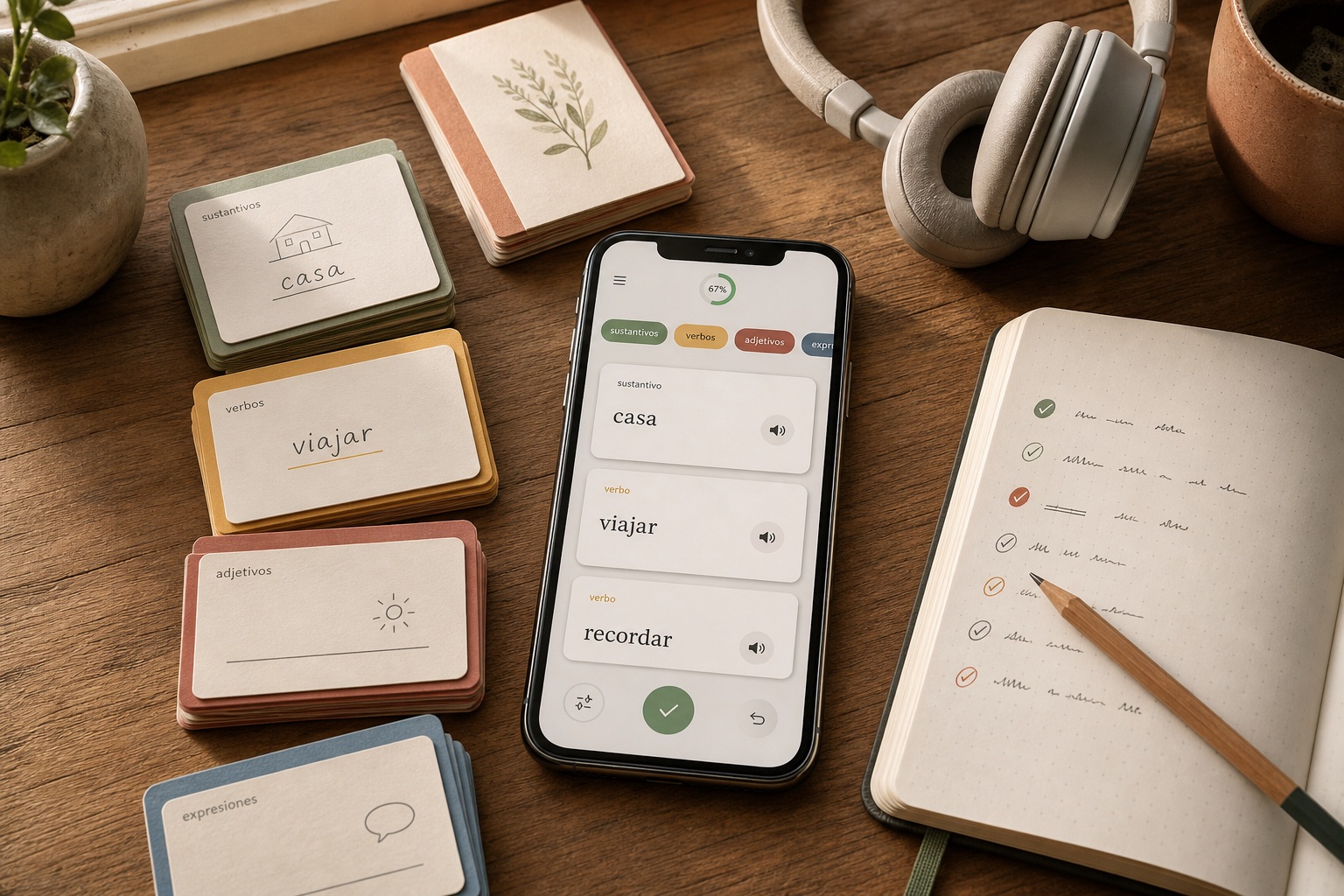
- Becoming comfortable with discourse markers involves attentive listening and contextual observation alongside spoken practice. When listening to dialogues or spoken media, observe how speakers use expressions such as a ver to buy planning time or dicho esto to transition between points, while recognizing that silent pauses remain an ordinary and functional feature of natural speech. For structured vocabulary review, flashcards offer a supplementary method to practice expressions: Hola Cards is a Spanish flashcard app for iOS and Android where titled Spanish–translation lists can be imported into custom groups for Spanish audio, writing, pronunciation, and spaced review. Web learning requires sign-in, and mobile guest mode is available. The app does not evaluate open conversation or automatically teach pragmatics, which develop through live conversational exchange. This guide serves as a complete, independent reference, and no app action is required to use the material.
Authoritative Sources and Curricular References
The descriptions and functional categorizations in this article are informed by established Hispanic linguistic research and official institutional curricula:
- Instituto Cervantes, Diccionario de términos clave de ELE, “Marcadores del discurso”
- Instituto Cervantes, Plan Curricular del Instituto Cervantes, “Tácticas y estrategias pragmáticas: B1-B2”
- RAE, Diccionario de la lengua española, “o sea”
Frequently Asked Questions About Spanish Filler Words
Are Spanish filler words simply the equivalent of saying 'um' or 'uh'?
No. While spoken Spanish includes hesitation sounds such as eh, functional discourse markers like bueno, a ver, or es decir perform communicative tasks categorized in Hispanic linguistics. Rather than serving merely as vocal fillers, these markers help manage turn-taking, indicate hesitation, organize points, or introduce reformulations, with many expressions fulfilling multiple functions depending on context, position, and intonation.
Is it considered bad grammar or rude to use hesitation phrases in Spanish?
Not inherently. Discourse markers and hesitation pauses are standard features of spontaneous spoken Spanish across all registers. However, appropriateness depends on context and register: an informal expression like o sea may feel out of place in formal presentations, where expository connectors or straightforward pauses are more customary. Overusing any single particle may also sound repetitive.
Should beginner Spanish learners try to imitate regional colloquial fillers?
Editorial guidance suggests focusing first on common functional markers documented across standard curricula, such as bueno, a ver, en primer lugar, or es decir, while recognizing that no expression is universally neutral in every setting. Highly regional expressions often carry specific pragmatic connotations and social registers, so observing how speakers use them in context is advisable before incorporating them into personal speech.
How can I avoid saying English filler words when speaking Spanish?
Allowing brief silent pauses while planning an utterance is an ordinary, natural aspect of conversation. When holding the conversational floor is intended, speakers often employ common markers such as a ver or pues, bearing in mind that their tone and effect vary with register and intonation rather than serving as fixed substitutes for English words.
Does Hola Cards teach open conversation or automated pragmatics?
No. Hola Cards is a Spanish flashcard app for iOS and Android designed for vocabulary review, Spanish audio, writing, pronunciation, and spaced repetition. It does not evaluate open-ended conversation or automatically teach pragmatics. Spoken pragmatic competence develops through contextual interaction and live communication.
Export Study List: 24 Conversational Discourse Markers
Copy this complete reference list of 24 Spanish expressions and functional descriptions to import directly into your preferred review deck or personal study notebook.
**Spanish Conversational Discourse Markers**

A ver... - Let's see (securing a brief moment to check information or order a thought)
Bueno... - Well... (initiating a response while calibrating tone or stance)
Pues... - Well / You see (maintaining your conversational turn while formulating an answer)
Mira... - Look / Listen (directing the listener's attention while establishing time to speak)
En primer lugar... - First of all (marking the initial point in an orderly presentation of ideas)
Por una parte... - On the one hand (signaling the first half of a balanced argument or observation)
Por otra parte... - On the other hand (introducing a complementary or contrasting perspective)
Para empezar... - To begin with (establishing a starting premise for a wider explanation)
Además... - Furthermore / In addition (attaching supplementary evidence or detail to an argument)
Por cierto... - By the way (introducing an associated thought or relevant side topic)
Dicho esto... - That being said (pivoting smoothly to a counterpoint after acknowledging an initial fact)
A propósito... - Speaking of which / Incidentally (transitioning to a connected matter inspired by the topic)
O sea... - In other words / Meaning that (rephrasing an idea for casual clarity or explanation)
Es decir... - That is to say (re-stating an idea with formal accuracy and precision)
Mejor dicho... - Rather / Or better said (correcting or refining an imprecise word choice)
En otras palabras... - Put another way (translating a concept into more accessible phrasing)
En realidad... - Actually / In fact (rectifying a misconception or highlighting objective reality)
La verdad es que... - To be honest / The truth is that (introducing a candid observation or nuanced reservation)
Hasta cierto punto... - To a certain extent (qualifying a statement to avoid making an absolute claim)
En principio... - In theory / As a baseline (signaling an intended plan that remains subject to change)
En fin... - All in all / Anyway (summarizing an exchange or preparing to wrap up a tangent)
Total, que... - So basically (distilling a lengthy narrative down to its core takeaway)
A lo que iba... - Getting back to my point (reclaiming the central thread after an interruption or detour)
Para terminar... - To conclude (announcing the closing remark of a monologue or contribution)
Retain Idiomatic Expressions with Daily Spaced Practice
Spaced repetition offers a structured way to reinforce vocabulary over time. You can import your study lists into Hola Cards on mobile or web to review Spanish audio, writing, pronunciation, and self-paced recall.