Expand Your Vocabulary
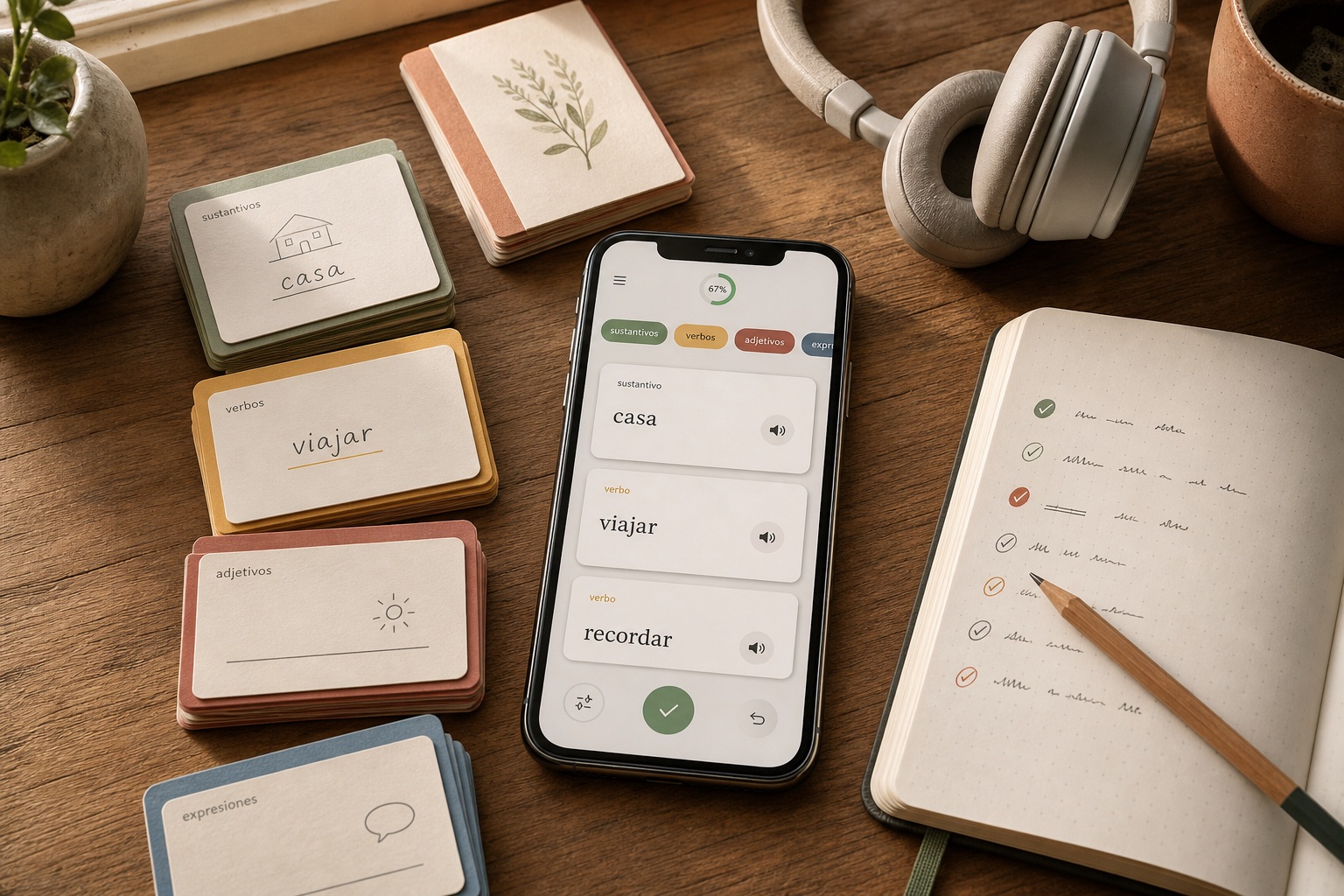
Strengthen individual words with flashcards. Hola Cards offers mobile offline vocabulary study with native audio for individual catalog terms to support your broader practice.
Spanish A1 vs A2 level
Contrasting Breakthrough A1 and Elementary A2 Spanish
Learners at the A1 level can understand and use familiar everyday expressions, simple rehearsed phrases, and basic sentences to satisfy immediate concrete needs. While interactions often rely on a cooperative partner who speaks slowly and clearly, the degree of support varies, and not every exchange requires constant assistance.
At A2, learners handle simple routine transactions like shopping, transit, and ordering food. However, A2 is elementary rather than fluent; speakers still pause frequently, make errors, and need cooperative partners who speak clearly.
Competency develops unevenly across skills. You might read public signs at A2 while spoken interaction remains at A1. Recording an uneven profile reflects your real communicative readiness better than a single blanket score.
Principles for Practical Self-Assessment
Study metrics such as vocabulary size, grammar scores, and accumulated study hours offer valuable indicators for organizing practice, but they cannot alone establish a functional CEFR level, which requires demonstrated communicative performance in real-world contexts.
Practical listening practice requires external, permitted short, clear, and slow audio or a supportive conversation partner. Learners should listen first without a visible transcript to identify two key facts (such as person, place, or time), and then record any repetitions or assistance required. A1 and A2 tasks do not expect comprehension of fast natural speech, multiple regional accents, or background noise, and no audio is embedded directly in this guide.
This task profile is an informal self-assessment guide and cannot assign or confirm an official A1 or A2 level, nor can it issue certification. The CEFR is a descriptive reference framework that does not issue certificates itself; its official descriptors are intended to orient learning goals and discussions with a teacher.
Twelve Illustrative Spanish Practice Sentences
Here are twelve original illustrative sentences designed for practicing reading, spoken interaction, and language production, rather than for diagnostic scoring or formal evaluation.
| Spanish Practice Phrase | Translation |
|---|---|
| Horario: lunes a viernes de 9:00 a 14:00. | Hours: Monday to Friday from 9:00 to 14:00. |
| Por favor, recoja su paquete en la recepción presentando su documento de identidad. | Please pick up your package at the reception desk by presenting your identity document. |
| Tren a Valencia: vía tres con diez minutos de retraso. | Train to Valencia: platform three, ten-minute delay. |
| Su pedido está listo para recoger en la tienda. | Your order is ready for pickup in store. |
| ¿Puede hablar más despacio? No comprendo esa palabra. | Could you speak slower? I do not understand that word. |
| Buenos días, busco una farmacia cerca de la estación. | Good morning, I am looking for a pharmacy near the station. |
| ¿Tiene una mesa para dos personas en la terraza? | Do you have a table for two on the terrace? |
| Quería cambiar esta camiseta azul por una talla mayor. | I would like to exchange this blue shirt for a larger size. |
| Vivo en un piso pequeño y trabajo en una biblioteca. | I live in a small apartment and work in a library. |
| El sábado comí con mi familia en el centro histórico. | On Saturday I ate with my family in the historic centre. |
| Hola Marcos, mañana no voy a clase por una cita médica. | Hello Marcos, tomorrow I miss class for a doctor appointment. |
| Mi barrio es tranquilo y tiene varios supermercados cerca. | My neighborhood is quiet with several nearby supermarkets. |
Evaluating Three Core Skill Domains
Observe how practical communicative demands shift from basic recognition to routine interactions across three core domains.
Spoken Interaction: Managing Routine Exchanges with Support
Conduct a two-way spoken roleplay with a partner simulating a cafe lunch order. Begin by requesting food, and then introduce a required follow-up change request, saying Quisiera la sopa del día, pero sin cebolla, por favor, followed by ¿Puede cambiar el refresco por agua mineral?. Note what extra help was needed during the conversation, such as slower speech or gestures, without applying any pass threshold. A1 learners can take part in simple, familiar supported exchanges, whereas A2 learners can handle short routine exchanges and follow-ups, though they may still need support. Record these reflections as nonvalidated observations for personal study planning, keeping in mind that informal roleplays cannot assign official A1 or A2 levels, CEFR credentials, or app-generated evaluations.
¿Puede hablar más despacio? No comprendo esa palabra. · Buenos días, busco una farmacia cerca de la estación. · ¿Tiene una mesa para dos personas en la terraza? · Quería cambiar esta camiseta azul por una talla mayor.
Production: Expressing Everyday Personal Details
Use a separate phone recorder to complete an original short spoken task describing your morning schedule, saying Me levanto a las siete, desayuno café con tostadas y salgo en autobús al trabajo. Next, draft a separate short written-message task with a clear communicative goal to notify a colleague about an unexpected delay, writing Hola Daniel, llego veinte minutos tarde porque el tren se ha retrasado. A1 learners can use simple phrases and sentences to describe familiar personal information, whereas A2 learners can connect short descriptions and write routine messages, with possible help. Review both productive outcomes as nonvalidated observations for personal study planning, keeping in mind that self-directed practice cannot assign official A1 or A2 levels, CEFR certification, vocabulary-count cutoffs, or automated evaluation.
Vivo en un piso pequeño y trabajo en una biblioteca. · El sábado comí con mi familia en el centro histórico. · Hola Marcos, mañana no voy a clase por una cita médica. · Mi barrio es tranquilo y tiene varios supermercados cerca.
Reading: From Isolated Signs to Routine Notices
Examine this original neighborhood clinic announcement: Aviso importante: la consulta dental cierra este jueves por reformas, pero abrimos el viernes a las nueve. Search the text to identify two specific operational facts, namely the reason for Thursday's closure and the Friday opening time, without looking up solutions or displaying immediate answers. After reading, record what extra help you used, such as checking a dictionary or reviewing individual vocabulary words. A1 learners can understand very short, familiar written notices, whereas A2 learners can extract key routine facts from short texts, though both may use support. Note your reflections to guide personal study planning, keeping in mind that these informal observations cannot assign official A1 or A2 levels, CEFR credentials, vocabulary cutoffs, or automated evaluations.
Horario: lunes a viernes de 9:00 a 14:00. · Por favor, recoja su paquete en la recepción presentando su documento de identidad. · Tren a Valencia: vía tres con diez minutos de retraso. · Su pedido está listo para recoger en la tienda.
Three-Tier Recording Scale
Independent: You complete the task easily without translations or partner coaching.
With Help: You achieve the goal when your partner speaks slowly or rephrases words.
Not Yet: You cannot complete the transaction even with supportive assistance.
Explore these related guides to expand your Spanish vocabulary and reading skills:
100 Most Common Spanish Words 40 Spanish Classroom Phrases for Beginners Spanish Listening Practice App Guide Spanish Graded Readers for A2 Learners
Building Your Practical Skill Profile
- Separately observe your reading comprehension, paired conversational interaction, and self-recorded spoken and written production.
- Practice with permitted external, clear, slow, and short audio by listening first without a transcript to identify two key facts, noting any assistance or visual support needed.
- Record partner assistance, necessary repetitions, and whether communication goals were achieved, focusing on practice needs rather than calculating a level score.
Official Framework References
Consult these official resources for standardized European language framework descriptors:
- Council of Europe: CEFR Global Scale Descriptions
- Council of Europe: Self-Assessment Grid
- Instituto Cervantes: Plan Curricular A1-A2
Frequently Asked Questions
Can this profile certify my language level?
No. This original profile cannot confirm an A1/A2 level or award certification. The CEFR is an educational framework rather than a certifying authority, though its official descriptors provide a structured basis for discussing your proficiency and progress with a teacher.
Does reaching A2 mean I can speak Spanish fluently?
No. A2 is an elementary stage. Learners manage routine tasks but still hesitate, make errors, and require cooperative partners.
Can I be A2 in reading but A1 in spoken interaction?
Yes. Skills develop unevenly. Learners often understand written notices at A2 while spoken interaction remains at A1.
Why can't reading text measure listening comprehension?
Unlike reading, where learners can re-read and control their pace, listening requires real-time comprehension where clear, slow, short audio and cooperative support are appropriate for both A1 and A2 learners. While visual support such as gestures or context can be very helpful, our recommendation to listen first without a visible transcript is simply an optional diagnostic task condition, not a universal CEFR requirement.
Copy the Twelve Practice Examples
Export these twelve original practice examples to review your skill profile over time.
**Self-Study Tools**

Horario: lunes a viernes de 9:00 a 14:00. - Hours: Monday to Friday from 9:00 to 14:00.
Por favor, recoja su paquete en la recepción presentando su documento de identidad. - Please pick up your package at the reception desk by presenting your identity document.
Tren a Valencia: vía tres con diez minutos de retraso. - Train to Valencia: platform three, ten-minute delay.
Su pedido está listo para recoger en la tienda. - Your order is ready for pickup in store.
¿Puede hablar más despacio? No comprendo esa palabra. - Could you speak slower? I do not understand that word.
Buenos días, busco una farmacia cerca de la estación. - Good morning, I am looking for a pharmacy near the station.
¿Tiene una mesa para dos personas en la terraza? - Do you have a table for two on the terrace?
Quería cambiar esta camiseta azul por una talla mayor. - I would like to exchange this blue shirt for a larger size.
Vivo en un piso pequeño y trabajo en una biblioteca. - I live in a small apartment and work in a library.
El sábado comí con mi familia en el centro histórico. - On Saturday I ate with my family in the historic centre.
Hola Marcos, mañana no voy a clase por una cita médica. - Hello Marcos, tomorrow I miss class for a doctor appointment.
Mi barrio es tranquilo y tiene varios supermercados cerca. - My neighborhood is quiet with several nearby supermarkets.
Advance Your Spanish Profile
Combine structured vocabulary practice with authentic listening and conversation to progress toward communicative independence.