Illustrative Sentence Pairs for Lexical and Syntactic Analysis
These eighteen Spanish sentences and English translations illustrate common questions of grammatical structure, discourse context, and regional comparison. Note: these rows are wholly original teaching examples created for this guide, not quotations or attested results from CORPES XXI.
| Spanish Example | English Meaning |
|---|---|
| ¿Con qué preposición suele combinarse este adjetivo en el lenguaje formal? | Which preposition does this adjective typically combine with in formal language? |
| El estudiante quiso comprobar si el verbo admite una construcción pronominal. | The student wanted to check whether the verb allows a pronominal construction. |
| Buscamos la forma en infinitivo para identificar los complementos habituales. | We searched for the infinitive form to identify its customary complements. |
| Nuestra duda era si la locución mantiene siempre la misma concordancia. | Our question was whether the phrase always maintains the same agreement. |
| Es necesario precisar si el término funciona como sustantivo o adverbio. | It is necessary to determine whether the term functions as a noun or an adverb. |
| ¿Aparece este giro verbal con mayor frecuencia en indicativo o subjuntivo? | Does this verbal idiom appear more frequently in the indicative or subjunctive? |
| Conviene ampliar el contexto donde la interfaz lo permita para comprobar si la frase tiene un sentido irónico. | It is advisable to expand the context where the interface makes it available to check whether the phrase has an ironic meaning. |
| Conviene verificar si una variante aparece dentro de una cita directa o en el discurso del autor. | It is advisable to verify whether a variant appears within a direct quotation or in the author's own speech. |
| Es conveniente revisar la ficha del texto para identificar el género y registrar posibles datos faltantes. | It is advisable to inspect the text record to identify the genre and note any missing data. |
| El examen del contexto discursivo ayuda a evaluar si el vocablo se emplea en un registro coloquial. | Examining the discursive context helps evaluate whether the term is used in a colloquial register. |
| Revisar las líneas contiguas permite analizar con mayor precisión la estructura de la oración. | Reviewing adjacent lines allows for a more precise analysis of the sentence structure. |
| Al consultar transcripciones orales, conviene observar si se registran vacilaciones propias del habla espontánea. | When consulting oral transcriptions, it is useful to observe whether hesitations typical of spontaneous speech are recorded. |
| Al comparar frecuencias normalizadas en la prensa rioplatense, se debe evaluar el tamaño y diseño de la muestra. | When comparing normalized frequencies in River Plate journalism, one must evaluate the sample size and design. |
| ¿Aparece esta locución con distinta frecuencia en los subcorpora andinos y peninsulares al comparar muestras equivalentes? | Does this phrase appear with different frequencies in Andean and Peninsular subcorpora when comparing equivalent samples? |
| Al contrastar medios escritos y orales, conviene ponderar el género y el diseño muestral antes de inferir diferencias de registro. | When contrasting written and oral media, it is advisable to weigh genre and sample design before inferring register differences. |
| El cálculo por millón de palabras facilita la comparación entre subcorpora, pero requiere considerar el género y el tamaño de cada muestra. | Calculating per million words facilitates comparison between subcorpora, but requires considering the genre and size of each sample. |
| ¿Presenta este modismo una frecuencia relativa distinta en las muestras de México y Centroamérica al contrastarlas con otras regiones? | Does this idiom present a different relative frequency in samples from Mexico and Central America when contrasted with other regions? |
| Al examinar la distribución por periodos, conviene analizar las variaciones cronológicas considerando las limitaciones del subcorpus. | When examining distribution across time periods, it is advisable to analyze chronological variations while considering subcorpus limitations. |
Copy Study Sentences
Copy these illustrative Spanish–English sentence pairs to paste into your personal language study notes.
CORPES XXI
Understanding CORPES XXI as a Reference Corpus
The Corpus del Español del Siglo XXI (CORPES XXI) is an RAE and ASALE reference corpus documenting authentic Spanish from 2001 onward across Spain, the Americas, the Philippines, and Equatorial Guinea. The RAE reports its June 2026 v1.5 release at nearly 420,000 documents and 455 million orthographic forms. Users should always note the version and date consulted.
CORPES XXI provides concordances, statistics, and inventories. Unlike learner dictionaries, it offers no definitions or normative rules. Unlike search engines, it relies on a planned academic sampling design across genres and regions, though it is not a perfectly balanced sociolinguistic sample and its coverage and metadata require checking. Unlike earlier reference corpora such as CREA or historical corpora like CORDE, it reflects strictly 21st-century production.
Corpus design, genre coverage, deduplication, and metadata completeness constrain conclusions. Attestation proves documented occurrence in sampled texts, but does not establish universal naturalness, register quality, or typicality.
What Corpus Evidence Can and Cannot Establish
Recorded occurrence is not recommendation or correctness. Attestation in CORPES XXI confirms that an author or speaker used the form in an archived document, not that the RAE endorses it, that it satisfies prescriptive grammar, or that it is stylistically recommended.
Absence is not proof of non-use. Emerging slang, digital neologisms, and spoken colloquialisms may not appear in the June 2026 v1.5 release. Zero hits indicates non-attestation within the sample, not that speakers avoid the phrase.
Never mistake raw frequency or a single count for regional preference or register quality. Because subcorpora vary in volume, genre composition, and sampling design, higher counts in Spain than Uruguay reflect document volume and sample design rather than speaker preference. Always evaluate normalized frequencies cautiously across comparable subcorpora, taking sample size, genre distribution, and corpus design into account.
Occurrence does not prove present currency, universal comprehension, or regional preference. An expression from 2002 may have declined, local idioms may not be understood in other regions, and a single count cannot demonstrate register quality or a formal-popular opposition. Always confirm usage with suitable dictionaries, grammars, and independent sources while inspecting available metadata.
Three Perspectives of Corpus Inquiry
Structuring your corpus research into distinct conceptual angles ensures that grammatical mechanics, contextual nuances, and regional distributions are analyzed systematically.
Formulating the Grammatical Query
Effective corpus investigation begins with a sharply defined syntactic or lexical question rather than an open-ended search. Learners examine specific variations—such as whether a verb accepts a prepositional complement, how an adjective behaves before versus after a noun, or whether an idiom retains fixed morphology. Clarifying the structural question beforehand enables you to choose appropriate search tokens and evaluate concordance lines against a clear hypothesis.
¿Con qué preposición suele combinarse este adjetivo en el lenguaje formal? · El estudiante quiso comprobar si el verbo admite una construcción pronominal. · Buscamos la forma en infinitivo para identificar los complementos habituales. · Nuestra duda era si la locución mantiene siempre la misma concordancia. · Es necesario precisar si el término funciona como sustantivo o adverbio. · ¿Aparece este giro verbal con mayor frecuencia en indicativo o subjuntivo?
Evaluating Concordance Lines and Discourse Context
Isolating a search hit within a single concordance snippet can obscure the true communicative function of an expression. Readers should expand context where the interface makes it available to verify whether the usage appeared in figurative speech, ironic commentary, direct quotation of a non-standard speaker, or translated prose. Evaluating authorial tone, syntactic dependencies, and publication genre—while inspecting available metadata and noting missing fields—ensures that empirical observations reflect genuine linguistic patterns rather than isolated stylistic anomalies.
Conviene ampliar el contexto donde la interfaz lo permita para comprobar si la frase tiene un sentido irónico. · Conviene verificar si una variante aparece dentro de una cita directa o en el discurso del autor. · Es conveniente revisar la ficha del texto para identificar el género y registrar posibles datos faltantes. · El examen del contexto discursivo ayuda a evaluar si el vocablo se emplea en un registro coloquial. · Revisar las líneas contiguas permite analizar con mayor precisión la estructura de la oración. · Al consultar transcripciones orales, conviene observar si se registran vacilaciones propias del habla espontánea.
Analyzing Regional and Subcorpus Distributions
Because contemporary Spanish spans more than twenty nations, comparing distributions across geographic subcorpora offers insight into regional variation, though a single count never demonstrates regional preference or register quality. Learners must analyze normalized frequencies per million words rather than raw occurrence totals to account for unequal subcorpus sizes, while keeping sample size, genre makeup, and corpus design in mind. Examining comparable geographic zones, time periods within the century, and communicative media cautiously prevents overgeneralizing localized sample patterns as universal Spanish norms.
Al comparar frecuencias normalizadas en la prensa rioplatense, se debe evaluar el tamaño y diseño de la muestra. · ¿Aparece esta locución con distinta frecuencia en los subcorpora andinos y peninsulares al comparar muestras equivalentes? · Al contrastar medios escritos y orales, conviene ponderar el género y el diseño muestral antes de inferir diferencias de registro. · El cálculo por millón de palabras facilita la comparación entre subcorpora, pero requiere considerar el género y el tamaño de cada muestra. · ¿Presenta este modismo una frecuencia relativa distinta en las muestras de México y Centroamérica al contrastarlas con otras regiones? · Al examinar la distribución por periodos, conviene analizar las variaciones cronológicas considerando las limitaciones del subcorpus.
The Practical Corpus Lookup Log
A disciplined lookup log turns casual searches into repeatable evidence. Begin each entry by defining a precise question, such as testing competing prepositions or adjective placement.
Record query parameters: exact form or lemma, CORPES version (such as June 2026 v1.5), subcorpus filters, raw hit counts, and normalized frequency per million words.
Save available context and inspect metadata (country, genre, date) while noting any missing fields, then confirm findings with a suitable dictionary or grammar manual to evaluate meaning and register.
Complement your corpus workflow with these guides on dictionaries and collocations:
How to Use a Spanish Dictionary for Language Learning Mastering Spanish Collocations: How Words Partner in Natural Speech
Five-Step Workflow for Investigating Words in CORPES XXI
- 1. Formulate a precise question: Define an explicit contrast before searching, such as testing competing prepositions, adjective position, or inflectional restrictions.
- 2. Query form or lemma: Search lemmas to analyze inflected variants, or search exact word forms to examine specific tenses or fixed idioms.
- 3. Inspect concordances in context: Review KWIC lines to identify collocations, then expand context where the interface makes it available to assess syntax and authorial tone, noting available metadata and missing fields.
- 4. Compare controlled subcorpora: Filter by region, genre, or period when available, relying on normalized frequency per million words rather than raw totals while accounting for sample size, genre distribution, and corpus design instead of inferring regional preference or register quality from a single count.
- 5. Confirm with independent authorities: Cross-check corpus observations against reputable learner dictionaries, descriptive grammars, and independent contemporary sources.
Sources and Reference Portals
These guidelines reference official academic documentation and linguistics portals:
- Real Academia Española: Banco de datos (CORPES XXI)
- Real Academia Española: Portal de consulta de corpus
- Universitat Pompeu Fabra: Recursos Lingüístics per a l'Aprenentatge (Reclic)
Frequently Asked Questions
Does an occurrence in CORPES XXI mean a word is correct or approved by the RAE?
No. CORPES XXI is an empirical descriptive corpus, not a prescriptive rulebook. An occurrence proves documented existence in contemporary Spanish, not academy recommendation, normative correctness, or conversational suitability.
Why might a common Spanish expression show zero occurrences in the corpus?
Corpora are finite samples. Emerging slang, digital terms, and spoken colloquialisms may not appear in the June 2026 v1.5 release. Zero hits indicates non-attestation within the sample, not proof of non-use.
How does CORPES XXI differ from CREA and search engines like Google?
CORPES XXI documents 21st-century Spanish from 2001 onward, distinguishing it from earlier reference corpora such as CREA and historical archives like CORDE. Unlike search engines indexing unvetted web pages, CORPES XXI applies a planned academic sampling design with searchable metadata and normalized frequencies, though metadata fields may be incomplete and coverage is not a perfectly balanced sociolinguistic sample.
Copy Study Sentences
Copy these illustrative Spanish–English sentence pairs to paste into your personal language study notes.
**Organizing Practice by Study Focus**

¿Con qué preposición suele combinarse este adjetivo en el lenguaje formal? - Which preposition does this adjective typically combine with in formal language?
El estudiante quiso comprobar si el verbo admite una construcción pronominal. - The student wanted to check whether the verb allows a pronominal construction.
Buscamos la forma en infinitivo para identificar los complementos habituales. - We searched for the infinitive form to identify its customary complements.
Nuestra duda era si la locución mantiene siempre la misma concordancia. - Our question was whether the phrase always maintains the same agreement.
Es necesario precisar si el término funciona como sustantivo o adverbio. - It is necessary to determine whether the term functions as a noun or an adverb.
¿Aparece este giro verbal con mayor frecuencia en indicativo o subjuntivo? - Does this verbal idiom appear more frequently in the indicative or subjunctive?
Conviene ampliar el contexto donde la interfaz lo permita para comprobar si la frase tiene un sentido irónico. - It is advisable to expand the context where the interface makes it available to check whether the phrase has an ironic meaning.
Conviene verificar si una variante aparece dentro de una cita directa o en el discurso del autor. - It is advisable to verify whether a variant appears within a direct quotation or in the author's own speech.
Es conveniente revisar la ficha del texto para identificar el género y registrar posibles datos faltantes. - It is advisable to inspect the text record to identify the genre and note any missing data.
El examen del contexto discursivo ayuda a evaluar si el vocablo se emplea en un registro coloquial. - Examining the discursive context helps evaluate whether the term is used in a colloquial register.
Revisar las líneas contiguas permite analizar con mayor precisión la estructura de la oración. - Reviewing adjacent lines allows for a more precise analysis of the sentence structure.
Al consultar transcripciones orales, conviene observar si se registran vacilaciones propias del habla espontánea. - When consulting oral transcriptions, it is useful to observe whether hesitations typical of spontaneous speech are recorded.
Al comparar frecuencias normalizadas en la prensa rioplatense, se debe evaluar el tamaño y diseño de la muestra. - When comparing normalized frequencies in River Plate journalism, one must evaluate the sample size and design.
¿Aparece esta locución con distinta frecuencia en los subcorpora andinos y peninsulares al comparar muestras equivalentes? - Does this phrase appear with different frequencies in Andean and Peninsular subcorpora when comparing equivalent samples?
Al contrastar medios escritos y orales, conviene ponderar el género y el diseño muestral antes de inferir diferencias de registro. - When contrasting written and oral media, it is advisable to weigh genre and sample design before inferring register differences.
El cálculo por millón de palabras facilita la comparación entre subcorpora, pero requiere considerar el género y el tamaño de cada muestra. - Calculating per million words facilitates comparison between subcorpora, but requires considering the genre and size of each sample.
¿Presenta este modismo una frecuencia relativa distinta en las muestras de México y Centroamérica al contrastarlas con otras regiones? - Does this idiom present a different relative frequency in samples from Mexico and Central America when contrasted with other regions?
Al examinar la distribución por periodos, conviene analizar las variaciones cronológicas considerando las limitaciones del subcorpus. - When examining distribution across time periods, it is advisable to analyze chronological variations while considering subcorpus limitations.
Practice Verified Vocabulary with Hola Cards
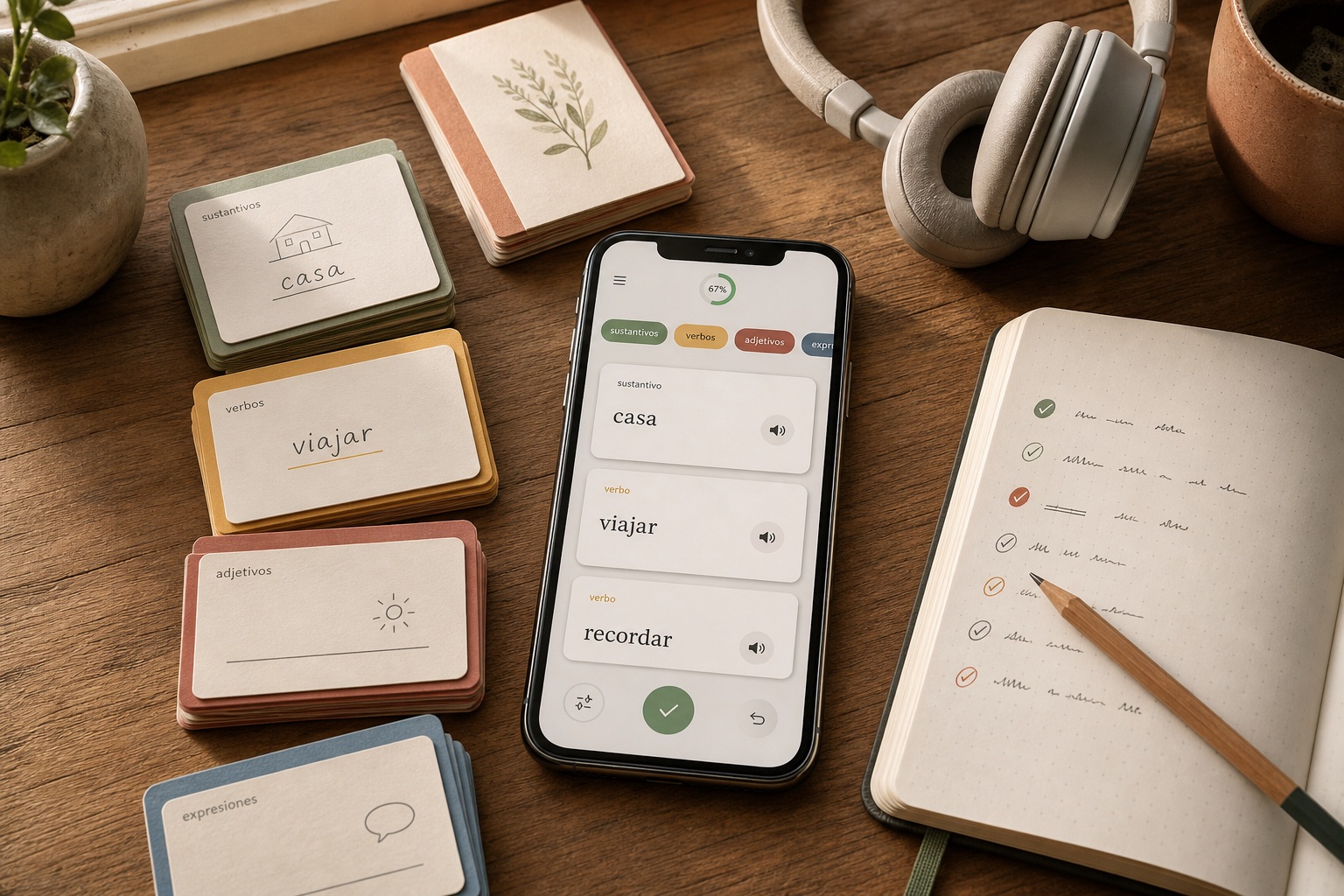
After checking language patterns in reference works, you can manually import your own Spanish–English lines into Hola Cards for mobile review. Note: Hola Cards is a flashcard study tool that does not connect to CORPES XXI, query corpora, verify usage, or provide an automatic dictionary.