Explore the Articulation Drills
Jump directly to the 12 beginner pronunciation drills below, organized by articulatory tier from foundational vowels to consonant contrasts.
Spanish tongue twisters for beginners
Why Practice Original Spanish Drills?
The Real Academia Española defines a trabalenguas as a word or phrase that is difficult to pronounce, traditionally used as a verbal game. For adult learners, newly composed alliterative drills offer practical motor conditioning. Rather than reciting archaic folklore, these deliberately playful, invented practice sentences target essential sound contrasts with accessible vocabulary, even if the phrasing is tailored for pronunciation rather than everyday conversation.
Pronunciation workshops, such as Ohio State University's CLAS sessions, use targeted phrases for lateral sounds like l and alveolar taps. However, evidence for drill transfer remains preliminary. In an eight-week conference abstract with 30 participants (22 experimental, 8 control) at PSLLT 2021, Greathouse and Jepson reported that while the experimental group produced more taps for /r/ on a second recording in target and non-target words, between-group differences specifically for /p/ were not statistically significant, showing the modest scope of short-term drill practice rather than general conversational fluency.
Every exercise in this guide is newly composed for adult beginners as deliberate, playful practice language rather than conversational speech or classic rhymes. None copy traditional folkloric verses. Instead, each sentence isolates predictable articulatory challenges: maintaining stable simple vowels without off-gliding, navigating contextual stop and approximant realizations for b, v, and d, distinguishing single taps from rolled trills, and practicing sibilants while acknowledging both regional seseo and Peninsular distinction as valid models.
Essential Practice Rules
Prioritize precision over speed. Rushing reinforces clumsy habits. Speak slowly until simple vowels maintain stable quality without off-gliding.
b and v generally share the same phoneme in Spanish, alternating between stop and approximant realizations depending on context, rather than maintaining an English-style stop versus labiodental fricative contrast.
Avoid throat tension during taps and trills. Relax your tongue against the alveolar ridge and let airflow drive vibration.
12 Original Articulation Drills
Practice these 12 drills sequentially, starting with stable simple vowels before tackling complex consonant contrasts.
| Spanish Exercise | Translation |
|---|---|
| Luisa lee libros largos a la luz de la luna. | Luisa reads long books by the light of the moon. |
| Mamá mira mi mapa morado por la mañana. | Mom looks at my purple map in the morning. |
| Tito toma té tibio todas las tardes. | Tito drinks warm tea every afternoon. |
| Beto vende vino blanco en vasos verdes. | Beto sells white wine in green glasses. |
| Julia junta juguetes rojos en la jaula vieja. | Julia gathers red toys in the old cage. |
| Seis socios siempre sirven sopa sencilla en la sala. | Six partners always serve simple soup in the room. |
| David pide dos dados dorados cada domingo. | David asks for two golden dice every Sunday. |
| Clara clava clavos cortos con calma en la caja. | Clara calmly hammers short nails into the box. |
| Ramón recoge rosas rojas cerca del río rápido. | Ramón gathers red roses near the fast river. |
| Sara compra peras caras para cuatro amigos. | Sara buys expensive pears for four friends. |
| El perro corre al cerro por el barro oscuro. | The dog runs to the hill through the dark mud. |
| Tres primos traen trigo fresco de la granja fría. | Three cousins bring fresh wheat from the cold farm. |
Progression by Articulatory Tier
These 12 original drills are organized into three tiers to systematically develop your articulatory control.
Tier 1: Vowel Stability and Flow
Focus on stable vowel quality and continuous airflow using l, m, and dental t without English-style vowel glides.
Luisa lee libros largos a la luz de la luna. · Mamá mira mi mapa morado por la mañana. · Tito toma té tibio todas las tardes. · Beto vende vino blanco en vasos verdes.
Tier 2: Consonant Placement and Fricatives
Isolate j generally and g specifically before e/i (ranging from soft breath to stronger friction by region), dental stop and approximant alternations for d, and sibilants—acknowledging valid seseo and distinction across regional varieties without treating either as an error.
Julia junta juguetes rojos en la jaula vieja. · Seis socios siempre sirven sopa sencilla en la sala. · David pide dos dados dorados cada domingo. · Clara clava clavos cortos con calma en la caja.
Tier 3: Alveolar Taps and Trills
Practice single tap r (generally used in tr and dr clusters) and the trill for word-initial single r and medial rr with relaxed airflow.
Ramón recoge rosas rojas cerca del río rápido. · Sara compra peras caras para cuatro amigos. · El perro corre al cerro por el barro oscuro. · Tres primos traen trigo fresco de la granja fría.
Core Articulatory Mechanics
Spanish features five vowel phonemes: a, e, i, o, and u. When articulating simple vowels, maintain stable vowel quality without introducing English-style off-glides.
While t is an unaspirated dental stop, d alternates between a dental stop (after pauses or nasals/lateral l) and a softer dental approximant between vowels, rather than having a single fixed stop articulation.
Consonant clusters like tr and dr require a light alveolar tap, not an automatic full trill.
Explore related guides to continue refining your Spanish consonant contrasts and spoken rhythm.
Mastering Spanish R and RR Pronunciation Spanish J and Soft G Pronunciation Guide Spanish Pronunciation Guide for Beginners Spanish Connected Speech and Rhythm
Three-Step Practice Method
- Deconstruct each phrase into single words. Practice individual catalog words slowly—using mobile guest access, offline review, or web online sign-in—to verify clarity before combining them.
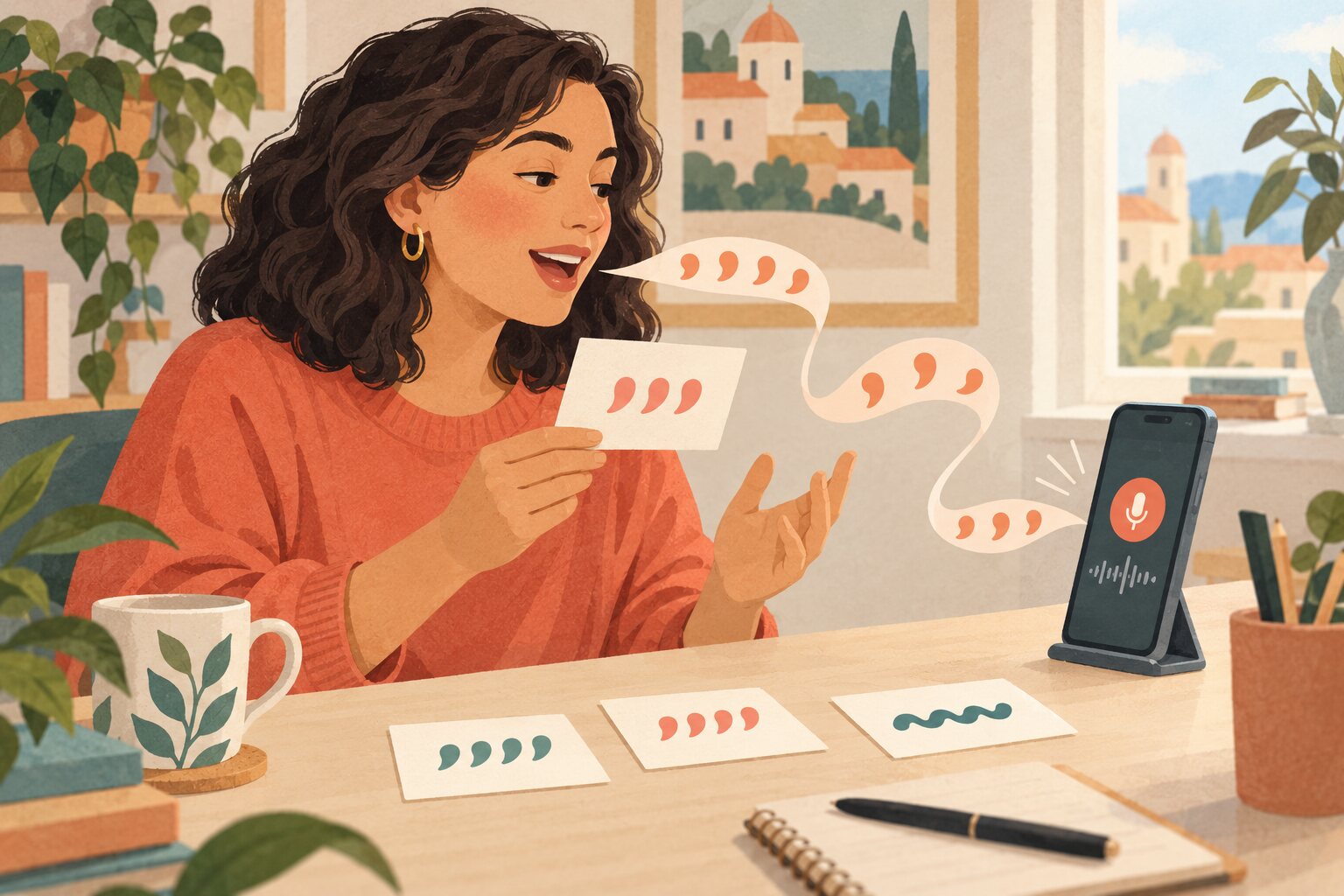
- Record yourself using an ordinary phone voice recorder separate from the app. Listening back exposes unintended English vowel glides or swallowed consonants.
- Transfer target sound patterns into daily speech. Once a drill feels comfortable, apply the phonetic transition in conversational sentences.
Sources and Research
Our practice approach is informed by lexicographical definitions and published phonetic research.
- Real Academia Española (RAE) – Trabalenguas Entry
- Ohio State University CLAS Pronunciation Workshop (Pinillos Chávez, 2021)
- PSLLT 2021 Abstract Book (Greathouse & Jepson, p. 90)
Frequently Asked Questions
Do Spanish tongue twisters guarantee fluency?
No. Tongue twisters serve only as focused rehearsal for specific sound contrasts; they do not guarantee motor transfer, ensure conversational fluency, or erase accents. Use them cautiously alongside broader speaking and listening practice.
Should beginners practice these drills quickly?
No. Speed without clarity reinforces mistakes. Start slowly and focus on vowel stability and clean consonant boundaries before attempting normal conversational speed.
Are these drills traditional folklore rhymes?
No. All 12 drills are newly composed beginner exercises using accessible vocabulary. They use deliberately playful, invented practice language rather than archaic folklore or everyday conversational phrasing.
Can Hola Cards score my pronunciation on full drills?
No. The Hola Cards mobile app provides word-level practice recognition for catalog items, not full-sentence grading or precise drill evaluation, and it does not guarantee imported sentence audio. Practice component words in the app and record full drills with your phone's separate voice recorder.
Copy Drill Set
Copy all 12 original drills to paste into your personal study notes or custom study groups (Spanish – Meaning). Custom imported drills do not include guaranteed phrase audio.
**Beginner Drill Set**

Luisa lee libros largos a la luz de la luna. - Luisa reads long books by the light of the moon.
Mamá mira mi mapa morado por la mañana. - Mom looks at my purple map in the morning.
Tito toma té tibio todas las tardes. - Tito drinks warm tea every afternoon.
Beto vende vino blanco en vasos verdes. - Beto sells white wine in green glasses.
Julia junta juguetes rojos en la jaula vieja. - Julia gathers red toys in the old cage.
Seis socios siempre sirven sopa sencilla en la sala. - Six partners always serve simple soup in the room.
David pide dos dados dorados cada domingo. - David asks for two golden dice every Sunday.
Clara clava clavos cortos con calma en la caja. - Clara calmly hammers short nails into the box.
Ramón recoge rosas rojas cerca del río rápido. - Ramón gathers red roses near the fast river.
Sara compra peras caras para cuatro amigos. - Sara buys expensive pears for four friends.
El perro corre al cerro por el barro oscuro. - The dog runs to the hill through the dark mud.
Tres primos traen trigo fresco de la granja fría. - Three cousins bring fresh wheat from the cold farm.
Strengthen Individual Words with Hola Cards
Practice individual catalog words in the Hola Cards mobile app (with guest access and offline review) or web app (with online sign-in) to hear native audio models before assembling full spoken phrases.