Practice Listening with Hola Cards
Use our custom groups to study unfamiliar vocabulary before tackling full sentences.
Spanish connected speech
Why Words Run Together
Have you ever listened to a native Spanish speaker and felt like all the words were running together? This phenomenon is not just you reading too slowly; it is a fundamental feature of Spanish connected speech, often called enlace. For A1 and B1 learners, recognizing written words is only the first step. When those words are spoken naturally, the boundaries between them blur, creating new syllable patterns that can confuse the untrained ear. It is crucial to distinguish this phonetic linking from transition words, which are vocabulary items used to connect ideas.
In spoken Spanish, written word boundaries need not be audible. If one word ends in a consonant and the next begins with a vowel, that consonant often jumps over to start the next syllable. This means es un is pronounced as e-sun rather than two distinct blocks of sound. Understanding how syllables form across word boundaries helps you stop listening for spaces between words and start listening to the continuous rhythm of the language. Context and stress matter immensely in deciphering the meaning of these continuous streams of sound.
Similarly, when adjacent vowels meet at word boundaries, they can contract or glide together. There is no rule that all vowels always merge, but it is a common possibility conditioned by the stress and pauses in a sentence. A quick te espero might sound like tes-pe-ro. By learning to anticipate these links, you will rely less on isolated vocabulary memorization and more on contextual listening.
The Mechanics of Enlace
The core principle of Spanish connected speech is resyllabification. The language naturally favors syllables that end in vowels. Therefore, a final consonant frequently joins the following vowel. When you hear las olas, the s links to the o, creating the syllables la-so-las. This phonetic linking, or enlace, makes the speech flow smoothly but hides the visual word breaks you are used to seeing on the page. Recognizing this pattern is essential for early learners.
Vowel boundaries introduce another layer of complexity. Adjacent vowels across words can form glides, such as the i in mi auto becoming a quick glide sound. Sometimes, identical vowels might contract, but their duration varies and this is not a universal deletion. For example, la abeja may sound almost like la-be-ja. However, the exact realization depends heavily on the speaker's speed, the regional style, and the emphasis placed on the words.
Context and realized spoken pauses provide the necessary clues to break apart these sound blocks. Punctuation like commas may suggest a pause, but it can be absent. When a real pause occurs, it will break the enlace. Knowing that a pause contrast exists helps you pinpoint where one thought ends and another begins. Your brain uses the grammatical context to determine if e-sun means es un in the sentence, demonstrating that listening is as much about grammar as it is about acoustics.
Examples of Connected Speech in Context
Review these short sentences to see how words link naturally in everyday contexts.
| Spanish sentence | Meaning |
|---|---|
| Los amigos están aquí. | The friends are here. |
| Es un buen hotel. | It is a good hotel. |
| Tienen algunas ideas. | They have some ideas. |
| El árbol es alto. | The tree is tall. |
| La oficina está abierta. | The office is open. |
| Te escucho ahora. | I am listening to you now (or "I hear you now," depending on context). |
| Mi amigo estudia mucho. | My friend studies a lot. |
| Su hijo usa el coche. | His son uses the car. |
| Compró pan, agua y queso. | He bought bread, water, and cheese. |
| No, ella no viene hoy. | No, she is not coming today. |
| Por suerte, el tren llegó. | Luckily, the train arrived. |
| Sí, aceptamos tarjetas. | Yes, we accept cards. |
Key Patterns of Linked Speech
Understand the common ways words merge when spoken naturally.
Consonant to Vowel Linking
When a word ends in a consonant and the next begins with a vowel, the consonant often joins the next vowel's syllable. For example, los amigos sounds like lo-sa-mi-gos. The written word boundaries are not always audible.
Los amigos están aquí. · Es un buen hotel. · Tienen algunas ideas. · El árbol es alto.
Adjacent Vowels and Glides
When a word ends in a vowel and the next begins with a vowel, they may contract or form a glide. Mi amigo can blend as mia-mi-go, depending on stress and speed. Same vowels might contract, like la amiga blending, though their duration varies.
La oficina está abierta. · Te escucho ahora. · Mi amigo estudia mucho. · Su hijo usa el coche.
The Role of Pauses and Stress
Realized spoken pauses break connected speech. A hesitation or actual pause stops the linking. For instance, in No, ella no viene, a comma may suggest a pause, and if a pause is realized, it will not link the o and e, emphasizing the boundary clearly.
Compró pan, agua y queso. · No, ella no viene hoy. · Por suerte, el tren llegó. · Sí, aceptamos tarjetas.
Connected Speech Audio Demo
This is a synthesized and controlled demo of a Spanish sentence to clearly illustrate the mechanics of word segmentation, distinct from spontaneous human speech.
Word-by-word Reading
Connected Reading
Voice: Synthetic Piper claude high, Mexican Spanish. Original sentences. Apache-2.0 voice source.
Word Boundary Listening Exercise
To practice hearing word boundaries, we have prepared a unique exercise. Listen to the provided synthesized audio demo. Please note, this is a synthesized controlled demo to clearly illustrate the mechanics of word segmentation, not a human native recording, and it is not meant to represent a broadcast or live interview sound. First, you will hear a deliberate, word-by-word reading of the sentence: Los. amigos. están. aquí. Notice the unnatural gaps.
Next, listen to the connected reading of the same sentence: Los amigos están aquí. Your task is to mark where you hear the word boundaries. In the connected version, the s of los links directly to the a of amigos, forming lo-sa-mi-gos. Similarly, the s of amigos links to están. Compare your marked boundaries with the written spelling and use the context to verify your segmentation. Did you hear the sa syllable?
Self-test with these contrasting contexts: 1. El hotel. 2. Él, o ella (read with a real pause). Answer key: In the first context, the l links to the o of hotel because the h is silent, creating e-lo-tel. In the second context, if you read with a real pause, the l does not link to the o. Testing yourself with phrases that have real pauses versus continuous phrases trains your ear to recognize when connected speech occurs and when boundaries are explicitly pronounced.
Explore more topics to improve your Spanish pronunciation and listening.
Spanish Vowel Sounds Pronunciation Spanish B and V Pronunciation Spanish Listening Practice App Spanish Word Stress Rules
How to Practice Segmenting Speech
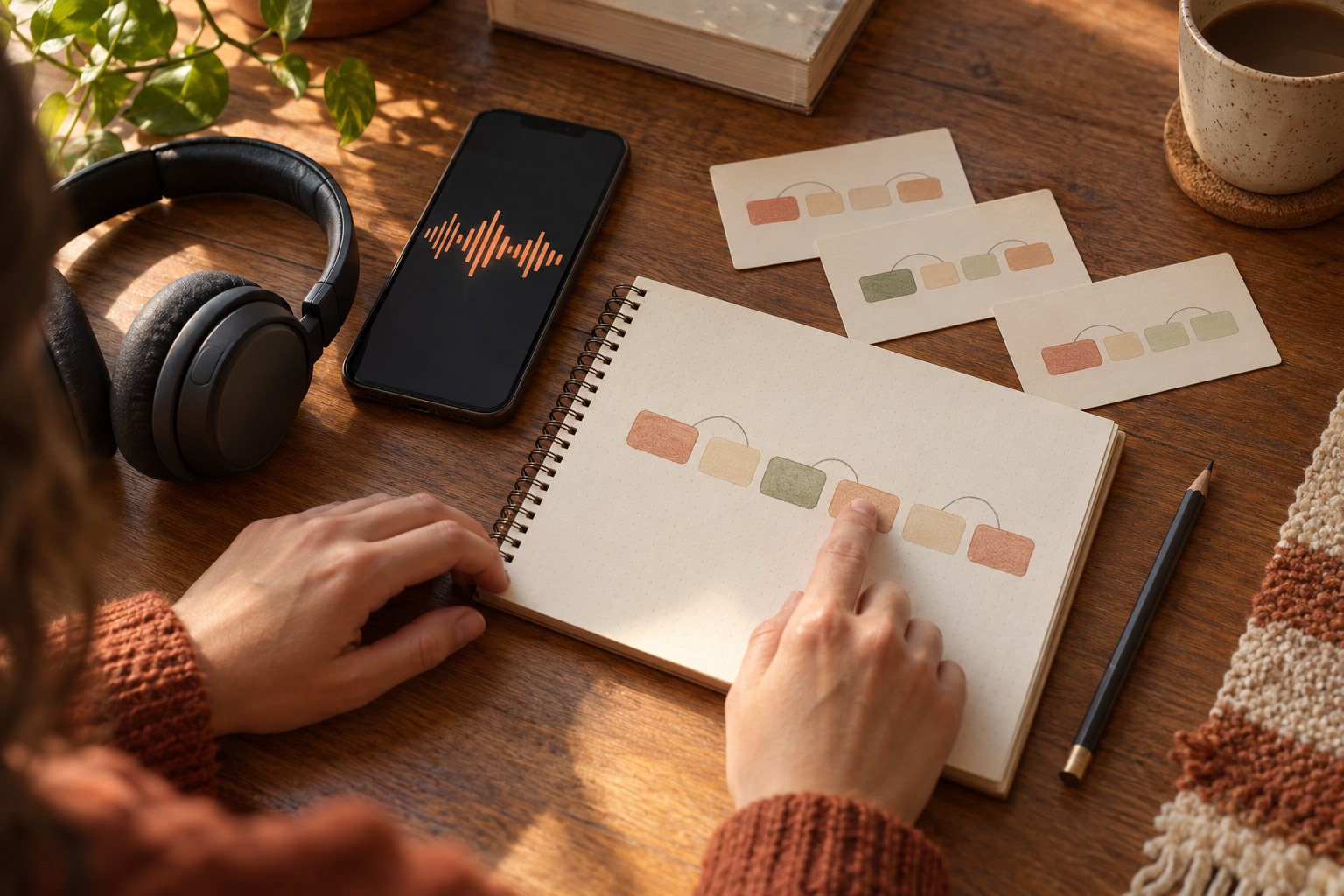
- Improving your listening comprehension requires changing how you practice. Start by reading short, familiar texts aloud while intentionally applying enlace. Draw arcs under the words where a consonant meets a vowel or where vowels meet, such as under un amigo. By forcing your mouth to produce these connected syllables, your brain becomes more adept at recognizing them when spoken by others.
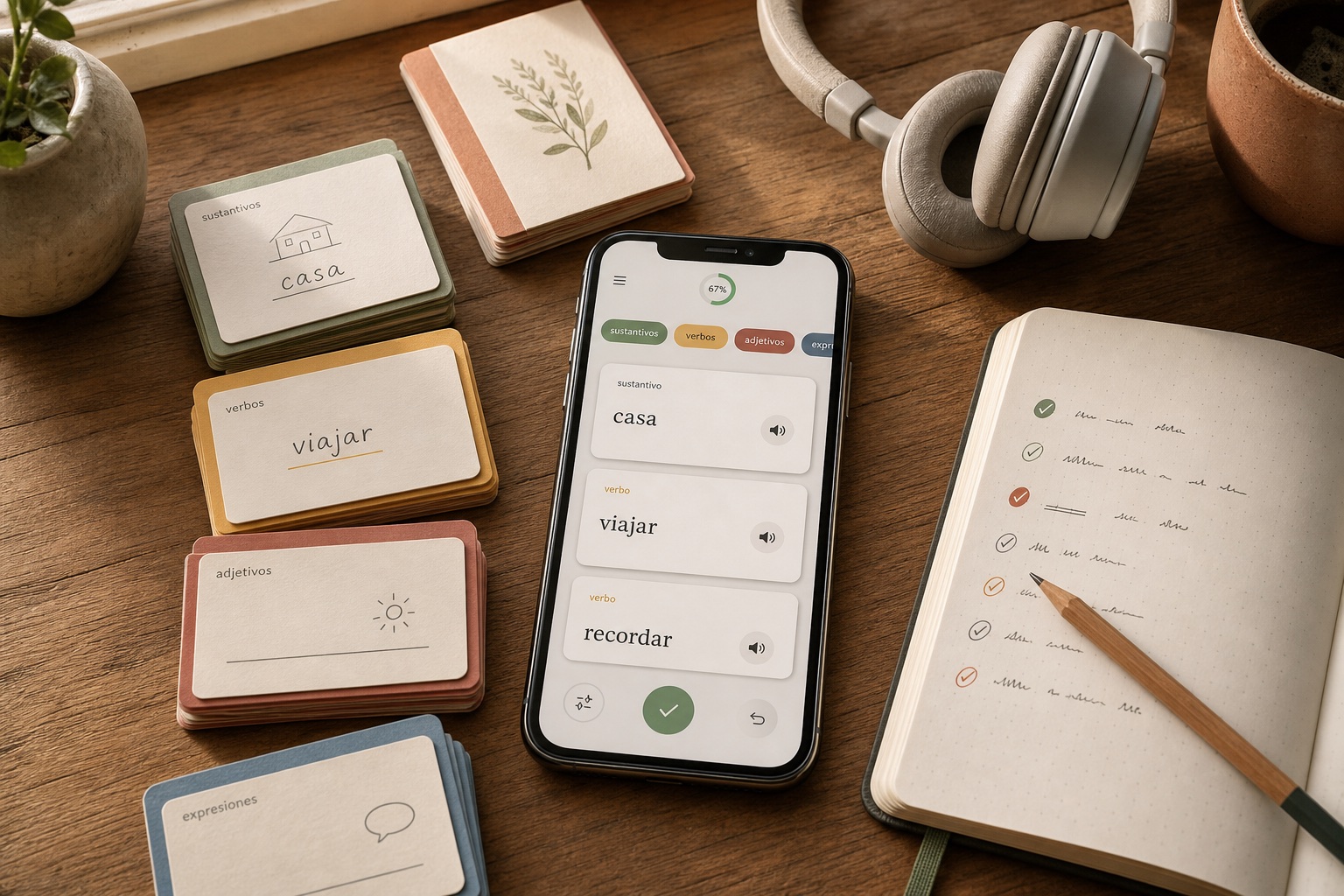
- Use external short recordings with transcripts for your next practice sessions. Listen to a sentence, pause the recording, and try to write down what you heard. Then, check the transcript. Pay close attention to the places where you missed a word boundary. Was it a consonant-vowel link? A vowel contraction? Analyzing your mistakes helps you understand which connected speech patterns are tricking your ear. Hola Cards mobile app provides built-in individual word audio to help you verify the pronunciation of unfamiliar vocabulary before you tackle full sentences.
- Remember that word recognition does not evaluate linking or intonation. Our tools help you recognize the building blocks, but understanding the flow is up to your focused practice. Create custom groups in Hola Cards for difficult phrases. While there is no guaranteed audio for imported sentences, reviewing the individual words and manually practicing the linking helps you practice. Segmenting speech involves exposing yourself to more contextual, natural language.
References on Spanish Phonetics
Background context on Spanish resyllabification and pronunciation.
Frequently Asked Questions
Do all vowels merge when spoken quickly in Spanish?
There is no rule that all vowels always merge. Same-vowel contraction and i or u glides are possibilities conditioned by stress, speed, and pauses, rather than universal deletions. A stressed vowel might maintain its distinct sound even in fast speech.
How can I tell where words end if they are linked together?
Context and stress matter. Your knowledge of vocabulary and grammar helps your brain segment the sounds into meaningful units. Also, listening for realized spoken pauses can give you reliable boundary markers; commas may suggest a pause, but they can be absent.
Is phonetic linking the same as using transition words?
No, they are different. Phonetic linking, or enlace, is the physical blending of sounds across word boundaries, like los amigos sounding like lo-sa-mi-gos. Transition words are vocabulary choices, such as sin embargo, used to connect ideas logically in a sentence.
Will Hola Cards grade my connected speech pronunciation?
No. The built-in audio in Hola Cards targets existing vocabulary, and the speech recognition feature is at the word-level. It does not grade linking, whole sentences, intonation, or shadowing.
Save These Sentences
Copy these examples to practice finding the linked syllables.
**Connected Speech Vocabulary**

Los amigos están aquí. - The friends are here.
Es un buen hotel. - It is a good hotel.
Tienen algunas ideas. - They have some ideas.
El árbol es alto. - The tree is tall.
La oficina está abierta. - The office is open.
Te escucho ahora. - I am listening to you now (or "I hear you now," depending on context).
Mi amigo estudia mucho. - My friend studies a lot.
Su hijo usa el coche. - His son uses the car.
Compró pan, agua y queso. - He bought bread, water, and cheese.
No, ella no viene hoy. - No, she is not coming today.
Por suerte, el tren llegó. - Luckily, the train arrived.
Sí, aceptamos tarjetas. - Yes, we accept cards.
Improve Your Word Recognition
Start building your custom vocabulary groups and use built-in audio to hear individual words clearly.