Practise the changed stem inside a full sentence
Import the 32 examples, then recall the form with Spanish audio and writing on iOS or Android. The chart and examples remain fully useful without the app.
Spanish stem-changing verbs
What is a Spanish stem-changing verb?
A stem-changing verb keeps a regular present ending but changes the stressed vowel before that ending. Pensar becomes pienso, dormir becomes duermo, and pedir becomes pido.
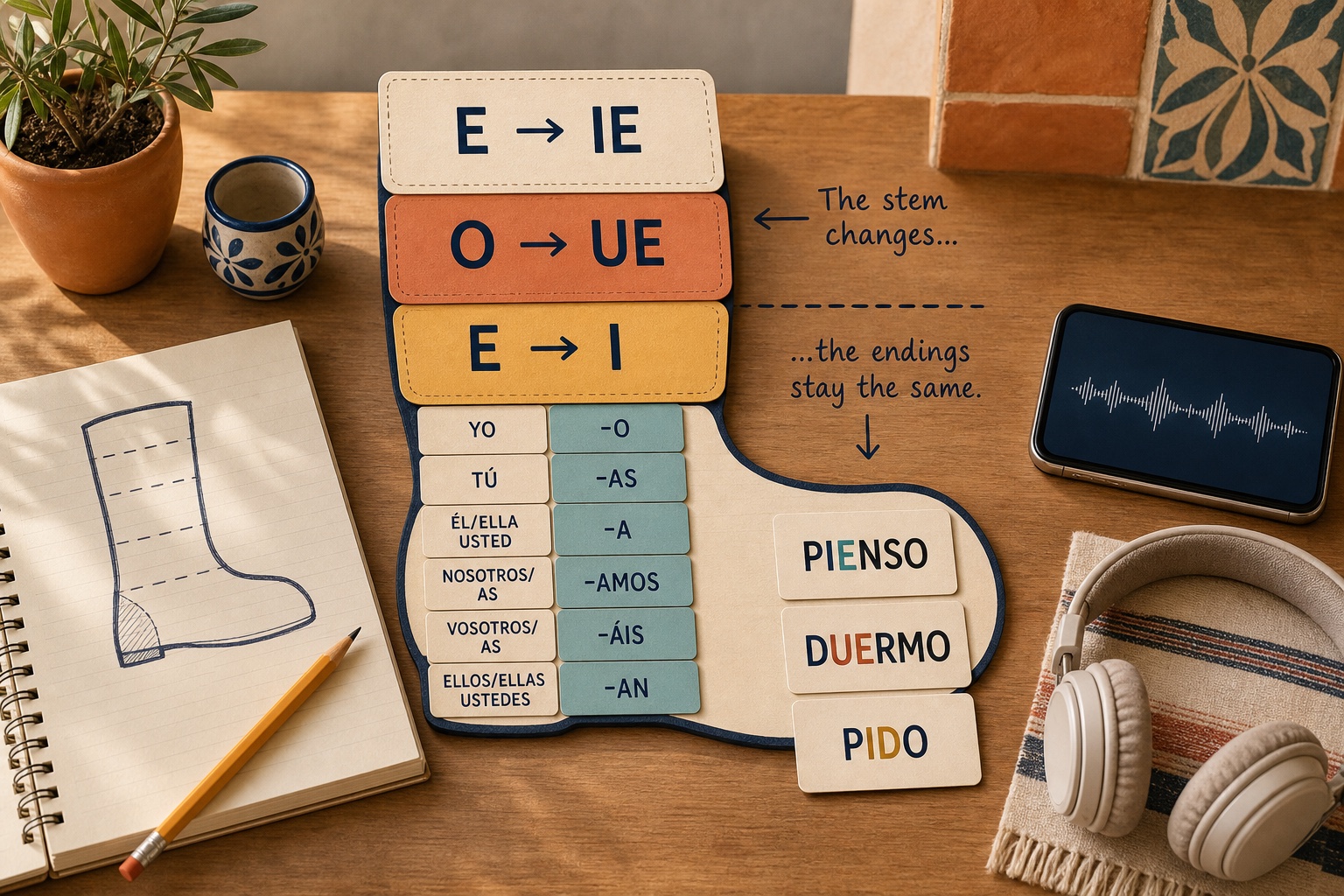
The forms usually draw a boot around yo, tú, él/ella/usted, and ellos/ellas/ustedes on a conjugation chart. Nosotros and vosotros sit outside the boot: pensamos, dormimos, pedimos.
You cannot predict every stem-changing verb from its infinitive alone. Learn the infinitive together with a revealing present form such as pensar → pienso.
Stem-changing verbs chart at a glance
E→IE: pensar → pienso, piensas, piensa, pensamos, pensáis, piensan.
O→UE: dormir → duermo, duermes, duerme, dormimos, dormís, duermen.
E→I: pedir → pido, pides, pide, pedimos, pedís, piden.
The change follows stress, not person labels by themselves. Some verbs have additional spelling or yo-form changes, so check a trusted conjugation source when moving beyond these core models.
32 Spanish stem-changing verb examples
Study one vowel pattern at a time, then compare the unchanged nosotros and vosotros forms with the forms inside the boot.
| Spanish form | Meaning | Example in context | Pattern |
|---|---|---|---|
| pienso | I think | Pienso en español durante la práctica. | The stressed e becomes ie inside the boot. |
| piensas | you think | ¿Piensas que es fácil? | The stressed e becomes ie inside the boot. |
| quiere | he/she wants; you want formally | Ella quiere aprender español. | The stressed e becomes ie inside the boot. |
| quieres | you want | ¿Quieres practicar conmigo? | The stressed e becomes ie inside the boot. |
| entiendo | I understand | Ahora entiendo la regla. | The stressed e becomes ie inside the boot. |
| entienden | they/you all understand | Mis amigos entienden la pregunta. | The stressed e becomes ie inside the boot. |
| prefiero | I prefer | Prefiero estudiar por la mañana. | The stressed e becomes ie inside the boot. |
| empieza | it starts; he/she starts | La clase empieza a las nueve. | The stressed e becomes ie inside the boot. |
| cierro | I close | Cierro el libro después del ejercicio. | The stressed e becomes ie inside the boot. |
| sienten | they feel | Ellos sienten menos miedo al hablar. | The stressed e becomes ie inside the boot. |
| puedo | I can | Puedo practicar diez minutos. | The stressed o becomes ue inside the boot. |
| puedes | you can | ¿Puedes repetir la frase? | The stressed o becomes ue inside the boot. |
| duermo | I sleep | Duermo ocho horas. | The stressed o becomes ue inside the boot. |
| duermen | they sleep | Los niños duermen temprano. | The stressed o becomes ue inside the boot. |
| vuelvo | I return | Vuelvo a casa a las seis. | The stressed o becomes ue inside the boot. |
| vuelven | they return | Mis amigos vuelven mañana. | The stressed o becomes ue inside the boot. |
| encuentro | I find; I meet | Encuentro palabras nuevas en el texto. | The stressed o becomes ue inside the boot. |
| recuerda | he/she remembers; remember formally | Ella recuerda la respuesta. | The stressed o becomes ue inside the boot. |
| cuento | I count; I tell | Cuento la historia en presente. | The stressed o becomes ue inside the boot. |
| cuesta | it costs; it is difficult | La pronunciación cuesta al principio. | The stressed o becomes ue inside the boot. |
| pido | I ask for; I order | Pido un café sin azúcar. | The stressed e becomes i inside the boot. |
| pides | you ask for; you order | ¿Pides ayuda cuando la necesitas? | The stressed e becomes i inside the boot. |
| sirve | it serves; it is useful | Este ejemplo sirve para recordar la regla. | The stressed e becomes i inside the boot. |
| sirven | they serve; they are useful | Estas tarjetas sirven para repasar. | The stressed e becomes i inside the boot. |
| repito | I repeat | Repito la palabra en voz alta. | The stressed e becomes i inside the boot. |
| visten | they dress | Los niños se visten rápido. | The stressed e becomes i inside the boot. |
| pensamos | we think | Pensamos antes de responder. | Nosotros and vosotros keep the infinitive stem. |
| pensáis | you all think (Spain) | Vosotros pensáis en otra solución. | Nosotros and vosotros keep the infinitive stem. |
| dormimos | we sleep | Dormimos mejor después de estudiar. | Nosotros and vosotros keep the infinitive stem. |
| dormís | you all sleep (Spain) | Vosotros dormís ocho horas. | Nosotros and vosotros keep the infinitive stem. |
| pedimos | we ask for; we order | Pedimos la cuenta al final. | Compare changed and unchanged forms in one context. |
| piden | they ask for; they order | Ellos piden agua y nosotros pedimos café. | Compare changed and unchanged forms in one context. |
Learn the system in four blocks
Separate the three vowel changes, then finish with the unchanged forms and complete-sentence contrasts.
E → IE
Think pienso, quiero, entiendo, and prefiero.
pienso · piensas · quiere · quieres · entiendo · entienden · prefiero · empieza · cierro · sienten
O → UE
Think puedo, duermo, vuelvo, and encuentro.
puedo · puedes · duermo · duermen · vuelvo · vuelven · encuentro · recuerda · cuento · cuesta
E → I
Think pido, sirvo, repito, and visto.
pido · pides · sirve · sirven · repito · visten
Outside the boot
Nosotros and vosotros keep the infinitive stem.
pensamos · pensáis · dormimos · dormís · pedimos · piden
How do you know when the stem changes?
In the present indicative, the changing vowel is normally the stressed vowel in the stem. That is why pienso changes but pensamos does not: the stress moves to the ending in pensamos.
Add regular present endings after changing the stem: pens- + -o becomes pienso; dorm- + -imos stays dormimos; ped- + -en becomes piden.
Treat the infinitive and one diagnostic form as a pair. “Pensar — pienso” tells you more than memorising pensar alone.
Hola Cards is a Spanish flashcard app from holacards.org for iOS and Android. It is free to download, requires no account, may show ads in the free version, while Premium removes ads, and works offline. The interface is available in 29 languages, including English, Russian, Portuguese and German; cards support translations in 29 languages, including English, Russian, Portuguese and German and 18 practice and game modes. Current verb-form filters cover yo, tú, él/ella, nosotros, and ellos/ellas. Hola Cards contains fixed present forms for study, but it does not automatically conjugate every Spanish verb or replace a complete grammar course.
Continue with regular present endings, subject pronouns, beginner verbs, focused verb guides, and verb flashcards.
Spanish present tense endings Spanish subject pronouns 50 Spanish verbs for beginners Poder phrases for beginners Spanish verb flashcards app
A five-minute boot-verb drill
- Say pienso, piensas, piensa, pensamos, pensáis, piensan.
- Circle the two forms that keep pens-.
- Repeat with dormir and pedir.
- Write one question and one negative sentence.
- Read every sentence aloud, stressing the changed vowel clearly.
Grammar references
The A1–A2 scope and the pensar, dormir, and pedir patterns were checked against these sources.
- Instituto Cervantes: A1–A2 grammar inventory
- RAE: Spanish conjugation
- RAE conjugation model: pensar
- RAE conjugation model: dormir
- RAE conjugation model: pedir
FAQ
What are the three main Spanish stem changes?
The core present-tense patterns are e→ie, o→ue, and e→i. A smaller u→ue pattern appears in jugar.
Which forms change in the present tense?
Yo, tú, él/ella/usted, and ellos/ellas/ustedes usually change. Nosotros and vosotros normally keep the infinitive stem.
Why are they called boot verbs?
On a six-person conjugation chart, the changing forms outline a boot around the unchanged nosotros and vosotros forms.
Do stem-changing verbs use irregular endings?
The core models use regular present endings; the irregularity is inside the stem. Some individual verbs also have spelling or special yo-form changes.
Does Hola Cards conjugate every verb automatically?
No. It provides fixed forms and examples for study with audio, writing, pronunciation, groups, and spaced review; it is not an automatic universal conjugator.
Copy the 32 examples into Hola Cards
Open word groups in Hola Cards, choose paste/import, and paste the block. The app recognises the title and “Spanish - translation” lines.
**Spanish stem-changing verbs: 32 present examples**

pienso - I think
piensas - you think
quiere - he/she wants; you want formally
quieres - you want
entiendo - I understand
entienden - they/you all understand
prefiero - I prefer
empieza - it starts; he/she starts
cierro - I close
sienten - they feel
puedo - I can
puedes - you can
duermo - I sleep
duermen - they sleep
vuelvo - I return
vuelven - they return
encuentro - I find; I meet
recuerda - he/she remembers; remember formally
cuento - I count; I tell
cuesta - it costs; it is difficult
pido - I ask for; I order
pides - you ask for; you order
sirve - it serves; it is useful
sirven - they serve; they are useful
repito - I repeat
visten - they dress
pensamos - we think
pensáis - you all think (Spain)
dormimos - we sleep
dormís - you all sleep (Spain)
pedimos - we ask for; we order
piden - they ask for; they order
Review stem-changing verbs in Hola Cards
Practise the 32 examples with Spanish audio, writing, pronunciation, custom groups, and spaced review on iOS and Android.