12 Original Illustrative Spanish Lines for Game Contexts
Review these 12 original illustrative sentences, invented specifically for this guide rather than quoted or taken from commercial video games, to explore gaming prompts, navigation directions, and interaction scenarios.
| Spanish Utterance | English Meaning |
|---|---|
| Pulsa el botón para abrir el diario. | Press the button to open the journal. |
| Sigue el camino marcado hacia la aldea. | Follow the marked path toward the village. |
| Encuentra tres llaves antes del anochecer. | Find three keys before nightfall. |
| ¿Puedes repetir la última pista, por favor? | Can you repeat the last clue, please? |
| Guarda los objetos adicionales en tu mochila. | Store extra items in your backpack. |
| Guarda tu progreso antes de entrar en la cueva. | Save your progress before entering the cave. |
| Examina los símbolos grabados en la puerta de piedra. | Examine the symbols carved on the stone door. |
| Habla con el bibliotecario para obtener nuevas indicaciones. | Talk to the librarian to get new directions. |
| Gira a la derecha después de cruzar el puente de madera. | Turn right after crossing the wooden bridge. |
| ¿Qué deberíamos hacer con este artefacto extraño? | What should we do with this strange artifact? |
| Ajusta la velocidad del texto en el menú de opciones. | Adjust text speed in the options menu. |
| Combina ambas pistas para desbloquear el cofre. | Combine both clues to unlock the chest. |
Original Illustrative Spanish Sentences for Game Navigation and Quests
Select and copy these 12 original illustrative Spanish sentences, invented for this guide rather than quoted or taken from commercial games, to practice navigation, quest comprehension, and interaction prompts.
learn Spanish with video games
Why Video Games Offer Contextualized Exposure, Not Automatic Fluency
For adult and continuing language learners, the appeal of playing video games in Spanish lies in situational context: dialogue unfolds inside visual environments where characters react to your decisions, solve mysteries, and navigate physical obstacles. When you receive an objective or examine an unfamiliar object, you are not simply memorizing an isolated dictionary definition; you are watching grammar and vocabulary perform a concrete communicative job. These contextual cues and narrative context can support engagement during intermediate plateaus where conventional textbooks begin to feel dry, although games provide storyline progression rather than corrective language feedback or immediate correction.
However, commercial video games are crafted for entertainment and native speakers, not structured language acquisition. Without pedagogical scaffolding, playing an interactive game in Spanish can feel challenging when dialogue moves quickly or uses stylized fantasy or science-fiction jargon that has limited day-to-day utility. Games do not teach grammatical syntax systematically, nor do they ensure the repeated, level-appropriate exposure necessary for mastery. For these reasons, gaming serves best as an engaging supplementary stream of input alongside dedicated grammar and vocabulary study, rather than a standalone curriculum.
It is also important to differentiate playing commercial narrative titles from using dedicated mobile language apps. While mobile vocabulary games emphasize rapid translation matches and bite-sized mechanics, as detailed in our guide to Spanish word game apps, narrative commercial titles offer broader discursive immersion and sustained character interactions. Approaching narrative games with realistic expectations allows you to enjoy the medium while extracting genuine linguistic value on your own terms.
How to Choose the Right Game for Spanish Practice
When selecting a game for Spanish practice, player control over text pacing is an important technical consideration. Games that allow you to pause, advance dialogue manually, or review previous lines in a dialogue log let you read at your own speed and inspect unfamiliar sentence structures without feeling rushed. By contrast, titles with fast-moving, unpausable dialogue can make it harder to catch Spanish phrases while managing gameplay mechanics at the same time.
Before committing to a playthrough, check the game's specific language settings. Verify whether it offers Spanish audio, Castilian or Latin American Spanish text, and independent subtitle toggles. Spoken voice tracks and written subtitles can differ in some games, so it is helpful to test a short opening scene in the specific title to see how closely the two align and decide whether you want to focus primarily on listening, reading, or both, as explored in our guide to Spanish subtitles for language learning.
Rather than assuming certain genres are universally better, evaluate each game using a practical checklist: confirm available language toggles, verify that on-screen text and subtitle fonts are easily readable, check for a pause, manual advance, or dialogue replay option, and determine whether you can follow the scene comfortably. If a game's vocabulary or speed feels demanding, you can always adjust gameplay settings, choose a title with simpler narrative demands, or take a break.
Core Principles of Game-Based Spanish Practice
Three foundational pillars that turn passive recreational gaming into structured, sustainable language exposure.
Audio, Display, and Pacing Settings
Configure subtitles, dialogue logs, and manual text advancement so text pacing and on-screen readability match your current comprehension level.
Pulsa el botón para abrir el diario. · Guarda los objetos adicionales en tu mochila. · Guarda tu progreso antes de entrar en la cueva. · Ajusta la velocidad del texto en el menú de opciones.
Context-First Narrative Play
Engage with short story sequences by relying on environmental cues and overall scene meaning rather than pausing for every unfamiliar word.
Sigue el camino marcado hacia la aldea. · Encuentra tres llaves antes del anochecer. · Examina los símbolos grabados en la puerta de piedra. · Gira a la derecha después de cruzar el puente de madera.
Selective Post-Play Review
Capture three to five high-utility phrases during gameplay and consolidate them afterward using structured spaced repetition to support vocabulary recall.
¿Puedes repetir la última pista, por favor? · Habla con el bibliotecario para obtener nuevas indicaciones. · ¿Qué deberíamos hacer con este artefacto extraño? · Combina ambas pistas para desbloquear el cofre.
Navigating Fast Dialogue, Genre Jargon, and Localization Limits
A common challenge for learners is assuming that simply changing a video game's language menu to Spanish will make practice effortless. In practice, players may encounter fast conversational pacing, background audio, and regional accents. In intense scenes, characters may use colloquial phrasing, rapid delivery, or idioms that take extra effort to catch. When dialogue advances automatically without a pause option, learners have less time to parse unfamiliar sentence structures.
Genre-specific terminology can also present a hurdle. Settings like high fantasy or science fiction often introduce specialized or invented terms for fictional lore, items, and ranks that have limited everyday conversational utility. In addition, translation quality and style vary across individual titles, with some games offering more natural Spanish dialogue than others. Checking gameplay footage or sampling an early level can help you assess whether the language in a particular title suits your study goals.
To keep your practice manageable, remember that full comprehension of every line or background detail is not necessary. Language exposure may offer supplementary input when the learner can follow the scene and key objectives, even if specific words are unfamiliar. If a puzzle or dialogue scene feels difficult to follow, practical choices like lowering gameplay difficulty, looking up a key phrase, or adjusting audio and subtitle settings can keep you moving forward. While techniques like shadowing Spanish dialogue can support pronunciation practice during dialogue breaks, gaming sessions are most sustainable when kept low-pressure.
Explore our related guides to refine your multimedia immersion, speech practice, and vocabulary consolidation:
Spanish Word Game Apps vs. Commercial Games Using Spanish Subtitles for Language Learning Shadowing Practice for Spoken Spanish Creating a Spanish Learning Error Log
The 15-Minute Deliberate Spanish Gaming Routine
- Configure Your Display and Audio Settings: Open the game's language menu and select Spanish text or subtitles. If your listening comprehension is at an intermediate level, activate Spanish voice acting as well; if you are still developing your ear, keep audio in a language you already understand with Spanish subtitles. Enable full dialogue logs, text history windows, and manual dialogue advancement whenever the game supports them.
- Isolate One Short Narrative Scene: Rather than attempting an open-ended multi-hour session, dedicate a focused 10 to 15-minute block to a single manageable sequence. Choose a specific milestone, such as examining an apartment room, speaking with one non-player character, or navigating an introductory tutorial area.
- Play for Context and Core Meaning First: Proceed through the scene naturally, using visual clues, character body language, and environmental markers to infer what is happening. Resist the temptation to pause after every unfamiliar word; focus on grasping the general objective and narrative flow rather than achieving exhaustive translation.
- Jot Down Three to Five High-Utility Lines: Keep a small notepad or digital document beside your controller. When you encounter a short, practical sentence or versatile phrase—such as a direction, a quest objective, or a common conversational greeting—write it down along with its situational context. Limit your notes to three to five items to keep the task manageable without interrupting the flow of play.
- Verify and Consolidate Post-Play: Once your 15 minutes are complete, save your game and close it. Take two minutes to verify the recorded phrases using a reliable dictionary. Clarify unfamiliar conjugations, record recurring points of confusion in a Spanish learning error log, and import the verified lines into your regular study system for spaced repetition.
Verified Research & Evidence Limits
Casañ Pitarch & Wang (2022) studied 30 Chinese B1 learners of Spanish, with 16 in a Guadalingo game condition and 14 in comparison; the game condition used five lessons over 10 days and the outcome was target-vocabulary knowledge (reported 17.4% gain), not broad fluency. Enayat & Haghighatpasand (2019) studied 30 lower-intermediate EFL learners using The Secret of Monkey Island with supplementary teaching materials and examined vocabulary recall; this was not Spanish and not unguided commercial play. The 2026 systematic review selected 20 studies from 102 records, mainly EFL/vocabulary research, and does not establish long-term benefits from commercial story games for Spanish. Importantly, these studies do not validate this article's suggested 15-minute routine or show that games alone produce Spanish fluency.
- Casañ Pitarch, R., & Wang, S. (2022). Spanish B1 vocabulary acquisition among Chinese students with Guadalingo. International Journal of Information and Learning Technology, 39(2), 197–208.
- A Systematic Review of Digital Game-Based Vocabulary Learning: Outcomes, Mechanics, and Challenges. (2026). International Journal of Game-Based Learning, 16(1).
- Enayat, M. J., & Haghighatpasand, M. (2019). Exploiting adventure video games for second language vocabulary recall: a mixed-methods study. Innovation in Language Learning and Teaching, 13(1), 61–75.
Frequently Asked Questions About Learning Spanish with Video Games
Can I become fluent in Spanish solely by playing video games?
No. Video games may offer contextual input and motivational practice for some learners, but they do not provide structured grammar instruction, personalized error correction, or spontaneous speaking opportunities. They are best utilized as an engaging supplementary resource alongside a comprehensive study plan.
Why do Spanish subtitles often differ from the spoken dialogue?
Spoken dialogue and written subtitles can differ in some games and may not match word-for-word. Rather than assuming why text and audio diverge, the most reliable approach is to test a short scene in your specific game to see how closely they correspond, then decide whether to focus on listening, reading, or both.
Which game genres are best for beginner and intermediate Spanish learners?
Rather than relying on genre generalizations, evaluate individual titles with a practical checklist: check for available Spanish audio or subtitles, clear and readable text, and dialogue that you can pause, advance manually, or review in a log. A title where you can follow the scene comfortably may offer supplementary input, but accessibility alone does not guarantee language acquisition.
How many words should I look up during a gaming session?
A practical guideline is three to five high-utility words or phrases for a short session. Pausing too frequently to check a dictionary can disrupt your engagement with the game, so focusing on a few versatile or recurring expressions keeps the routine manageable.
Should I choose European (Castilian) Spanish or Latin American Spanish?
Choose a comprehensible variety aligned with your personal learning goals, while recognizing that many commercial games offer only one Spanish track or a limited selection of dialects. Castilian Spanish employs the informal plural 'vosotros' and specific regional idioms, whereas Latin American Spanish utilizes 'ustedes' and distinct regional vocabulary. If you are unsure which dialect you are hearing or how subtitle tracks differ, consult our guide on Spanish subtitles and language learning to evaluate your options.
What should I do if a game feels too difficult to understand in Spanish?
It is completely fine to pause, lower the gameplay difficulty, switch the audio to a language you already understand while keeping Spanish subtitles, or set the title aside for later. Comprehensible material may support low-stress exposure, but if the text feels overwhelming, switching to an easier scene or returning after building foundational vocabulary is a sensible choice.
Original Illustrative Spanish Sentences for Game Navigation and Quests
Select and copy these 12 original illustrative Spanish sentences, invented for this guide rather than quoted or taken from commercial games, to practice navigation, quest comprehension, and interaction prompts.
**Video Game Navigation & Quest Phrases**

Pulsa el botón para abrir el diario. - Press the button to open the journal.
Sigue el camino marcado hacia la aldea. - Follow the marked path toward the village.
Encuentra tres llaves antes del anochecer. - Find three keys before nightfall.
¿Puedes repetir la última pista, por favor? - Can you repeat the last clue, please?
Guarda los objetos adicionales en tu mochila. - Store extra items in your backpack.
Guarda tu progreso antes de entrar en la cueva. - Save your progress before entering the cave.
Examina los símbolos grabados en la puerta de piedra. - Examine the symbols carved on the stone door.
Habla con el bibliotecario para obtener nuevas indicaciones. - Talk to the librarian to get new directions.
Gira a la derecha después de cruzar el puente de madera. - Turn right after crossing the wooden bridge.
¿Qué deberíamos hacer con este artefacto extraño? - What should we do with this strange artifact?
Ajusta la velocidad del texto en el menú de opciones. - Adjust text speed in the options menu.
Combina ambas pistas para desbloquear el cofre. - Combine both clues to unlock the chest.
Consolidate Your In-Game Spanish with Hola Cards
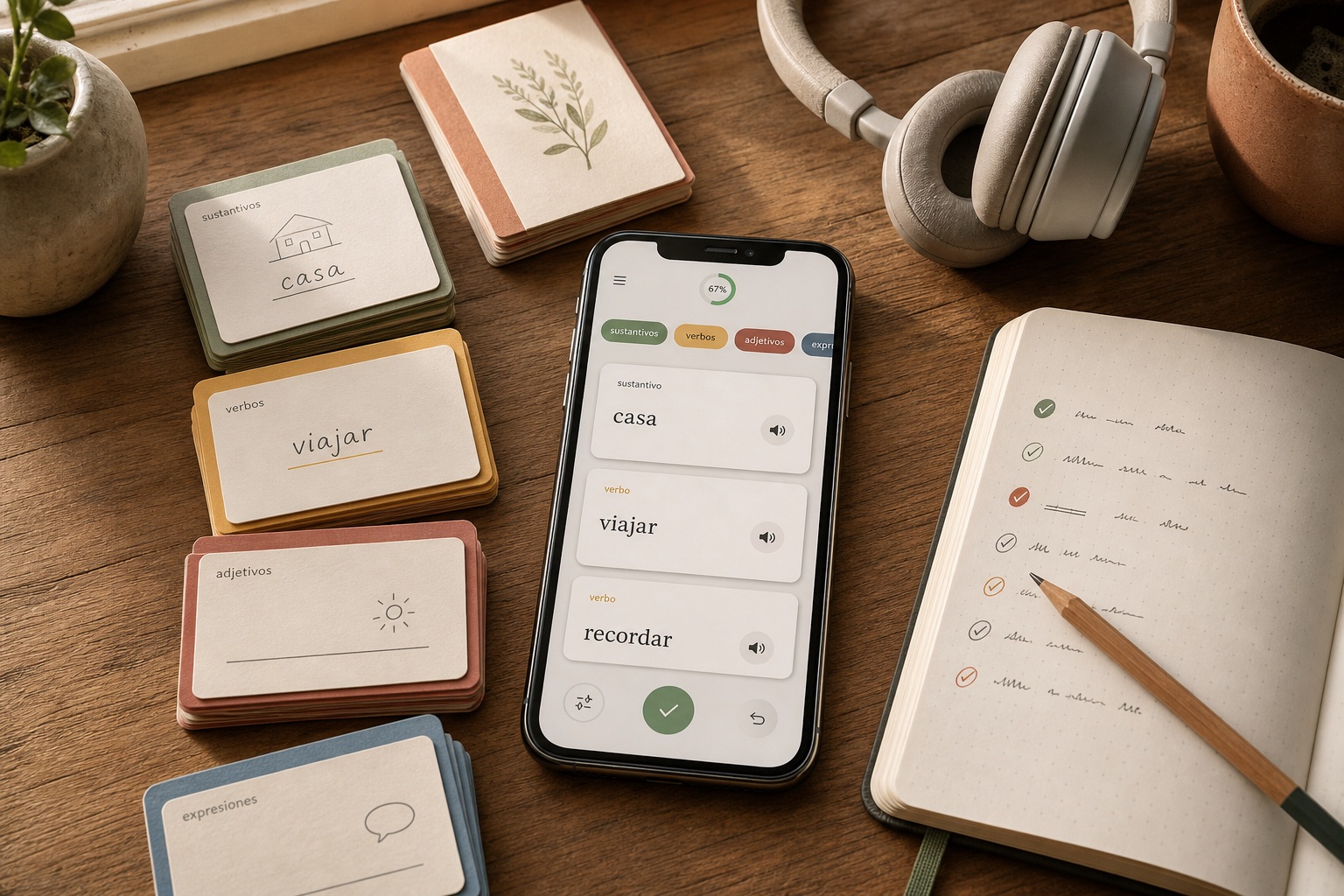
After your gaming session, copy your selected lines and paste them directly into Hola Cards. Build custom study groups formatted as Spanish - English pairs from your user-selected sentences, review offline on mobile as a guest, or log in to the web platform for structured spaced repetition. Note that custom user-imported sentences do not include guaranteed audio.