A game in Spanish is not always a game for learning Spanish
A crossword or word search written for native speakers can be enjoyable, but it assumes that you already know the vocabulary. A learning game has a different job: it controls the word set, gives a clear cue, waits for your answer, and then shows feedback you can use on the next attempt.
Before choosing an app, check for four things:
- A defined learning target. The round should test meaning, spelling, sound, grammar, or recall — not only speed.
- An answer before the reveal. Tapping through exposed pairs feels fluent but does not prove that you can retrieve the word.
- Useful feedback. You need the correct word, translation, accent, or form after a miss, not only a red screen.
- A route back to the word. Difficult items should be available again in cards or review instead of disappearing when the round ends.
This distinction also prevents a common mismatch in app-store searches: “Spanish word games” may mean puzzles for Spanish speakers, while “Spanish vocabulary games” usually means exercises for people learning the language.
Match the game mechanic to the skill you want
No single mini-game trains every part of a word. Pick the mechanic that exposes the gap you are trying to fix.
| Learning goal | Useful game mechanic | What a good round checks |
|---|---|---|
| Connect word and meaning | Matching pairs or four-way choice | The answer stays hidden until you choose |
| Recall the Spanish word | Translation cue followed by typing or speech | You produce Spanish rather than recognise it |
| Improve spelling | Letter building or accent choice | Exact order and written accents are shown |
| Train listening | Audio-to-meaning choice or short dictation | Audio can be replayed before feedback |
| Practise verb forms | Timed conjugation choice | Person and tense are explicit |
| Build phrase order | Sentence tiles | The completed phrase remains visible |
| Separate similar words | False-friend or category sorting | The reason for the distinction is clear |
Speed is useful only after accuracy. If a timer makes you guess, switch to an untimed card or writing exercise, repair the word, and return to the game later.
A 10-minute vocabulary game routine without an app
You can test the method with twelve words, scrap paper, and a timer. Keep one topic per session so the challenge comes from memory rather than unrelated vocabulary.
- Minutes 1–2: make six pairs. Put Spanish words face down in one column and their meanings in another. Match them without turning every card over at once.
- Minutes 3–5: reverse the cue. Look at each meaning and say or write the Spanish word before checking the card.
- Minutes 6–7: isolate the weak feature. Rebuild misspelled words from letter tiles, or circle the accent that changes the form.
- Minutes 8–9: add sound. Ask a partner or text-to-speech tool to play five words and choose or write what you heard.
- Minute 10: replay only the misses. Finish when you can retrieve each failed word once without a hint.
Change the mechanic before changing the whole word list. The same twelve words can move from recognition to recall, spelling, and listening, which makes progress easier to notice.
How vocabulary games work in Hola Cards
Hola Cards is a Spanish vocabulary app for iPhone, iPad, and Android. It is free to download, requires no account, may show ads in the free version, while Premium removes ads, works offline, and includes more than 2,300 word and verb-form cards with translations, examples, and audio.
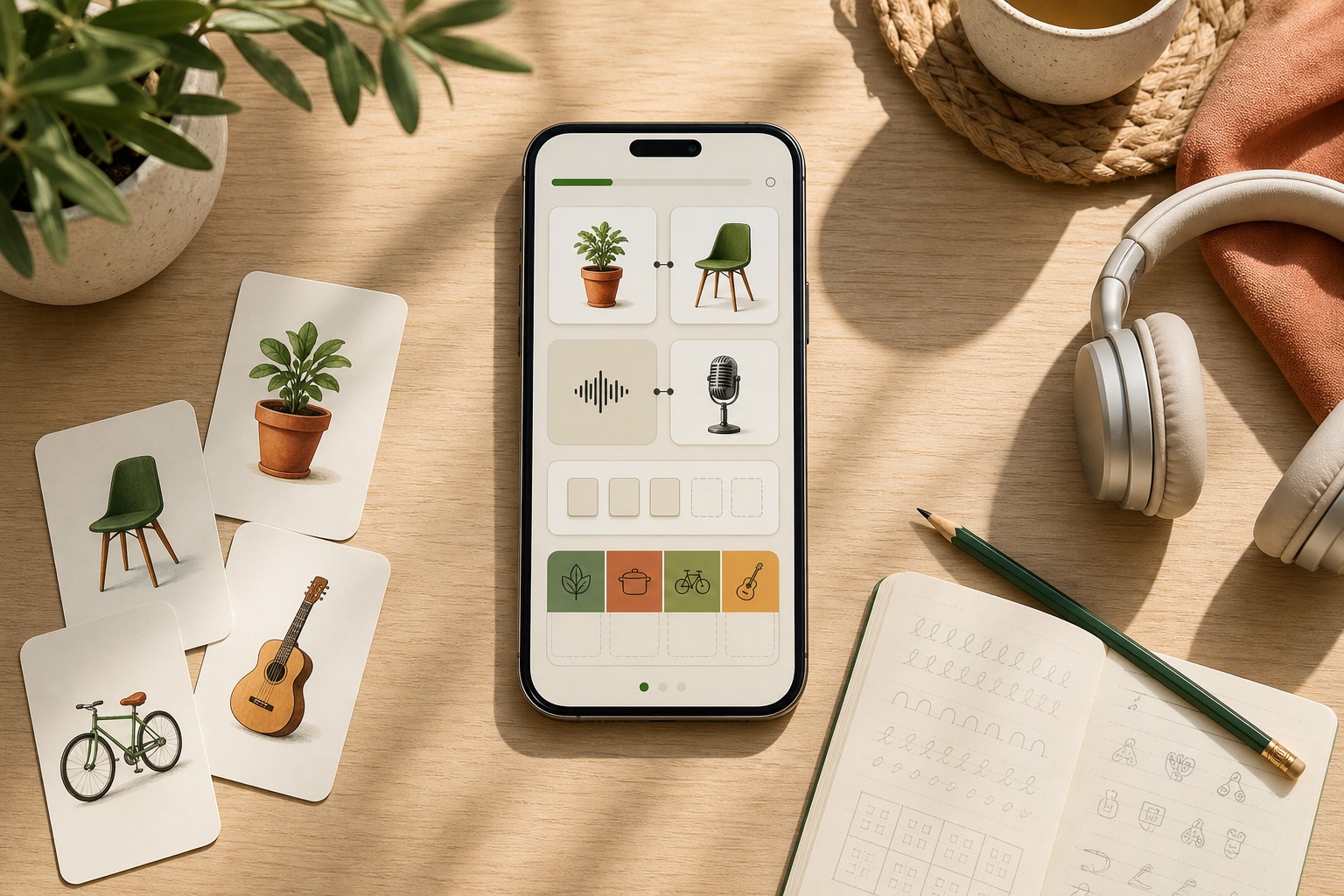
The current app exposes 18 study routes: Cards, Speech Capture, nine tiles in Games, and seven focused drills in Practice. The mechanics cover several different retrieval jobs:
- Meaning and visual choice: Memory Pairs, Quick Pairs, Picture Pick, Categories, and Word Choice.
- Sound and spelling: Listening Choice, Audio Dictation, Accent Tap, Writing, and Build word.
- Forms and phrase structure: Verb Sprint, Articles, Sentence Builder, and False Friends.
- Varied recall: 2048 and Voice Maze add a different pace without replacing the underlying word work.
The game and practice screens do not all use the same pool. Some draw on words you have learned; some activities use a smaller built-in set. Audio Dictation currently uses ten fixed words, for example, so it is a focused sound-to-spelling drill rather than dictation across the full dictionary.
Card translations are available in 29 languages, including English, Russian, Portuguese and German, and the interface is localised in 29 languages, including English, Russian, Portuguese and German. An optional recurring Premium subscription unlocks additional content and advanced features; the price is shown by the store for the user’s region.
Honest limit: Hola Cards is not a story-based course, a multiplayer word game, or a substitute for conversation and grammar instruction. Use its games to train vocabulary decisions, then meet the same words in sentences, listening, and real communication.
Use the game without learning to game the score
A high score can come from pattern recognition, fast tapping, or remembering where a tile was. To keep the score connected to Spanish, say the target word before you tap, pause after a miss, and explain the correction in one short phrase.
Rotate only when the skill changes. A useful sequence is cards for first exposure, a choice game for meaning, writing or letter building for recall, and listening for sound. Repeating four speed games in a row may feel varied while testing the same shallow recognition.
End on evidence, not exhaustion. Ten focused minutes with a short repair list are more valuable than a long session whose only result is a larger points total. On the next day, begin with the previous misses before adding new words.
Questions about Spanish vocabulary game apps
What is the best Spanish word games app for a beginner?
Choose by learning goal. A beginner benefits from clear word-and-meaning pairs, model audio, spelling feedback, and a route from cards into recall. Hola Cards combines those vocabulary tasks, but it is not a complete grammar course.
Do Spanish vocabulary games make you fluent?
No. Games can strengthen fast access to words, spelling, and basic forms. Fluency also needs connected speech, listening to longer material, sentence building, feedback, and real communication.
Are flashcards or word games better for Spanish vocabulary?
Use both for different jobs. Cards are efficient for first exposure and checking details. Games are useful after that because they force a decision under a new cue. A game should send difficult words back to review.
Is Hola Cards a Spanish game app for children?
Hola Cards is a general vocabulary app, not a child-specific curriculum. It has visual and game-based modes, but it does not provide a children’s story path, parent controls, or age-level lessons.
Can I play Spanish vocabulary games offline?
Hola Cards stores its core cards and practice content on the device, so study works offline. Some advanced voice features require the optional Premium subscription and a speech model downloaded to the device.