Spanish Practice Sentences for Daytime Study and Next-Day Recall
Use these twelve original sentences for deliberate daytime practice and next-day retrieval checks.
| Spanish Practice Sentence | English Translation and Learning Focus |
|---|---|
| Estudio esta palabra en voz alta durante la tarde. | I study this word aloud during the afternoon. |
| Escribo una frase completa para recordar el significado. | I write a complete sentence to remember the meaning. |
| Repaso las tarjetas difíciles antes de terminar mi sesión. | I review the difficult flashcards before finishing my session. |
| Apago todos los reproductores de audio antes de dormir. | I turn off all audio players before going to sleep. |
| Intento recordar la traducción sin mirar la respuesta. | I try to recall the translation without looking at the answer. |
| Organizo mi vocabulario nuevo en grupos pequeños y claros. | I organize my new vocabulary into small, clear groups. |
| Compruebo de memoria las palabras que aprendí ayer. | I check from memory the words that I learned yesterday. |
| Recuerdo el sustantivo pero olvido el artículo correspondiente. | I remember the noun but forget the corresponding article. |
| Anoto en mi cuaderno los términos que no recordé. | I write down in my notebook the terms that I did not remember. |
| Pronuncio la frase otra vez antes de mirar la solución. | I pronounce the sentence again before looking at the solution. |
| Separo las palabras dominadas de aquellas que necesitan repaso. | I separate mastered words from those that need review. |
| Verifico la pronunciación correcta con el audio de catálogo. | I verify the correct pronunciation with the catalog audio. |
Export Sentences for Study
Copy these practice sentences for waking study in flashcard decks or notebooks.
learn Spanish while sleeping
Passive Listening Versus Neural Memory Consolidation
Memory consolidation stabilizes memories formed during conscious wakefulness, but ordinary overnight playback has not been shown to teach usable Spanish, including broad vocabulary, complex grammar, auditory comprehension, or conversational speaking.
Laboratory targeted memory reactivation (TMR) uses EEG to detect slow-wave sleep and replay selected cues paired with daytime study, contrasting sharply with playing an unmonitored playlist all night.
Neither extreme is accurate: sleep cueing is neither useless nor an established consumer study technique. While cues can influence pre-learned traces or establish narrow implicit associations under strict laboratory conditions, functional Spanish requires deliberate waking practice.
What Controlled Sleep Research Actually Demonstrates
In a 2025 home study by Salfi et al., 24 adults learned Italian translations of 40 pseudowords while awake; a wearable closed-loop EEG system replayed half after detecting slow waves (+8.6% cued versus -4.6% uncued test-retest accuracy). This was a small controlled targeted memory reactivation (TMR) study evaluating artificial pseudowords, not passive full-lesson listening or proof of conversational language learning.
Most TMR tests cue material learned awake, but a narrow 2022 experiment with 22 adults reported an implicit association between novel Japanese words heard during sleep and sounds participants had familiarized with while awake, measured via image choice after waking. This restricted result is not broad vocabulary learning, comprehension, grammar, speaking or fluency and does not validate passive Spanish lessons, differing entirely from playing unattended audio playlists. Furthermore, findings across sleep cueing are not uniform: a 2020 study of 11–13-year-olds (PMC7060261) cued Dutch vocabulary during NREM sleep and found no behavioral recall benefit in that sample, despite a neural theta response.
Effects also vary according to sleep architecture. A 2017 adult foreign-vocabulary TMR nap study (PubMed 28697944) found no overall cued-word benefit at the group level; outcomes varied with subsequent REM duration, showing an opposite direction among participants with little or no REM sleep. Together with the adolescent null result, these mixed findings demonstrate that sleep cueing outcomes are variable and cannot be generalized into a practical consumer technique.
Two Core Pillars of Effective Vocabulary Retention
Durable retention relies on deliberate daytime encoding and unassisted next-day retrieval verification.
Deliberate Waking Practice
Effective vocabulary learning begins with conscious daytime practice. Learners pronounce words aloud, analyze grammatical context in full sentences, and practice active retrieval while fully awake.
Estudio esta palabra en voz alta durante la tarde. · Escribo una frase completa para recordar el significado. · Repaso las tarjetas difíciles antes de terminar mi sesión. · Apago todos los reproductores de audio antes de dormir. · Intento recordar la traducción sin mirar la respuesta. · Organizo mi vocabulario nuevo en grupos pequeños y claros.
Next-Day Recall Verification
Testing recall unassisted the next morning helps learners verify which words can be retrieved without prompts. Unremembered items can then be logged for targeted daytime study.
Compruebo de memoria las palabras que aprendí ayer. · Recuerdo el sustantivo pero olvido el artículo correspondiente. · Anoto en mi cuaderno los términos que no recordé. · Pronuncio la frase otra vez antes de mirar la solución. · Separo las palabras dominadas de aquellas que necesitan repaso. · Verifico la pronunciación correcta con el audio de catálogo.
A Realistic Five-Minute Waking and Retrieval Routine
For a five-minute routine, select a few relevant Spanish words while awake. Pronounce each term aloud, review its meaning, and practice active retrieval by producing the Spanish phrase unassisted before checking notes.
Complete your study session before bed. If audio playback disturbs rest, stop it before sleep. Never sacrifice sleep quality to study, as natural rest supports daytime learning.
The next day, test recall before checking flashcards or answer keys. Note hesitant words in an error log for focused daytime review. This routine provides a practical study habit, not clinical sleep advice.
Explore related guides on evidence-based language learning methods, error tracking, and connected Spanish speech.
Spaced Repetition Guide for Spanish Vocabulary Spanish Learning Error Log Strategy Spanish Connected Speech and Listening Guide
Illustrative Worked Example: Waking Encoding to Next-Day Recall
- This worked example illustrates a five-minute waking routine and is clearly labeled illustrative, not research data. During evening review, a learner selects two nouns: la llave (the key) and el puente (the bridge).
- The learner actively studies and pronounces la llave and el puente aloud while awake, testing unassisted recall against English prompts. The learner stops all audio before sleep to protect natural rest.
- The next day, the learner tests recall before reviewing notes. Successfully retrieving la llave confirms initial retention, while hesitation on el puente flags that term for daytime review.
Verified Research Citations
Review primary peer-reviewed literature on targeted memory reactivation and vocabulary testing.
- Salfi et al. (2025) Closed-loop TMR study
- Koroma et al. (2022) Implicit sleep association study
- PMC7060261 Adolescent NREM vocabulary cueing study
- PubMed 28697944 Adult daytime nap TMR study
Frequently Asked Questions
Can I learn Spanish by playing audio all night?
No. Ordinary all-night background playback is not an established way to learn usable Spanish. Ordinary overnight playback has not been shown to teach usable Spanish, including conversational vocabulary, grammar, comprehension, or speaking fluency, and playing audio overnight risks disrupting sleep.
What is targeted memory reactivation?
Targeted memory reactivation (TMR) is a laboratory method using EEG sleep-stage detection to replay specific cues that were previously paired with waking learning.
Do I need to learn words before sleep cueing?
Prior waking study is not universally necessary in every experimental design, but most TMR tests cue material learned awake. A narrow 2022 experiment with 22 adults reported an implicit association between novel Japanese words heard during sleep and sounds participants had familiarized with while awake, measured via image choice after waking. However, this restricted result is not broad vocabulary learning, comprehension, grammar, speaking or fluency and does not validate passive Spanish lessons. Ordinary overnight playback has not been shown to teach usable Spanish.
Does evidence show fluency or specific laboratory task performance?
Controlled cueing studies and the limited 2022 association/image-choice result demonstrate only narrow test performance on specific laboratory measures, and there is no evidence these methods teach conversational fluency, complex grammar, comprehension, or speaking ability.
Should I sacrifice sleep to study?
No. Restful sleep is vital for cognitive health and memory consolidation. Never sacrifice sleep quality or play disruptive audio all night. This guide is educational, not medical or sleep-disorder advice.
How can I use Hola Cards here?
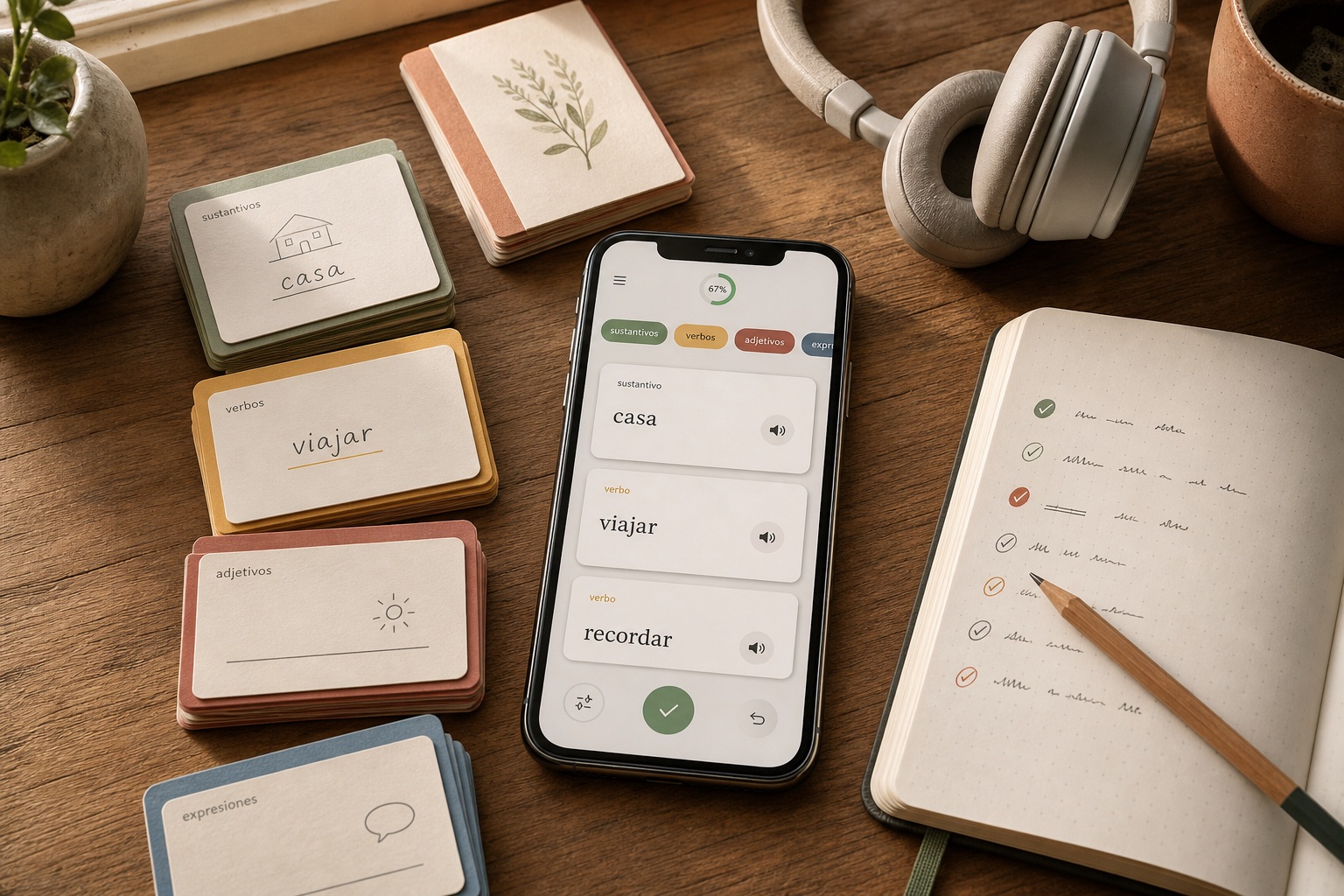
Hola Cards helps with awake vocabulary practice through spaced repetition, catalog audio, and offline review on mobile. The app does not play lessons or teach during sleep.
Export Sentences for Study
Copy these practice sentences for waking study in flashcard decks or notebooks.
**Waking Vocabulary Deck**

Estudio esta palabra en voz alta durante la tarde. - I study this word aloud during the afternoon.
Escribo una frase completa para recordar el significado. - I write a complete sentence to remember the meaning.
Repaso las tarjetas difíciles antes de terminar mi sesión. - I review the difficult flashcards before finishing my session.
Apago todos los reproductores de audio antes de dormir. - I turn off all audio players before going to sleep.
Intento recordar la traducción sin mirar la respuesta. - I try to recall the translation without looking at the answer.
Organizo mi vocabulario nuevo en grupos pequeños y claros. - I organize my new vocabulary into small, clear groups.
Compruebo de memoria las palabras que aprendí ayer. - I check from memory the words that I learned yesterday.
Recuerdo el sustantivo pero olvido el artículo correspondiente. - I remember the noun but forget the corresponding article.
Anoto en mi cuaderno los términos que no recordé. - I write down in my notebook the terms that I did not remember.
Pronuncio la frase otra vez antes de mirar la solución. - I pronounce the sentence again before looking at the solution.
Separo las palabras dominadas de aquellas que necesitan repaso. - I separate mastered words from those that need review.
Verifico la pronunciación correcta con el audio de catálogo. - I verify the correct pronunciation with the catalog audio.
Strengthen Spanish Recall with Focused Daytime Practice
Hola Cards provides spaced repetition flashcards for iOS and Android with catalog audio. It is an awake study tool that does not play sleep audio.